
In the ever-evolving world of interior design, the half wall has emerged as a versatile architectural element that strikes the perfect balance between openness and definition. These partial partitions offer homeowners an elegant solution to create distinct zones within their living spaces while maintaining the airy, connected feel that modern living demands. Unlike full-height walls that can make rooms feel closed off and cramped, half walls provide just enough separation to define areas without sacrificing natural light flow or visual continuity. They represent a thoughtful approach to spatial planning that honors both functionality and aesthetic appeal.
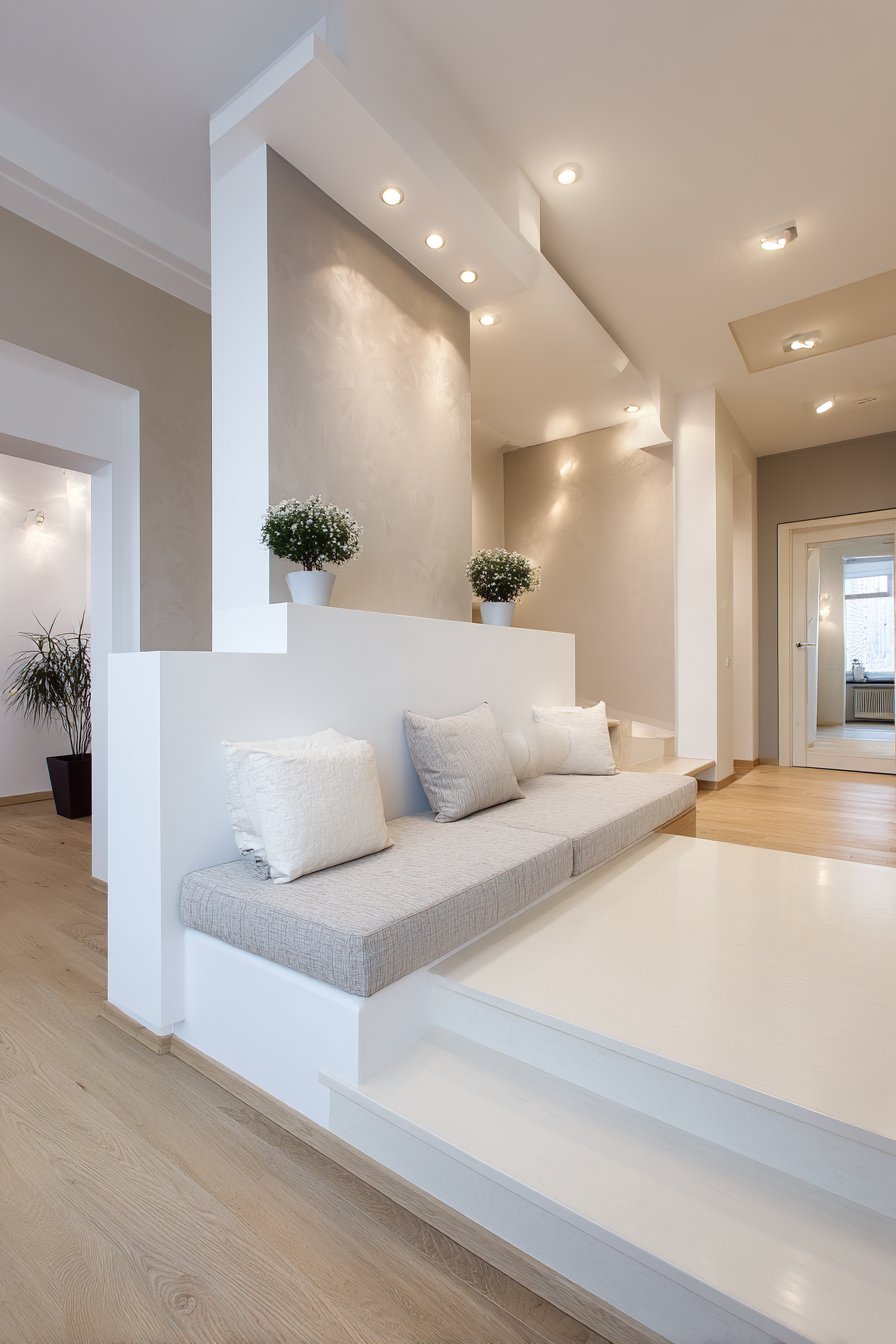
The beauty of half wall ideas lies in their remarkable adaptability to virtually any home style, from rustic farmhouses to sleek contemporary lofts. Whether you’re looking to separate your kitchen from your dining area, create a subtle boundary between your entryway and living room, or add architectural interest to an open floor plan, half walls offer endless creative possibilities. They can serve multiple purposes simultaneously—acting as room dividers, display surfaces, storage solutions, or even functional furniture pieces like breakfast bars. This multi-functional nature makes them an incredibly smart investment for homeowners seeking to maximize both the utility and beauty of their spaces.
Throughout this comprehensive guide, we’ll explore twenty-nine inspiring half wall ideas that showcase the remarkable range of this design element. From traditional wainscoting applications to modern glass-paneled partitions, from industrial exposed brick constructions to bohemian macramé-adorned dividers, each concept demonstrates how half walls can be customized to reflect your personal style while enhancing your home’s functionality. Whether you’re planning a major renovation or simply seeking fresh ideas to update your current space, these thoughtfully designed half wall concepts will inspire you to reimagine the possibilities within your own home.
1. Contemporary Kitchen Bar Height Partition
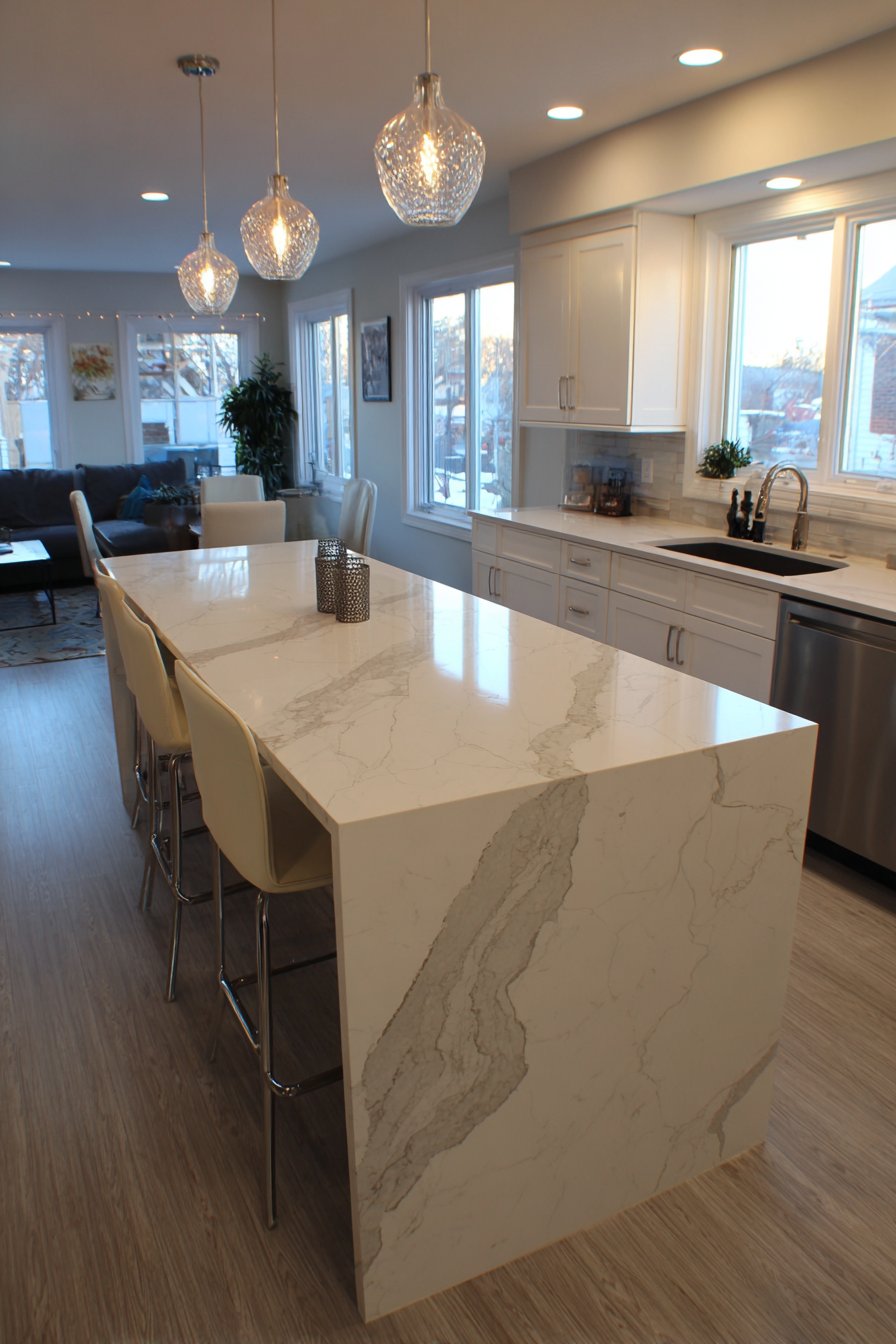
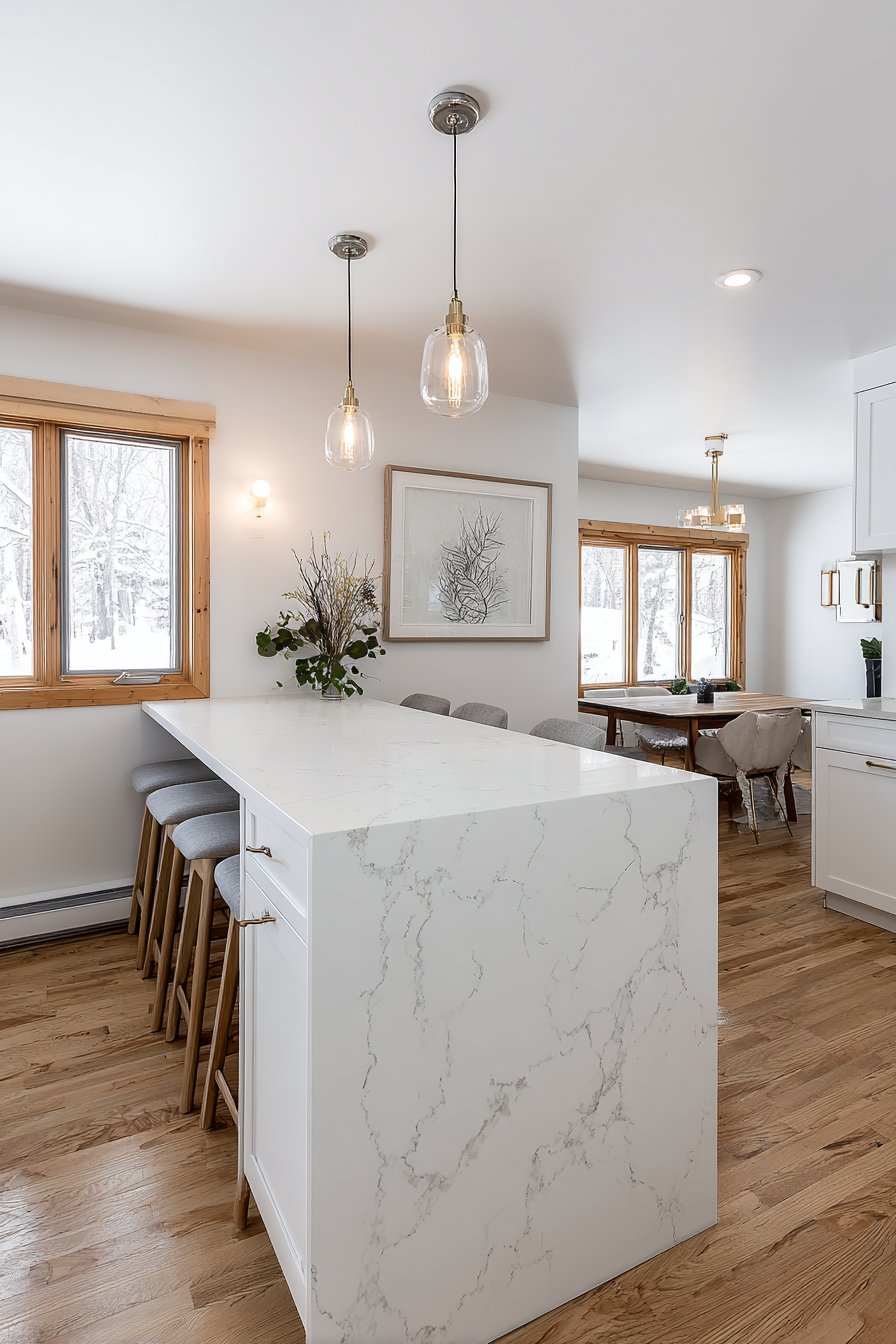
The modern open-concept kitchen benefits immensely from a well-designed half wall that serves double duty as both a spatial divider and a functional breakfast bar. This sophisticated approach features a sleek half wall partition positioned at bar height, approximately 42 inches from the floor, creating a natural boundary between the cooking zone and dining area. The waterfall quartz countertop extending over the kitchen side adds a touch of luxury while the smooth, continuous surface showcases the natural veining patterns that make quartz such a desirable material. The visual effect of the countertop cascading down the side creates a sculptural quality that elevates the entire design.
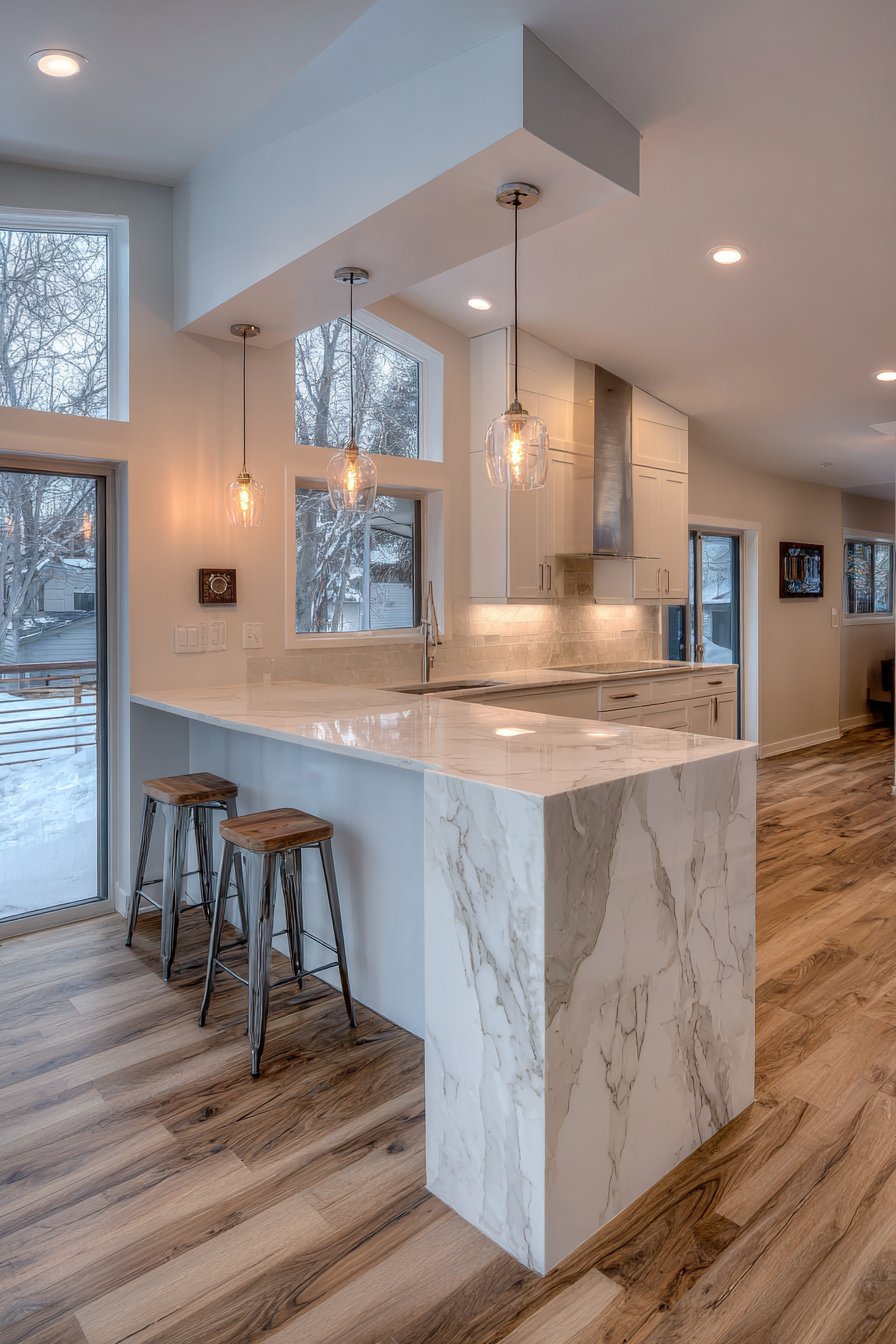
The foundation of this half wall consists of white shaker-style cabinetry that provides valuable storage while maintaining a clean, classic aesthetic that never goes out of style. Three minimalist bar stools tucked neatly beneath the overhang create an intimate dining spot perfect for quick breakfasts or casual entertaining. The pendant lights suspended above the bar area serve a dual purpose—providing task lighting for dining while adding a decorative element that draws the eye upward and emphasizes the ceiling height. The interplay between the white cabinetry and the gray-veined quartz creates a sophisticated neutral palette that works beautifully with virtually any decorating scheme.
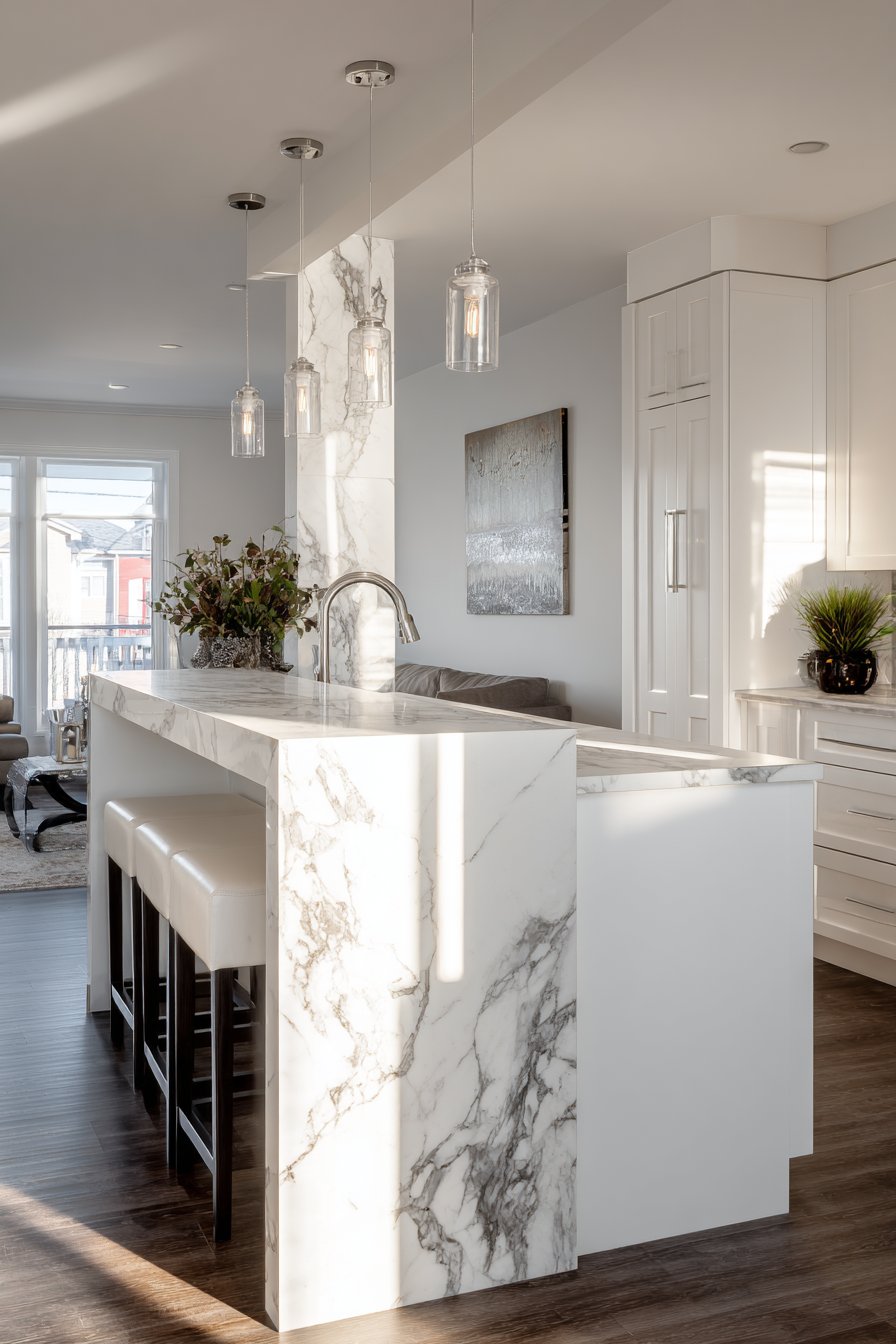
Natural daylight streaming through nearby windows bathes the space in soft, flattering light that highlights the material quality and craftsmanship of the installation. This thoughtful positioning near natural light sources ensures that neither the kitchen nor the dining area feels dark or enclosed, maintaining the open, airy quality that makes modern floor plans so appealing. The half wall creates just enough separation to define the spaces functionally while preserving the visual connection that allows family members to interact seamlessly whether they’re cooking or dining.
Key Design Tips:
- Position the half wall at standard bar height (42 inches) to accommodate comfortable seating with bar stools
- Choose a waterfall countertop edge to create visual drama and showcase premium materials
- Install pendant lighting directly above the bar area at approximately 30-36 inches from the counter surface for optimal illumination
- Select a quartz countertop with subtle veining for sophisticated visual interest without overwhelming the space
- Ensure adequate knee clearance of at least 12 inches under the overhang for comfortable seating
- Coordinate the cabinet finish with other cabinetry in the space for cohesive design flow
2. Traditional Wainscoting Entrance Divider
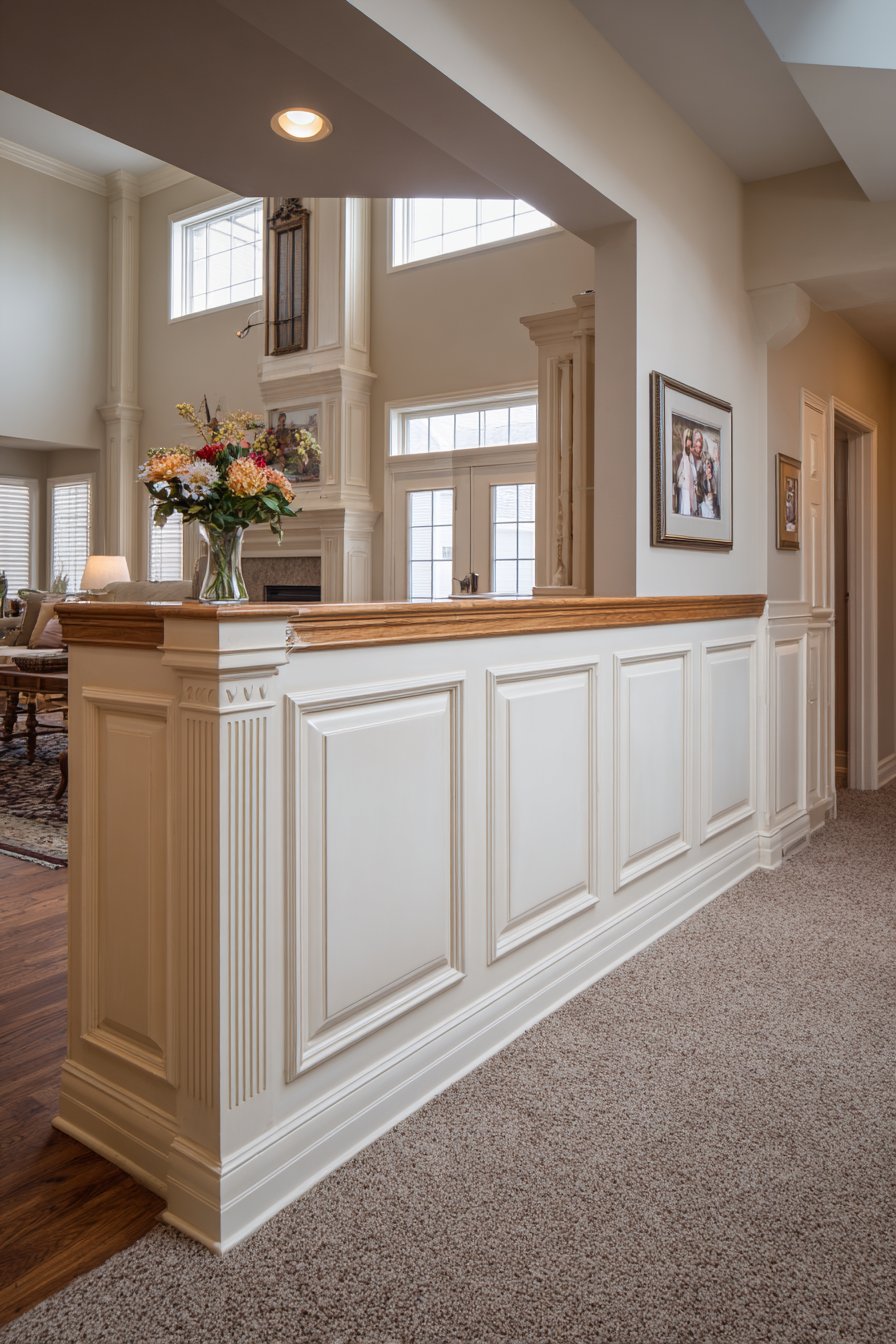
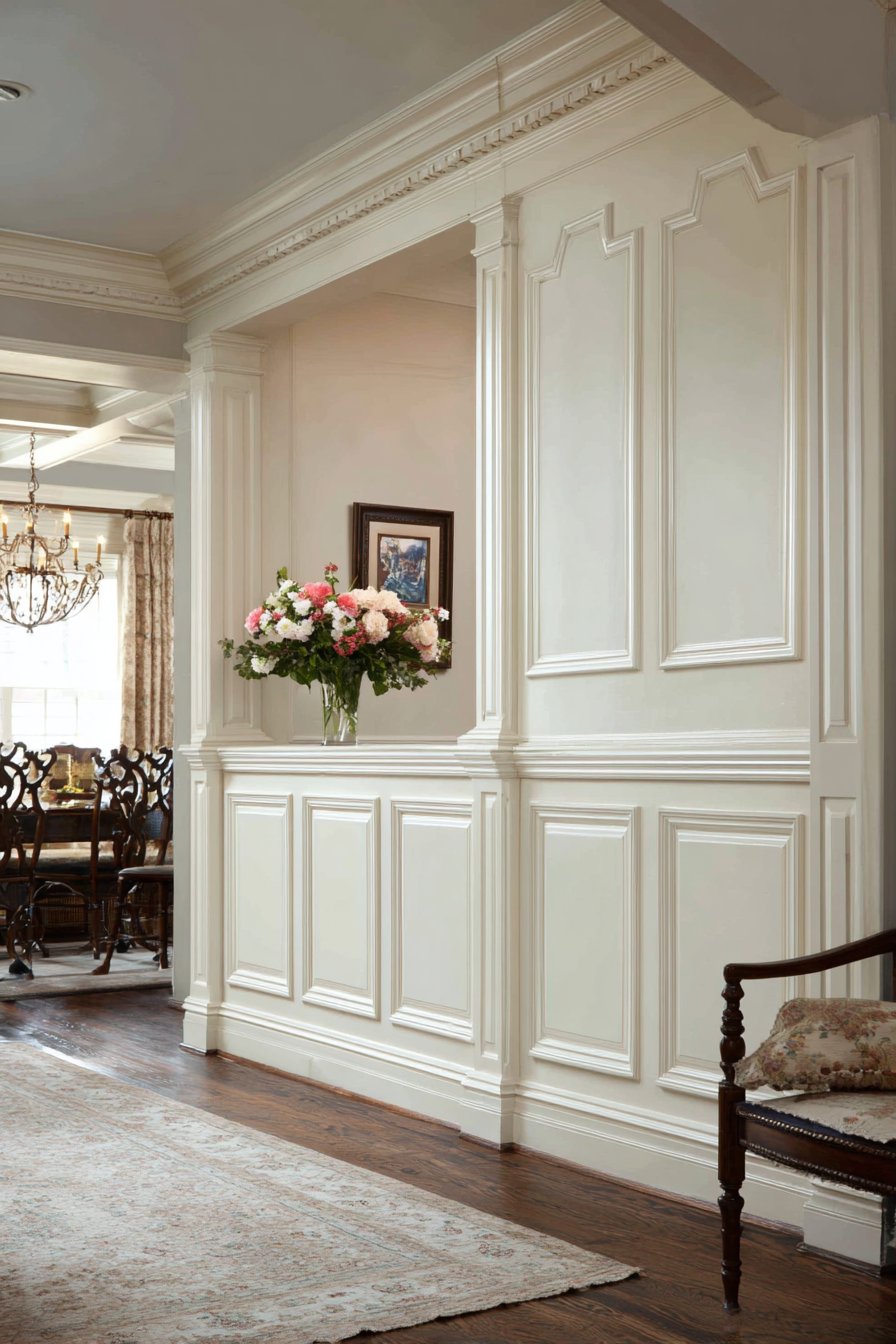
The timeless elegance of traditional wainscoting creates a refined separation between formal living spaces and entrance hallways, embodying the classical design principles that have endured for centuries. Standing at a modest 36 inches tall, this half wall features expertly crafted wainscoting panels painted in a soft cream color that exudes warmth and welcomes guests from the moment they enter. The detailed trim molding and beveled top rail demonstrate the level of craftsmanship that defines quality traditional design, while the warm oak finish on the cap rail introduces natural wood tones that prevent the white-on-white scheme from feeling too stark or clinical.
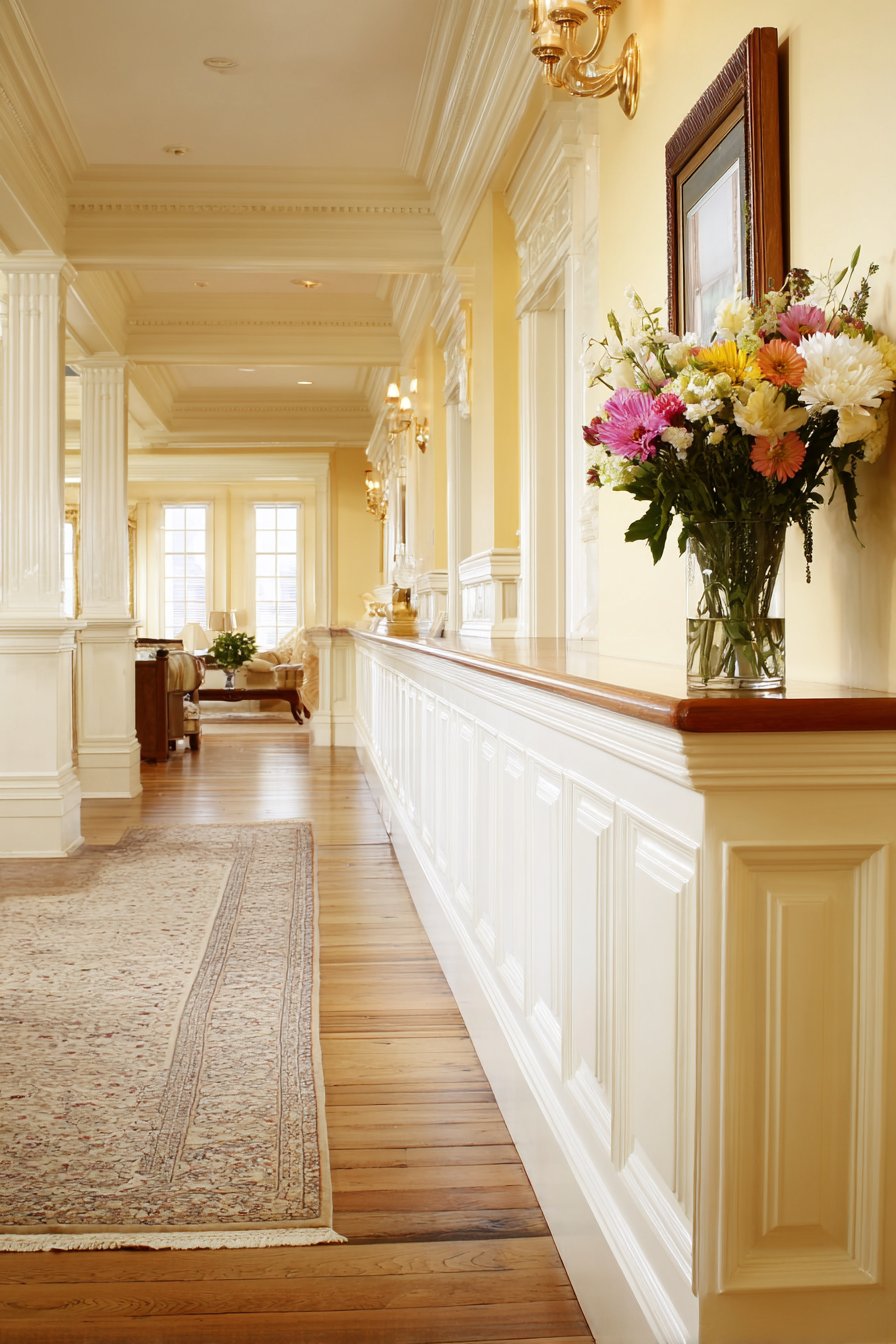
The architectural detailing in this design serves both aesthetic and practical purposes. The wainscoting panels add texture and visual interest to what might otherwise be plain wall surfaces, while the substantial cap rail provides a convenient surface for displaying personal touches like family photographs or fresh flowers in decorative vases. This practical display space allows homeowners to personalize the area and create a welcoming first impression without requiring additional furniture or wall-mounted shelving. The transition from carpeted living room to hardwood hallway flooring is elegantly managed by the half wall, which helps define the boundary between these different zones while allowing them to flow naturally into one another.
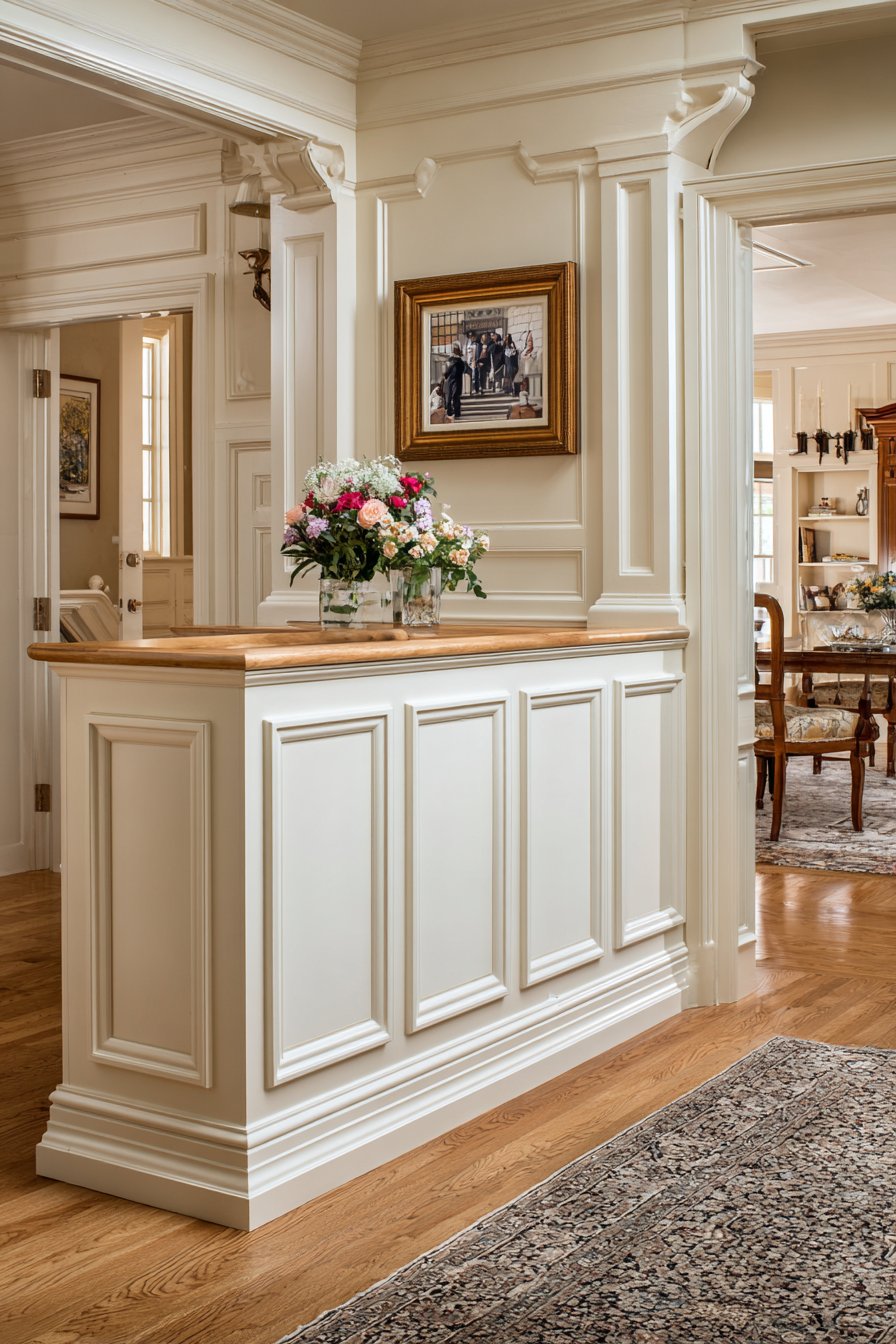
The soft cream paint color was chosen deliberately to complement both traditional and updated interiors, serving as a neutral backdrop that won’t compete with furniture or artwork. The warm oak cap rail introduces just enough natural wood tone to create visual warmth without overwhelming the predominantly light color scheme. Professional interior photography captures how soft, diffused lighting emphasizes the traditional craftsmanship, casting gentle shadows that highlight the depth and dimension of the molding details. This approach to architectural detailing demonstrates how classic design elements can create elegant room divisions that enhance rather than interrupt the flow of a home.
Key Design Tips:
- Maintain traditional proportions by keeping the half wall height at approximately one-third of the ceiling height
- Choose premium-grade lumber for trim work to ensure clean lines and precise joints that will last for decades
- Apply multiple thin coats of paint rather than one thick coat for a smooth, professional finish
- Install the cap rail with a slight overhang (about 3/4 inch) to create subtle shadow lines that add dimension
- Consider the traffic flow and position the half wall to guide movement naturally through the space
- Select paint colors that coordinate with both adjacent rooms to create visual harmony throughout the home
3. Modern Glass-Paneled Office Partition
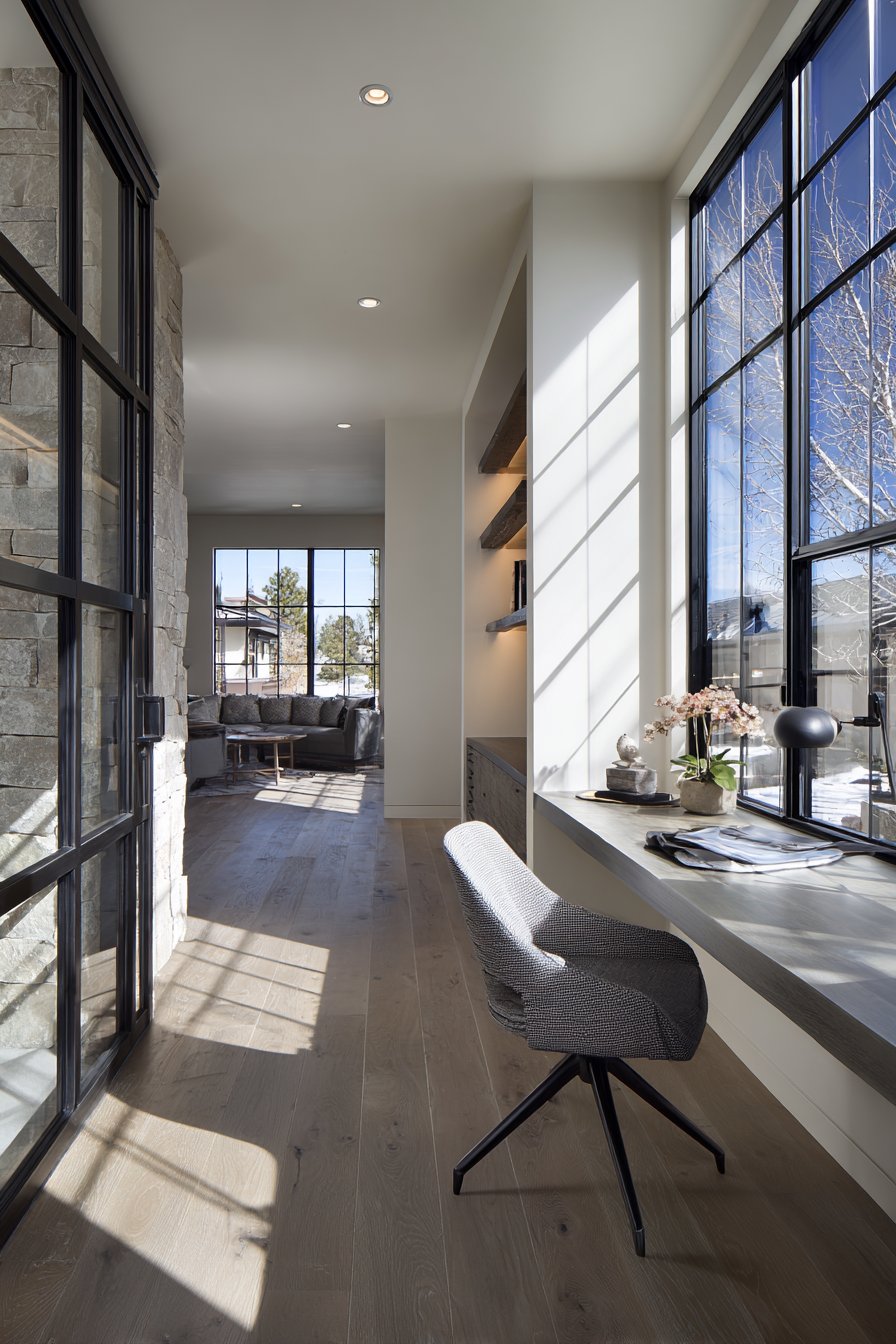
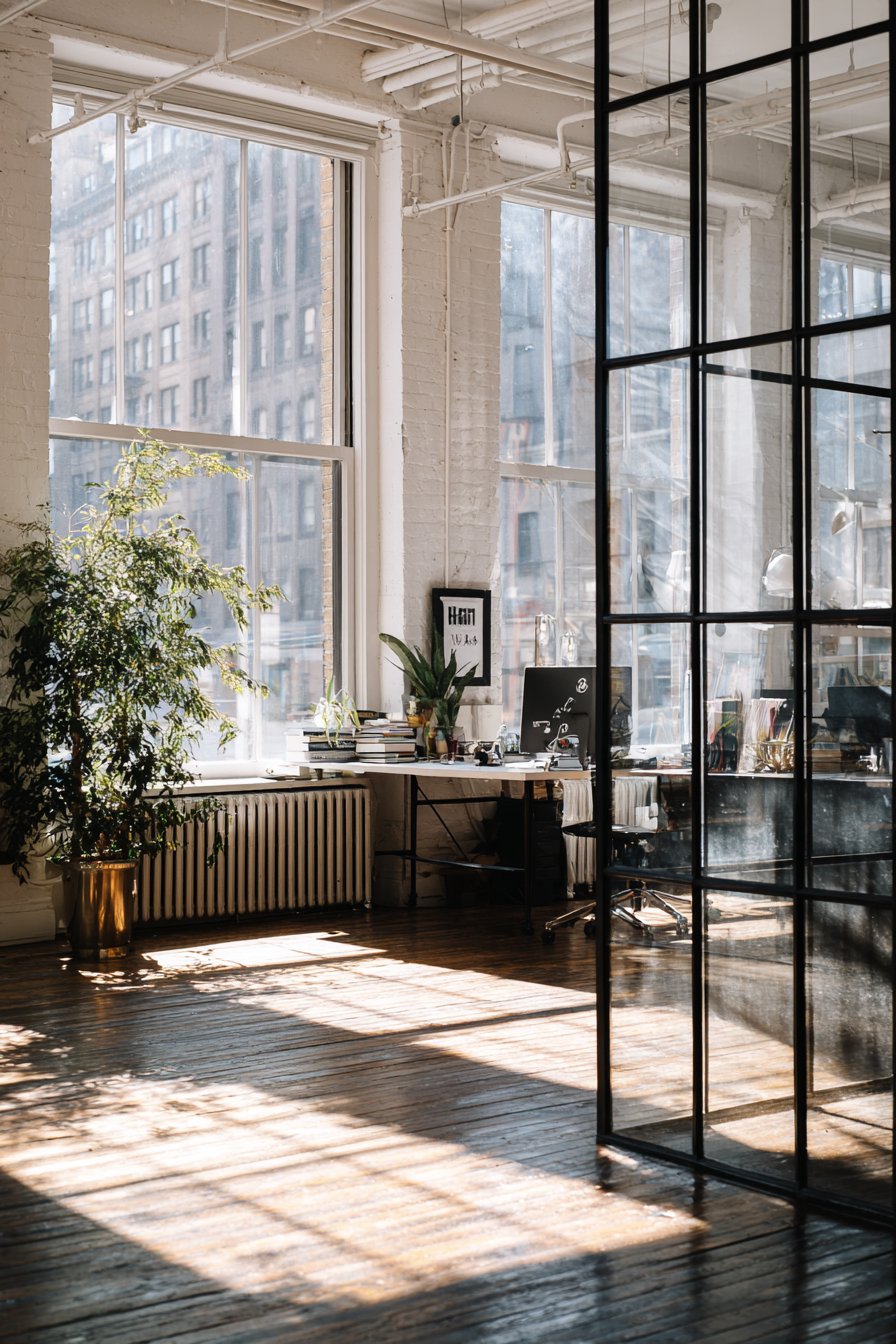
The contemporary home office demands design solutions that provide privacy and focus while maintaining the visual openness that prevents workspaces from feeling isolated or claustrophobic. This innovative half wall design achieves that delicate balance through the strategic use of glass panels set within sleek black metal framing, creating a transparent boundary that defines the workspace without cutting it off from the rest of the living area. The industrial-inspired metal framework provides structural support while adding bold linear elements that contribute to the modern aesthetic. The transparency of the glass allows natural light to penetrate throughout the space while still establishing a clear psychological boundary between work and leisure zones.
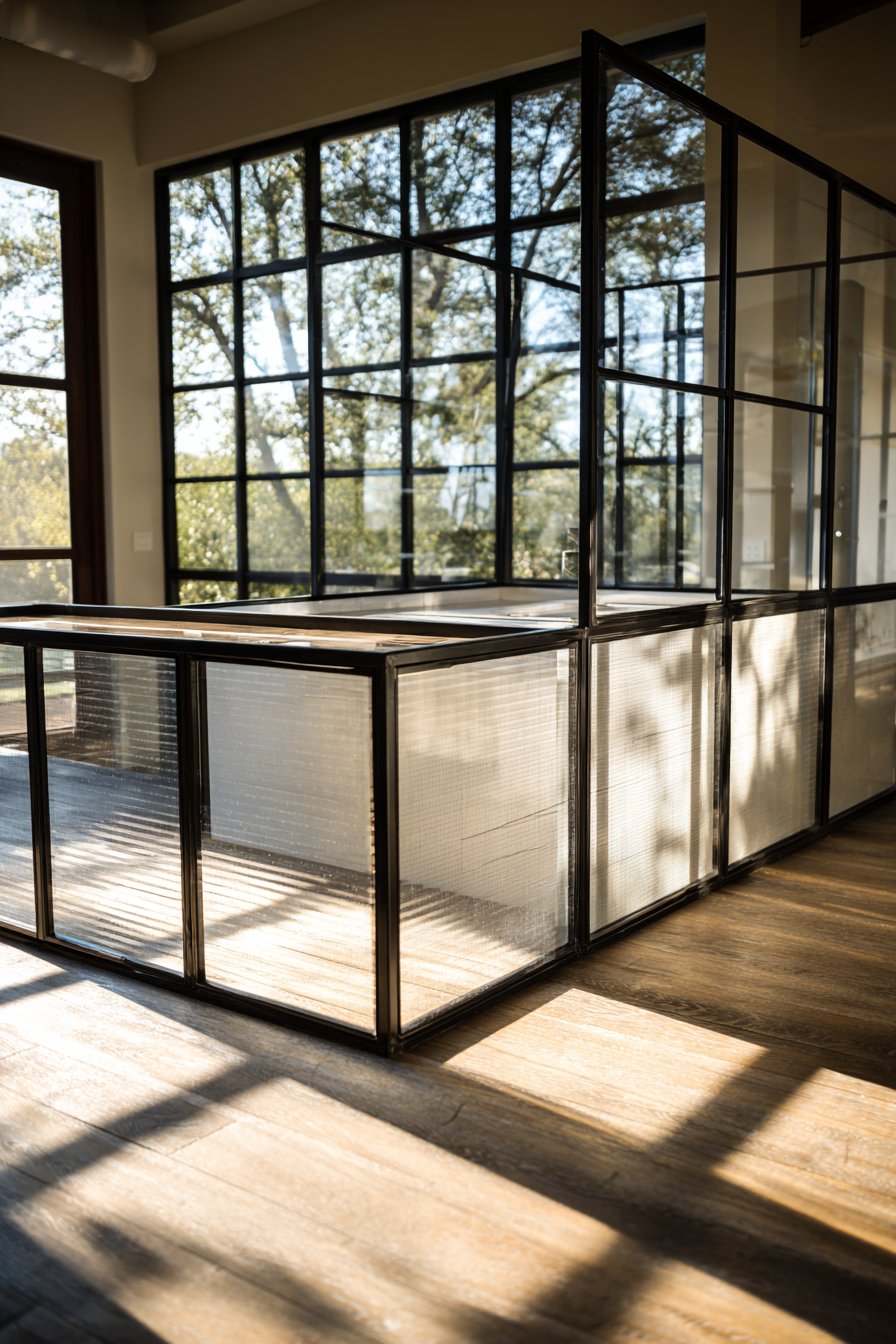
The white painted wood base anchors the glass upper section while cleverly concealing integrated cable management channels—a crucial practical consideration in today’s technology-dependent work environments. These hidden channels keep power cords, ethernet cables, and other necessary wiring organized and out of sight, maintaining the clean, uncluttered appearance that’s essential to productive workspace design. A floating desk extending from the office side maximizes the functional utility of the half wall while keeping the living room side clean and minimal, demonstrating how good design can serve multiple purposes simultaneously without appearing busy or complicated.
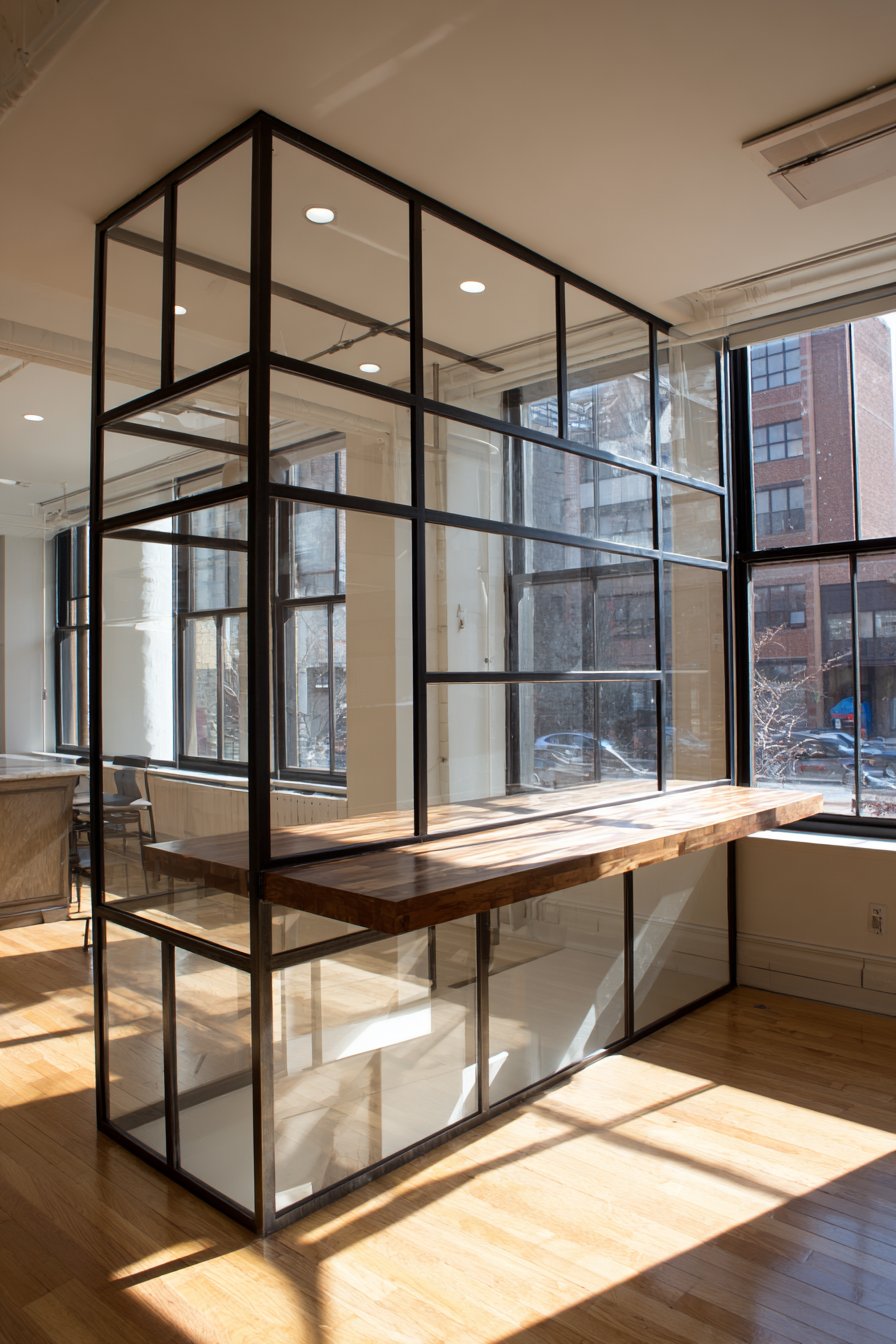
Large windows flooding the space with natural light create interesting shadow patterns through the glass panels, adding dynamic visual interest that changes throughout the day as the sun moves across the sky. This interplay of light and shadow prevents the workspace from feeling static or monotonous, instead creating an environment that feels alive and connected to the natural world outside. The balanced exposure achieved through professional photography techniques showcases how the modern industrial aesthetic can feel warm and inviting rather than cold or institutional when executed with attention to material quality and spatial relationships.
Key Design Tips:
- Choose tempered safety glass for all panels to ensure durability and safety in high-traffic areas
- Position the half wall to maximize natural light flow into both the office and living areas
- Install the glass panels with adequate support—at least every 36 inches—to prevent flexing or rattling
- Use powder-coated metal framing in matte black for a contemporary look that resists fingerprints and shows less wear
- Incorporate hidden cable management from the design phase to avoid visible cord clutter
- Ensure the floating desk is properly anchored to wall studs and can support at least 100 pounds for stability
- Consider adding a small gap at the base of the glass panels to allow air circulation between zones
4. Rustic Reclaimed Barn Wood Divider
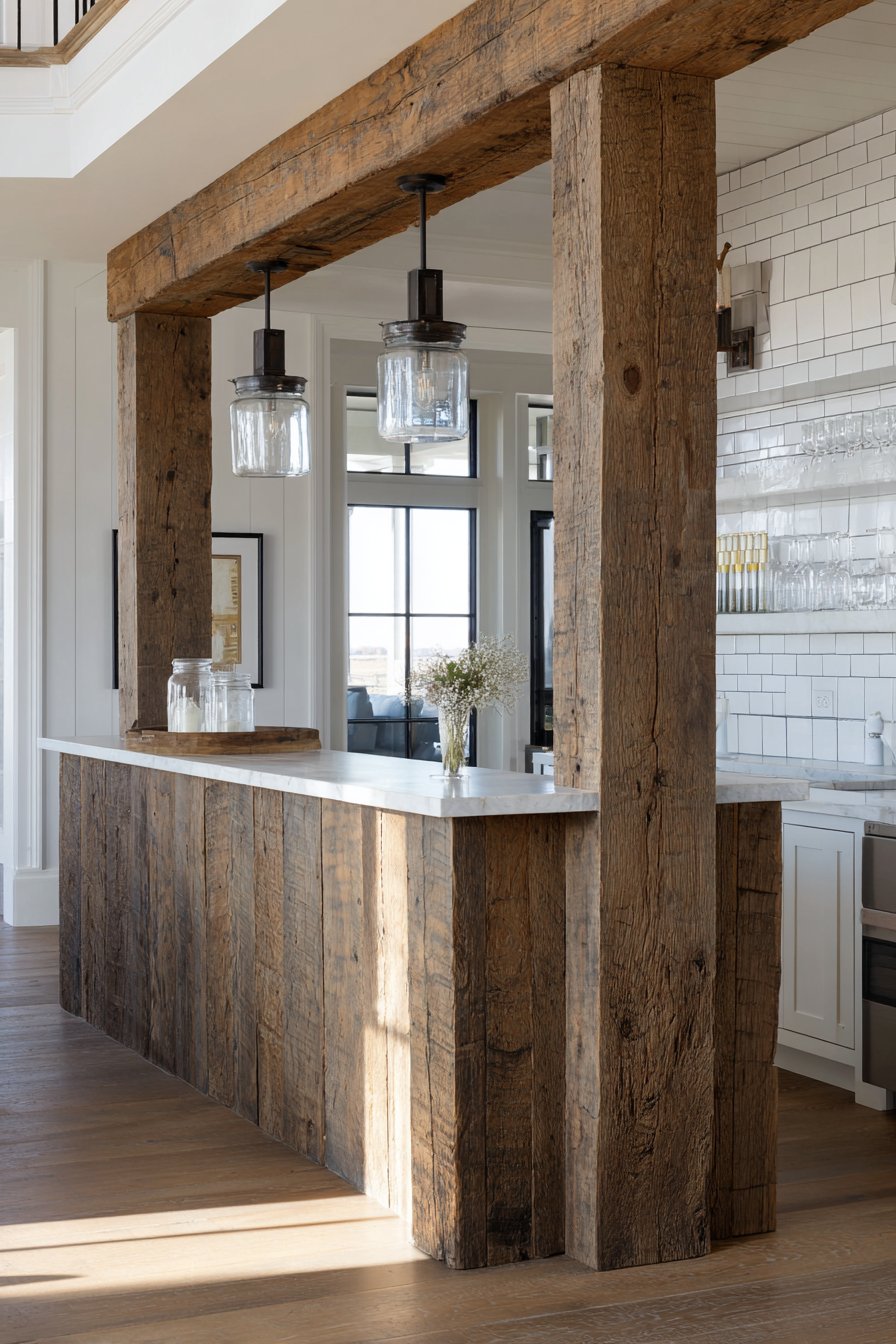
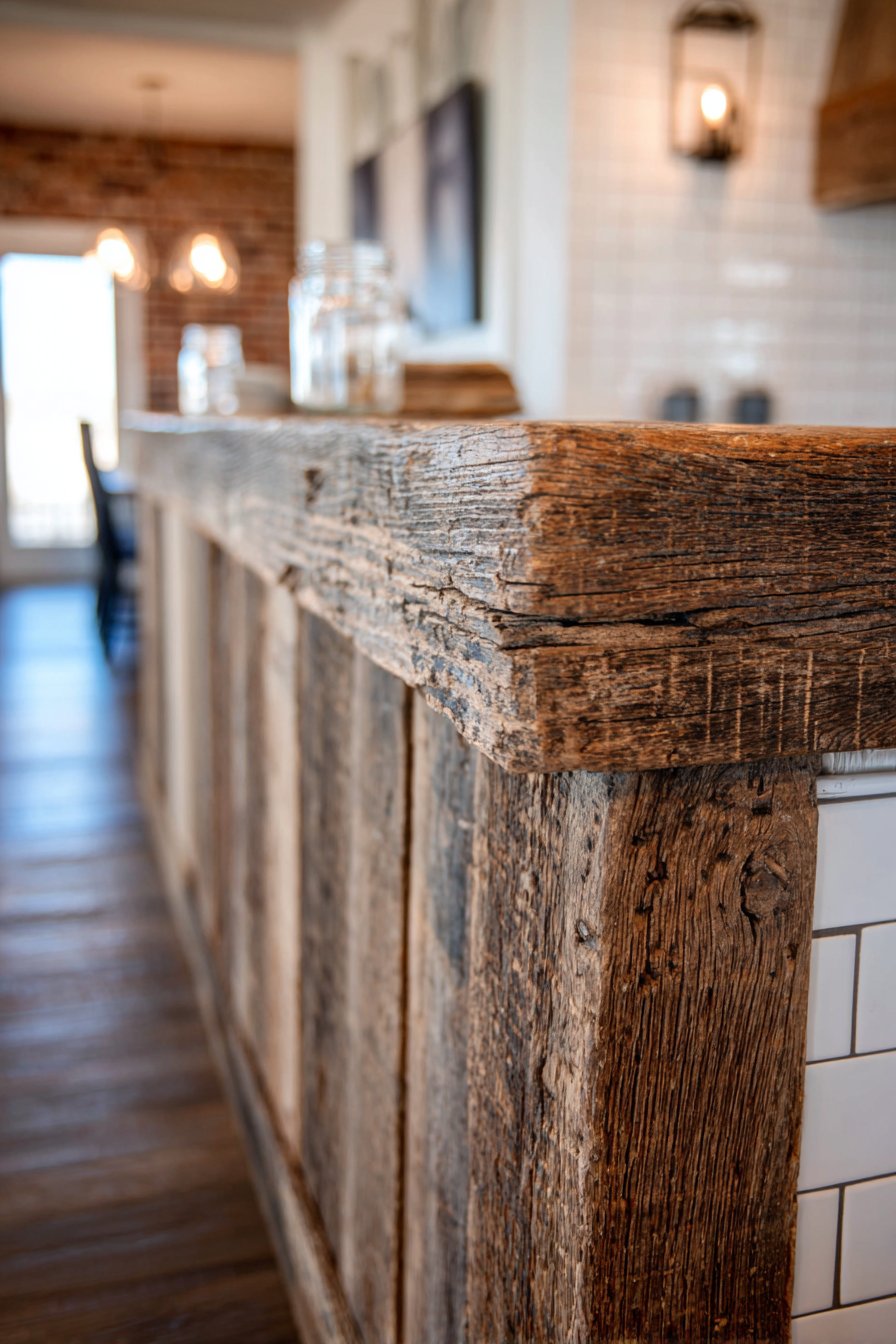
The farmhouse aesthetic celebrates authenticity, history, and the natural beauty of aged materials, making reclaimed barn wood an ideal choice for creating a half wall that serves as both functional room divider and conversation-starting focal point. Standing approximately 40 inches high, this charming partition features vertical planks salvaged from old barns, each board telling its own story through weathered surfaces, nail holes, and the rich patina that only decades of exposure can create. The thick rough-hewn beam serving as the cap rail reinforces the rustic character while providing substantial visual weight that grounds the design and creates a strong horizontal line that guides the eye across the space.
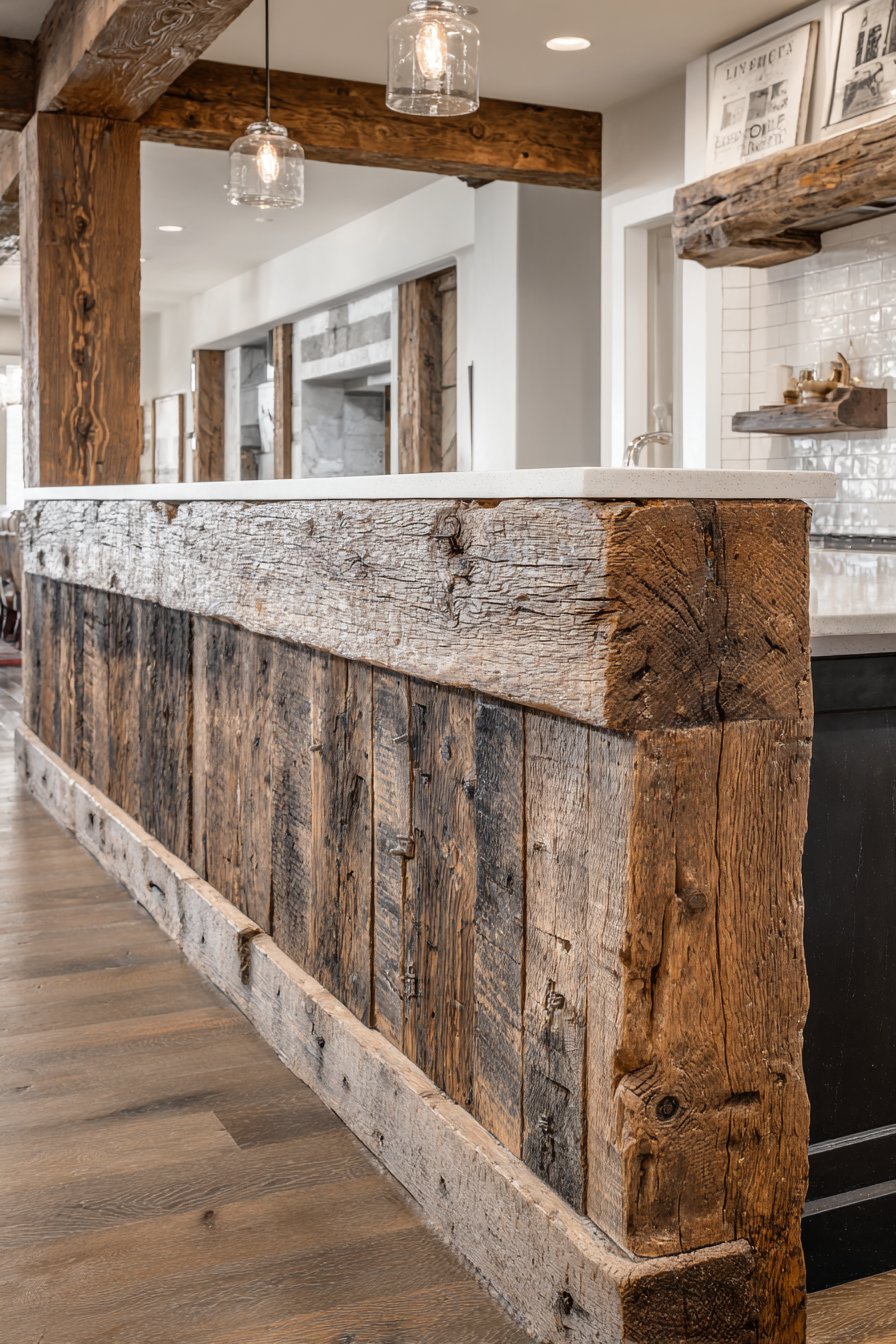
The authentic aged wood texture creates a striking contrast with the clean, white subway tile backsplash visible in the kitchen beyond, demonstrating how rustic elements can coexist beautifully with more contemporary finishes. This juxtaposition prevents the rustic aesthetic from feeling too theme-heavy or contrived, instead creating a layered, collected look that suggests the home has evolved organically over time. Mason jar sconces mounted on the kitchen side serve double duty as both practical lighting sources and charming decorative accents that reinforce the farmhouse theme without resorting to clichéd or overly cutesy elements.
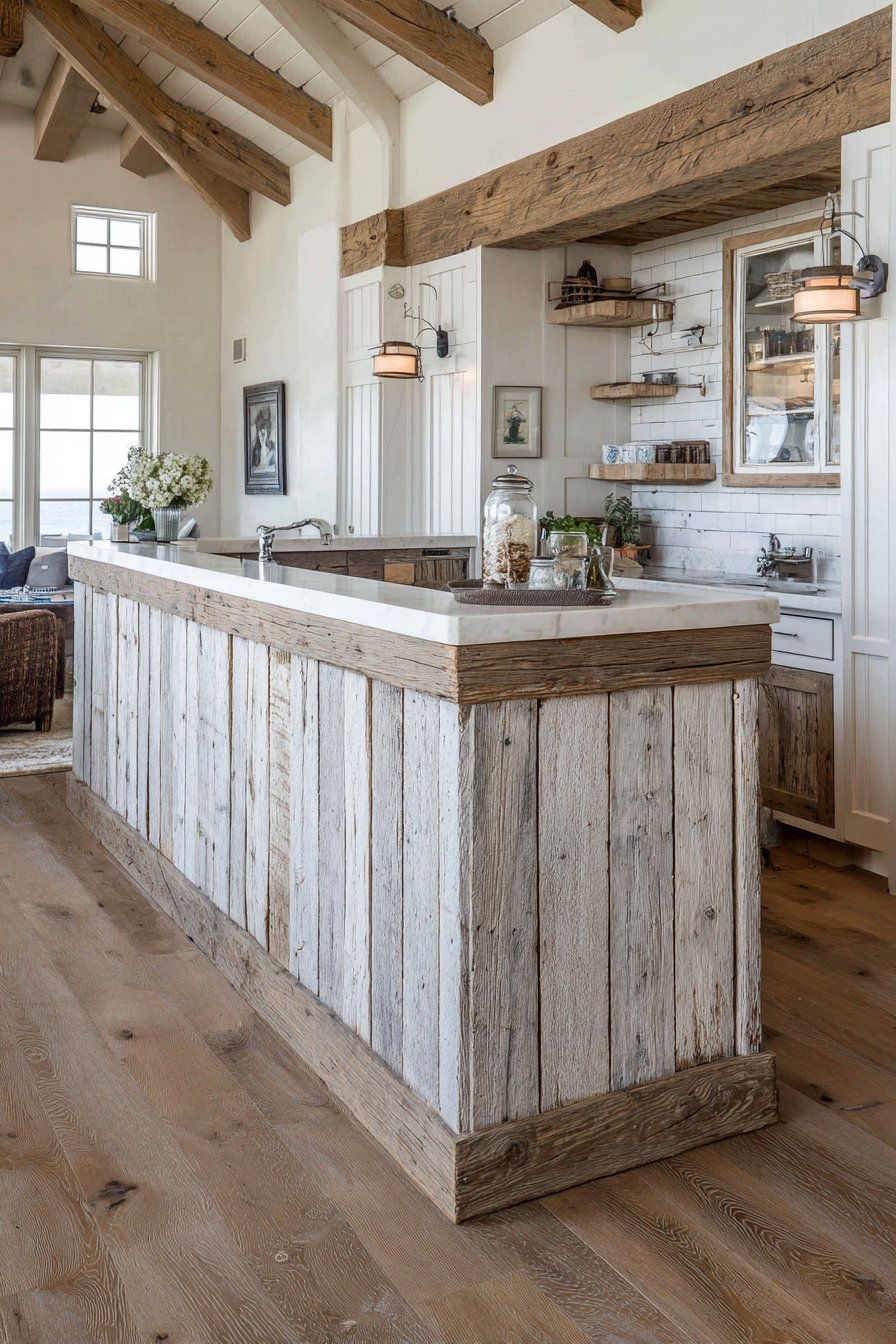
Warm natural light filtering through the space emphasizes the varied tones and textures within the reclaimed wood, from silvery gray weathered sections to deeper brown areas where the original wood color remains more saturated. Wide-angle interior photography captures how effectively this half wall defines separate zones while maintaining the open, welcoming quality essential to family-friendly spaces. The authentic material details—including natural wood grain patterns, checks and splits from decades of weather exposure, and subtle color variations from board to board—create visual richness that manufactured materials simply cannot replicate.
Key Design Tips:
- Source reclaimed wood from reputable suppliers who properly clean, denail, and kiln-dry the material to eliminate pests and excessive moisture
- Seal reclaimed wood with a clear matte finish to protect the surface while preserving the authentic weathered appearance
- Vary the width of vertical planks for a more authentic, collected look rather than using uniform boards
- Install a substantial cap rail (at least 3-4 inches thick) to provide visual weight and create a practical surface for displaying decorative items
- Consider the color range of the reclaimed wood and how it will coordinate with other finishes in adjacent spaces
- Use appropriate fasteners designed for old, potentially brittle wood to prevent splitting during installation
- Leave slight gaps between vertical planks to acknowledge the rustic aesthetic and allow for natural wood movement
5. Minimalist Scandinavian White Partition
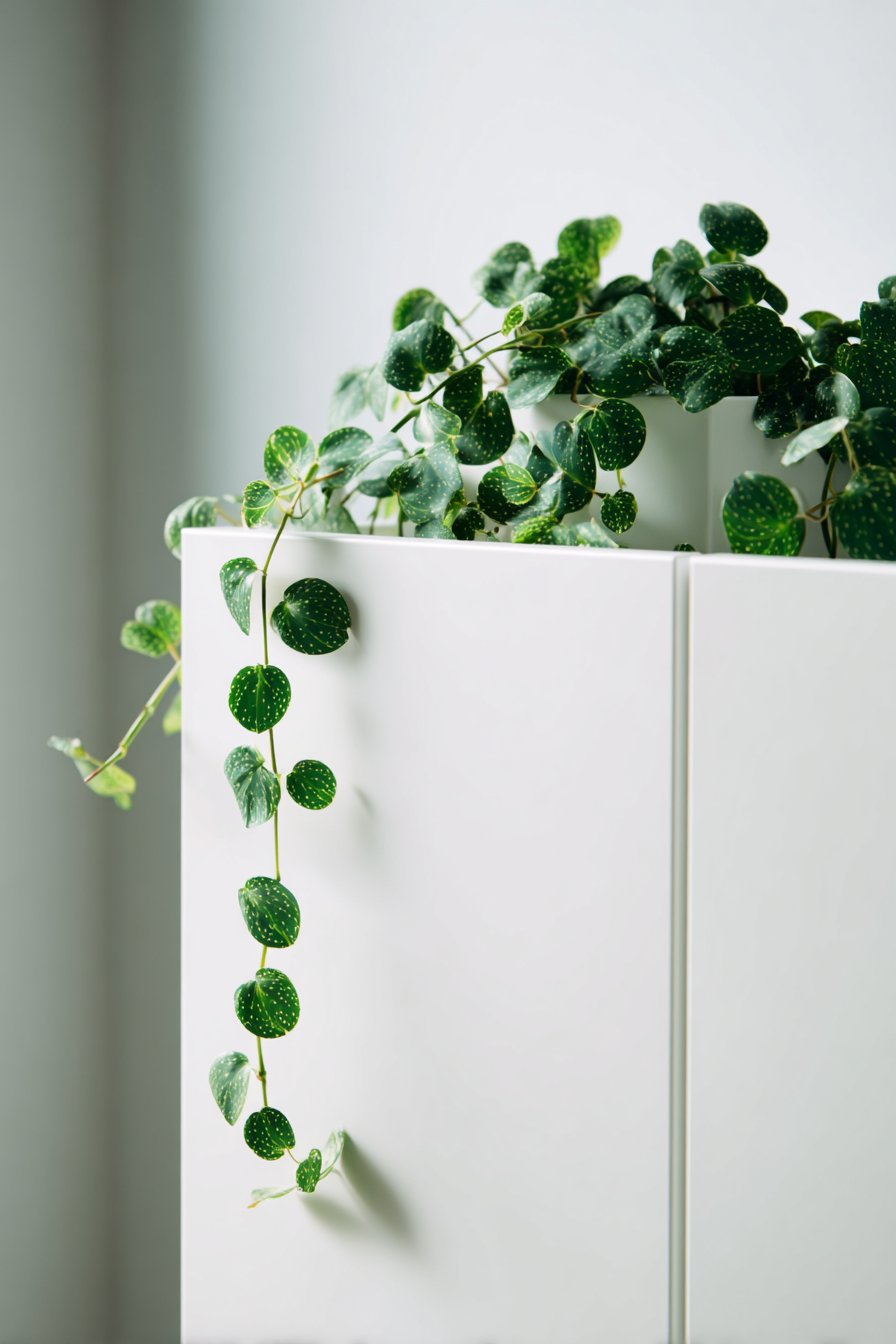
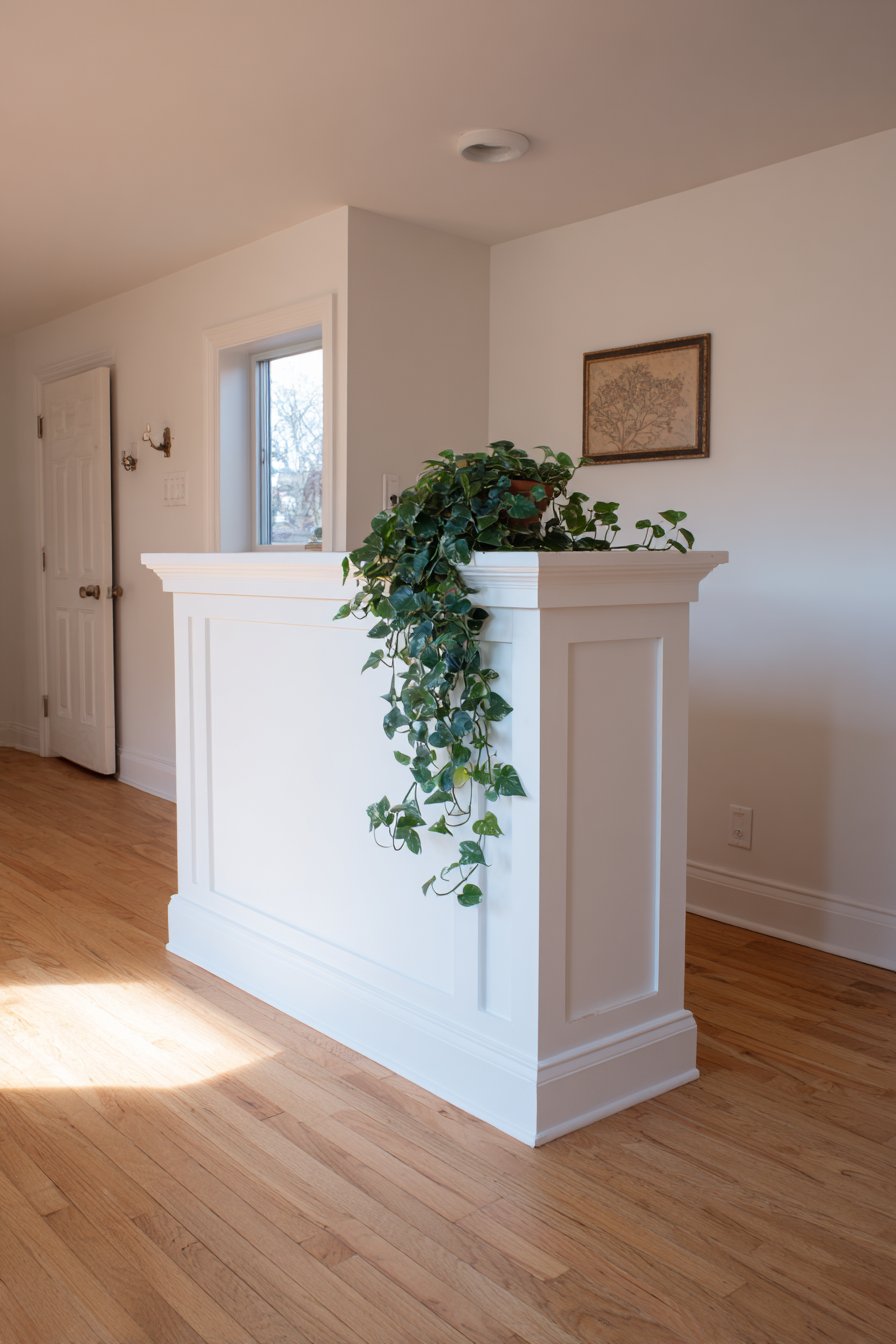
The Scandinavian design philosophy prioritizes simplicity, functionality, and the mindful elimination of unnecessary elements, resulting in spaces that feel serene, uncluttered, and remarkably calming. This minimalist half wall exemplifies these principles through its clean-lined construction in matte white finish, standing 44 inches tall with seamless joints and absolutely no visible hardware to interrupt the pure geometric form. The structure elegantly divides the living area from a dedicated home workspace, creating distinct zones within an open floor plan while maintaining the light, airy quality that defines Nordic interior design.
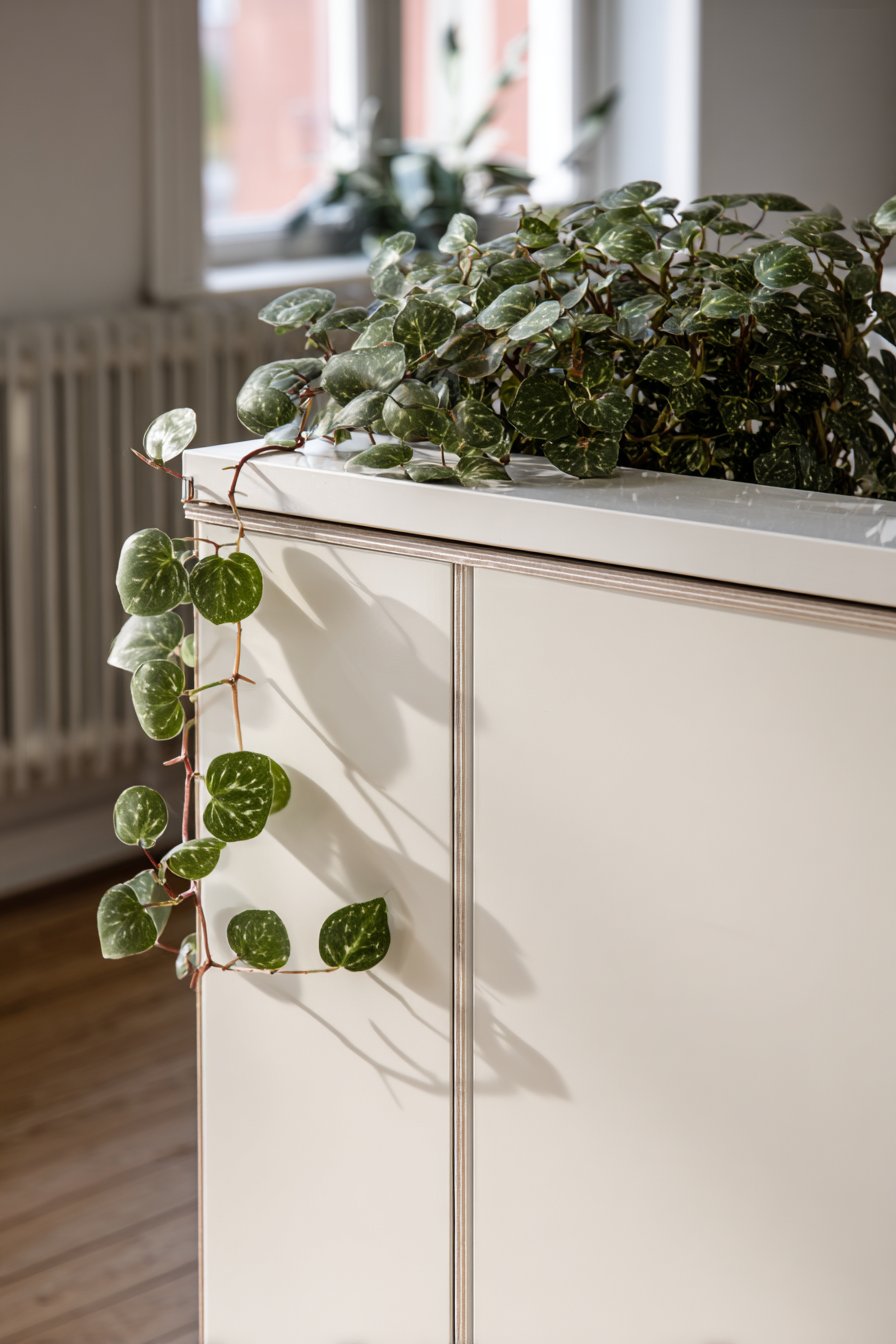
The deliberately simple squared cap rail eschews any decorative molding or ornamental detail, instead relying on perfect proportions and flawless execution to create visual interest. This restraint requires exceptional craftsmanship—when design is stripped to its essentials, every joint, every surface, and every angle must be absolutely perfect because there are no decorative elements to distract from or disguise any imperfections. The negative space beneath the half wall represents a particularly thoughtful detail, allowing light to flow freely across the floor plane and preventing the partition from feeling heavy or obstructive despite its substantial presence.
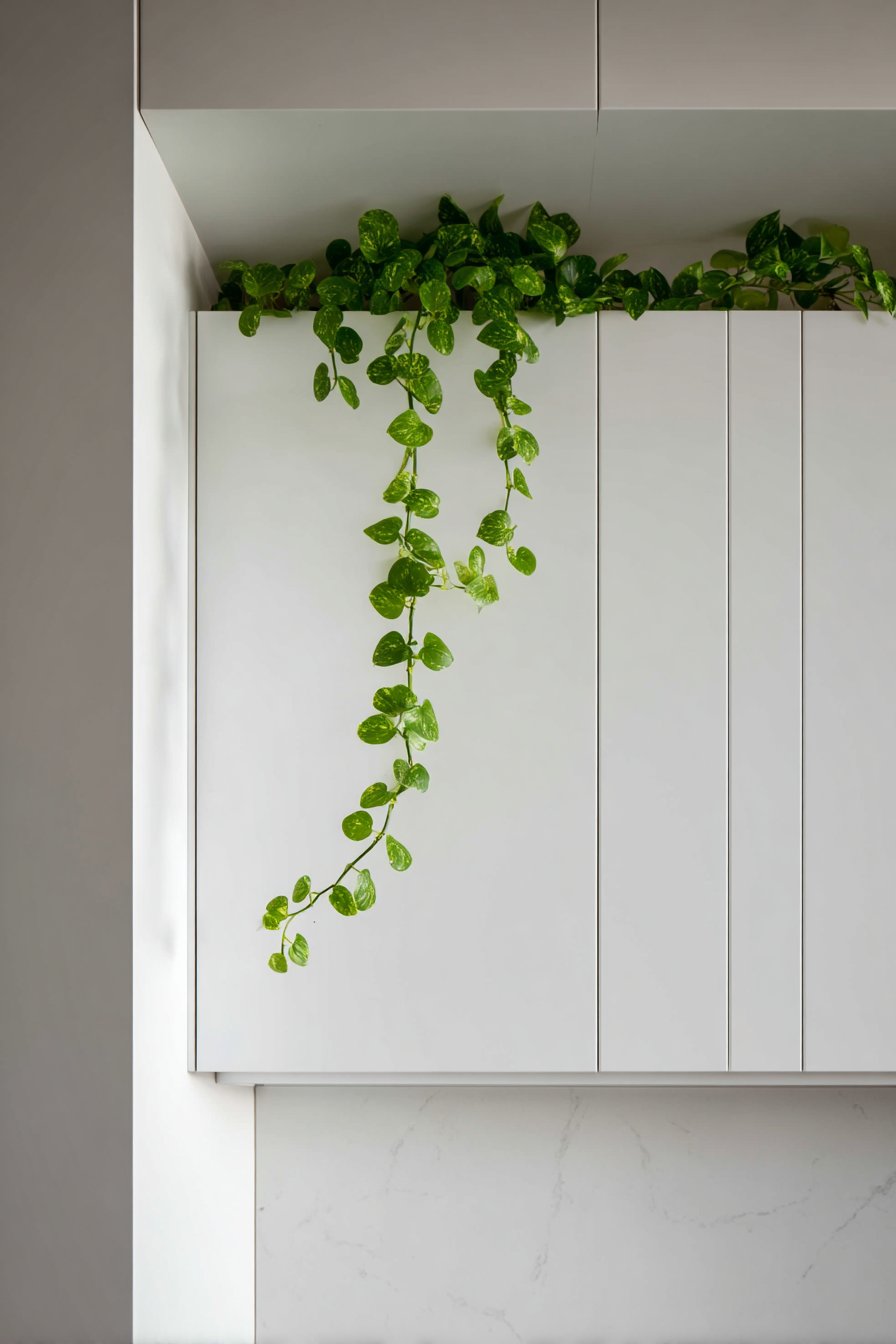
A single trailing pothos plant draped naturally over the cap rail introduces the only organic element in this otherwise minimal composition, its living green presence providing just enough visual softness to prevent the stark white surfaces from feeling cold or clinical. Professional interior photography utilizing soft Nordic lighting—that characteristic diffused, even illumination that seems to emanate from everywhere and nowhere simultaneously—showcases the pure geometric form and demonstrates how functional simplicity can achieve a level of beauty that ornate decoration often cannot match.
Key Design Tips:
- Use high-quality paint with a matte or eggshell finish to create smooth, non-reflective surfaces that hide minor imperfections
- Ensure all joints are perfectly flush and filled completely, then sanded smooth before painting for seamless transitions
- Apply at least three coats of white paint, sanding lightly between coats for a flawless finish
- Create negative space at the base by elevating the wall on minimal supports or recessing it slightly from the floor
- Select a simple, squared cap rail profile that emphasizes clean geometry rather than decorative molding
- Limit decorative elements to one or two carefully chosen organic accents like plants to prevent visual clutter
- Use integrated or hidden fasteners throughout to maintain the clean, hardware-free appearance
6. Mediterranean Stucco Arch Divider
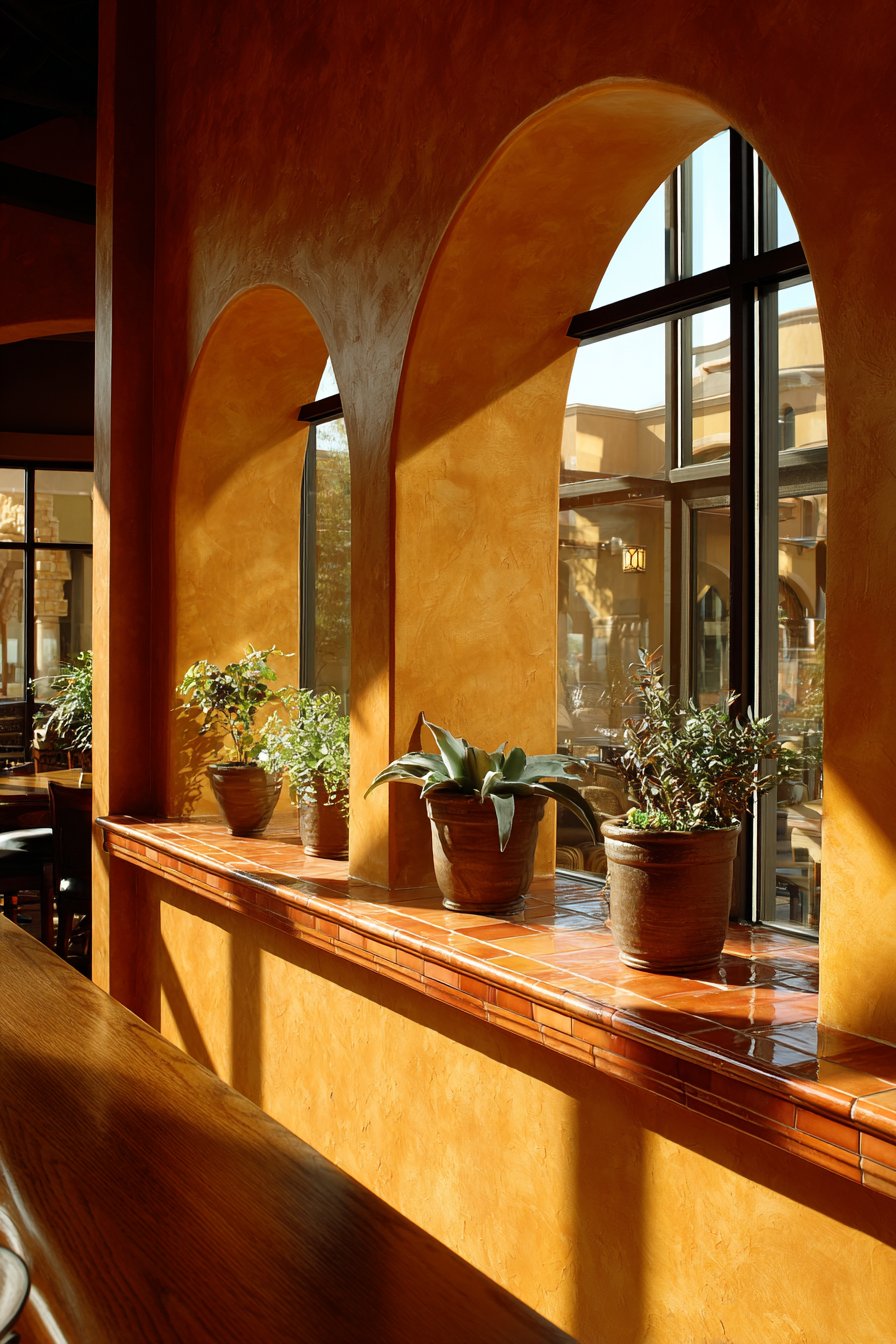
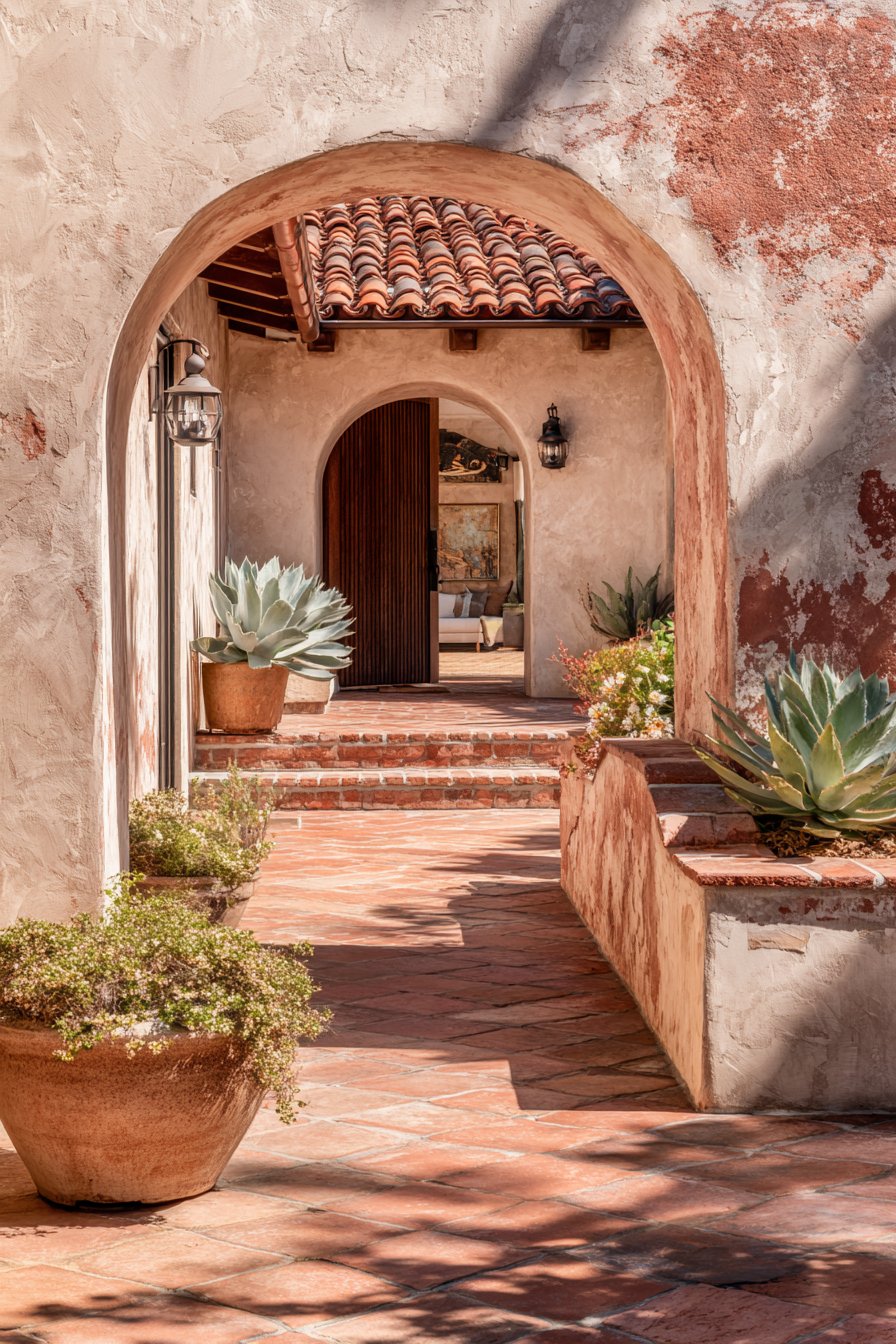
The romance and warmth of Mediterranean design comes alive in this beautifully crafted half wall featuring traditional stucco finishing and graceful arched openings that frame views between adjacent spaces. The structure serves as an elegant separator between a sun-drenched dining area and an intimate reading nook, incorporating three decorative arched cutouts that allow visual connection while maintaining distinct functional zones. The stucco finish in warm ochre tones evokes the sun-baked walls of Tuscan villas and Spanish courtyards, bringing a sense of Old World charm and timeless elegance to contemporary homes.
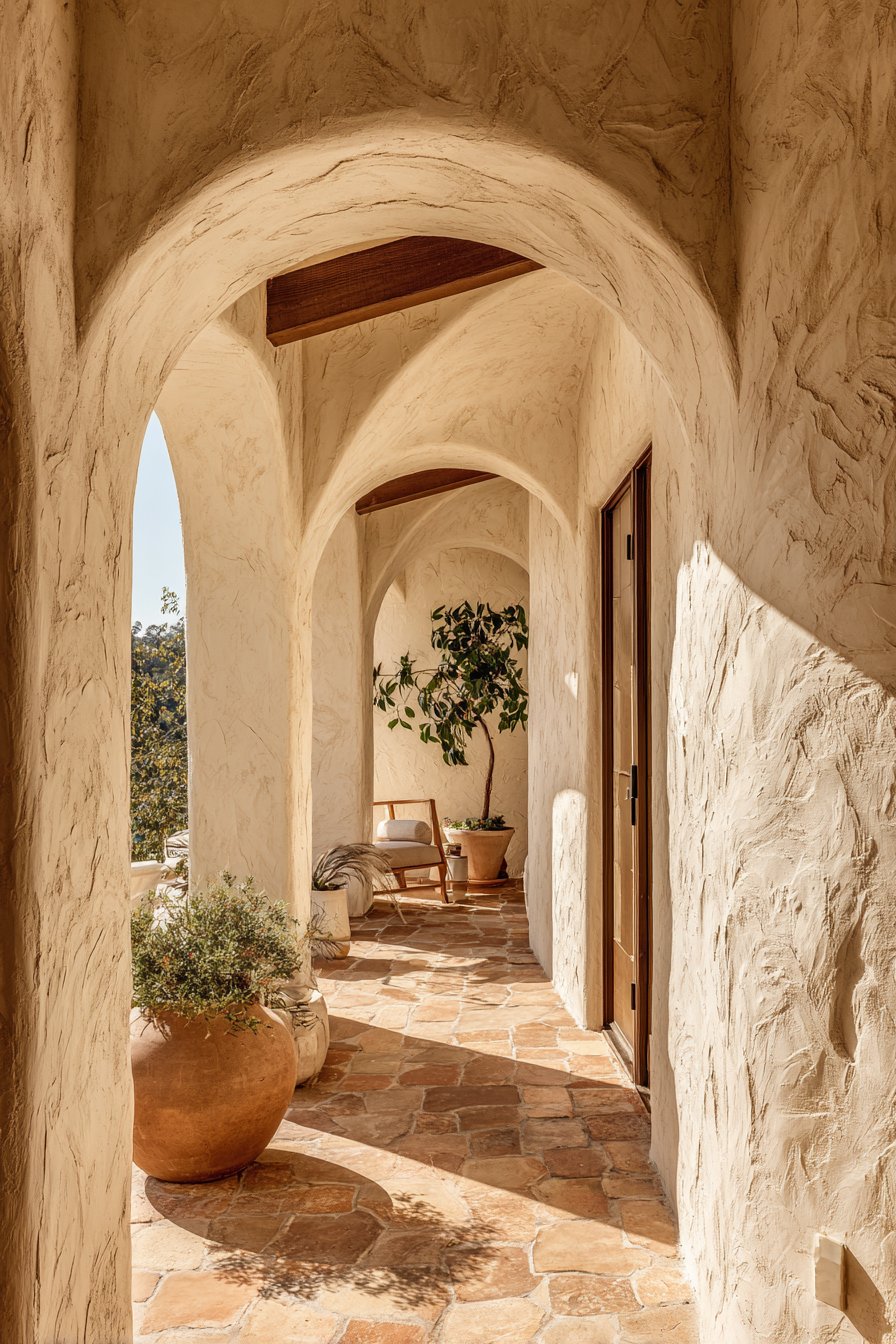
The arched openings represent more than mere decorative flourishes—they serve practical purposes by allowing light and air to circulate freely between spaces while creating beautiful framed vistas that draw the eye through the home. Terra cotta tiles topping the wall edge introduce rich earth tones and provide textural contrast against the smoother stucco surfaces, while also protecting the upper edge from wear and damage. Potted succulents nestled within the arched niches add living green elements that thrive in the bright natural light these openings admit, creating miniature garden moments that bring life and vitality to the architectural features.
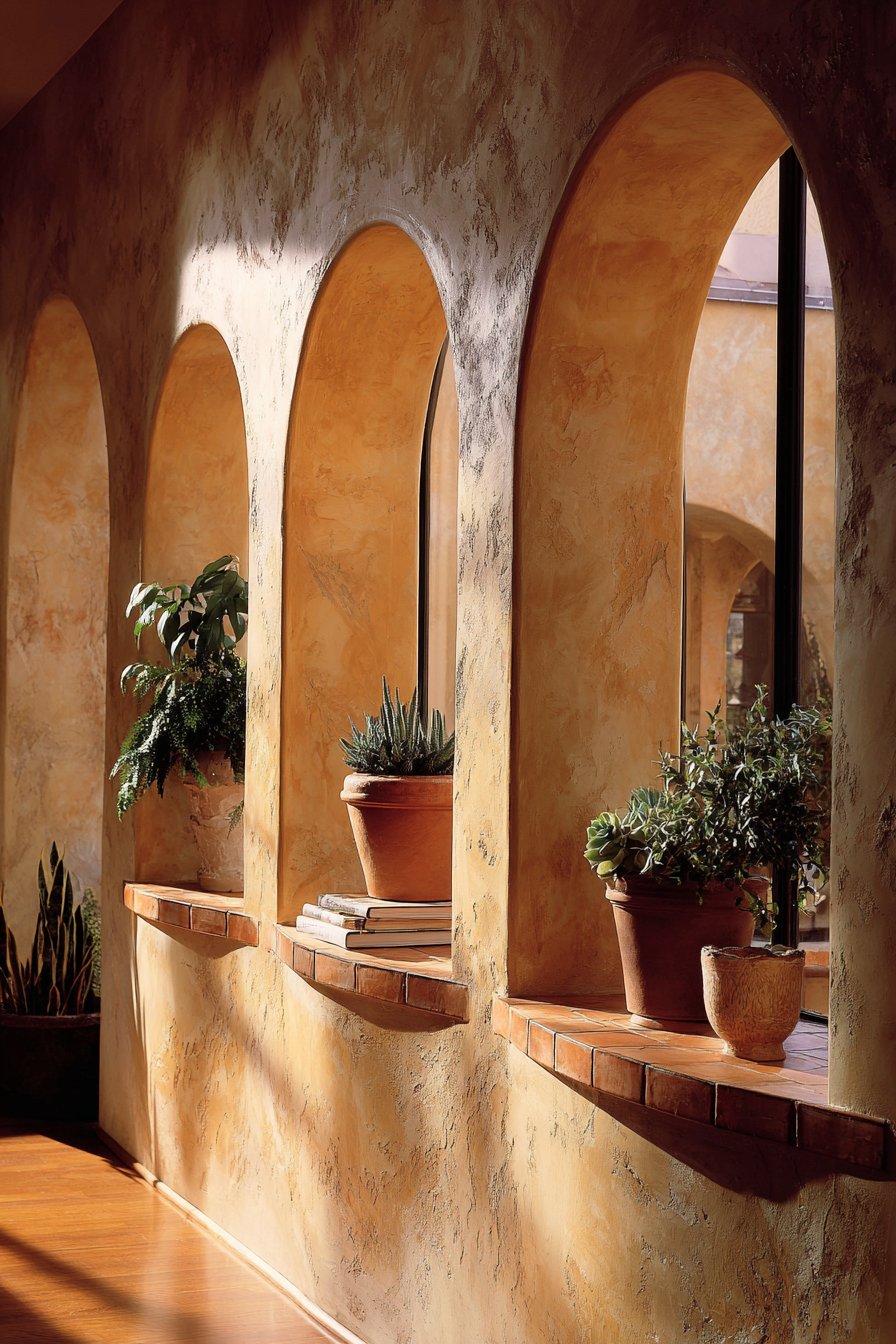
Natural afternoon light streaming through the arches creates constantly changing shadow patterns on the stucco surfaces, adding dynamic visual interest that transforms throughout the day. The subtle texture variations inherent in hand-applied stucco finishes catch and reflect light differently across the surface, creating depth and dimension that flat painted walls cannot achieve. Interior design photography captures this romantic architectural detail and the warm, inviting atmosphere that Mediterranean design principles naturally create, demonstrating how traditional building techniques and materials can feel fresh and relevant in contemporary applications.
Key Design Tips:
- Create gentle, proportional arch curves using flexible templates or trammel points for consistent shapes
- Apply stucco in multiple layers, allowing each to dry completely before adding the next for authentic depth and texture
- Use traditional terra cotta tiles or quality reproductions for the cap detail to ensure color consistency and durability
- Position arched openings to frame specific views or create sight lines to focal points in adjacent rooms
- Select drought-tolerant plants like succulents for niches to minimize maintenance while adding living elements
- Vary the size of the arched openings slightly for a more authentic, handcrafted appearance rather than perfect uniformity
- Consider the direction of natural light and position the wall to maximize the shadow play through the arches
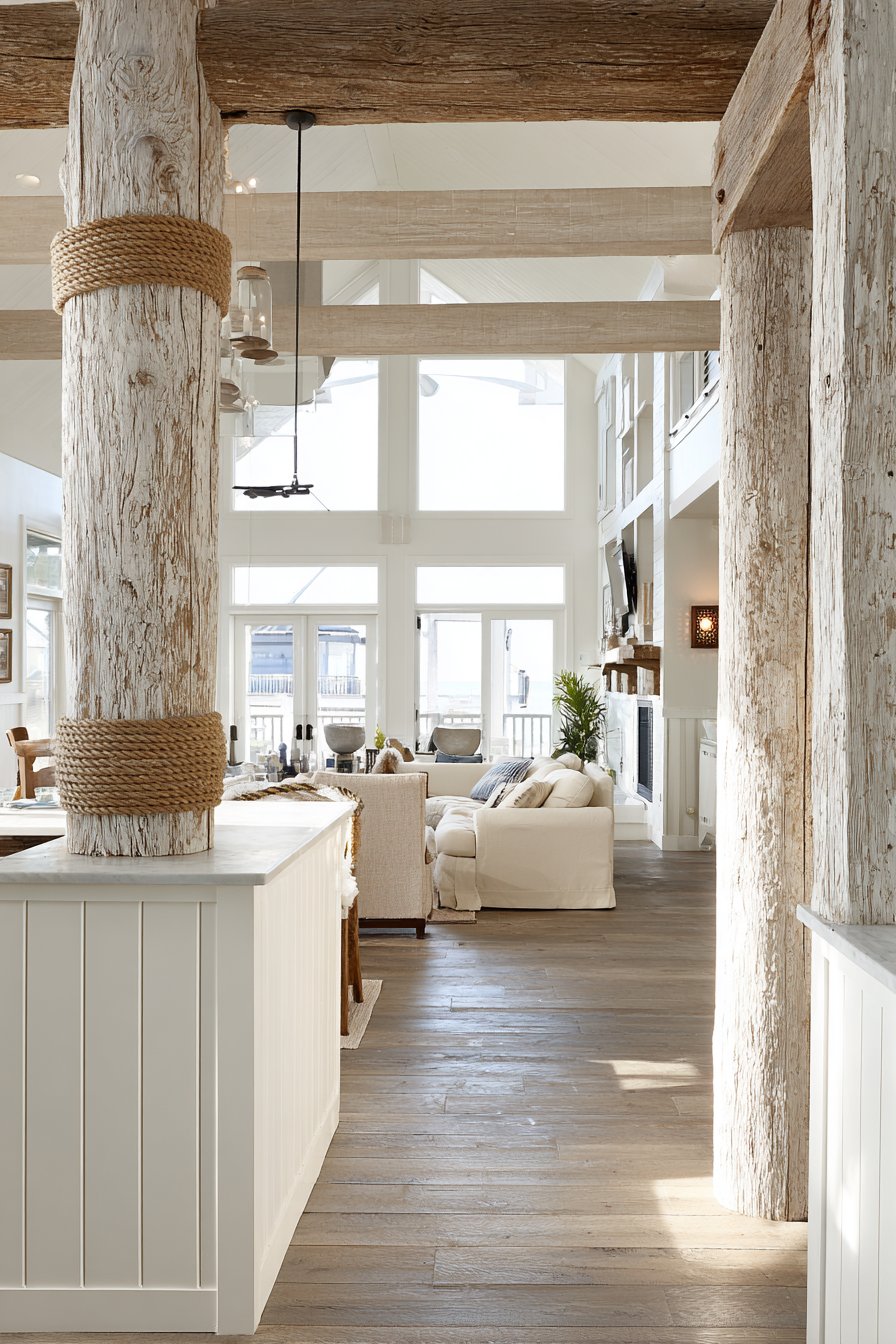
7. Coastal Tongue-and-Groove Beach House Divider
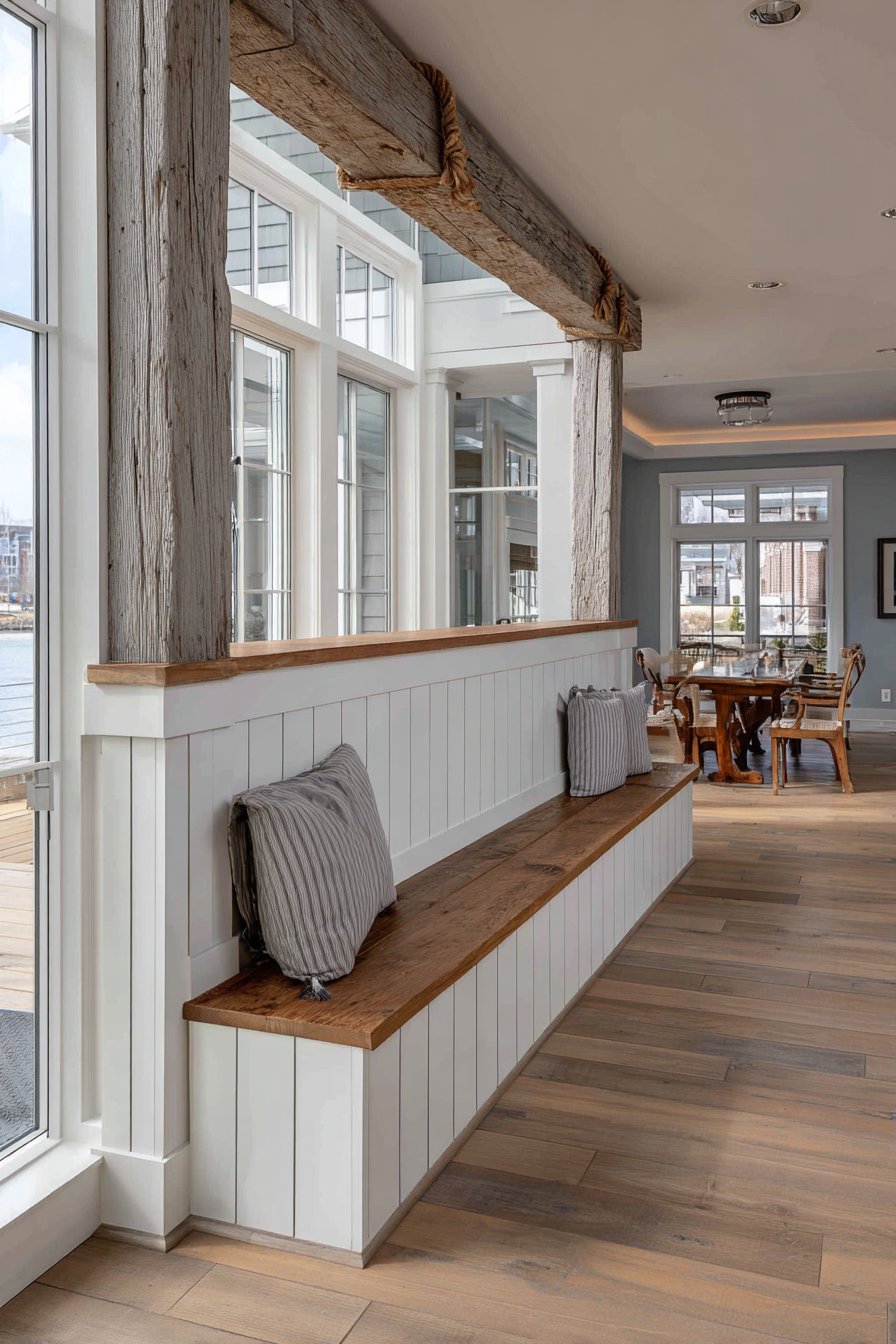
The relaxed, breezy aesthetic of coastal design finds perfect expression in this charming half wall constructed with white-painted tongue-and-groove paneling installed in vertical orientation. Separating the main seating area from a sunny enclosed sunroom, this 38-inch-high partition embodies the casual elegance that defines beach house living. The vertical orientation of the planks creates pleasing linear patterns that draw the eye upward while adding subtle texture that prevents the all-white surfaces from appearing flat or monotonous. Each board’s shadow line where it meets the next contributes to the layered, dimensional quality that makes this wall treatment so visually appealing.
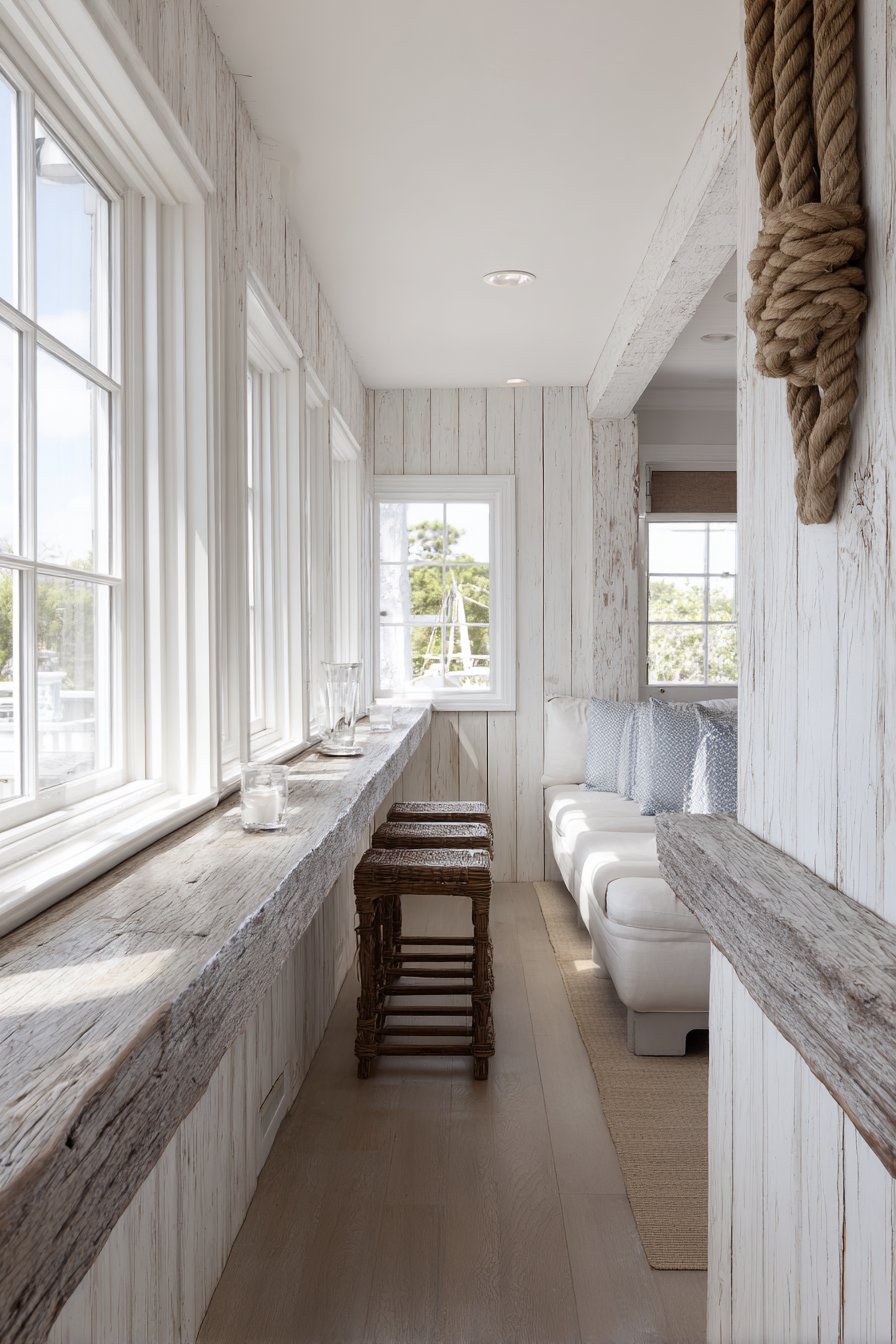
The weathered driftwood-style cap rail introduces the perfect amount of natural, organic contrast to the crisp white painted base, its gray patina suggesting years of sun and salt air exposure. This careful balance between painted and natural wood finishes prevents the design from feeling too monochromatic while maintaining the light, bright quality essential to coastal aesthetics. Rope detailing wrapped decoratively around support posts adds an authentic nautical reference without resorting to overly literal or themed decoration—it’s a subtle nod to maritime traditions that feels organic rather than forced.
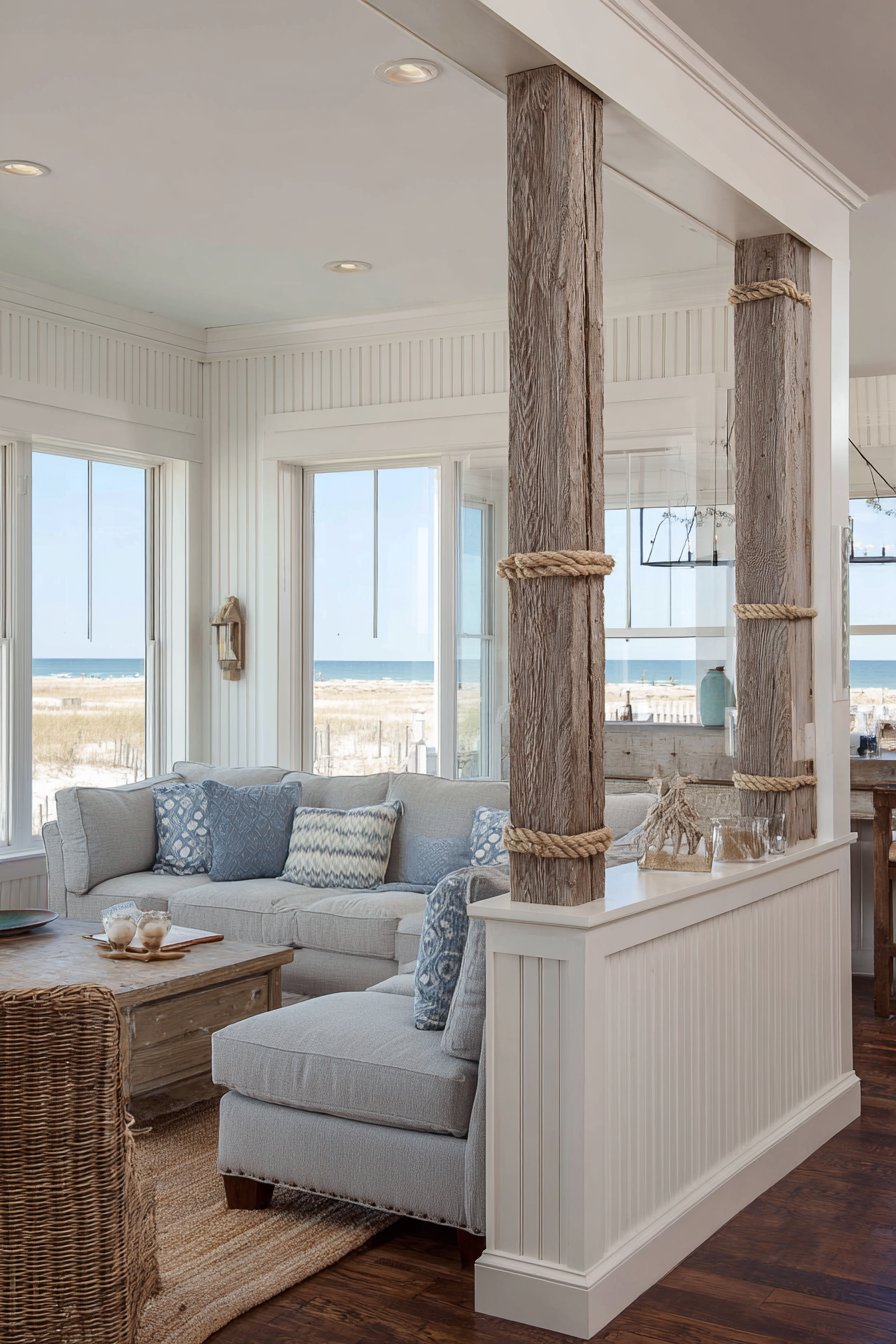
Large windows beyond the half wall flood both adjacent spaces with brilliant natural light, creating the sun-drenched, optimistic atmosphere that makes coastal homes so appealing. The casual, breezy aesthetic emerges not from any single element but from the thoughtful combination of white-painted surfaces, natural wood accents, nautical-inspired details, and abundant sunshine. Wide-angle interior photography emphasizes the texture details created by the tongue-and-groove installation while capturing the relaxed coastal vibe that invites you to kick off your shoes, settle in, and let the cares of the world drift away with the tide.
Key Design Tips:
- Install tongue-and-groove boards vertically to create height-emphasizing lines and facilitate water drainage if used in humid environments
- Select a white paint with slight warm undertones rather than stark, cool white to maintain the inviting coastal aesthetic
- Allow the driftwood cap rail to show authentic weathering and texture variations for genuine beach-worn character
- Use marine-grade rope for decorative details to ensure it won’t deteriorate in humid coastal environments
- Apply a protective clear coat to the driftwood cap rail to preserve its weathered appearance while protecting against wear
- Ensure the white paint is specifically formulated for high-humidity environments to prevent yellowing or mildew
- Position the half wall to maximize views to outdoor areas and natural light sources
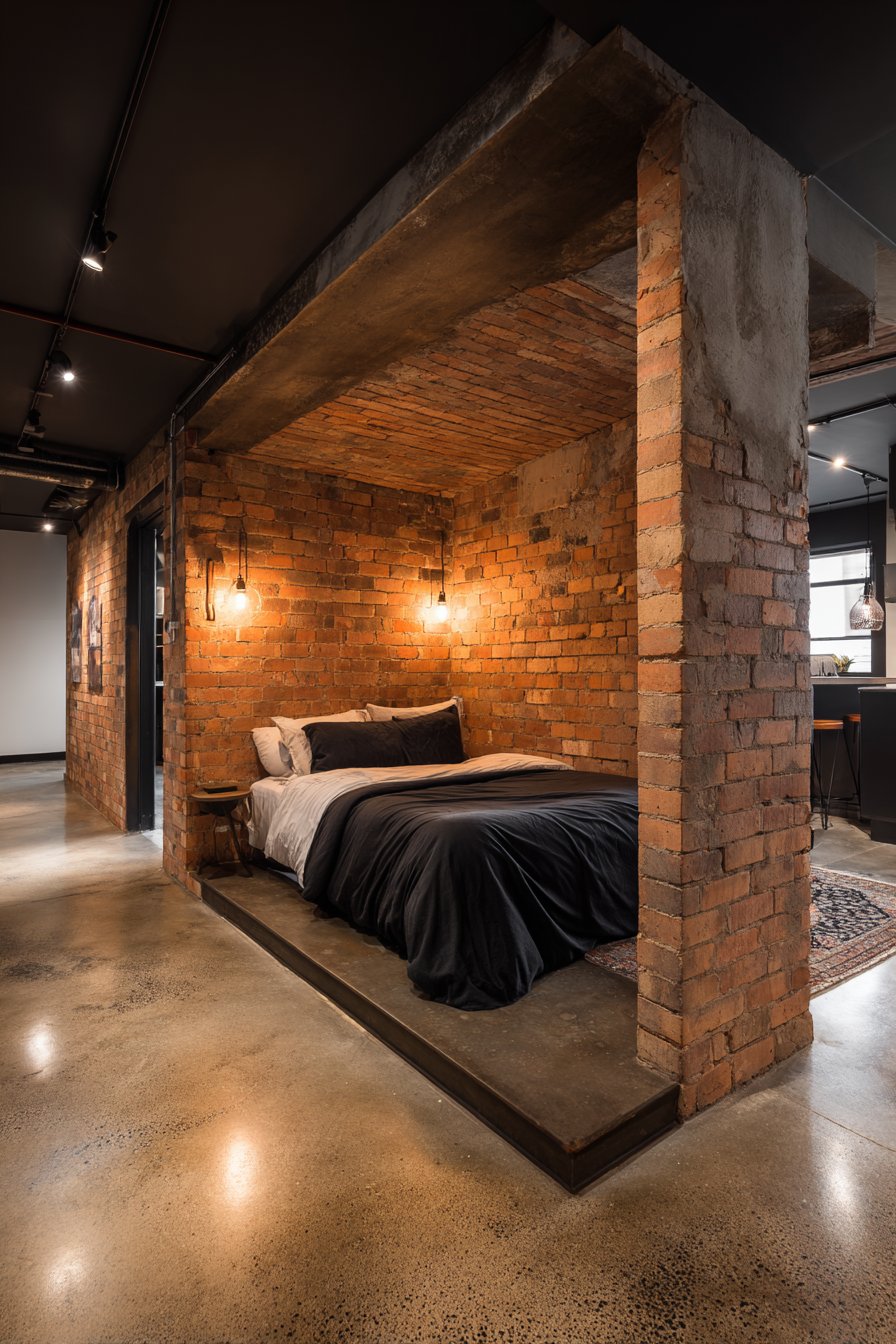
8. Industrial Exposed Brick Loft Partition
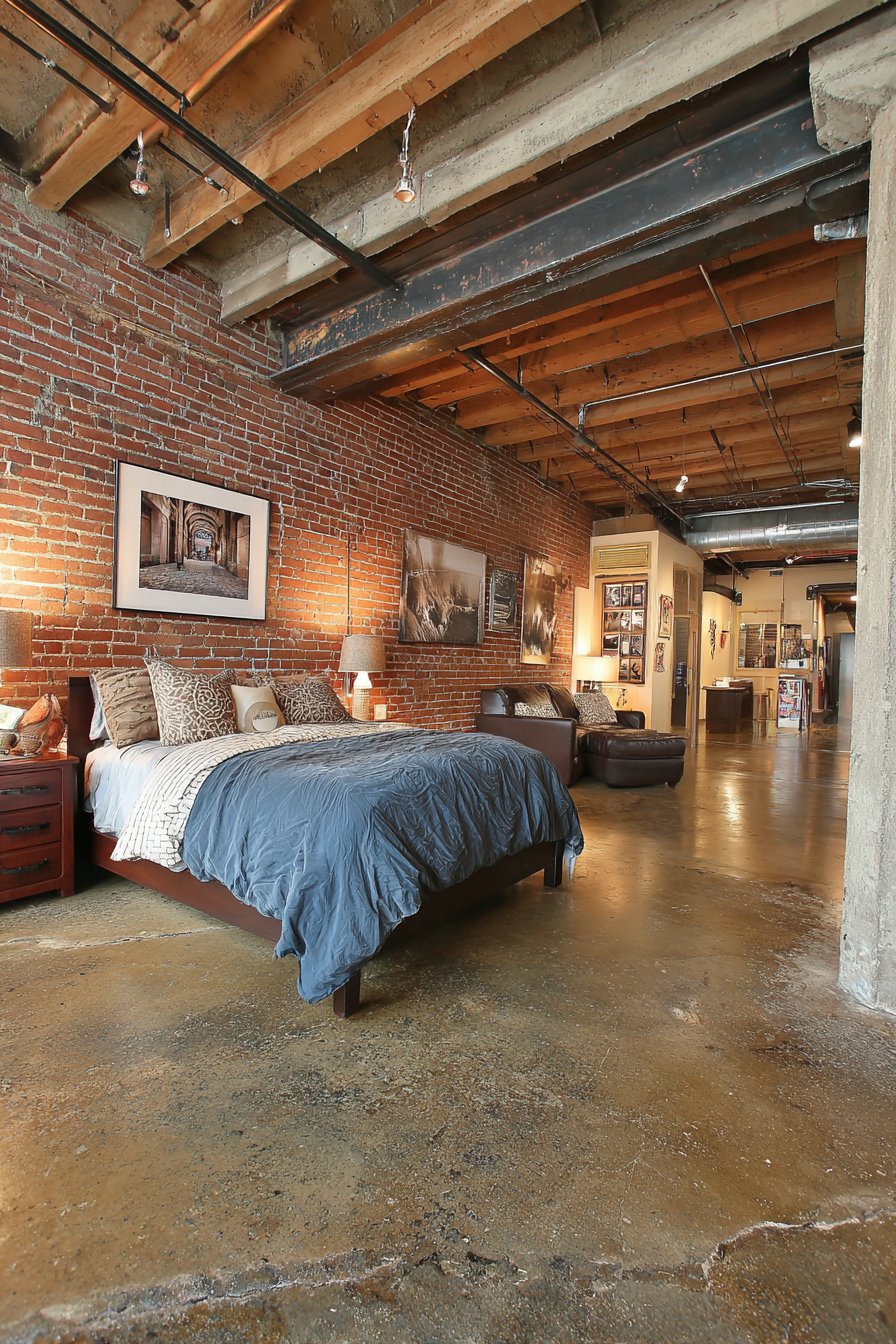
The raw, urban aesthetic of industrial design celebrates honest materials and authentic construction, making exposed brick an ideal choice for creating dramatic half walls in loft environments. This striking partition divides the sleeping area from the main living space in a converted loft apartment, its exposed brick construction showcasing the building’s original structural materials with natural mortar joints and beautifully varied red-brown tones that only authentic aged brick can provide. The thick steel plate cap rail in matte black finish introduces a bold horizontal element while paying homage to the industrial heritage of the space, its visible weld marks serving as reminders that function often creates its own austere beauty.
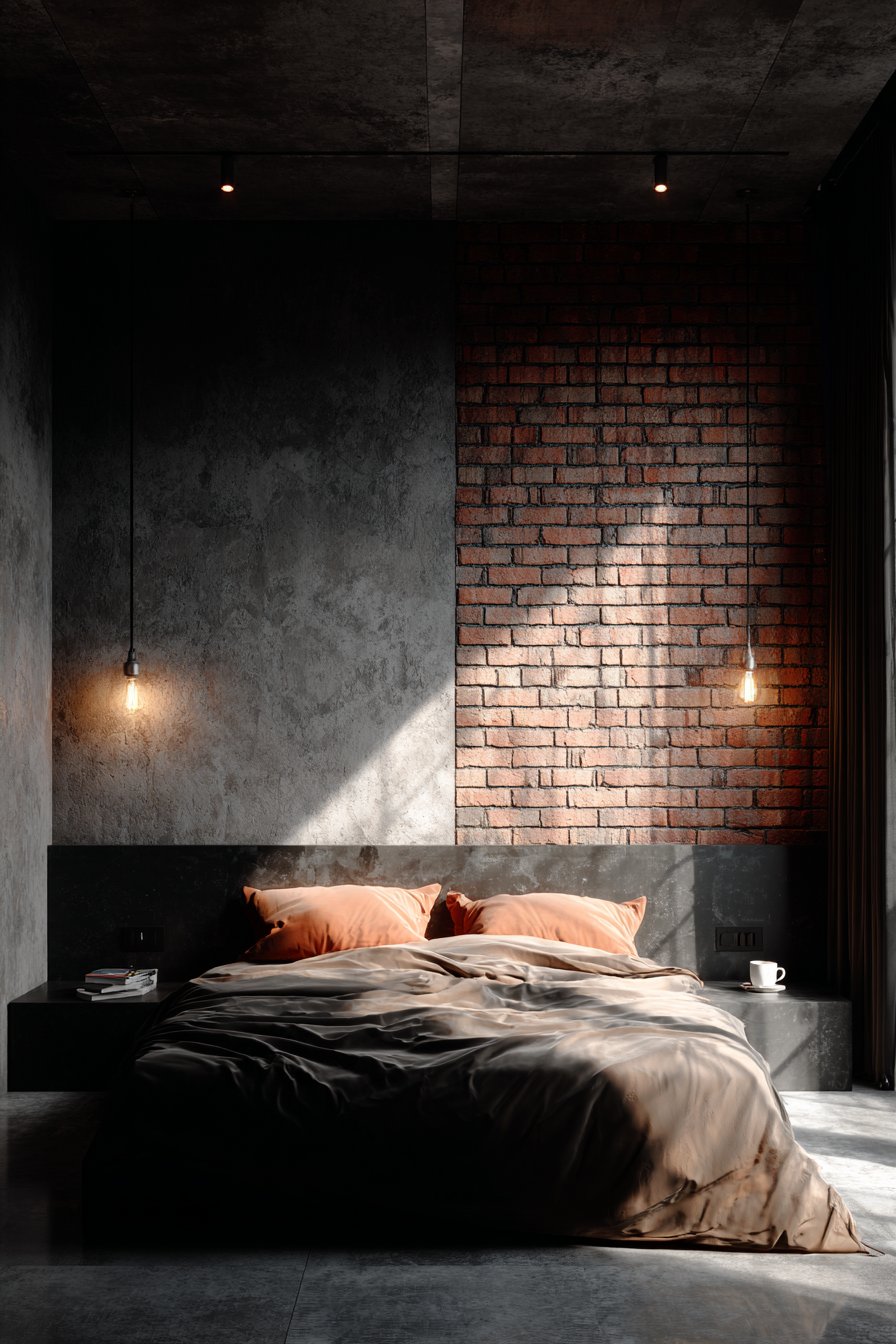
Edison bulb wall sconces mounted directly on the brick surface provide ambient lighting while reinforcing the vintage industrial aesthetic—these early incandescent designs with their visible filaments represent the marriage of utility and beauty that defines the best industrial design. The warm glow from these fixtures creates dramatic contrast against the dark brick surfaces, highlighting texture and creating pools of golden light that soften the potentially harsh materials. Polished concrete flooring extending throughout the space complements the brick walls perfectly, both materials sharing an honest, utilitarian character that refuses to apologize for its industrial origins.
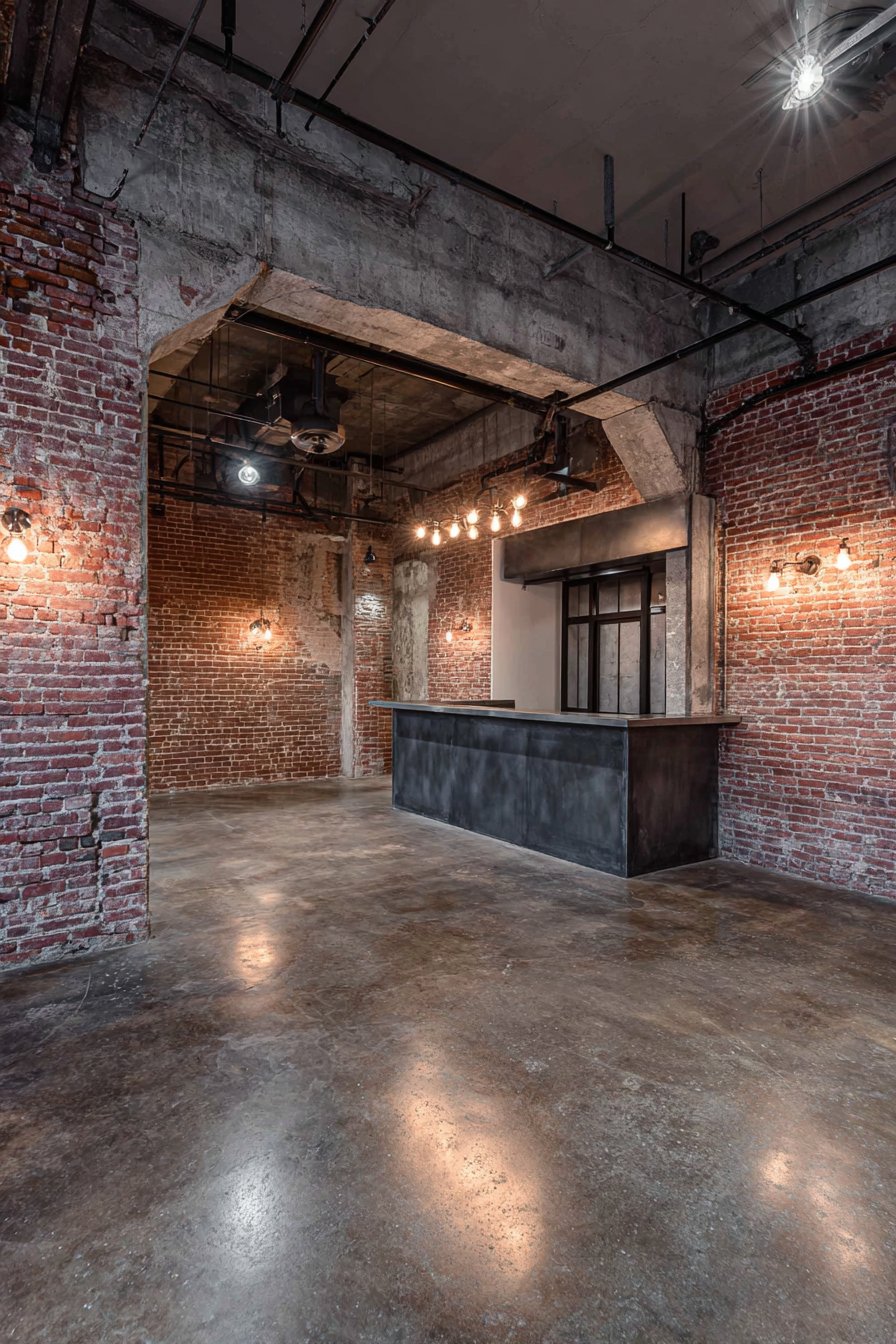
Interior photography with dramatic side lighting emphasizes the raw material textures and urban aesthetic, casting deep shadows that accentuate the dimensional quality of the brick surface and create a moody, atmospheric quality. The varied tones within the brick—from deep burgundy to pale salmon—create visual richness that keeps the eye engaged, discovering new details with each viewing. This half wall demonstrates how industrial materials traditionally considered rough or unfinished can be celebrated as primary design elements that bring character, history, and authentic urban edge to contemporary living spaces.
Key Design Tips:
- If using authentic old brick, have it professionally cleaned and sealed to prevent mortar dust while preserving the aged appearance
- Choose a substantial steel cap rail (at least 1/4 inch thick) to provide adequate visual weight against the heavy brick below
- Leave mortar joints in their natural state or apply minimal tooling to maintain authentic industrial character
- Install Edison-style fixtures on dimmer switches to control mood and highlight the decorative quality of the visible filaments
- Ensure the brick wall is properly supported—exposed brick is heavy and requires adequate structural foundation
- Embrace imperfections in the brick surface as character marks rather than flaws to be concealed
- Balance the rough brick texture with smoother surfaces in adjacent areas to prevent visual overload
9. Built-In Shelving Storage Partition
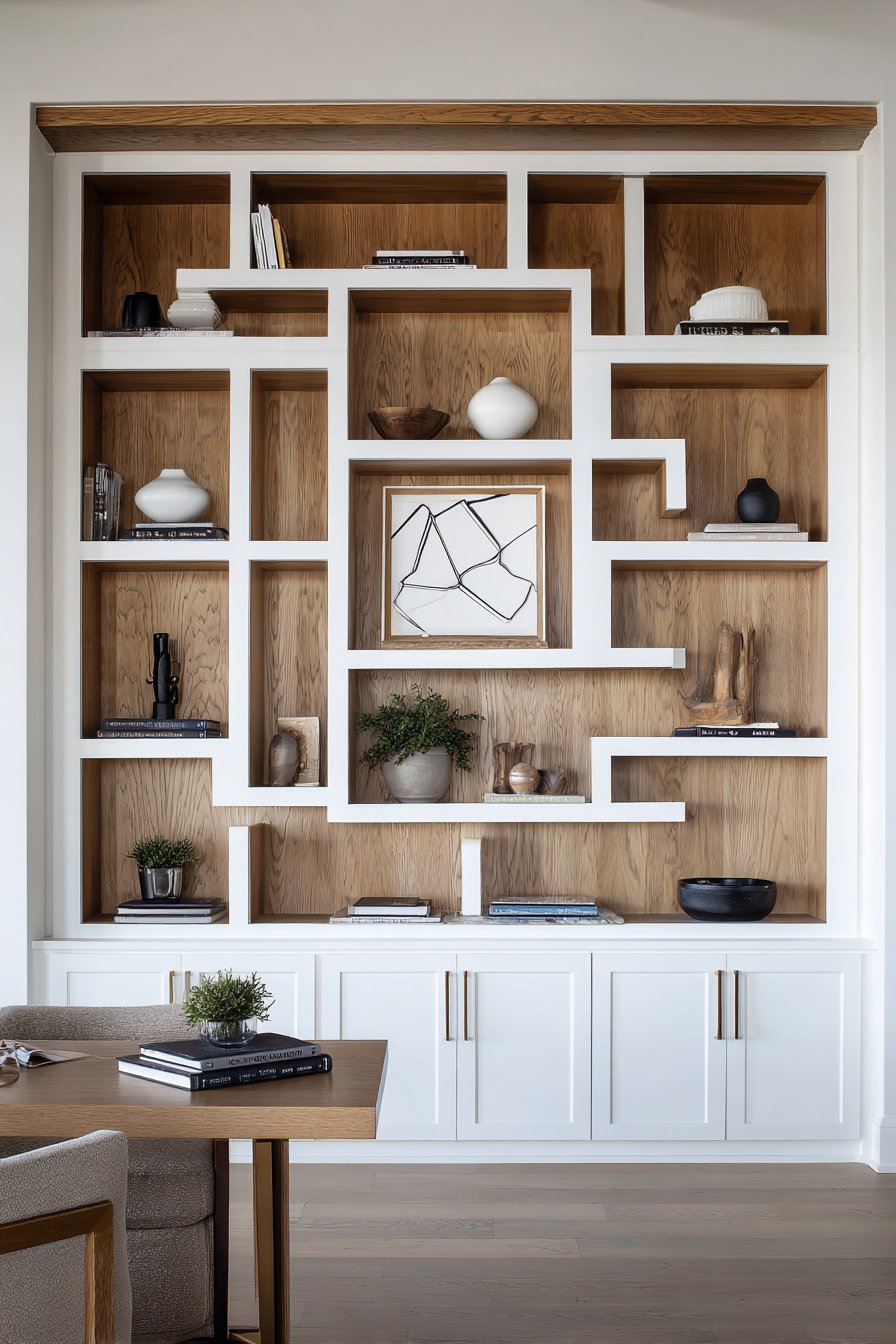
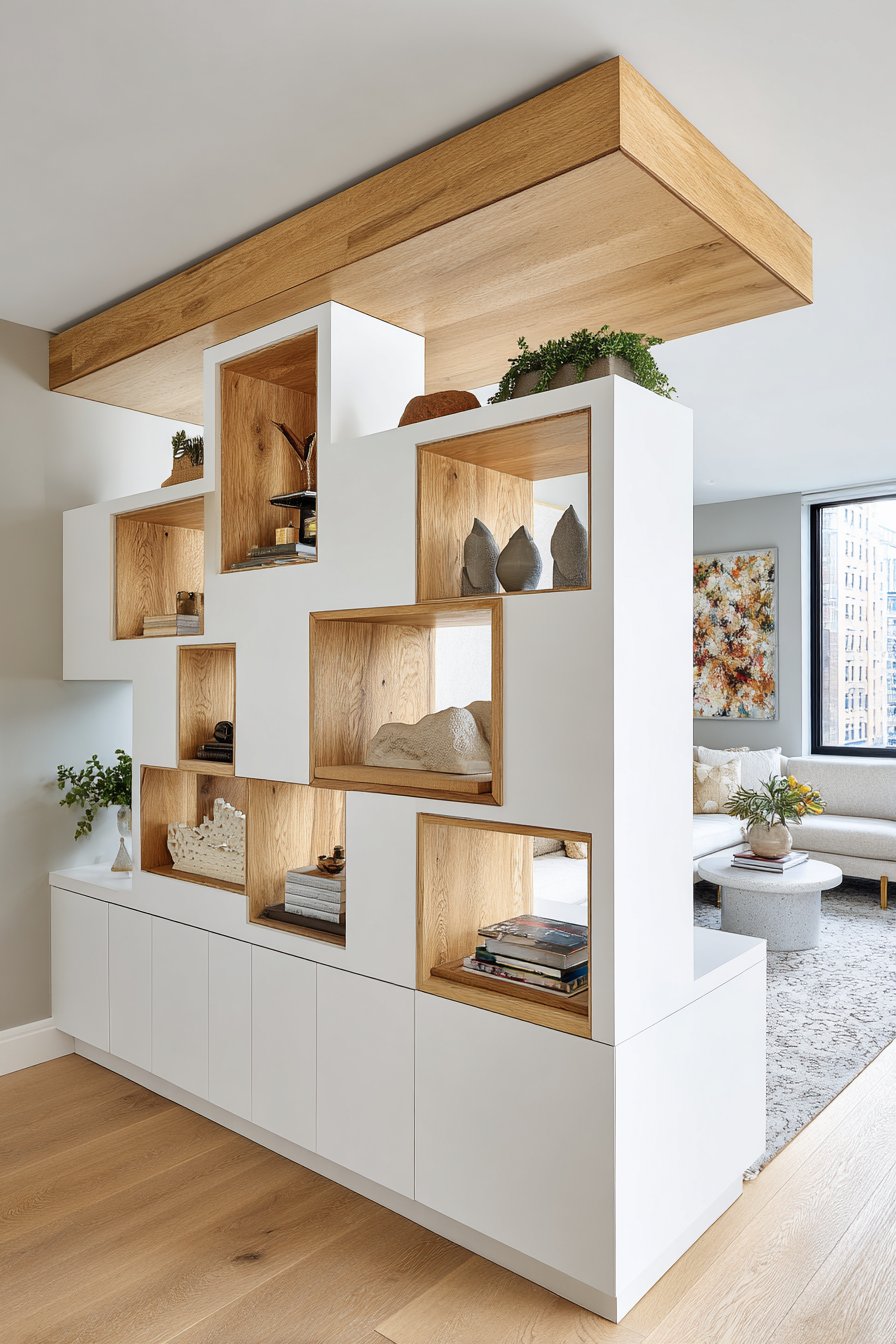
Functionality reaches new heights in this ingenious half wall design that transforms a simple room divider into valuable storage space through the integration of built-in shelving. The white painted framework incorporates four generously sized open cubby sections, each providing display space for carefully curated collections of decorative objects, books, and living plants that add personality and life to the partition. This dual-purpose approach maximizes the utility of every square foot, particularly valuable in homes where space is at a premium and every element must earn its place through multi-functionality.
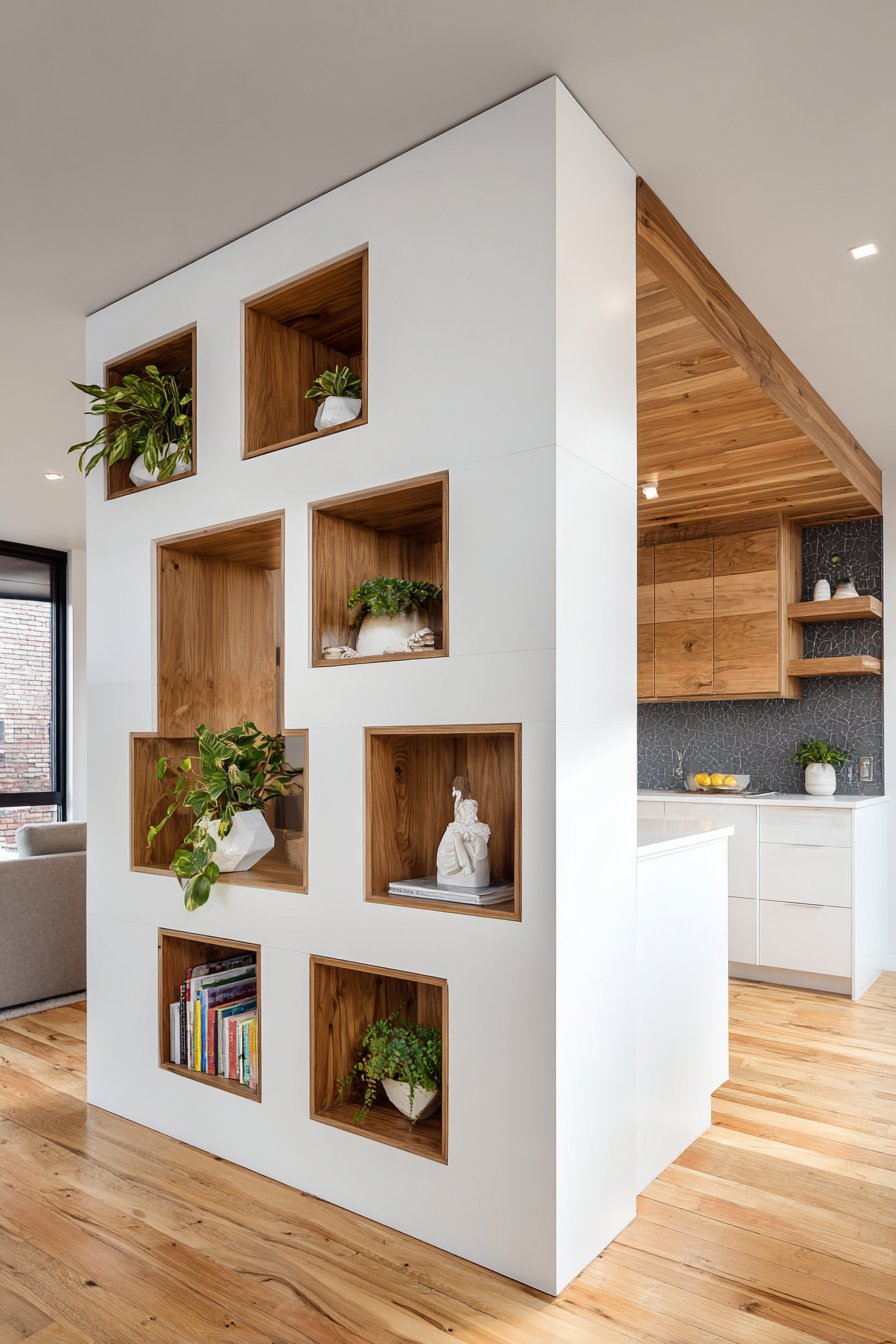
Natural wood backing within each cubby creates warm contrast against the white frame while adding depth and visual interest to the open storage sections. This thoughtful detail prevents the cubbies from appearing as mere holes in the wall, instead creating finished, intentional spaces that showcase displayed items to their best advantage. The top rail finished in matching wood provides visual continuity and ties the natural wood elements together into a cohesive composition. The careful balance between white painted surfaces and natural wood tones creates a transitional aesthetic that works beautifully in both traditional and contemporary settings.
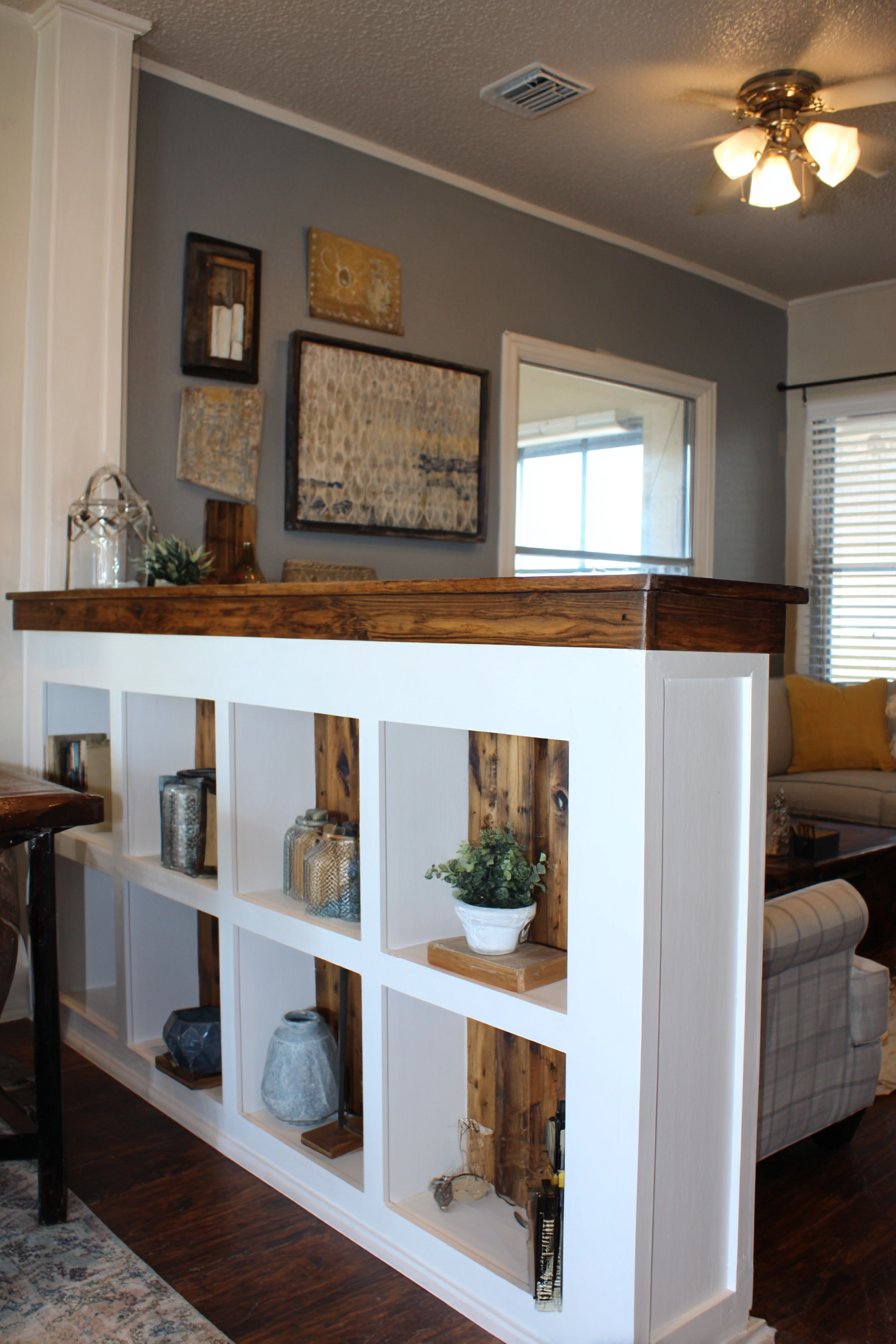
Wide-angle photography with balanced lighting demonstrates how effectively this design serves both its functional storage role and its spatial division purpose. The open nature of the cubbies allows light to filter through while maintaining visual connection between the home office and living room spaces. The displayed items—ranging from leather-bound books to ceramic vessels to trailing pothos plants—add layers of personality and prevent the white framework from feeling too sterile or institutional. This approach to half wall design proves that practical storage solutions need not sacrifice aesthetic appeal when executed with attention to proportion, material selection, and thoughtful styling.
Key Design Tips:
- Size cubby openings to accommodate standard storage bins or baskets if organization is a primary goal
- Install the wood backing at least 1-2 inches behind the face of the frame to create shadow depth
- Maintain consistent spacing between cubbies for visual rhythm and balanced proportions
- Apply furniture-grade paint to all white surfaces for durability in high-traffic areas
- Consider asymmetrical cubby arrangements for more dynamic visual interest if symmetry isn’t required
- Include at least one larger opening sized for books or taller decorative objects
- Install adjustable shelving within some cubbies for maximum flexibility in displaying items of varying heights
- Finish the wood backing with the same stain or finish as the cap rail for cohesive material continuity
10. Mid-Century Modern Horizontal Slat Partition
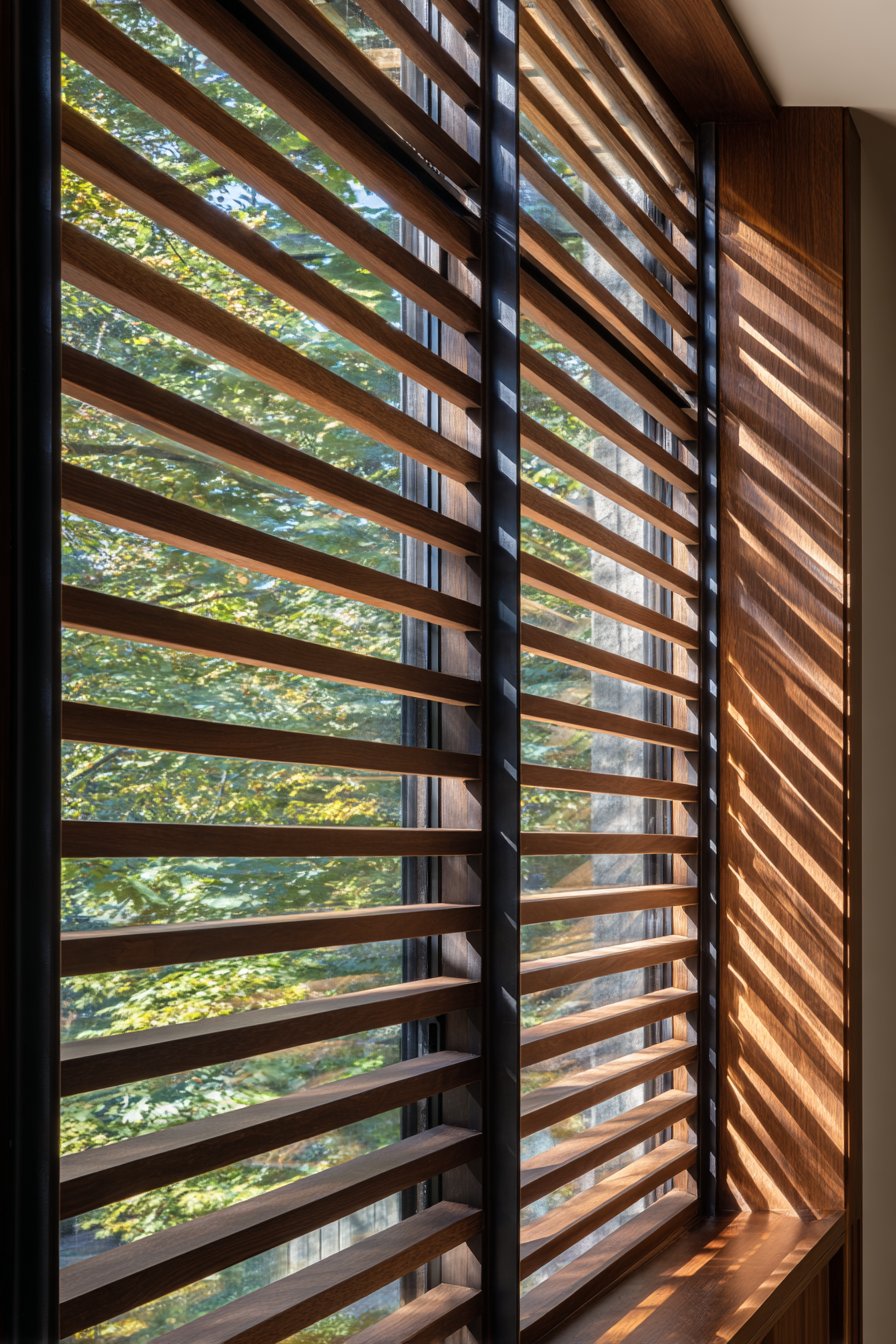
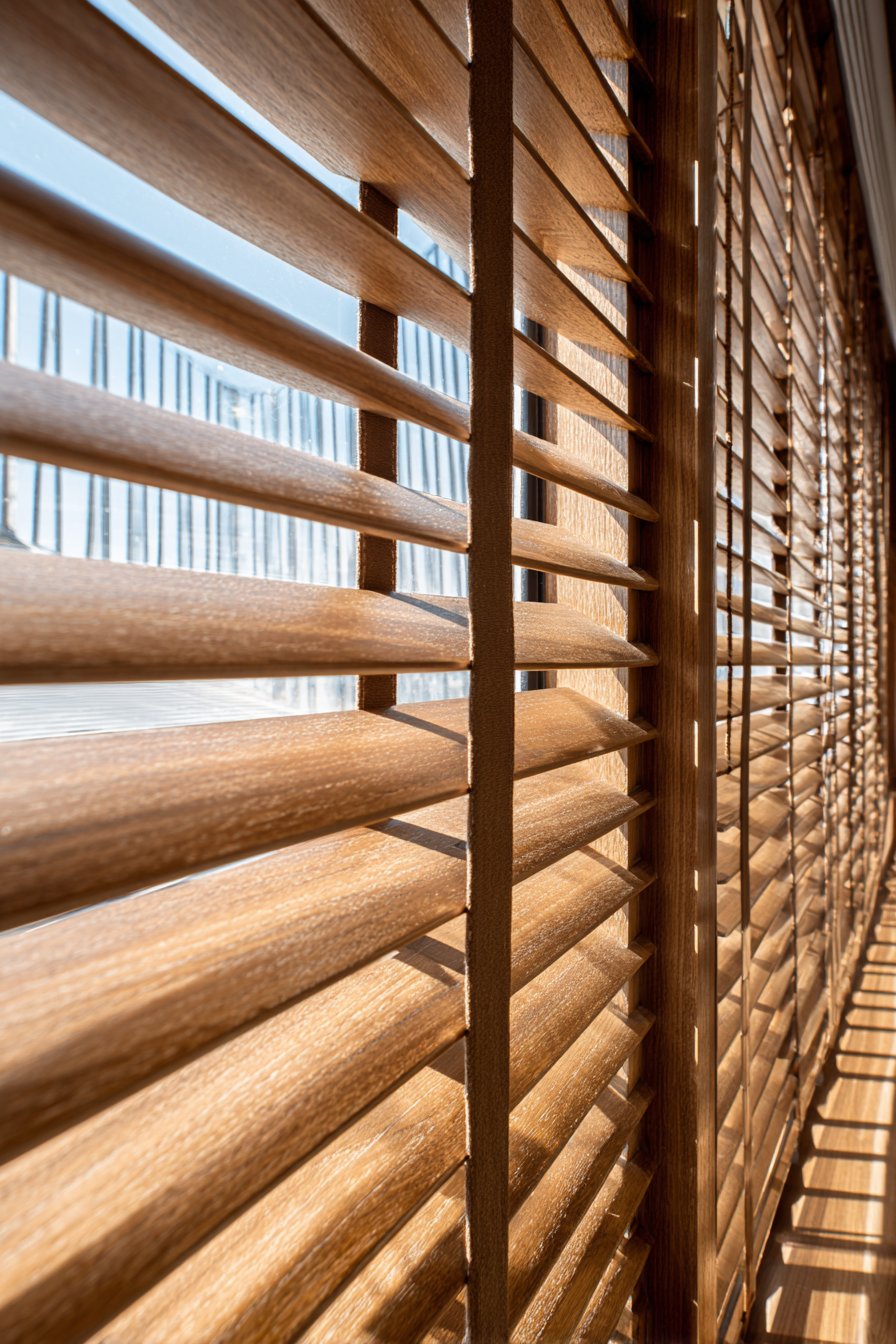
The iconic mid-century modern aesthetic finds beautiful expression in this half wall featuring horizontal wood slat construction with evenly spaced gaps that allow filtered light and partial views between adjacent spaces. The warm walnut-stained slats mounted on minimal black metal framework create the perfect balance of organic wood warmth and industrial-inspired metal structure that characterizes the best mid-century design. This partition separates the dining area from the living room while maintaining the visual connection and spatial flow that open-concept living demands, demonstrating how screen-like partitions can define zones without creating barriers.
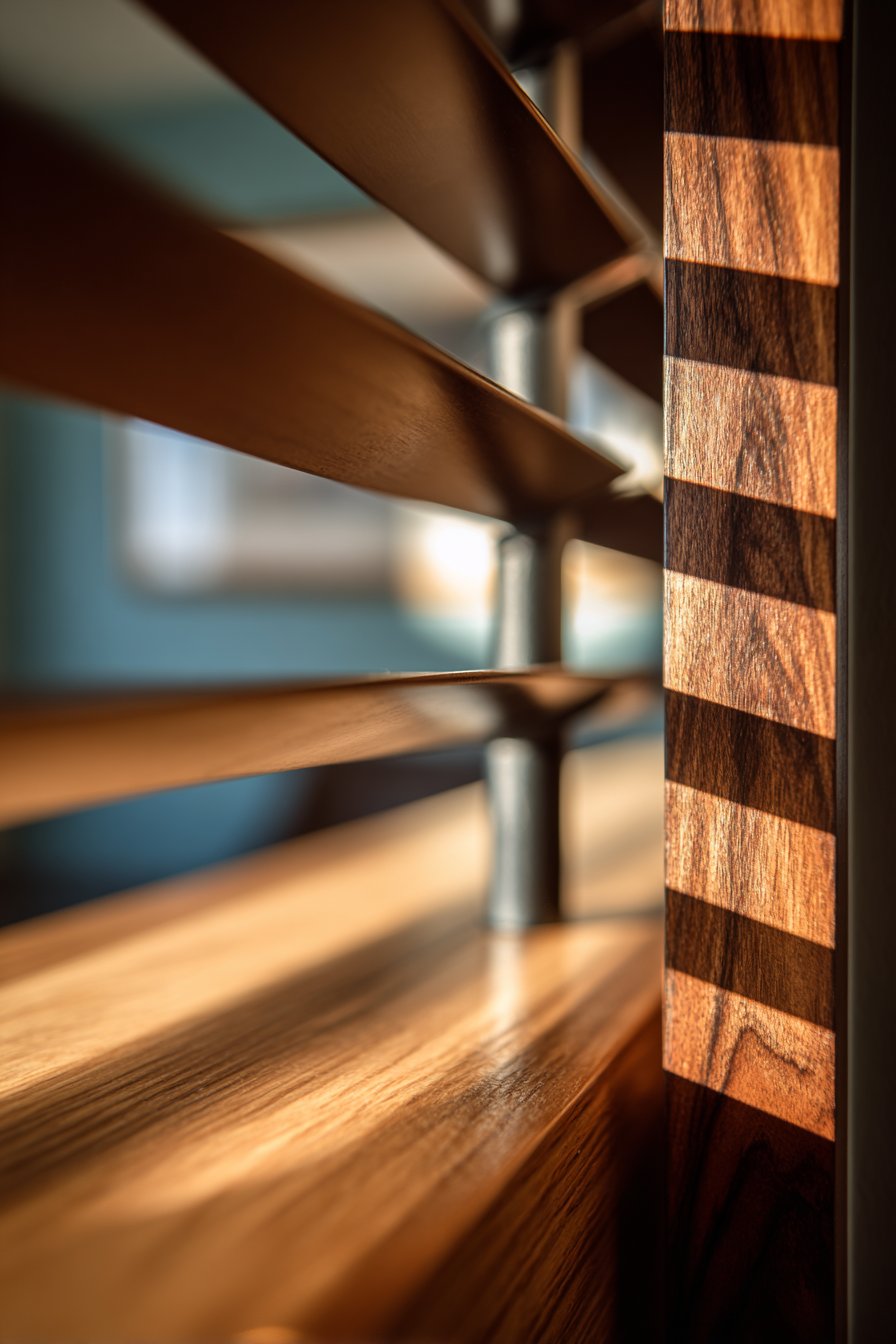
The linear pattern created by the horizontal slats introduces strong geometric elements that complement the clean lines of mid-century furniture and architecture. The evenly spaced gaps serve both practical and aesthetic purposes—allowing light to penetrate through the partition while creating intriguing shadow patterns that change throughout the day as natural light shifts. The warm walnut stain on the wood slats provides rich, organic contrast to the matte black metal framework, this classic material combination appearing repeatedly in mid-century furniture and architectural applications.
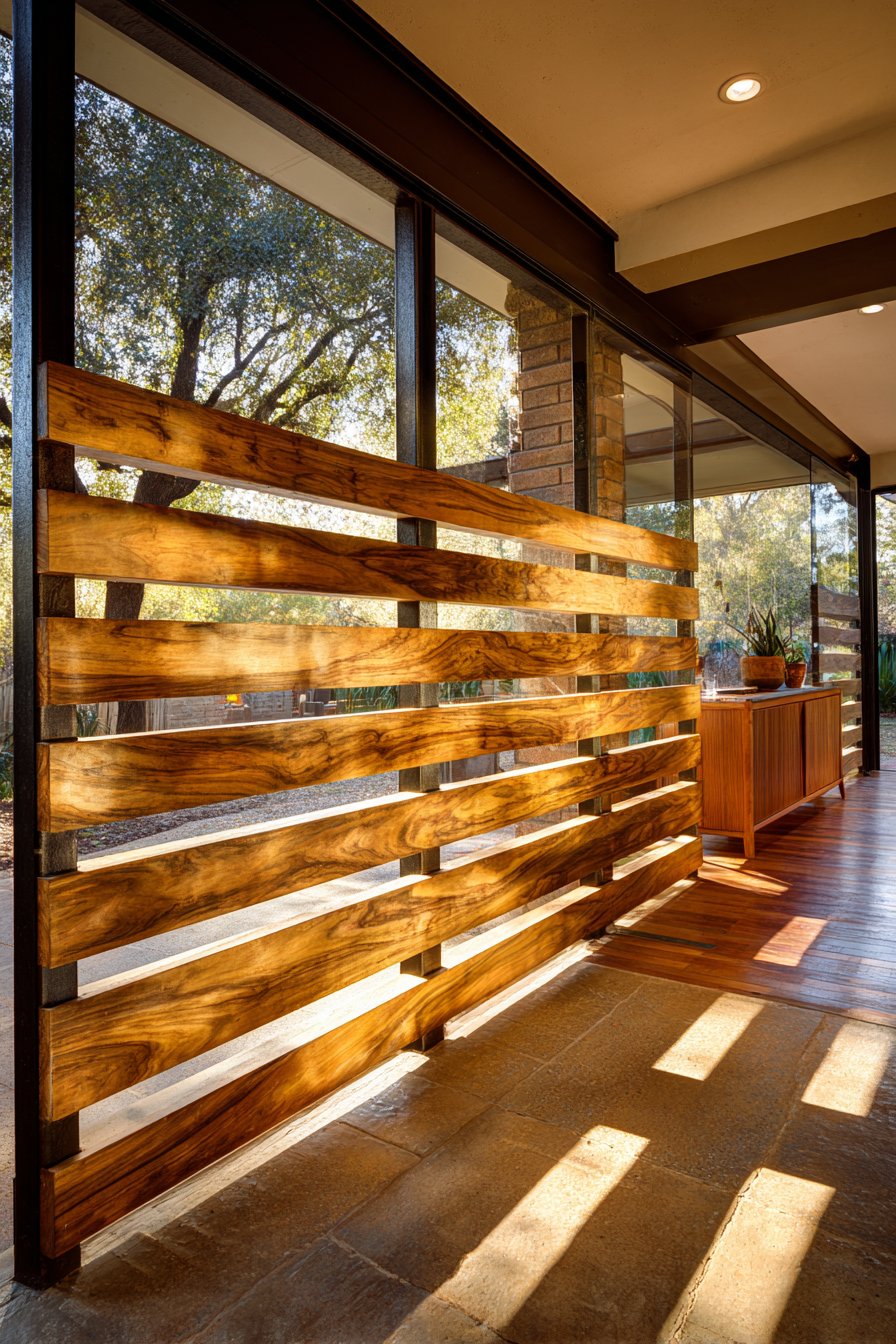
A geometric credenza visible on one side of the partition reinforces the mid-century aesthetic through its characteristic tapered legs and clean-lined case design. Professional interior photography captures the iconic mid-century aesthetic with natural lighting that emphasizes the beautiful wood grain patterns and the delicate shadow play created by light filtering through the gaps between slats. This approach to spatial division represents mid-century design philosophy at its finest—creating functional separations through honest materials and thoughtful proportions rather than relying on solid barriers or fussy ornamentation.
Key Design Tips:
- Select consistent-width slats (typically 3-4 inches) and maintain equal spacing between them for visual rhythm
- Use walnut or walnut-stained wood to achieve the authentic warm tones central to mid-century aesthetics
- Choose powder-coated steel framework in matte black for durability and period-appropriate finish
- Position horizontal slats to align with sight lines when seated to maximize privacy while maintaining openness when standing
- Ensure adequate structural support—horizontal slats can sag over long spans without proper framework
- Apply multiple coats of protective finish to the wood to prevent staining and maintain the rich color
- Consider the view from both sides and position the metal framework to minimize visual obstruction from primary sight lines
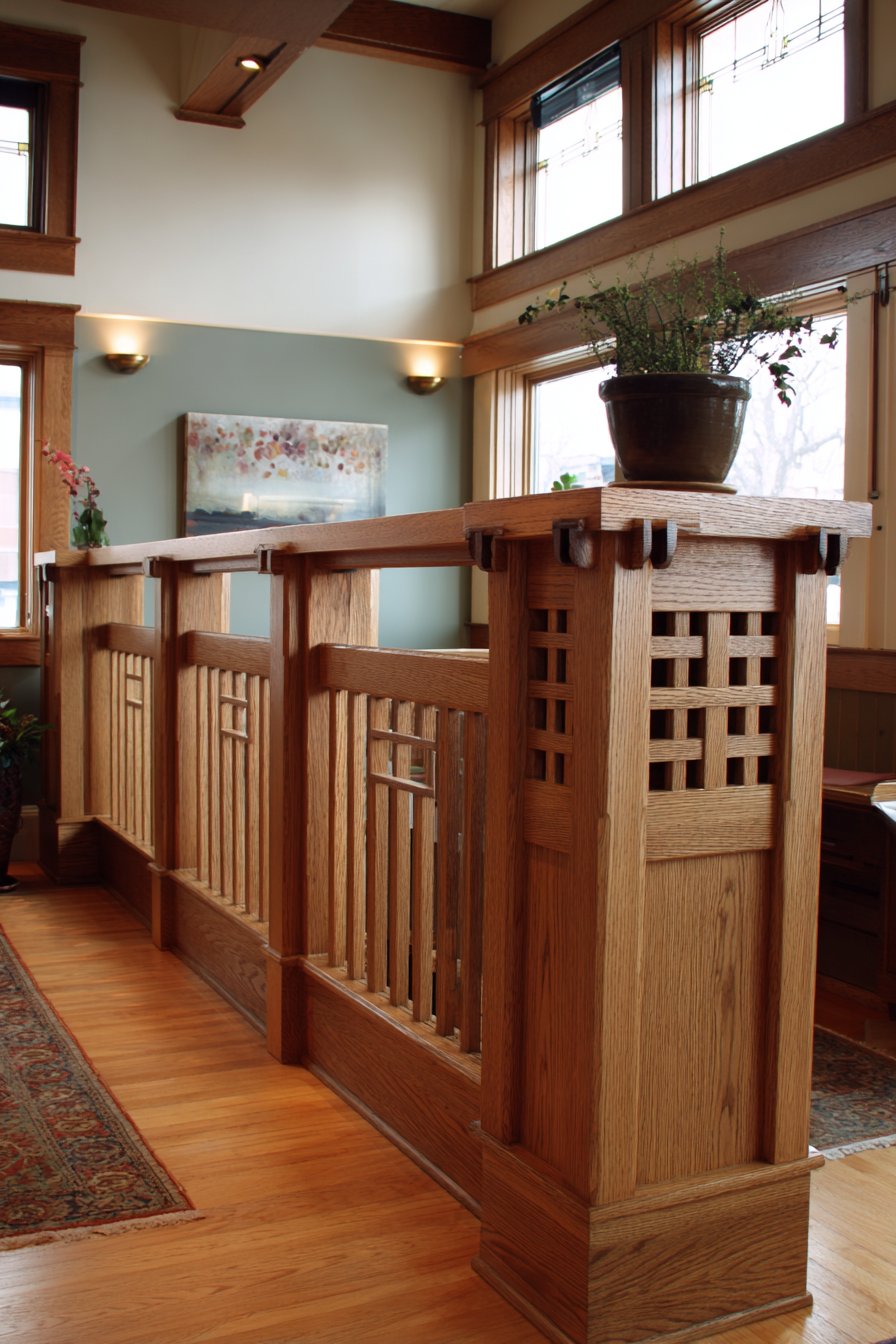
11. Craftsman Mission-Style Oak Partition
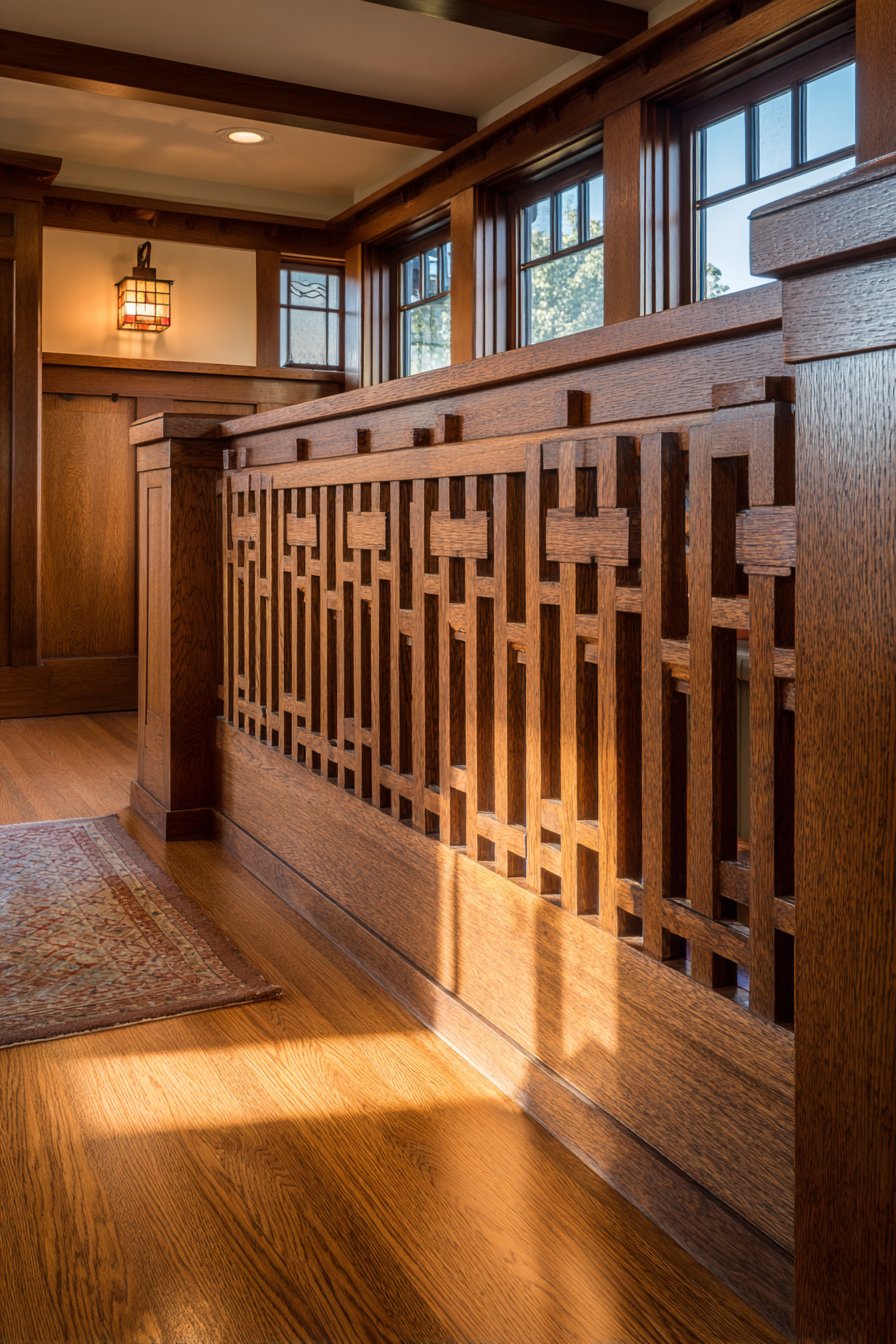
The Craftsman movement celebrated handcrafted quality and honest joinery, principles beautifully embodied in this substantial half wall dividing the entryway from the living room. Standing 42 inches tall, this impressive partition features mission-style geometric cutouts in the side panels and substantial square posts at each end, details that immediately identify it as belonging to the Arts and Crafts tradition. Quarter-sawn oak throughout displays the prominent ray fleck patterns that distinguish this premium lumber grade, the unique figure created by the sawing method creating silvery flecks that shimmer subtly as light plays across the surface.
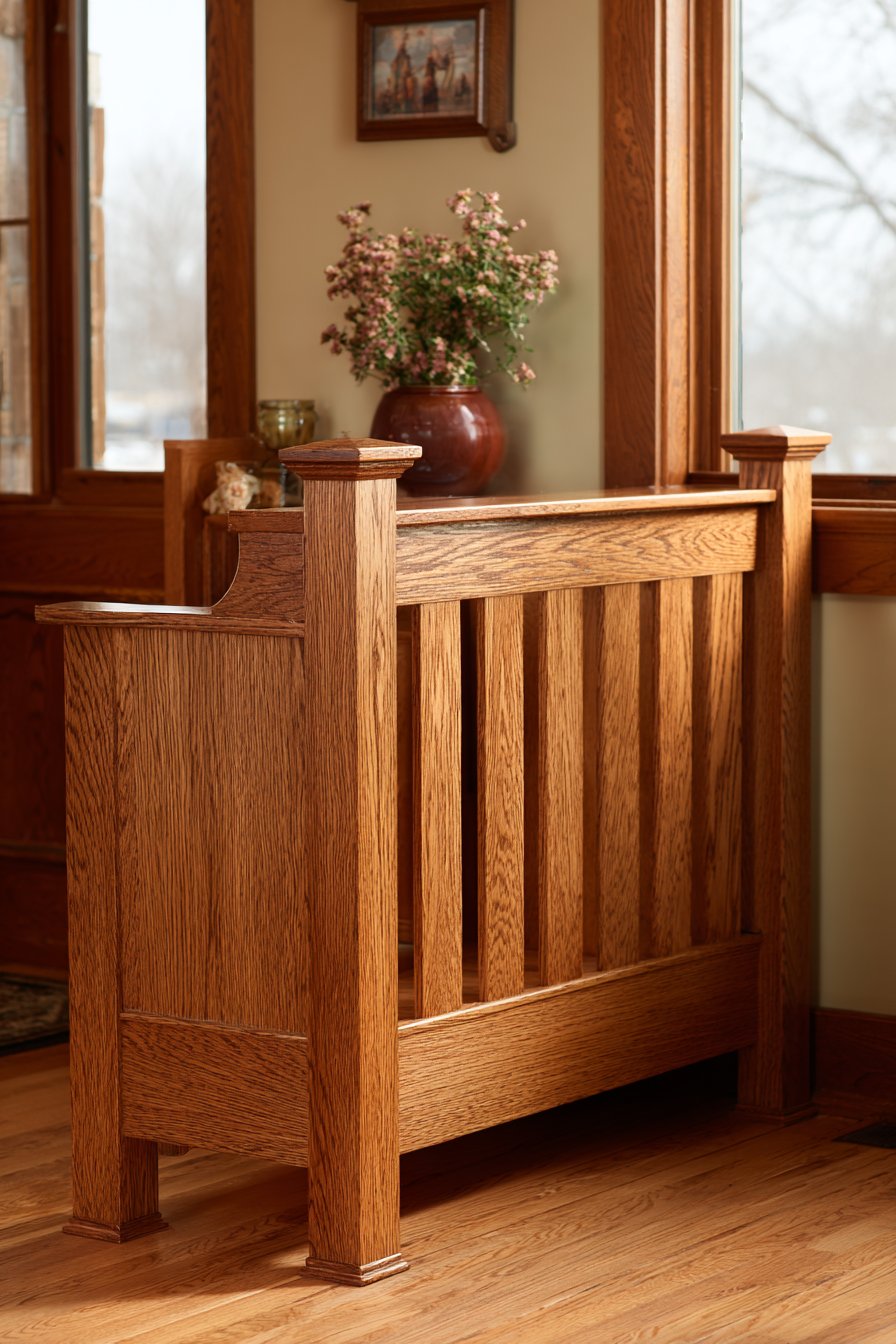
The warm honey-tone finish applied to the oak enhances the natural beauty of the wood while providing protection against daily wear. This finish choice represents careful consideration—neither too dark to obscure the distinctive grain pattern nor too light to miss the wood’s inherent warmth and character. Built-in bench seating extending from one side transforms the partition into a practical furniture piece, providing a convenient spot to sit while removing shoes or setting down packages. This integration of seating demonstrates the Craftsman principle of built-in furniture that serves multiple purposes while contributing to the overall architectural character.
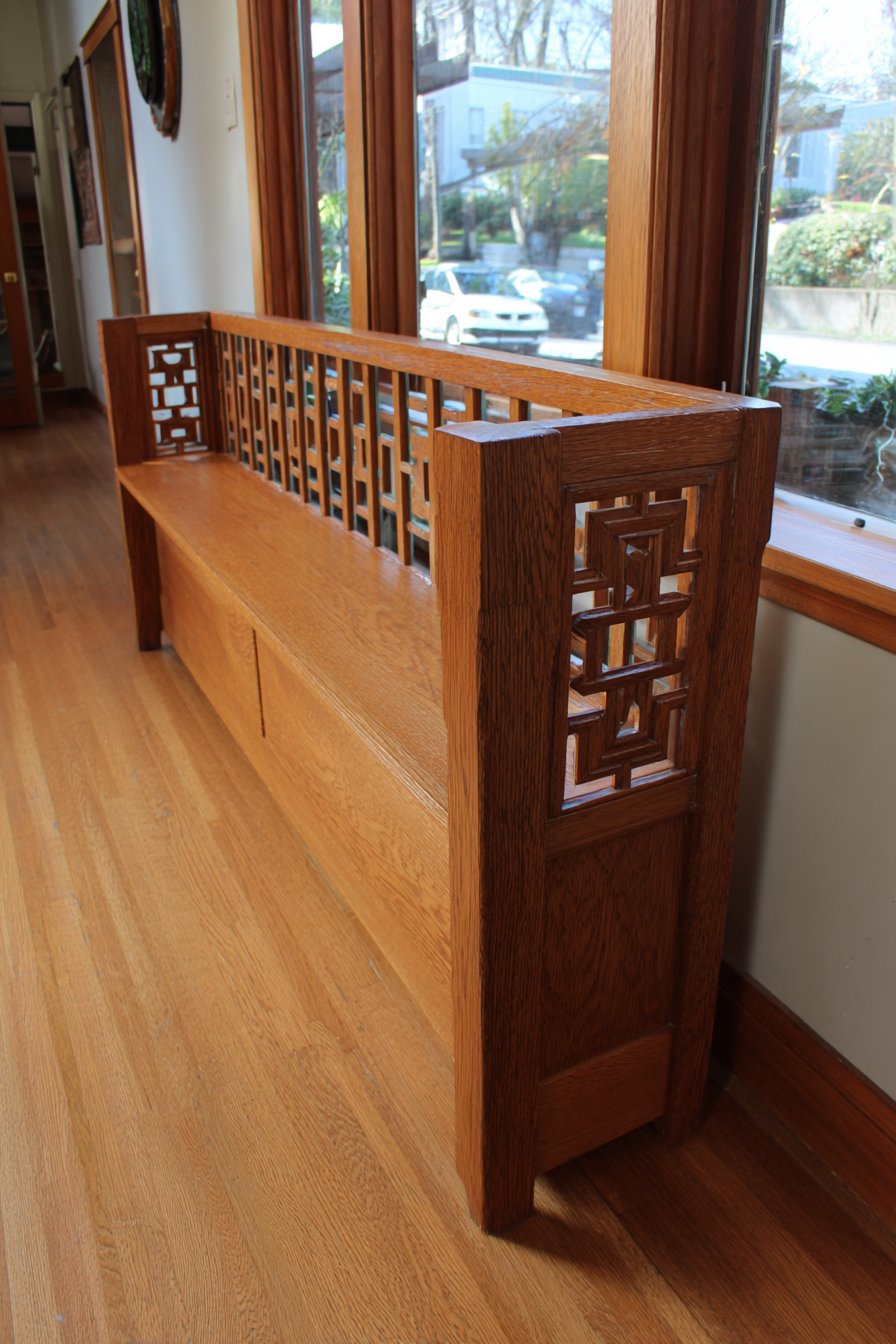
Natural light from nearby windows highlights the fine woodworking details—the precisely cut geometric panels, the perfect joinery where horizontal rails meet vertical stiles, and the hand-selected lumber that ensures consistent grain patterns throughout the piece. Interior design photography emphasizes traditional craftsmanship and architectural character, capturing how quality materials and skilled execution create furniture-grade woodworking that elevates the entire space. The substantial visual weight of this half wall grounds the design while the mission-style details add authentic period character without feeling reproduced or artificially aged.
Key Design Tips:
- Invest in quarter-sawn oak for its distinctive ray fleck figure and superior dimensional stability
- Size the geometric cutouts proportionally—typically one-third to one-half the height of the panel area
- Apply hand-rubbed oil finishes or high-quality stains that enhance rather than obscure the wood grain
- Use traditional joinery techniques like mortise-and-tenon for authentic construction and maximum strength
- Finish built-in seating with comfortable cushions in leather or heavy textiles appropriate to the Arts and Crafts aesthetic
- Install through-tenons at key joints and leave them slightly proud for authentic Craftsman detailing
- Select square or rectangular profiles for posts and rails rather than rounded edges to maintain the rectilinear aesthetic
- Consider the scale carefully—Craftsman details work best when generously proportioned rather than delicate
12. Living Wall Vertical Garden Partition
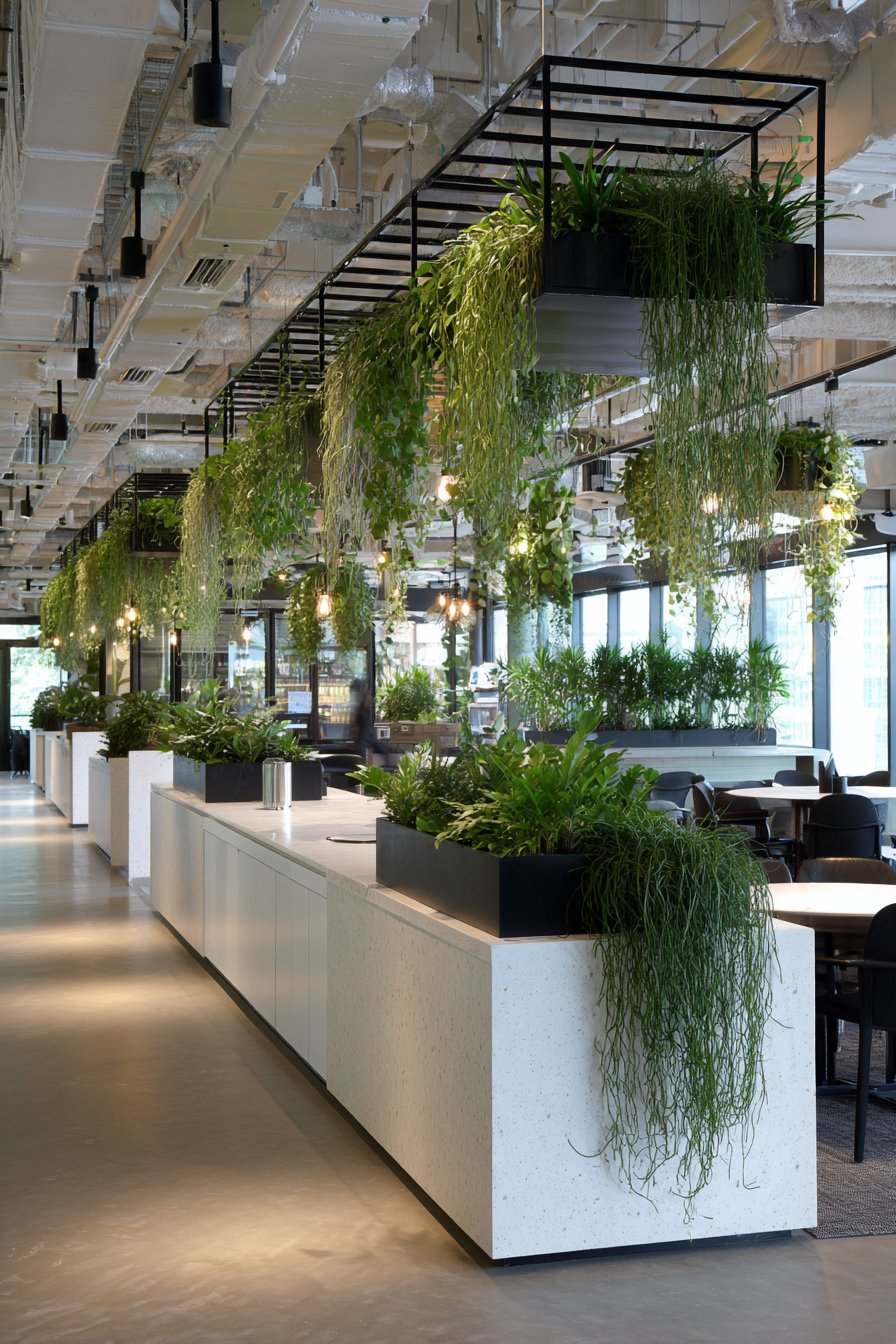
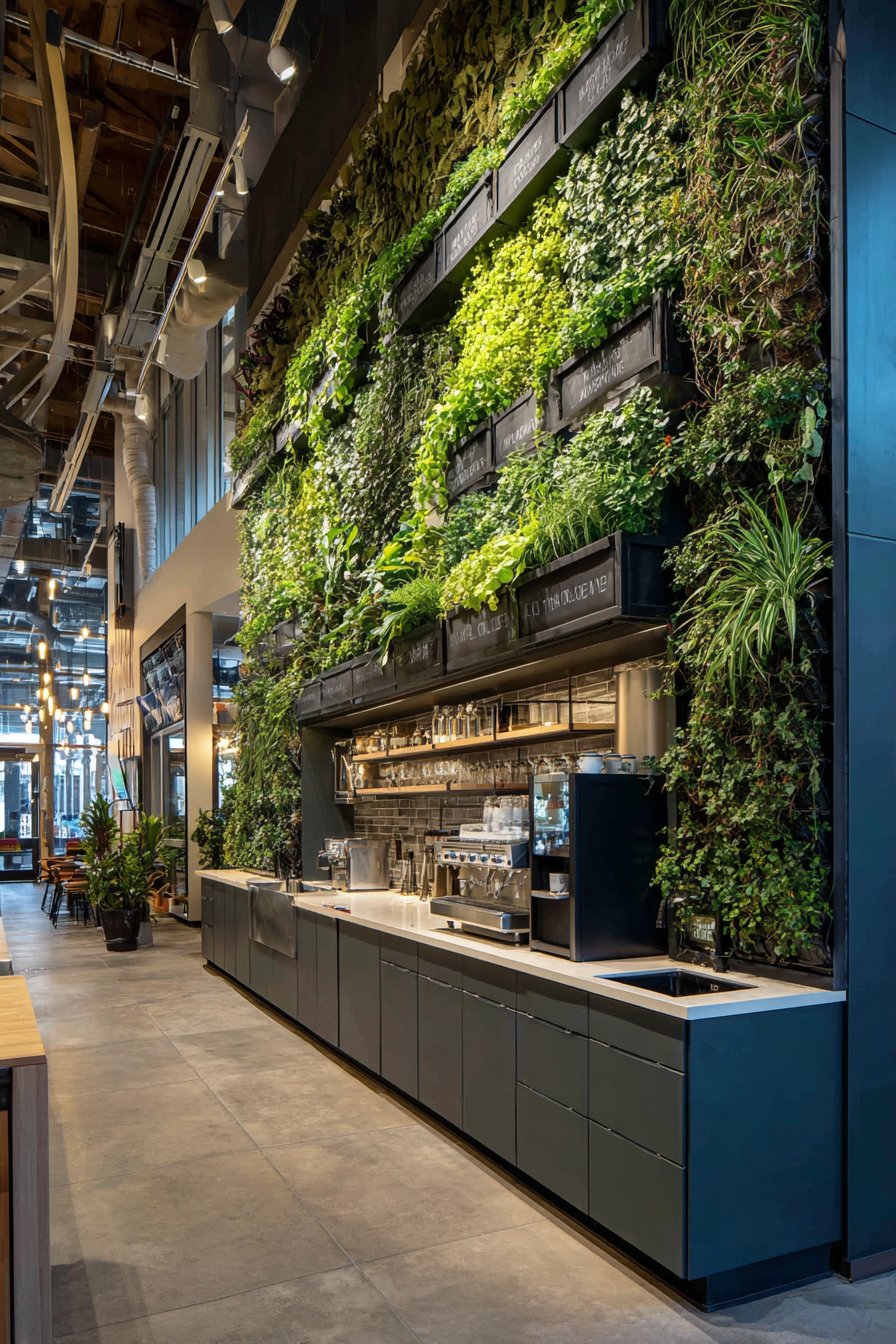
Biophilic design principles recognize humans’ innate connection to nature and seek to incorporate living elements into built environments, making this vertical garden half wall a perfect embodiment of this progressive design philosophy. The innovative partition combines crisp white painted base cabinetry providing storage and structure with upper sections holding modular plant containers in matte black finish. Various trailing and upright plants create natural, ever-changing separation between kitchen and dining areas while simultaneously improving indoor air quality and bringing the vitality of living greenery into daily spaces.
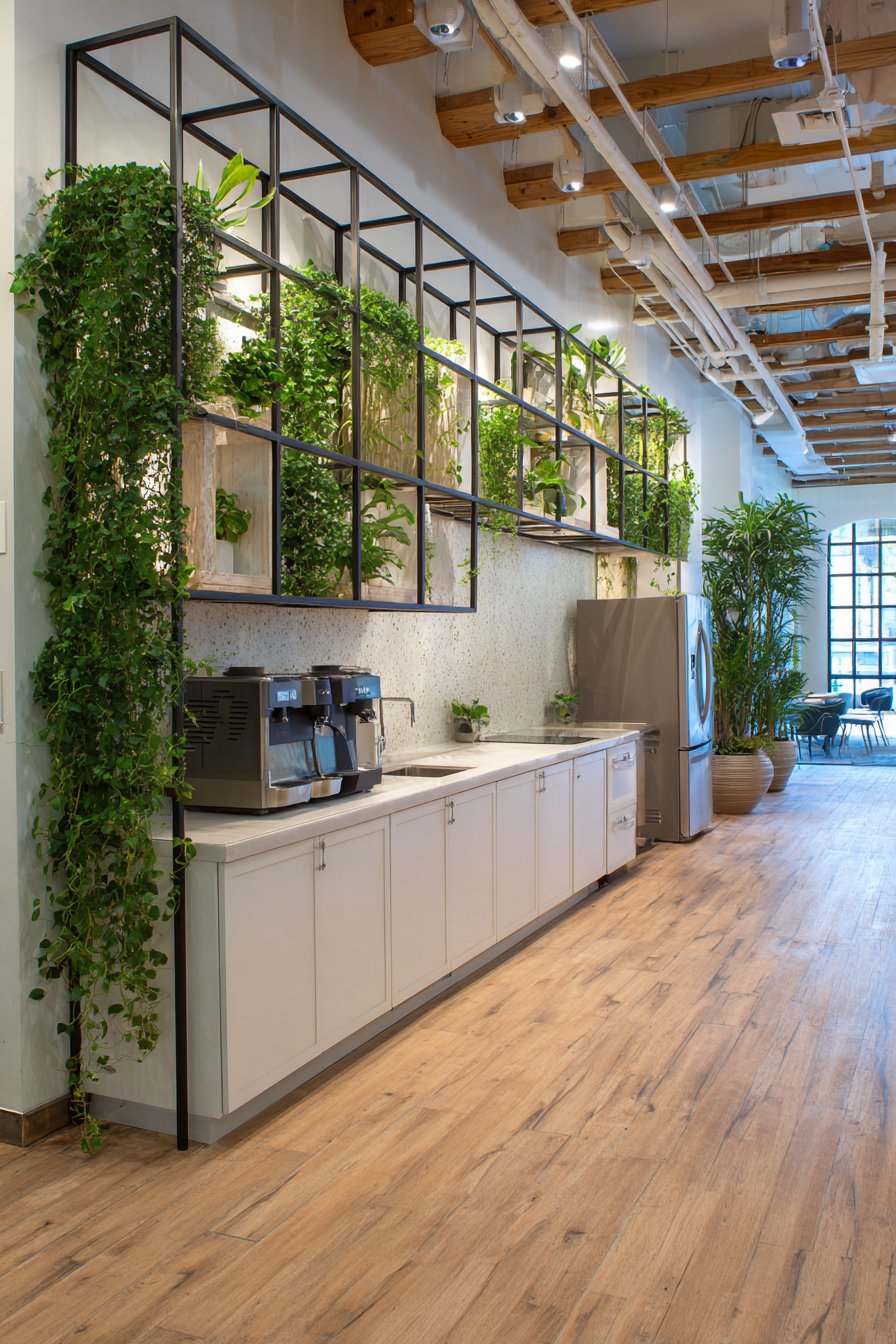
The selection of plant varieties—from cascading pothos and ivy to upright ferns and compact succulents—creates varied textures and multiple shades of green that prevent monotony while maintaining cohesive natural aesthetics. Integrated drip irrigation keeps maintenance requirements manageable, a crucial consideration for busy homeowners who love the idea of living walls but worry about the time commitment required. This automated watering system transforms what could be a high-maintenance feature into a relatively low-effort design element that delivers continuous benefits.
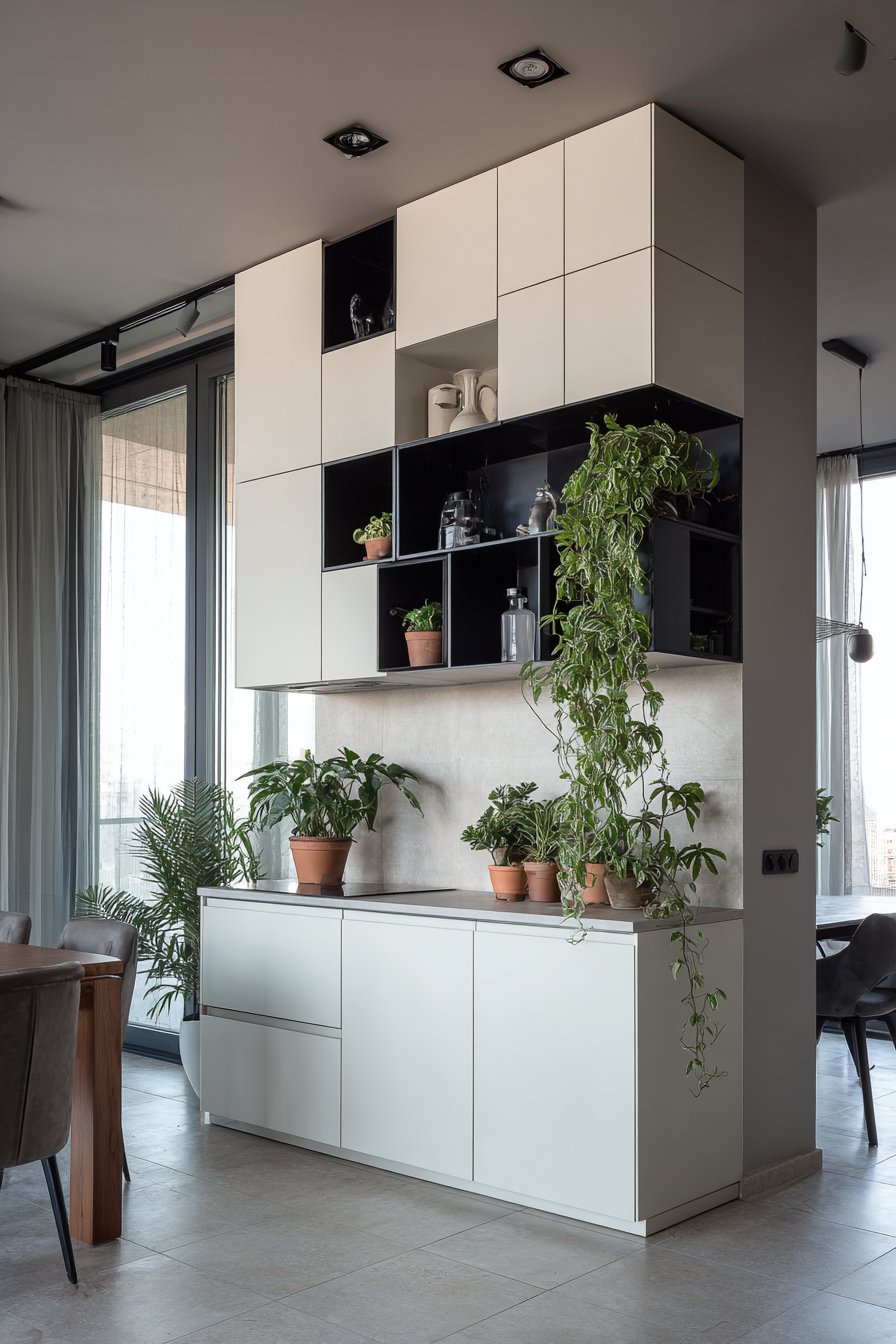
Wide-angle interior photography with abundant natural lighting showcases the biophilic design and fresh, organic aesthetic that only living plants can provide. The contrast between the structured, geometric black containers and the organic, unpredictable growth patterns of the plants creates dynamic tension that keeps the design visually interesting. Sunlight filtering through the leaves creates dappled shadow patterns on nearby surfaces, adding another layer of natural beauty to the space. This approach demonstrates how contemporary design can incorporate nature not as decoration but as an integral, functional component of the living environment.
Key Design Tips:
- Choose plant varieties with similar light and water requirements to simplify maintenance
- Install proper drainage systems and waterproof backing to protect surrounding surfaces
- Select a mix of trailing, upright, and bushy plants for varied texture and visual interest
- Position the living wall near natural light sources or supplement with full-spectrum grow lights
- Use self-watering containers or install drip irrigation on timers for consistent moisture without daily attention
- Allow adequate air circulation around plants to prevent mold and promote healthy growth
- Plan for plant replacement—even with good care, some plants will eventually need refreshing
- Consider the mature size of plants and choose varieties that won’t outgrow their spaces too quickly
13. Eclectic Mixed-Material Artistic Partition
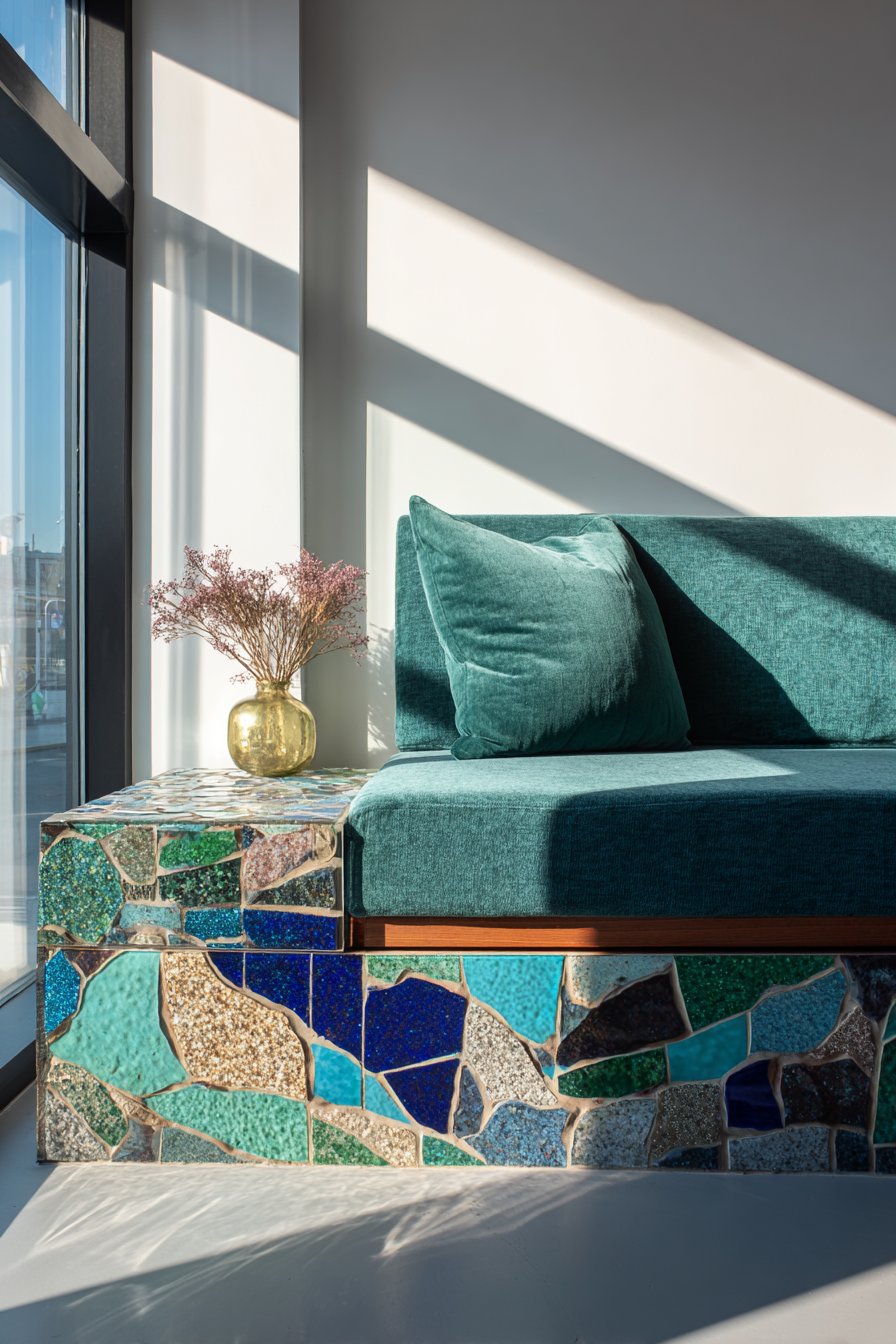
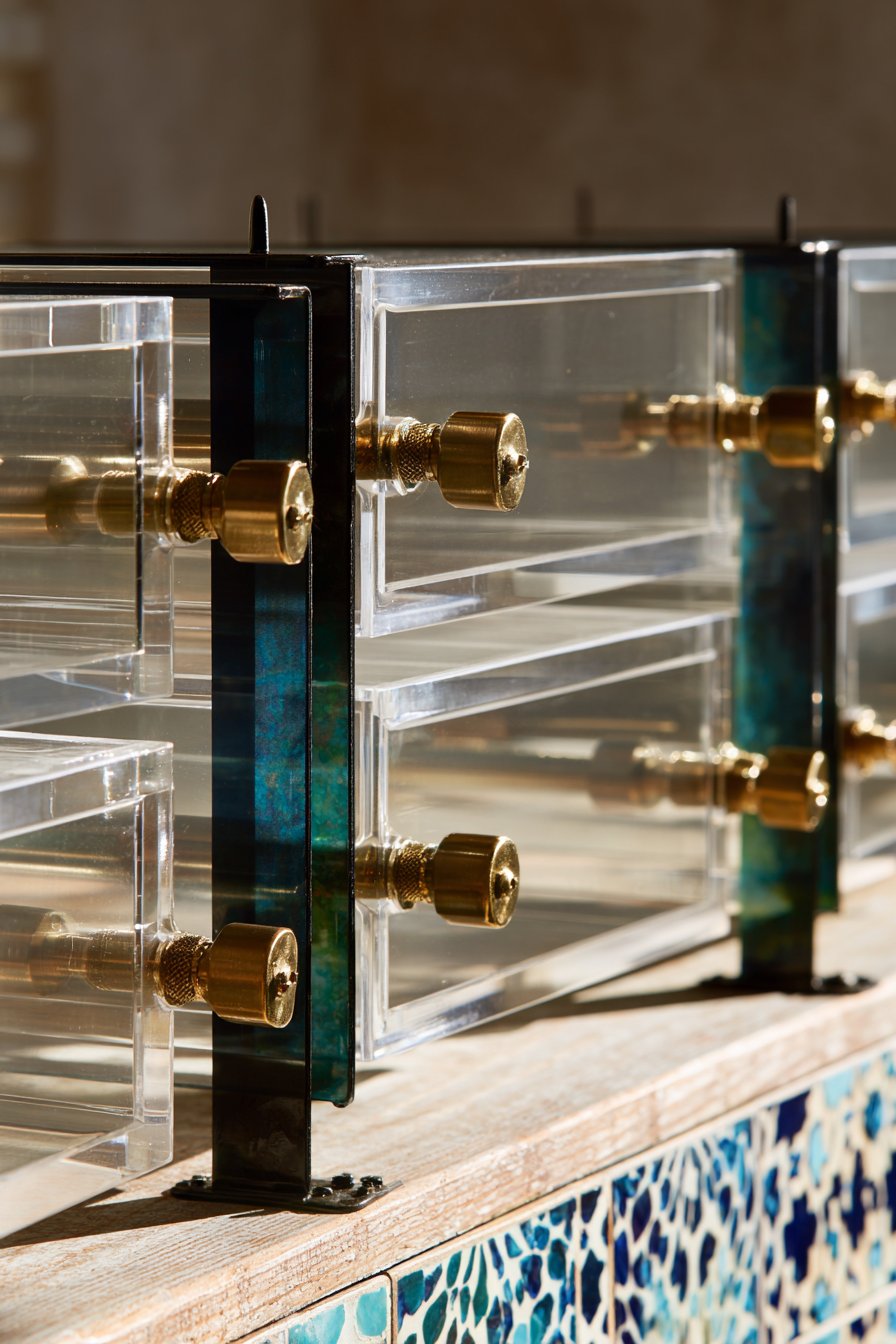
Creative spirits and design adventurers will appreciate this boldly eclectic half wall that celebrates artistic expression through unexpected material combinations. The lower half features colorful mosaic tile in blues and greens with irregular patterns that suggest ocean depths or abstract expressionist paintings, each tile placement contributing to an overall composition that rewards close examination. The upper section contrasts dramatically with clear acrylic panels set in minimal black frames, creating transparency that allows light to flood through while the mosaic base provides visual weight and color saturation.
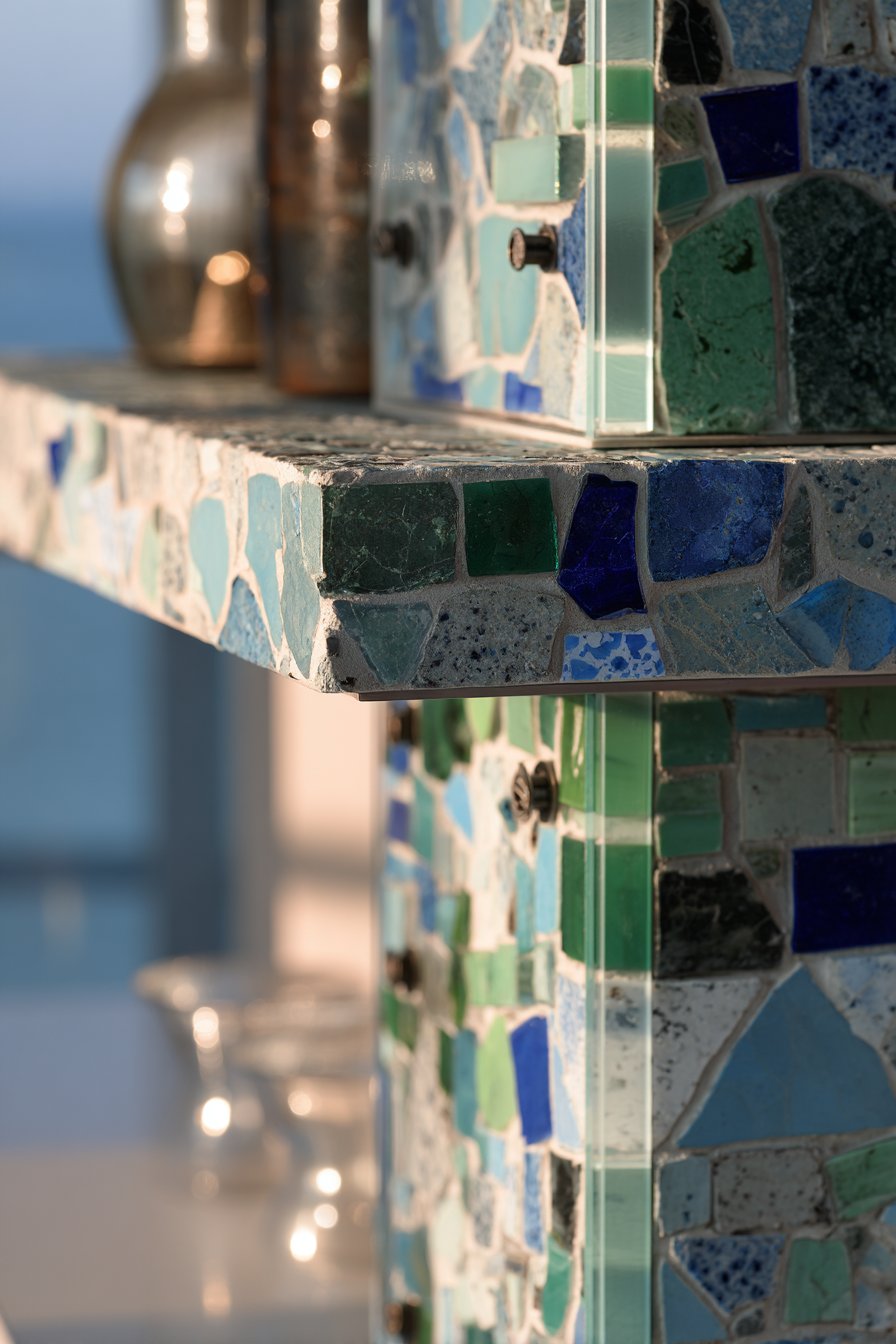
Vintage brass hardware accents punctuate the design, introducing warm metallic tones that bridge the cool blue-green mosaic and the neutral acrylic panels. These carefully chosen vintage pieces—perhaps salvaged doorknobs, drawer pulls, or decorative brackets—add layers of history and personality while demonstrating how found objects can be incorporated into custom design applications. The playful combination creates privacy through the mosaic lower section while maintaining openness and light flow through the transparent upper panels, a practical solution that serves functional needs while making a bold artistic statement.
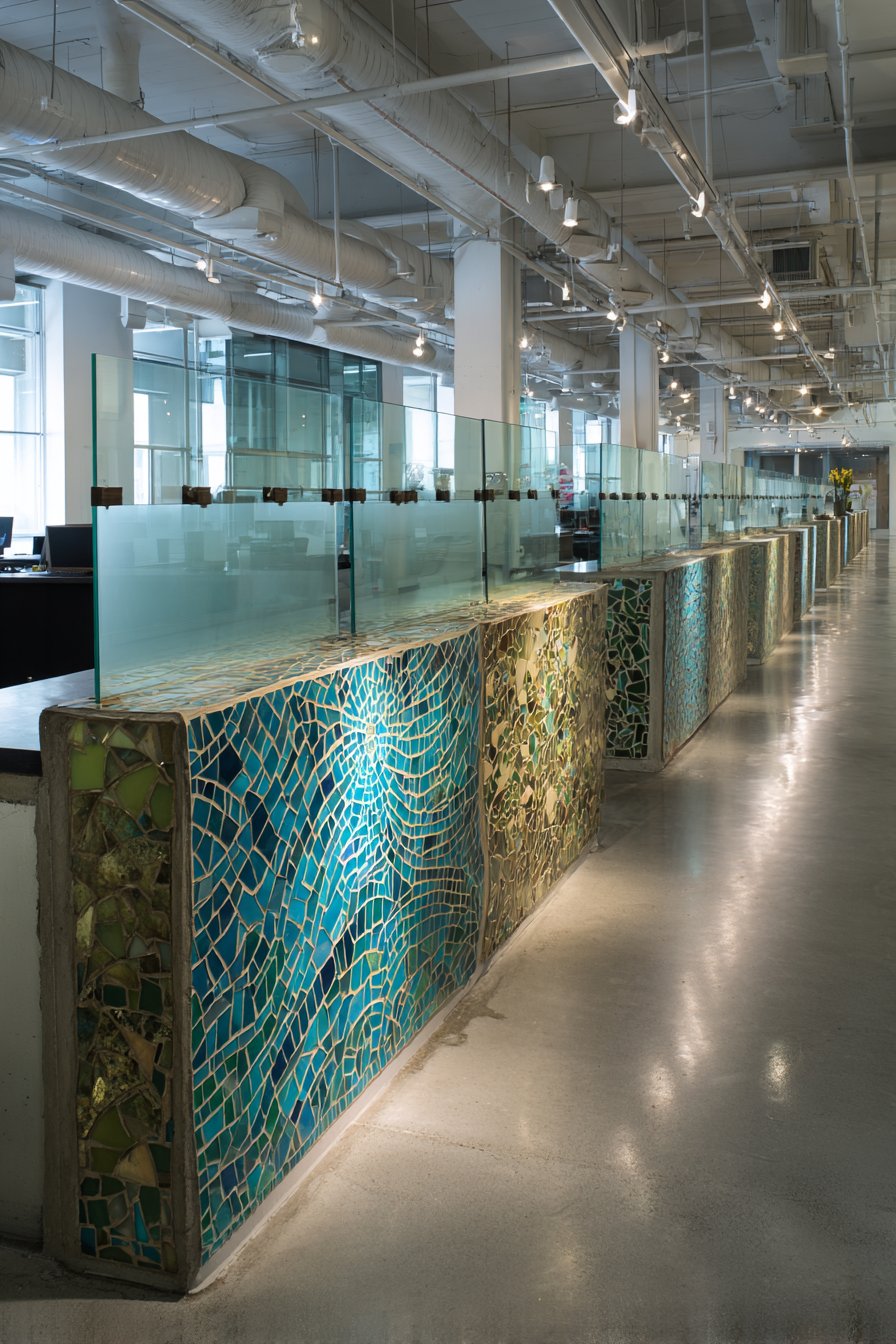
Interior photography with vibrant natural lighting emphasizes the artistic material mix and creative personality that defines this unique partition. Sunlight streaming through the clear acrylic panels casts interesting shadows and highlights the texture of the mosaic surface, while also illuminating the colors within the tiles so they seem to glow from within. This half wall demonstrates that design rules are meant to be creatively interpreted rather than rigidly followed, and that personal expression should take precedence over playing it safe when the goal is creating spaces that truly reflect individual character and artistic sensibility.
Key Design Tips:
- Plan the mosaic pattern carefully before installation, laying out tiles dry to ensure balanced color distribution
- Use high-quality tile adhesive specifically formulated for vertical applications to prevent tiles from sliding
- Seal mosaic surfaces with penetrating sealer to protect grout and facilitate cleaning
- Select acrylic panels at least 1/4 inch thick for adequate rigidity and clarity without distortion
- Mix eras and styles deliberately in hardware selections rather than attempting to match everything perfectly
- Consider the weight of mosaic tile and ensure adequate structural support in the base construction
- Allow the creative mix to emerge organically rather than forcing incompatible elements together
- Balance bold artistic elements with simpler surrounding finishes to prevent visual chaos
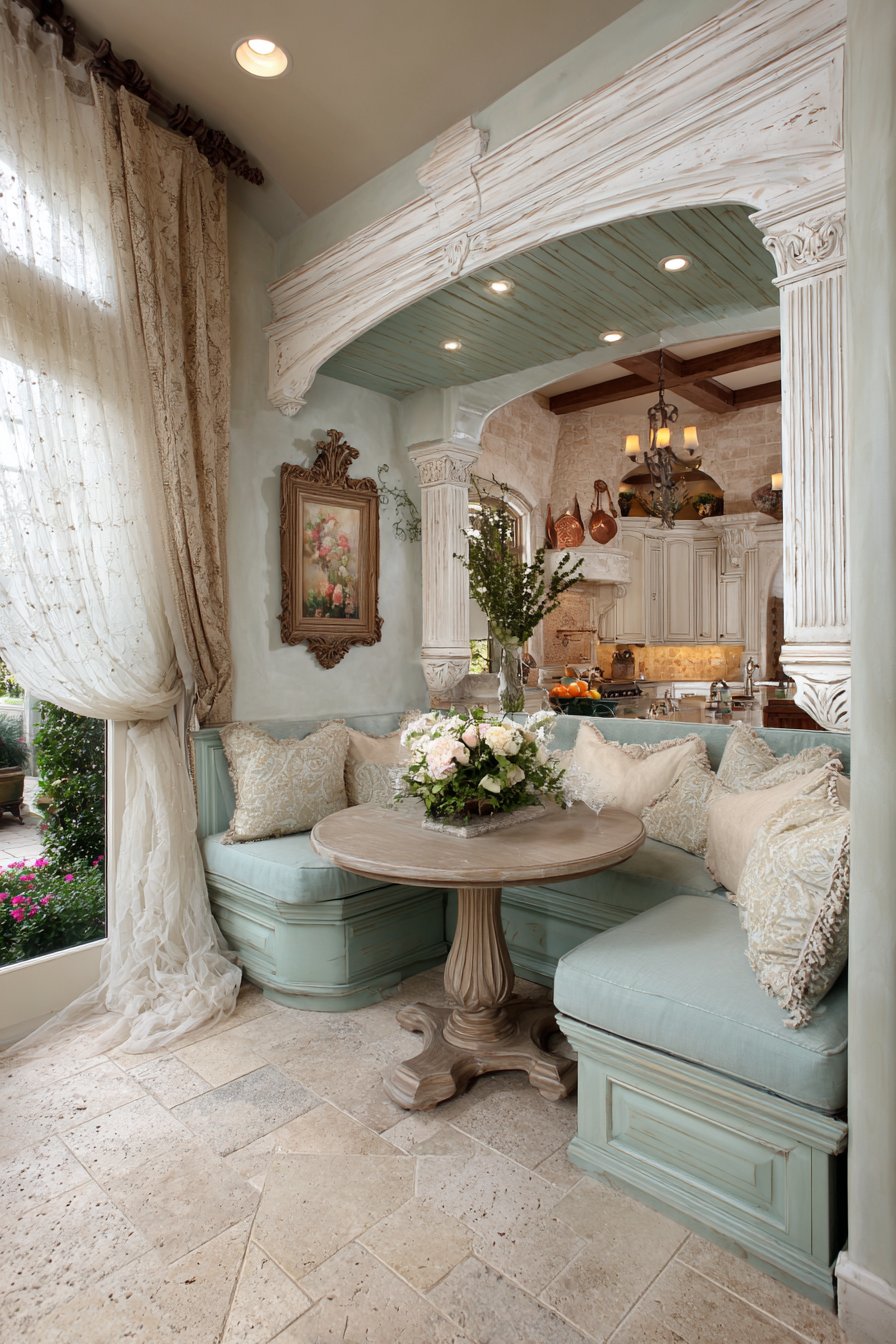
14. French Country Sage Green Beadboard Divider
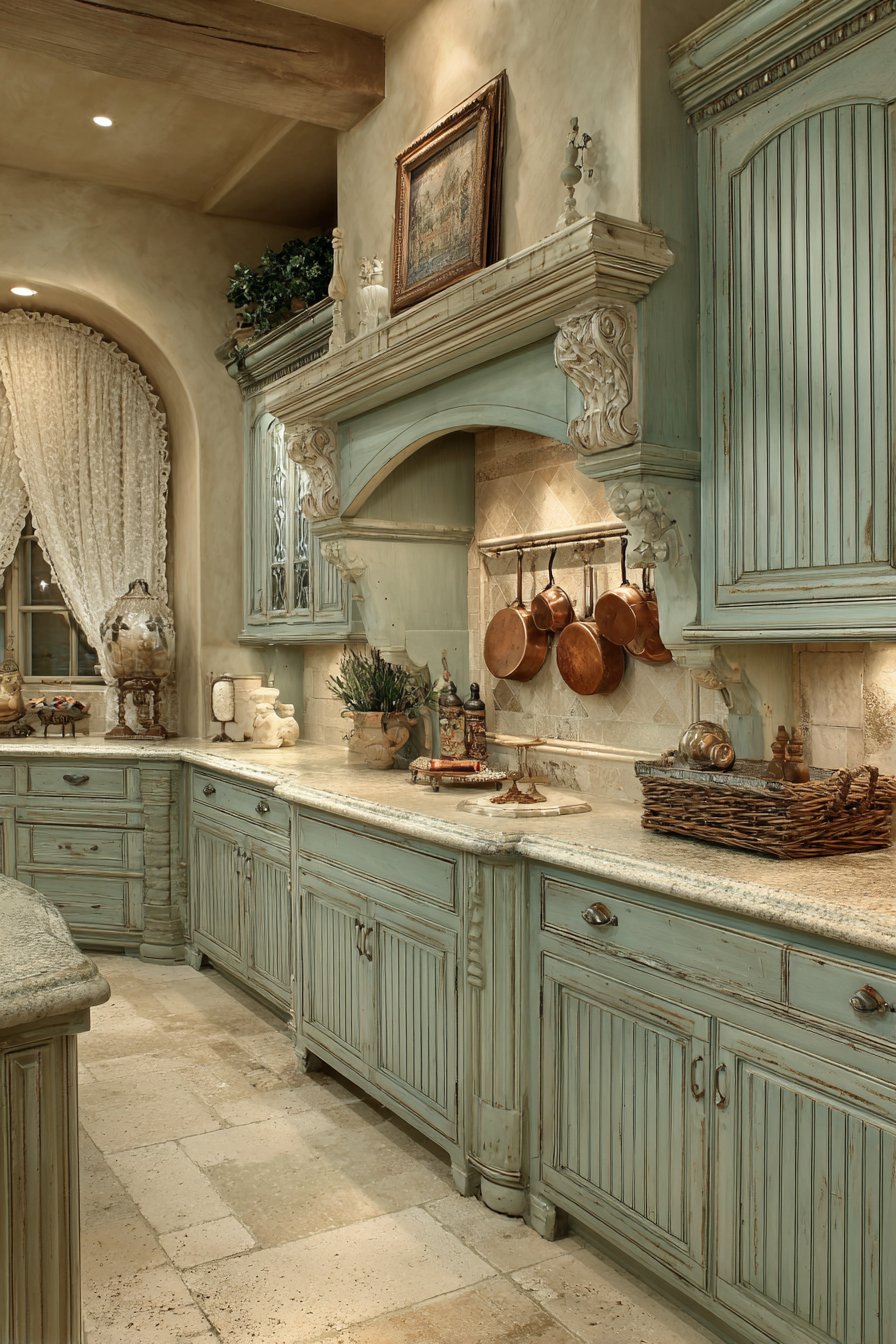
The gentle romance of French country design comes alive in this charming half wall featuring painted beadboard paneling in soft sage green, creating an elegant separation between the kitchen and an intimate breakfast nook. The 36-inch height provides subtle definition without blocking sight lines or making either space feel enclosed. Decorative carved corbels supporting a distressed white-painted cap rail add vertical interest while introducing the layered, collected aesthetic that characterizes provincial French design. These corbels serve both structural and decorative purposes, their classical profiles adding architectural sophistication while supporting the substantial cap rail.
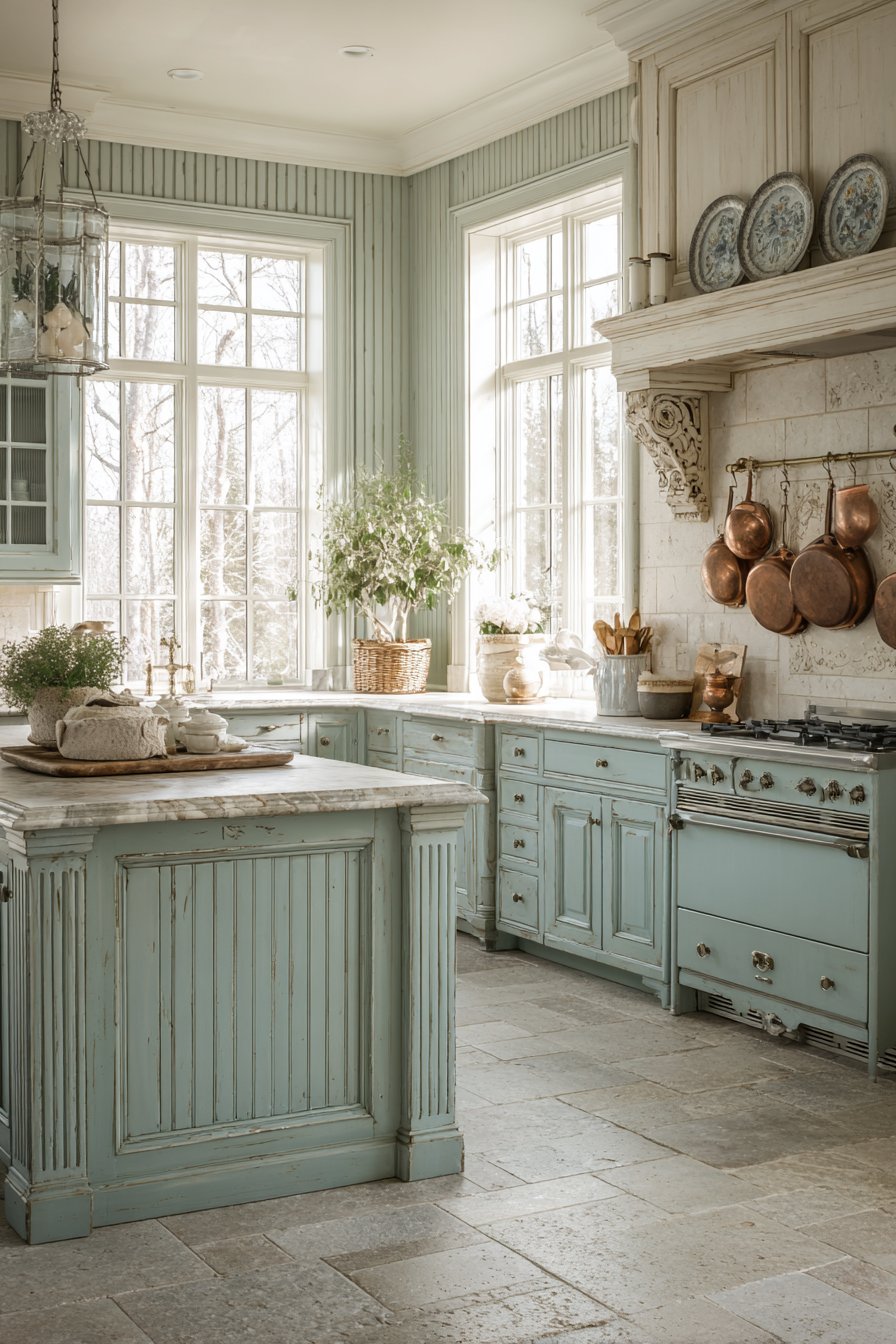
Vintage copper cookware hanging from mounted hooks on the kitchen side introduces warm metallic accents that beautifully complement the cool sage green tones. This practical storage solution keeps frequently used pots and pans within easy reach while displaying them as decorative elements—a characteristically French approach that sees no division between functional objects and beautiful design. The aged patina on the copper pieces adds authentic character and suggests years of use in the preparation of lovingly prepared meals shared with family and friends.
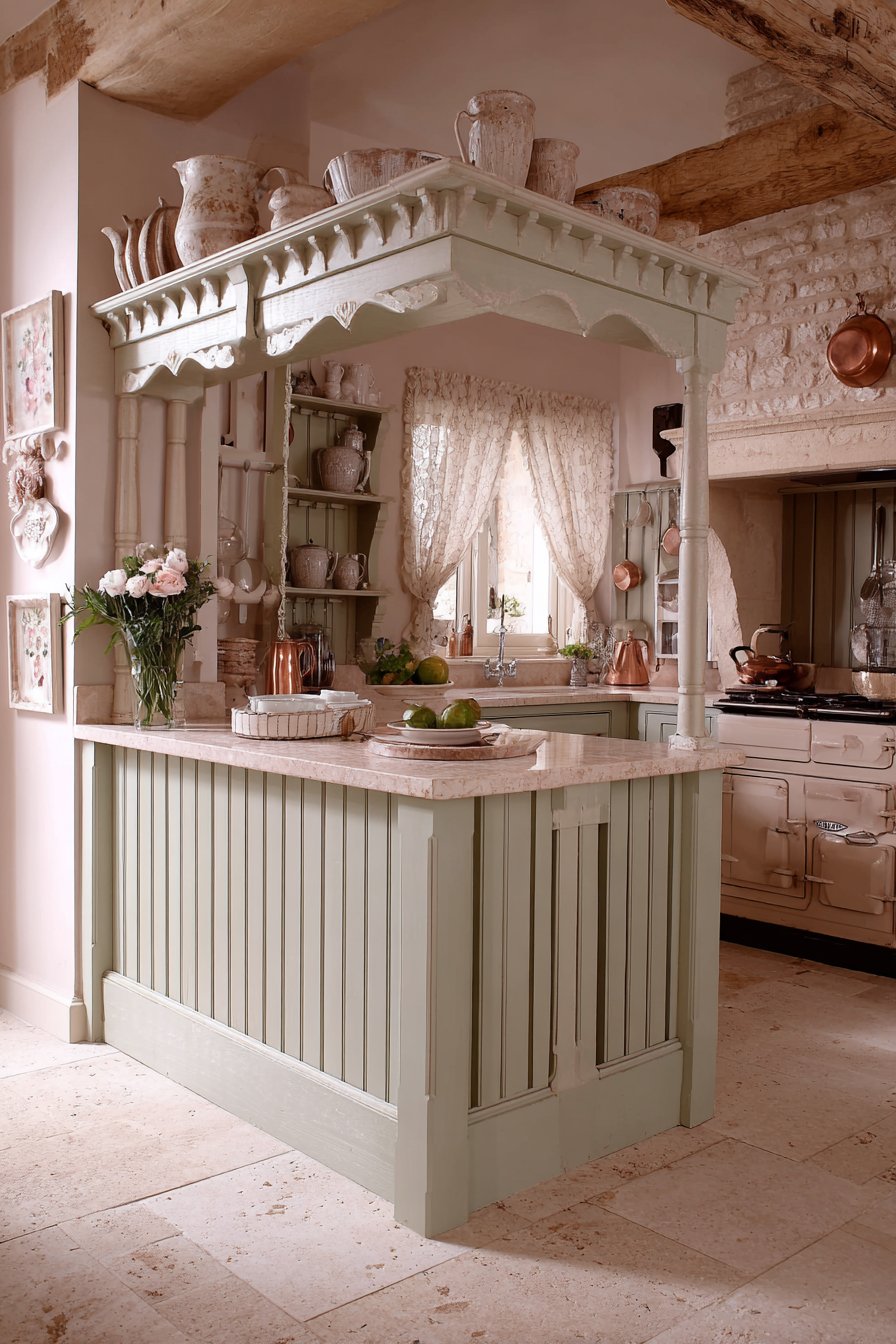
Limestone tile flooring adds to the provincial aesthetic with its naturally varied surface showing the geological history contained within sedimentary stone. Soft morning light filtering through lace curtains creates a romantic ambiance that interior photography captures beautifully, highlighting the subtle color variations in the painted sage green finish and the gentle patina on the distressed white cap rail. This approach to half wall design demonstrates how traditional French country elements can create spaces that feel both elegantly refined and warmly welcoming, sophisticated yet thoroughly livable.
Key Design Tips:
- Choose a sage green with gray undertones rather than yellow undertones for a more sophisticated, authentic French country palette
- Distress the white cap rail subtly and unevenly, focusing on edges and high points where natural wear would occur
- Install beadboard with proper spacing to account for wood movement in humid kitchen environments
- Select carved corbels with classical profiles like acanthus leaves or scroll work for authentic provincial character
- Apply a protective sealer to copper cookware to maintain patina or allow it to develop naturally for evolving character
- Use limestone or limestone-look porcelain tile with natural variation rather than uniform surfaces
- Layer window treatments with both lace and heavier fabric for authentic French country light control
- Apply a clear protective topcoat over the painted finish in kitchen areas to facilitate cleaning
15. Modern Farmhouse Shiplap and Iron Partition
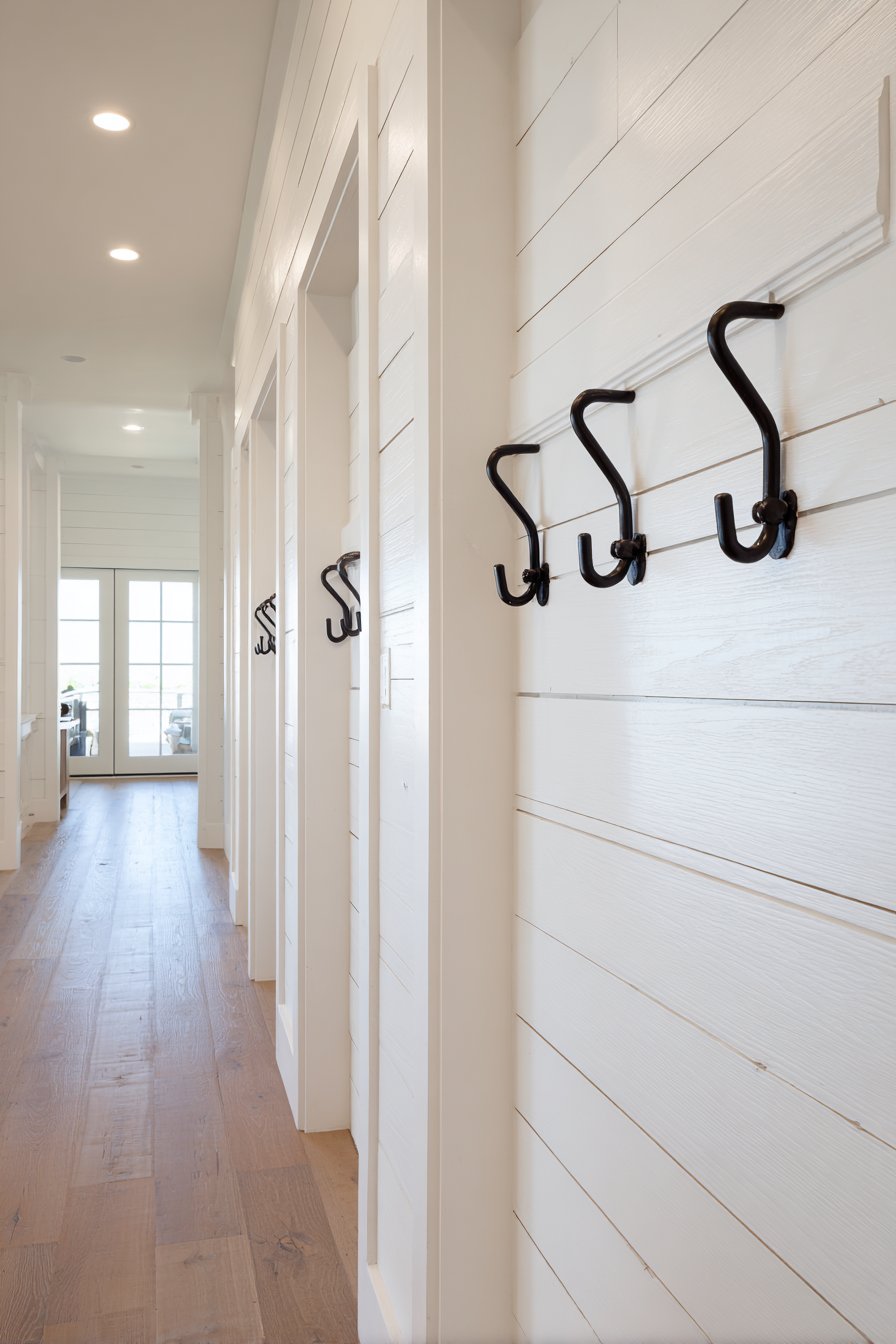
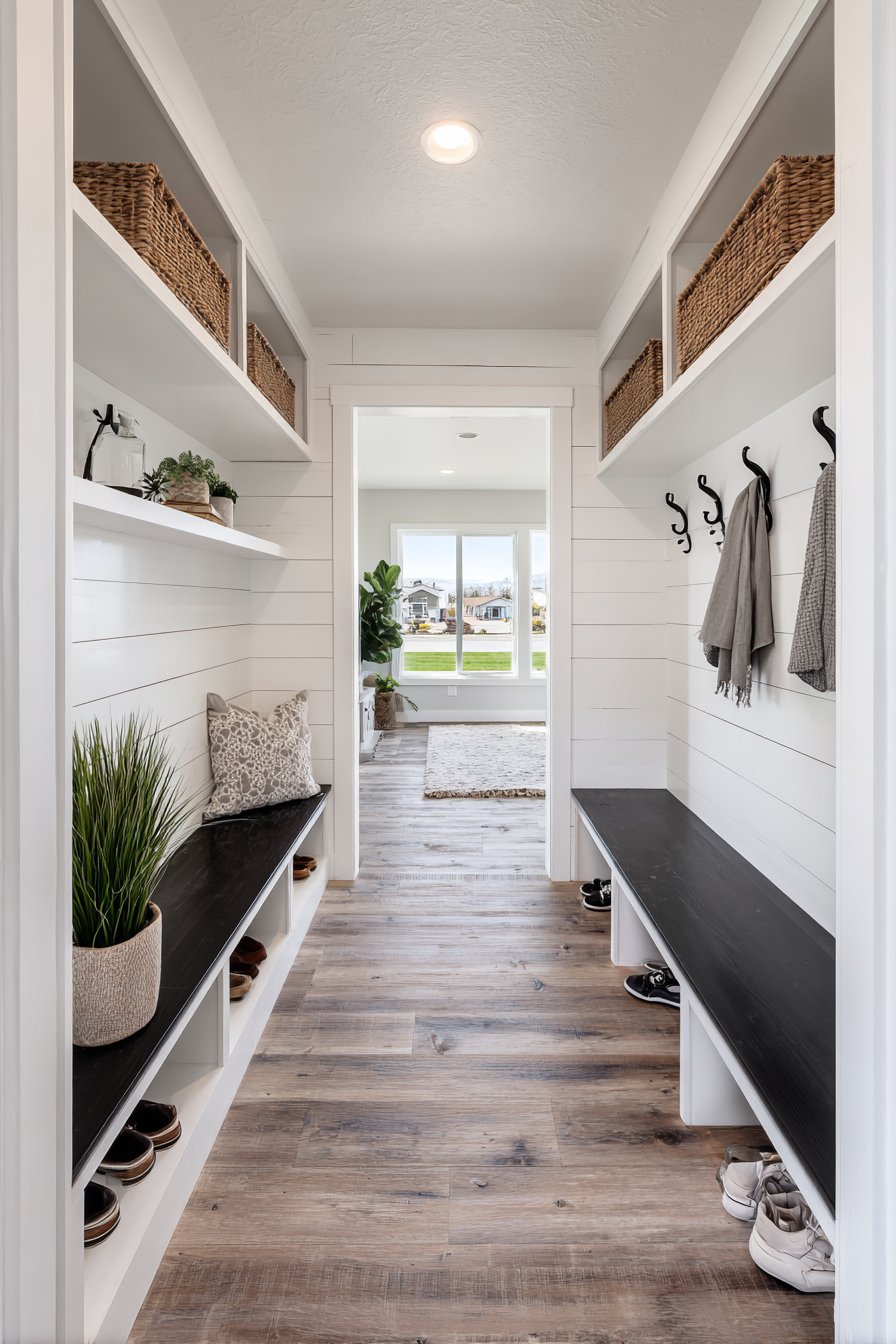
The enduringly popular modern farmhouse aesthetic finds perfect expression in this half wall featuring classic shiplap construction painted in crisp white with contrasting black metal accents. Dividing the mudroom from the main living area, this partition addresses practical needs while delivering the clean, fresh aesthetic that makes farmhouse style so universally appealing. The horizontal shiplap boards create pleasing shadow lines at each overlap, adding texture and dimension to what could otherwise be plain white surfaces. Each board’s subtle reveal where it meets the next creates a rhythm that draws the eye horizontally across the wall.
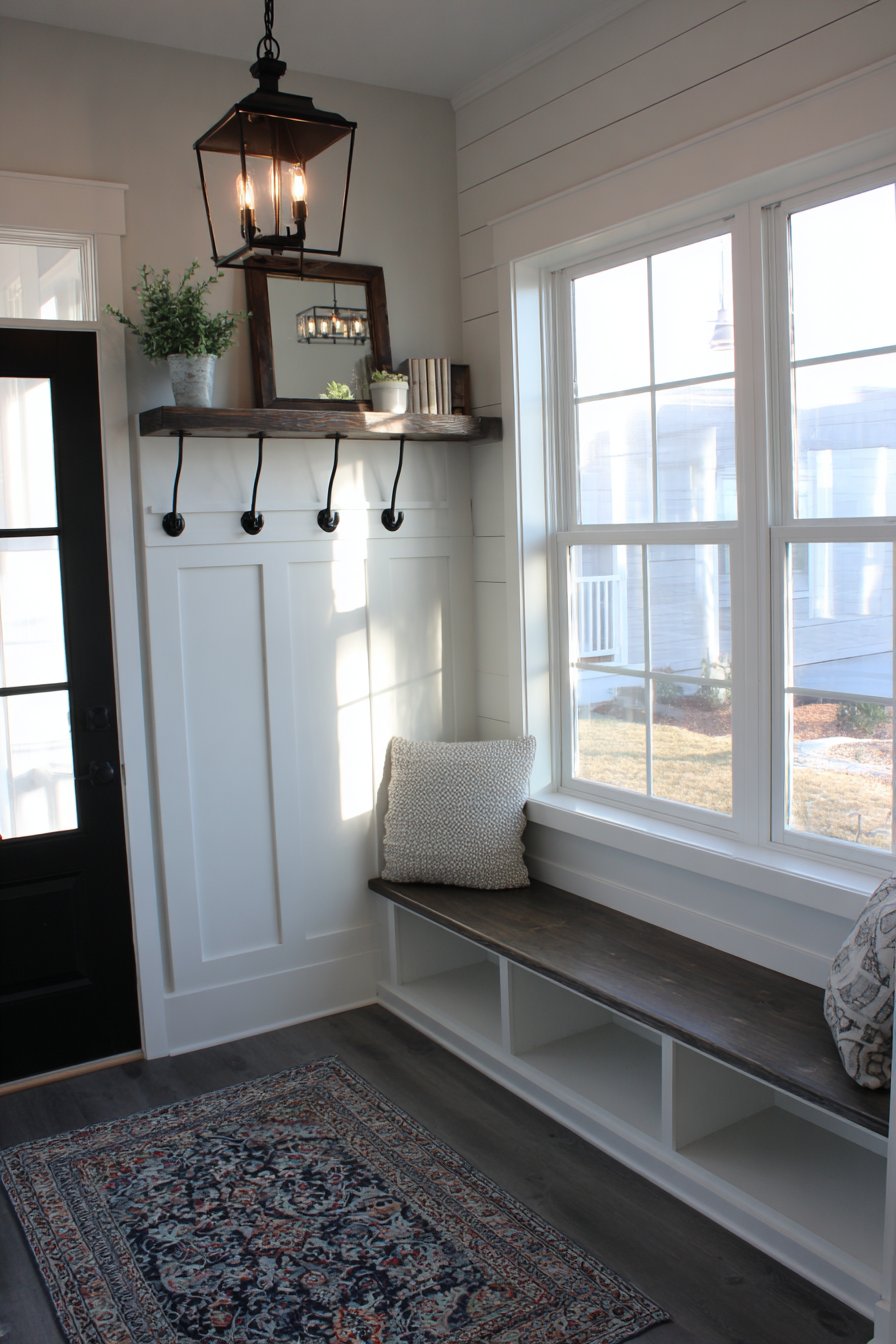
Coat hooks mounted on the entry side provide practical storage for outerwear and bags, transforming the partition into functional furniture that serves mudroom storage needs. On the living room side, a narrow display ledge offers space for rotating seasonal décor or family photographs without requiring wall-mounted shelving. Black iron support brackets add industrial contrast while reinforcing the structure and introducing the mixed-metal elements that characterize evolved farmhouse design. These brackets serve dual purposes—providing actual structural support while also creating strong visual accents that prevent the white surfaces from appearing too sweet or cottage-like.
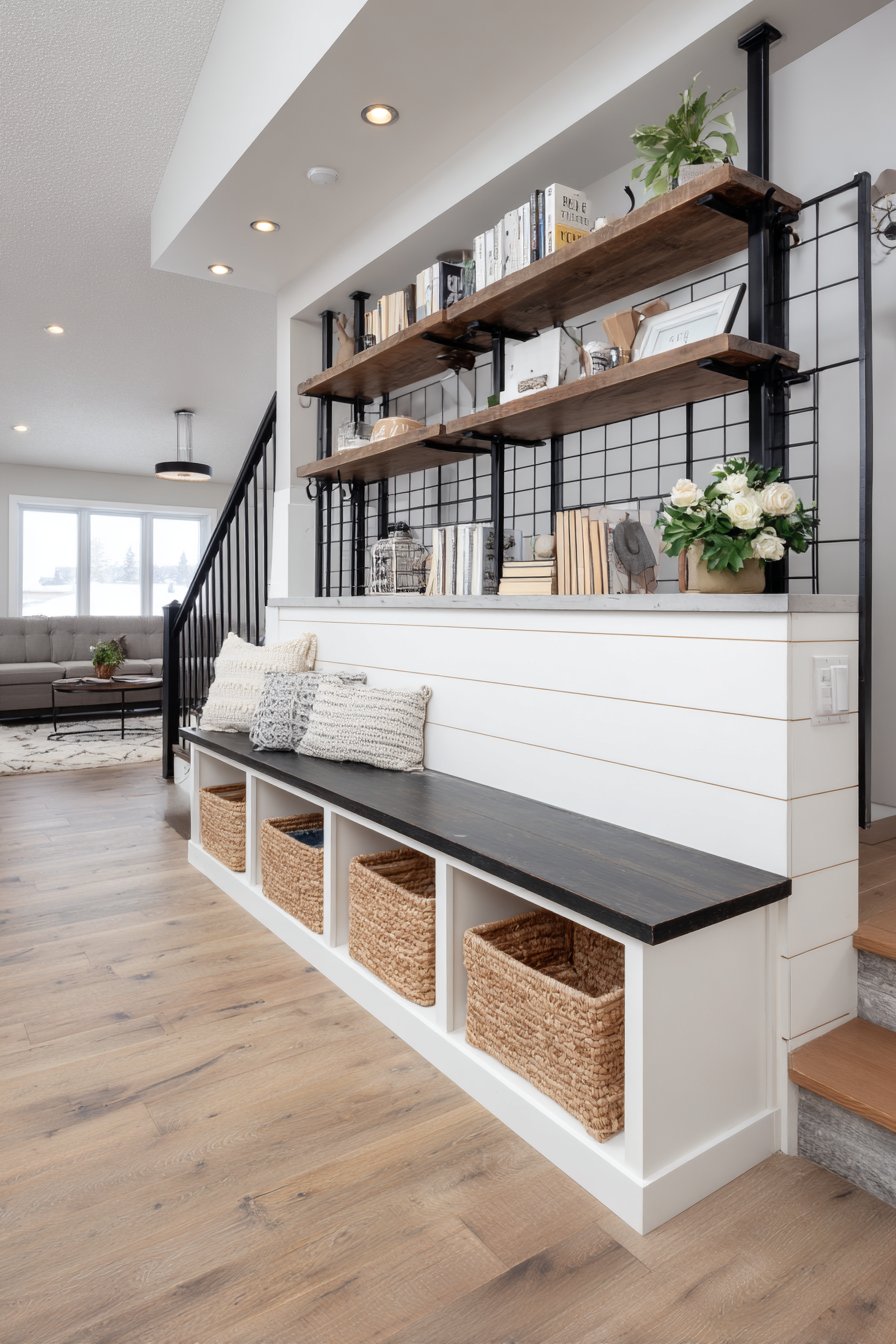
Wide-angle interior photography with balanced natural lighting showcases the crisp white finish and functional details that make this partition both beautiful and hardworking. The interplay between the smooth white painted surfaces and the matte black metal creates high contrast that defines spaces crisply while the horizontal lines guide movement and create visual continuity. This design demonstrates how farmhouse aesthetics have evolved beyond purely rustic applications to incorporate industrial elements and cleaner lines while maintaining the welcoming, lived-in quality that makes this style so enduringly popular.
Key Design Tips:
- Install shiplap boards with consistent reveals (typically 1/8 inch) for uniform shadow lines
- Use nickel gap spacers during installation to ensure perfectly consistent spacing between boards
- Select heavy-duty iron or steel brackets rated to actually support the ledge weight plus displayed items
- Apply semi-gloss or satin white paint for durability in high-traffic mudroom environments
- Position coat hooks at varying heights to accommodate both adult outerwear and children’s items
- Ensure the display ledge has a slight lip or back support to prevent items from sliding off
- Powder-coat all metal elements in matte black for consistency and durability
- Install shiplap boards horizontally for traditional farmhouse aesthetic or vertically for height emphasis
16. Japanese Bamboo Zen Partition
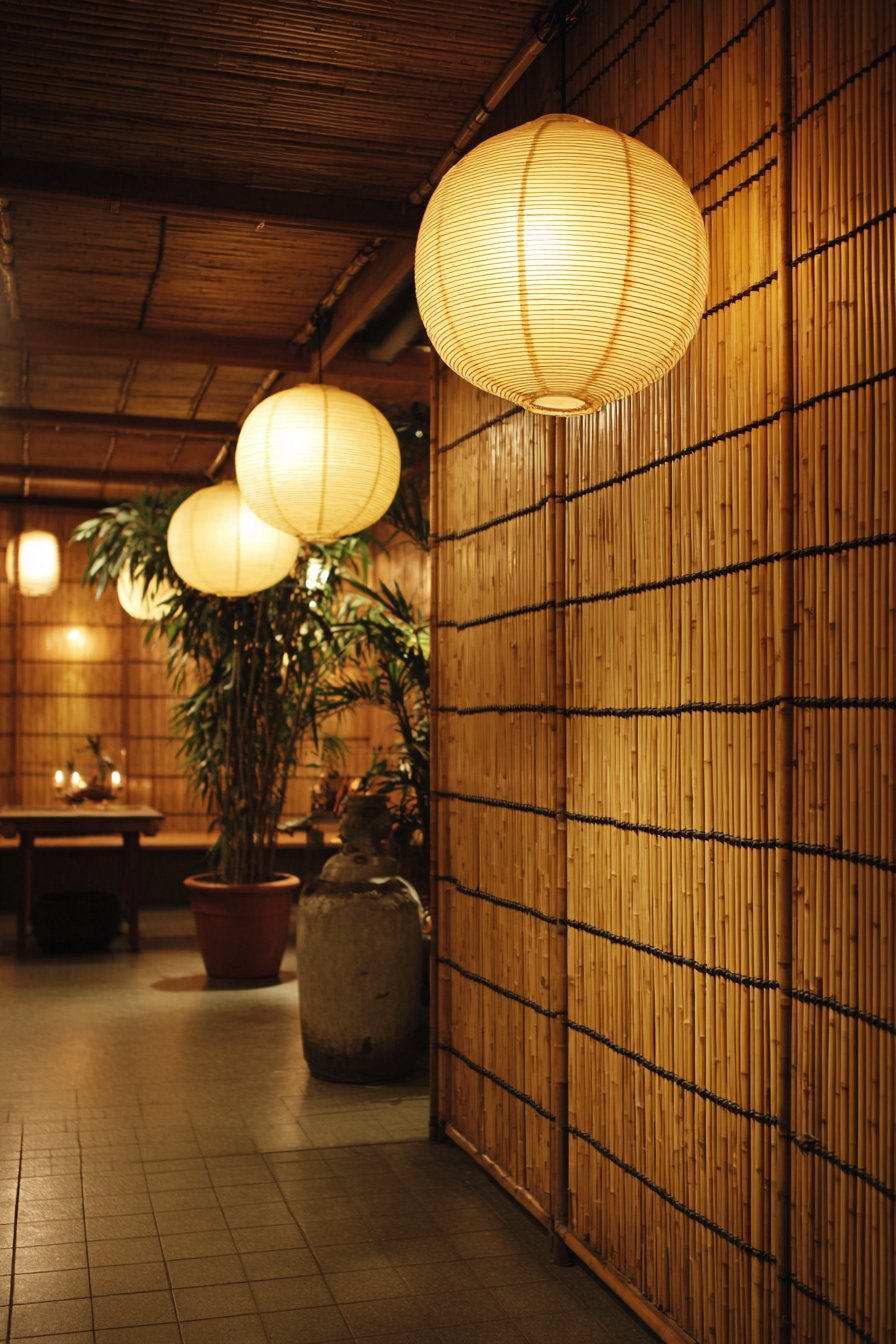
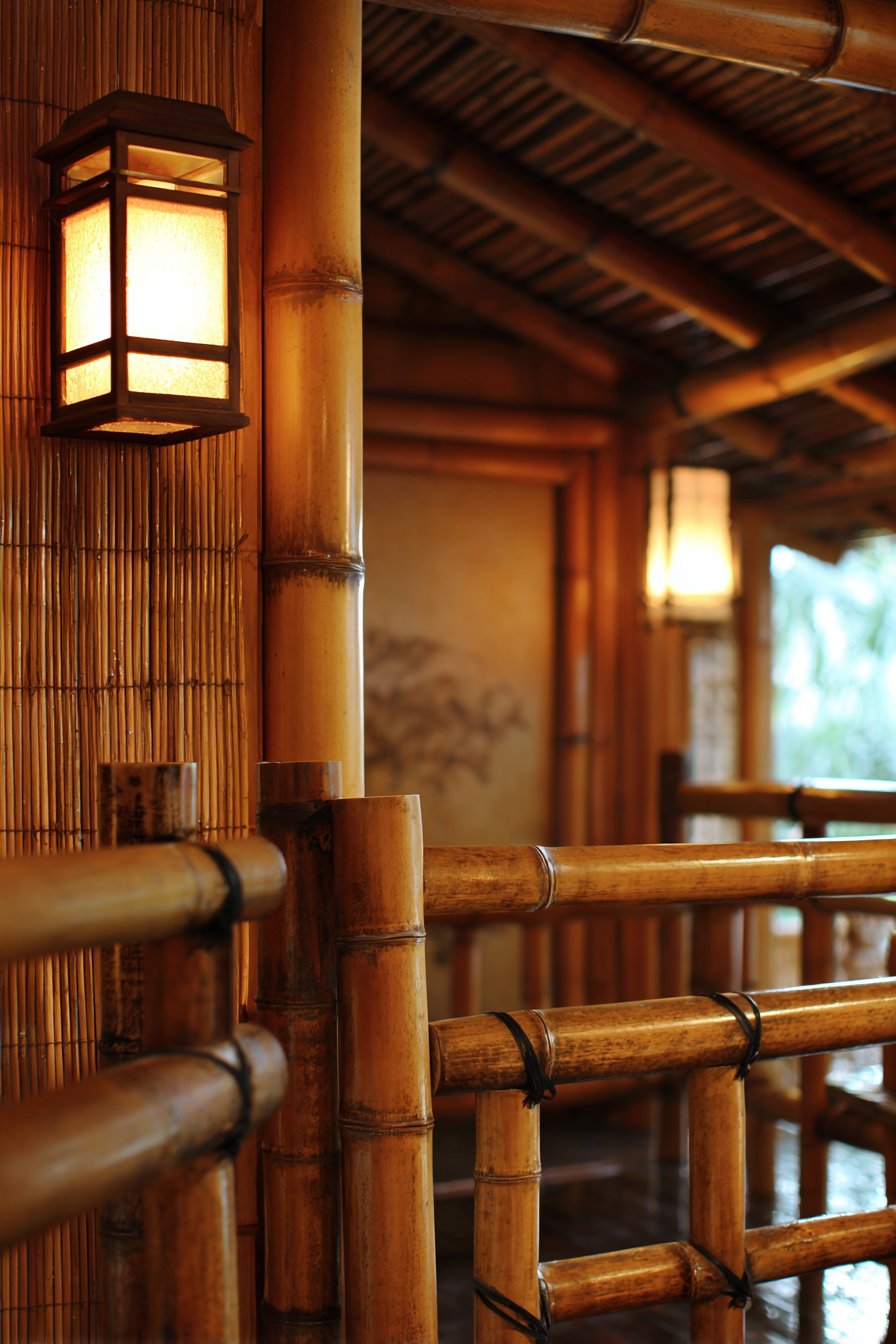
Eastern design philosophy emphasizes simplicity, natural materials, and the creation of tranquil spaces for contemplation, principles beautifully embodied in this Japanese-inspired half wall. Natural bamboo construction with horizontal orientation creates a serene partition between a dedicated meditation space and the main living area, the closely spaced bamboo poles bound with traditional black cord creating both structure and subtle decoration. Standing 40 inches high with a simple bamboo cap rail, this partition provides gentle separation without imposing harsh boundaries that would disrupt the harmonious flow of energy through the space.
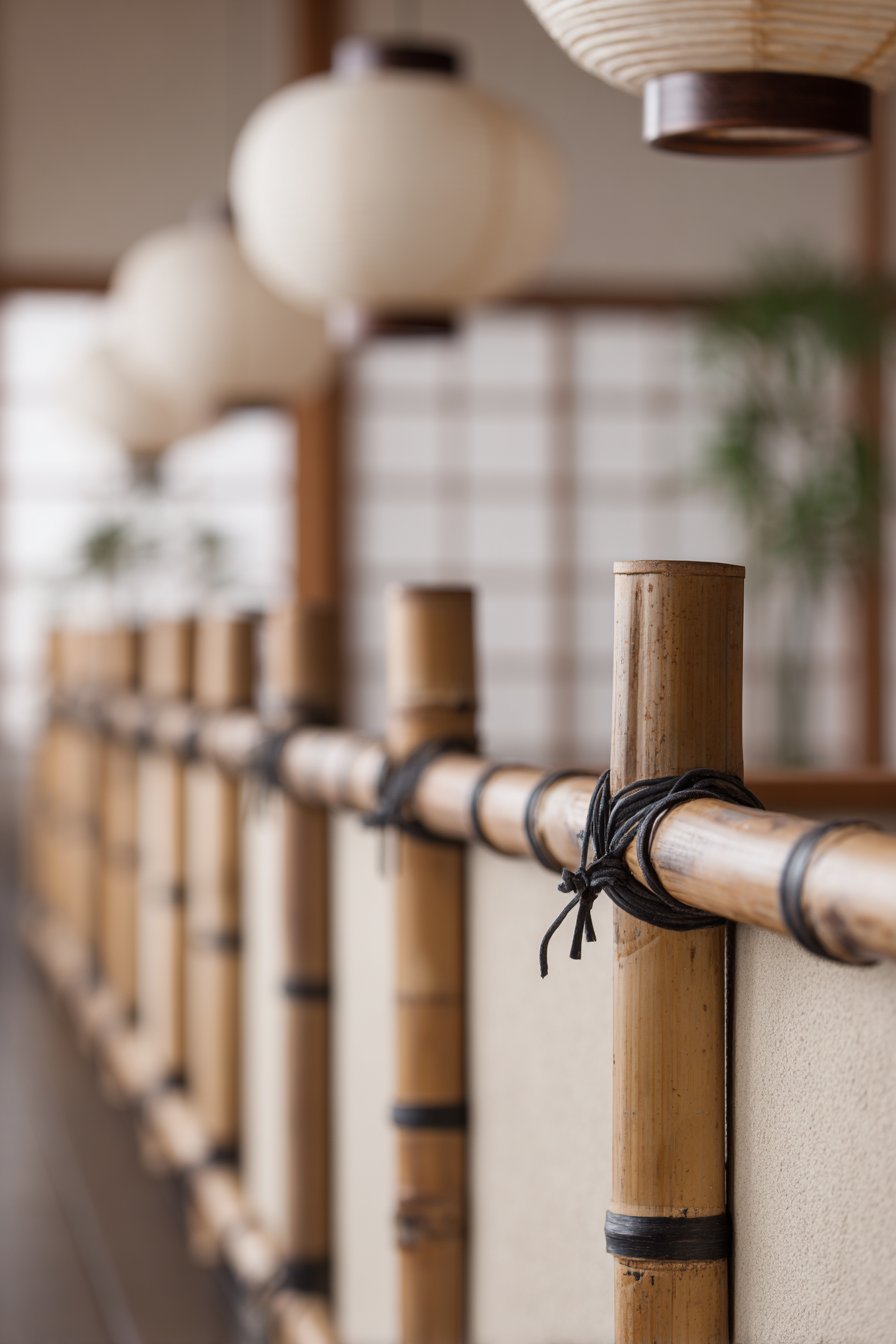
The organic material and clean lines embody wabi-sabi principles—the Japanese aesthetic philosophy that finds beauty in imperfection, impermanence, and incompleteness. Each bamboo pole displays its own unique diameter, color variation, and natural node placement, these individual differences celebrated rather than concealed or standardized. The black cord binding creates rhythmic vertical accents at regular intervals while serving the practical purpose of securing the poles in place. This functional decoration represents authentic Japanese design thinking where utility and beauty merge seamlessly.
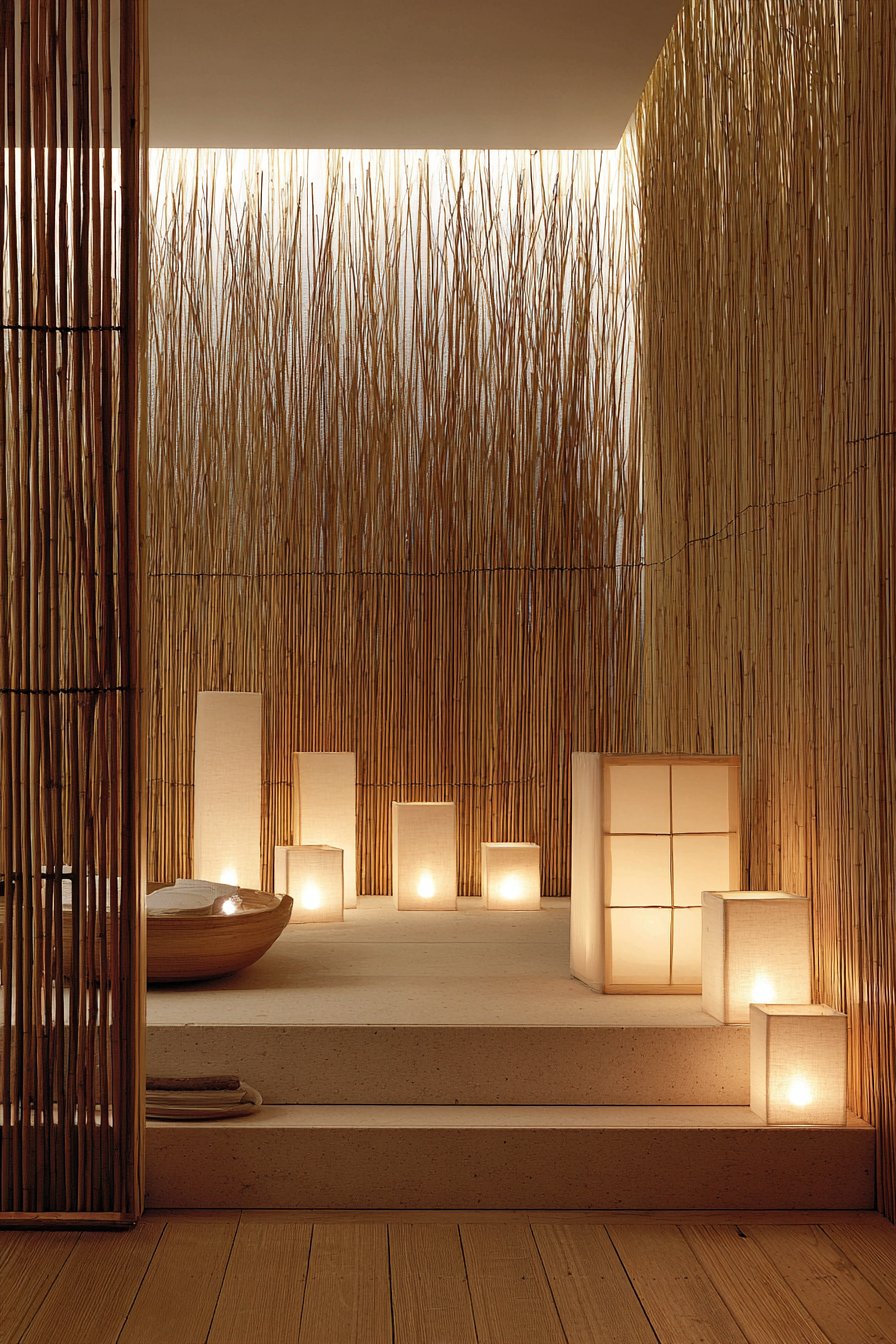
Soft diffused lighting from traditional paper lanterns creates gentle shadows that emphasize the cylindrical form of the bamboo poles and create subtle patterns on surrounding surfaces. Interior photography capturing the zen-like simplicity and natural material beauty demonstrates how restraint and natural materials can create spaces of profound calm in our busy modern lives. The partition serves not as a barrier but as a transitional element that gently suggests the shift from active living space to contemplative meditation area, respecting the different energies of each zone while maintaining overall spatial harmony.
Key Design Tips:
- Source bamboo from sustainable suppliers and select poles of relatively consistent diameter for easier installation
- Treat bamboo with natural oils or sealers to prevent splitting and insect damage while preserving appearance
- Space bamboo poles closely enough to create visual screening but with small gaps to allow air circulation
- Use traditional black cotton or hemp cord for binding to maintain authentic Japanese aesthetic
- Keep the cap rail simple and refined—a single bamboo pole or minimal wood beam rather than ornate molding
- Position the partition to create asymmetrical spatial divisions rather than perfect halves for more dynamic composition
- Incorporate natural light sources and minimize artificial lighting for authentic zen atmosphere
- Select complementary materials in adjacent spaces that honor the natural, minimal aesthetic
17. Glamorous Mirrored Dressing Area Divider
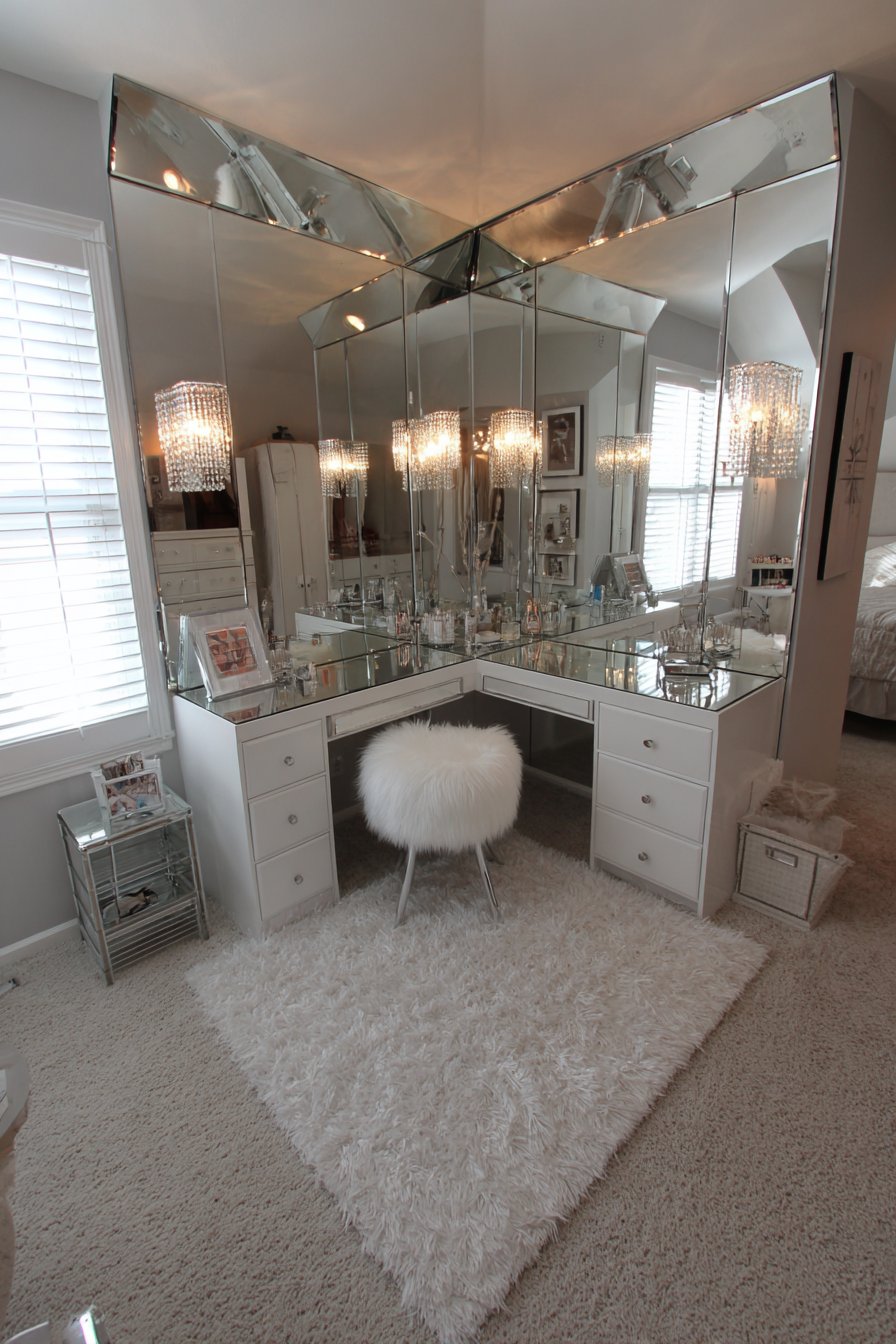
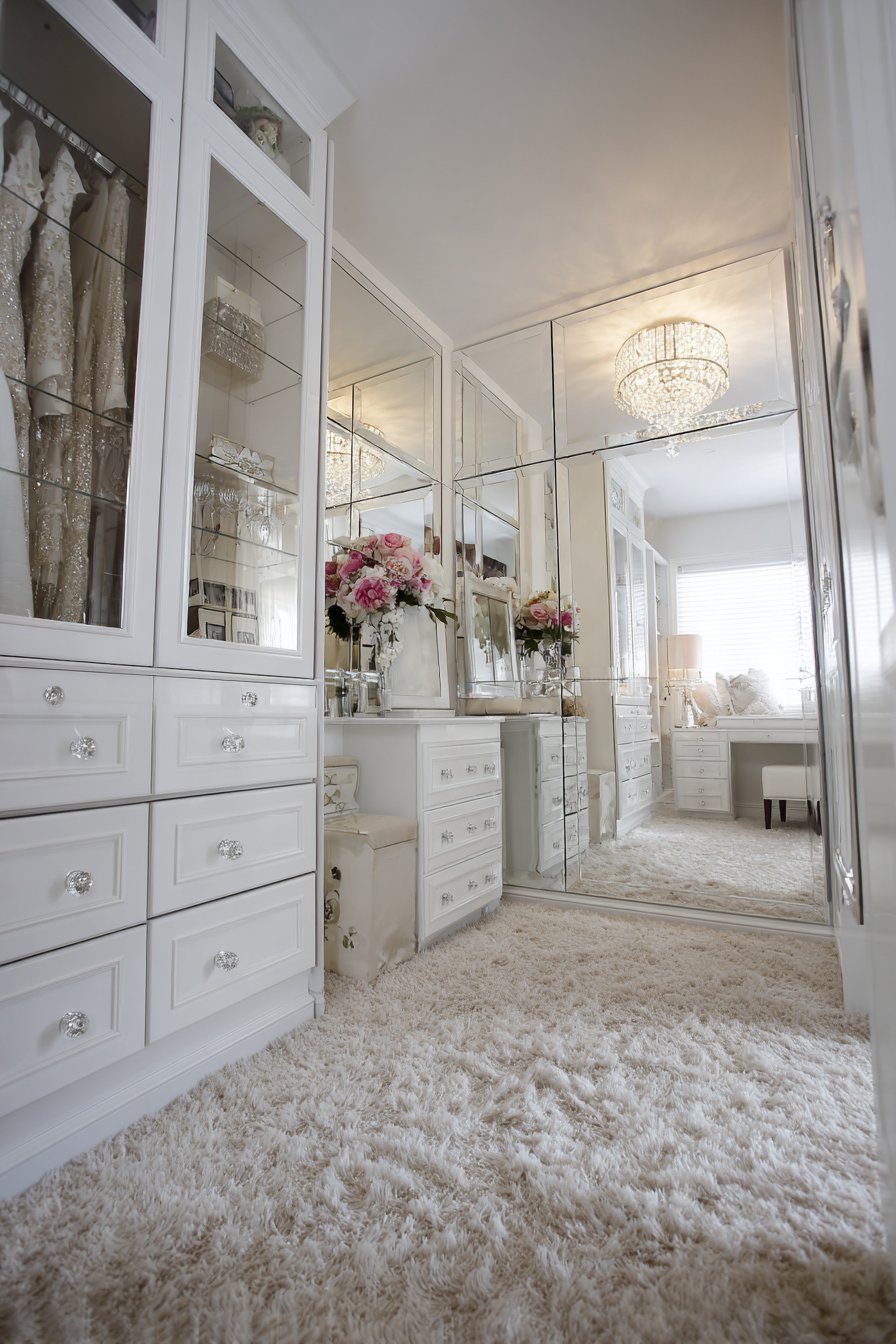
Luxury and sophistication define this glamorous half wall featuring mirrored panel inserts and polished chrome trim, creating an elegant separation between a dressing area and the master bedroom. The white lacquered base cabinetry provides concealed storage for clothing and accessories while supporting the mirrored upper sections that reflect light and create the illusion of expanded space—a clever design strategy particularly valuable in moderately sized bedrooms. The mirrors serve multiple purposes simultaneously: providing functional reflection for dressing, bouncing light throughout the space, and creating visual interest through their reflective properties.
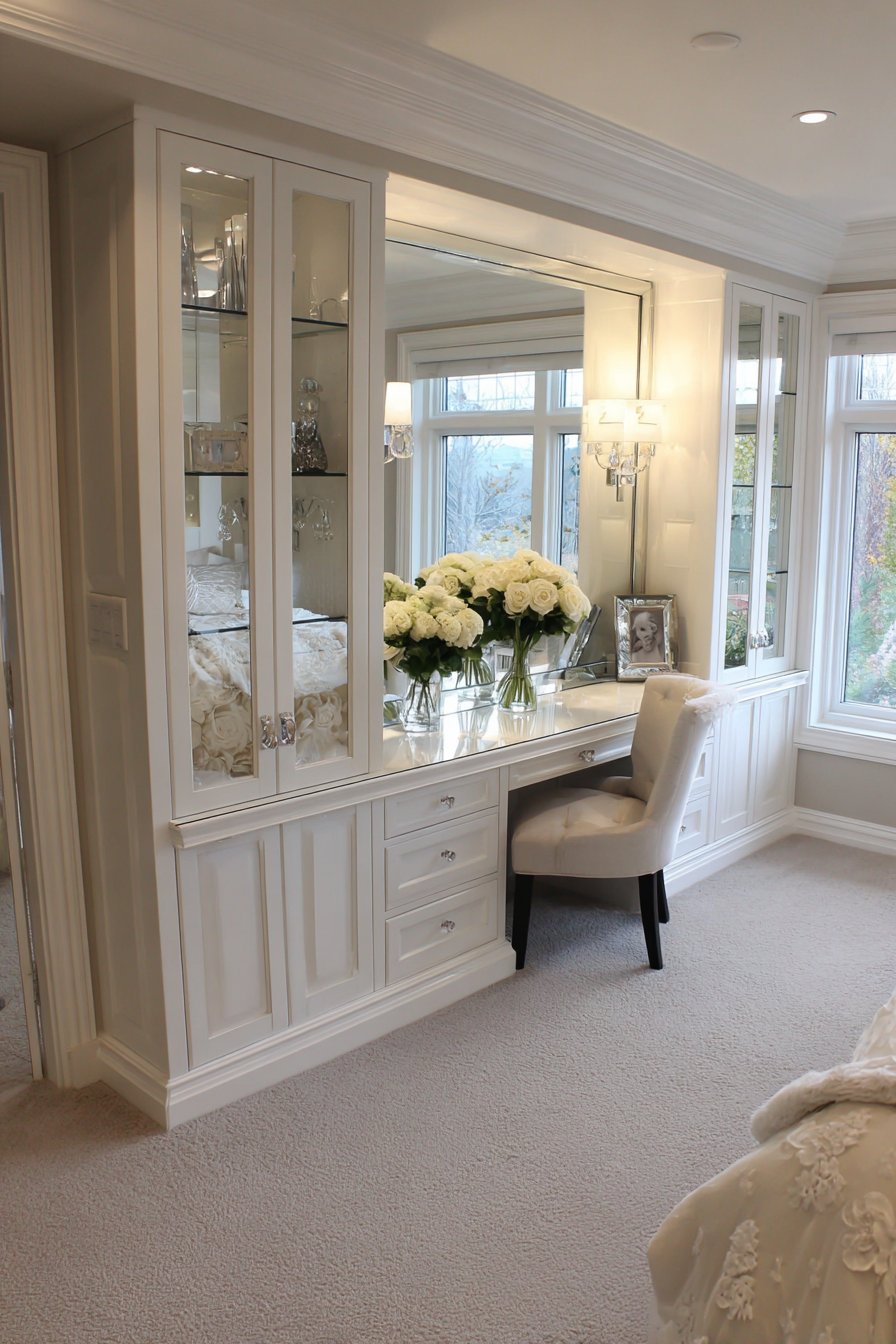
Crystal knob details on the cabinetry introduce sparkle and traditional glamour while LED strip lighting installed along the top rail adds contemporary functionality and creates a subtle glow that enhances the luxurious atmosphere. This combination of classic glamorous elements like mirrors and crystal with modern technology like LED lighting creates an updated take on Hollywood Regency style that feels fresh rather than dated. The plush carpet in champagne tones complements the luxe aesthetic while providing soft, warm surfaces underfoot—an important sensory consideration in bedroom spaces.
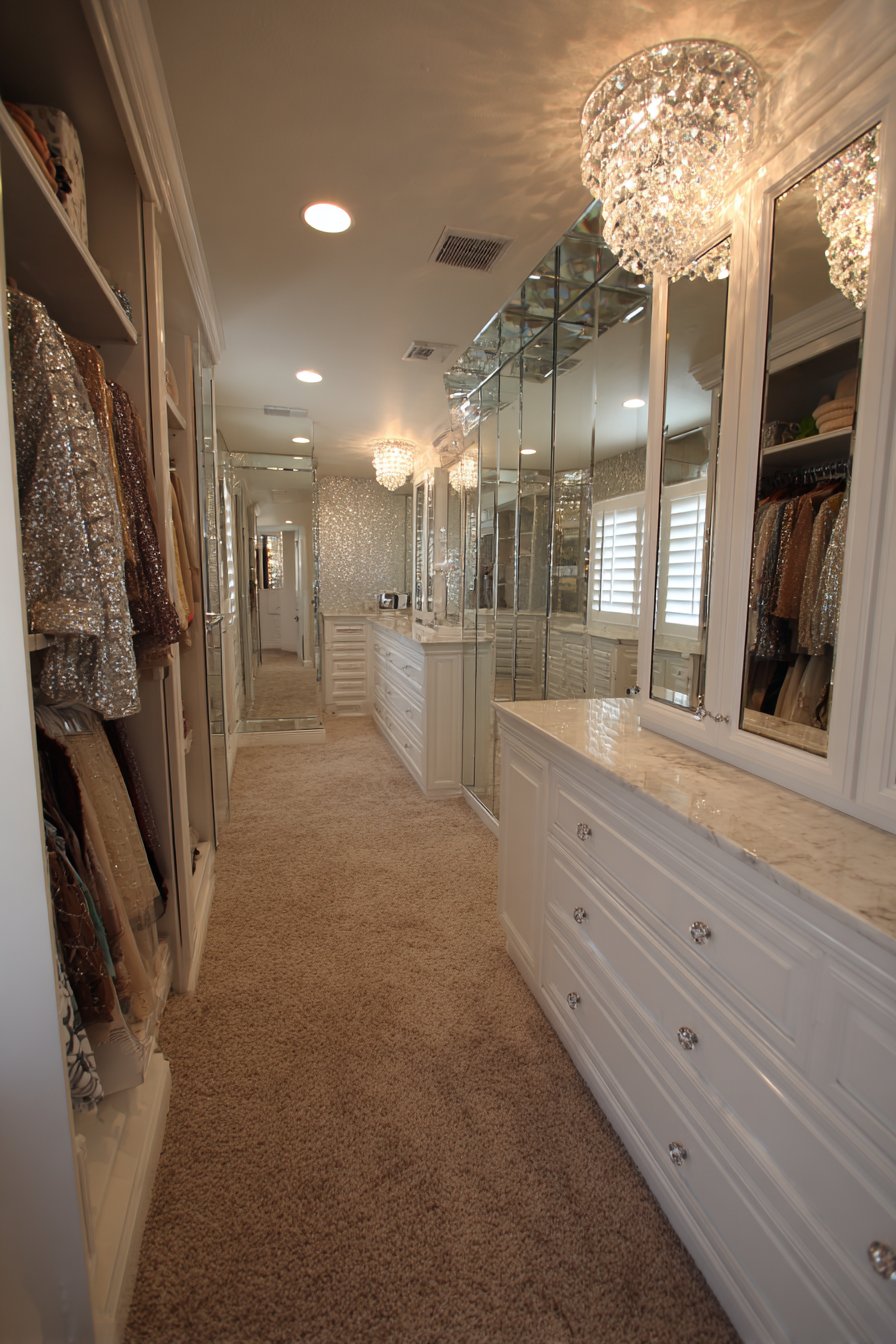
Professional interior photography with carefully balanced lighting emphasizes the reflective surfaces and elegant details without creating harsh glare or unwanted reflections. The interplay between the glossy white lacquer, the mirrored panels, the chrome trim, and the crystal accents creates multiple levels of reflection and sparkle that catch and redirect light throughout the space. This approach to half wall design demonstrates how glamorous aesthetics can be achieved through thoughtful material selection and detail execution rather than requiring elaborate ornamentation or excessive decoration.
Key Design Tips:
- Use high-quality mirror glass with proper backing to prevent silvering deterioration over time
- Install mirrors with adequate support and use proper mirror adhesives in addition to mechanical fasteners
- Choose LED strip lighting with dimming capability for adjustable ambiance
- Select crystal or glass knobs with substantial weight—lightweight plastic alternatives will undermine the luxe aesthetic
- Apply multiple coats of high-gloss white lacquer with thorough sanding between coats for perfectly smooth surfaces
- Clean mirrors regularly with appropriate glass cleaner to maintain clarity and prevent buildup
- Consider sight lines and position mirrors to reflect attractive views rather than clutter or less appealing areas
- Use polished chrome rather than brushed nickel to maintain the glamorous aesthetic
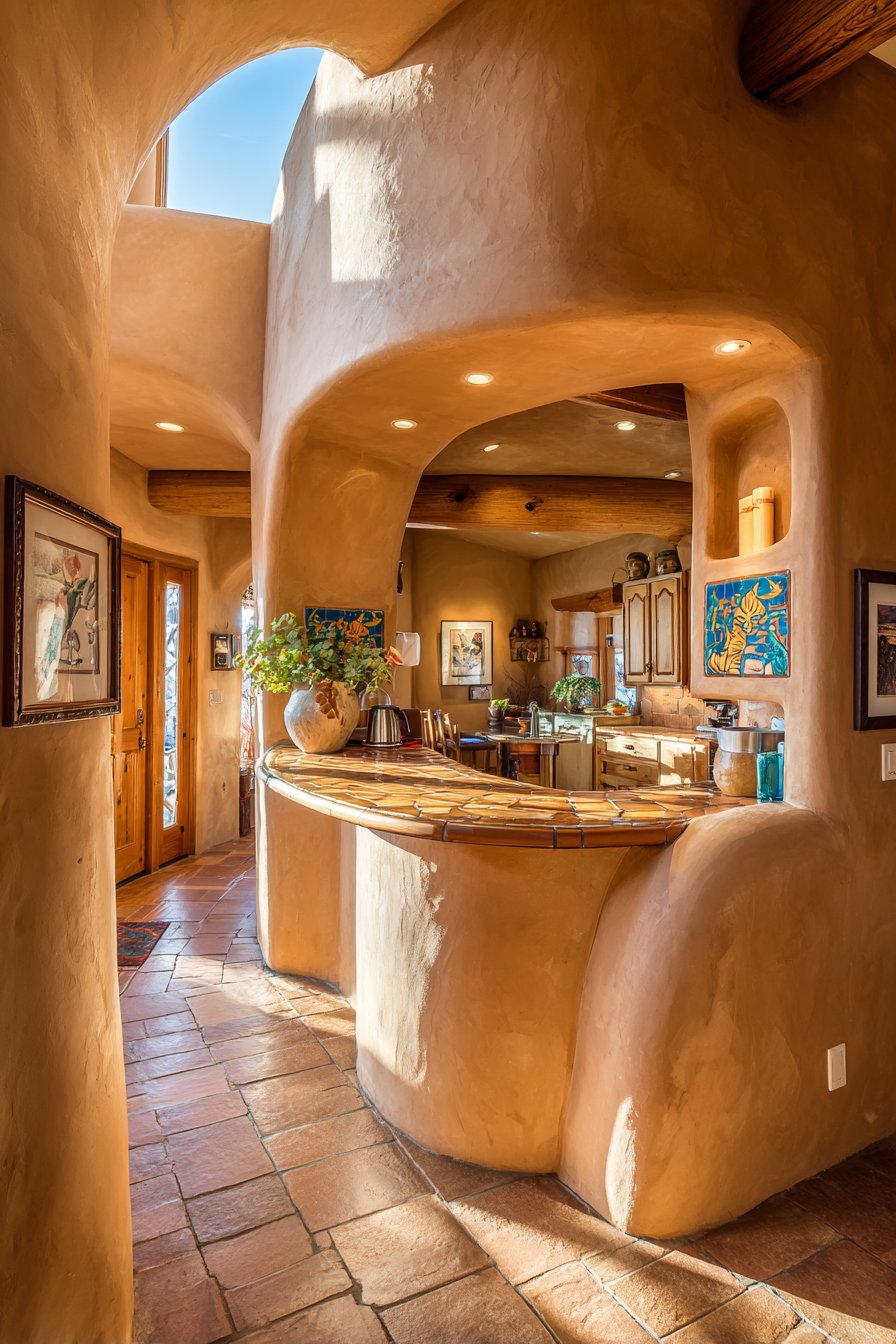
18. Southwestern Adobe-Style Pueblo Partition
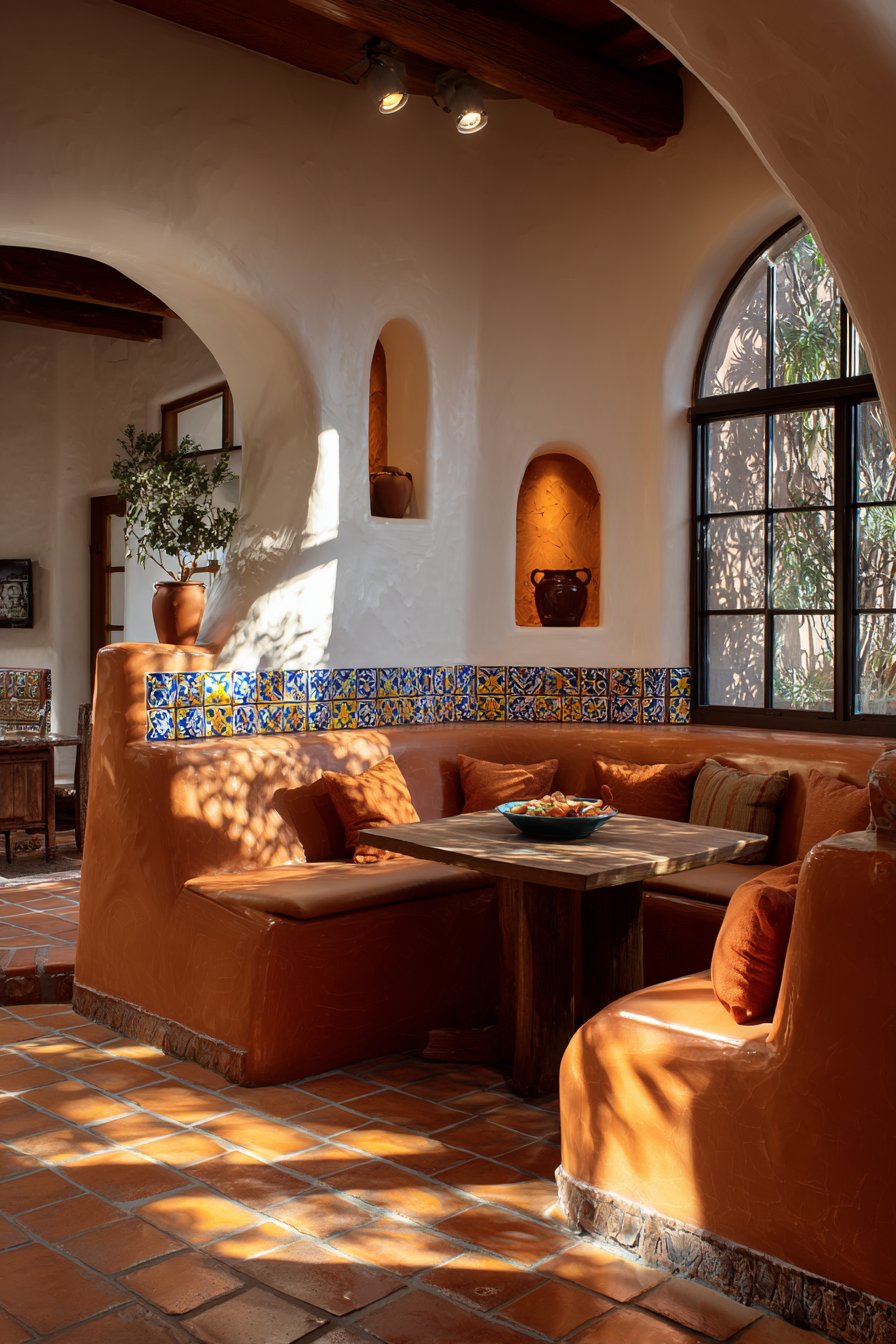
The warm, earthy aesthetic of Southwestern design embraces organic forms and traditional building methods, beautifully exemplified in this half wall featuring adobe-style plaster in warm terracotta tones. Dividing a dining area from an intimate conversation space, the partition stands 38 inches tall with the rounded edges and organic curves characteristic of pueblo architecture. These soft, flowing forms contrast dramatically with the sharp corners and straight lines common in contemporary construction, creating a sculptural quality that transforms a simple room divider into an artistic statement.
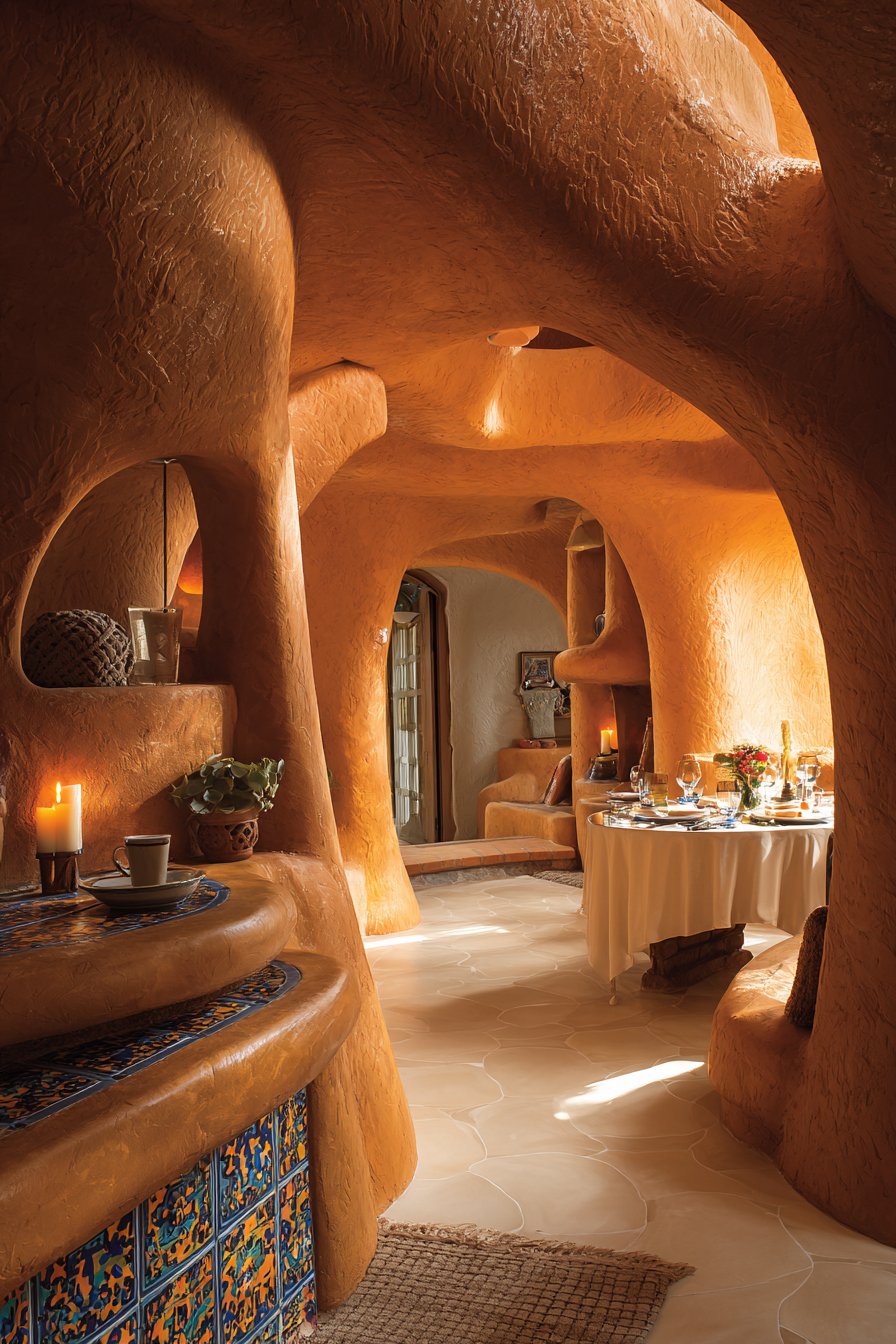
Decorative Talavera tile insets in vibrant blue and yellow patterns introduce brilliant color accents that pop against the warm terracotta plaster. These hand-painted Mexican tiles represent centuries of ceramic tradition, their folk-art patterns and saturated glazes adding layers of cultural richness and visual interest. Built-in niches carved into the wall provide display spaces for pottery, candles, and other decorative objects, these shadow-creating recesses adding depth and practical function while honoring the niche tradition found in historic pueblo architecture.
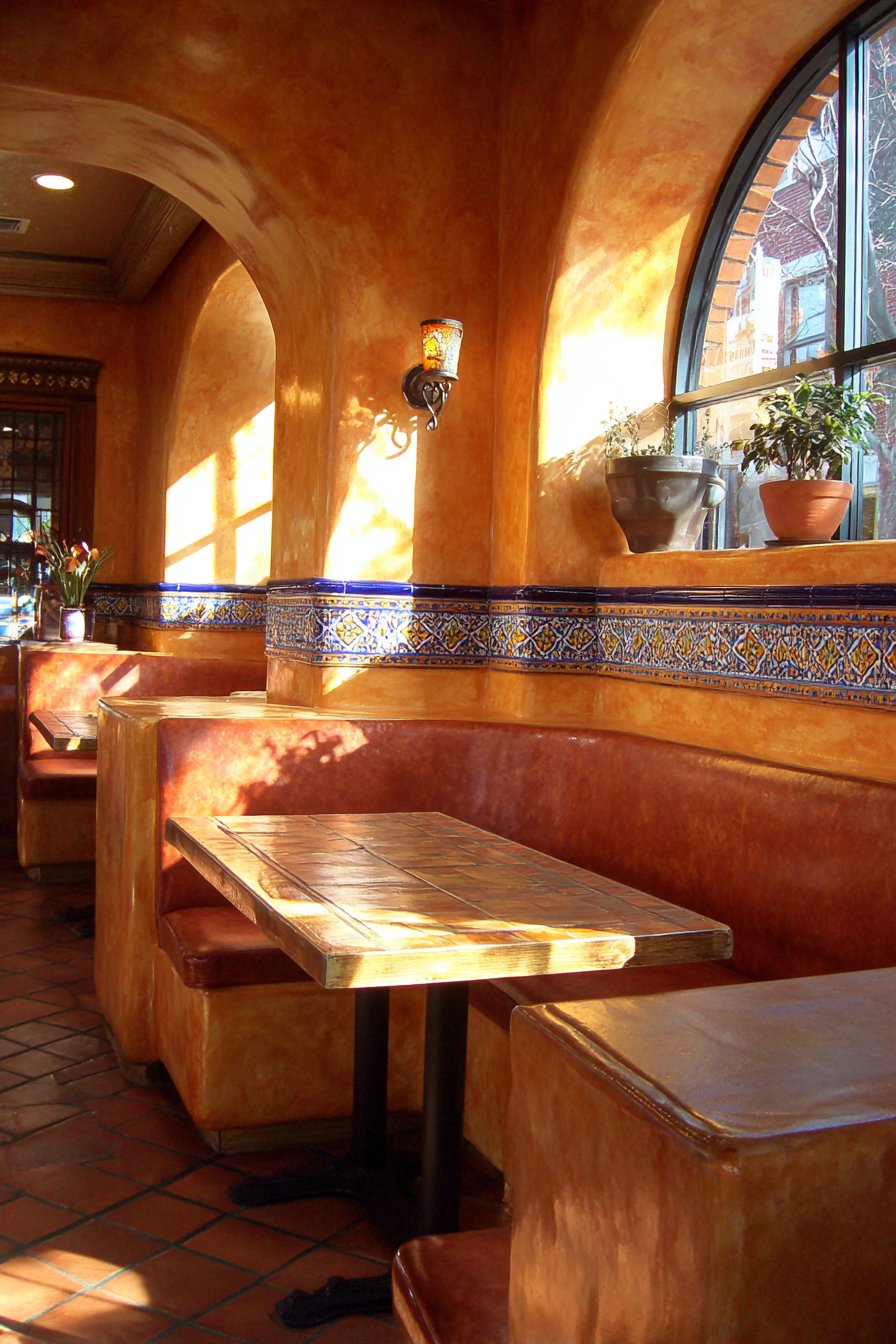
Saltillo tile flooring in varied terra cotta tones adds authentic regional character while its handmade irregularities and natural color variations create visual warmth underfoot. Natural light creates beautiful shadow play on the textured plaster surfaces, these constantly shifting shadows emphasizing the hand-crafted quality and organic forms. Interior photography emphasizing the handcrafted quality captures how traditional Southwestern building methods and materials can create spaces that feel connected to place and history while remaining thoroughly livable and appropriate for contemporary life.
Key Design Tips:
- Apply plaster in multiple layers by hand to create authentic texture variations and slight imperfections
- Form rounded edges and corners gradually through successive plaster applications rather than sharp molding
- Integrate Talavera tiles during plastering for seamless installation rather than surface-mounting afterward
- Create niches at varying heights and sizes for more authentic, organic appearance
- Seal plaster surfaces with penetrating sealer to facilitate cleaning while maintaining matte appearance
- Choose authentic Saltillo tiles with natural variation rather than standardized machine-made versions
- Position niches to accommodate candles safely with adequate clearance from combustible materials
- Consider the warm color palette throughout adjacent spaces to create cohesive Southwestern design flow
19. Luxury Bathroom Frosted Glass Partition
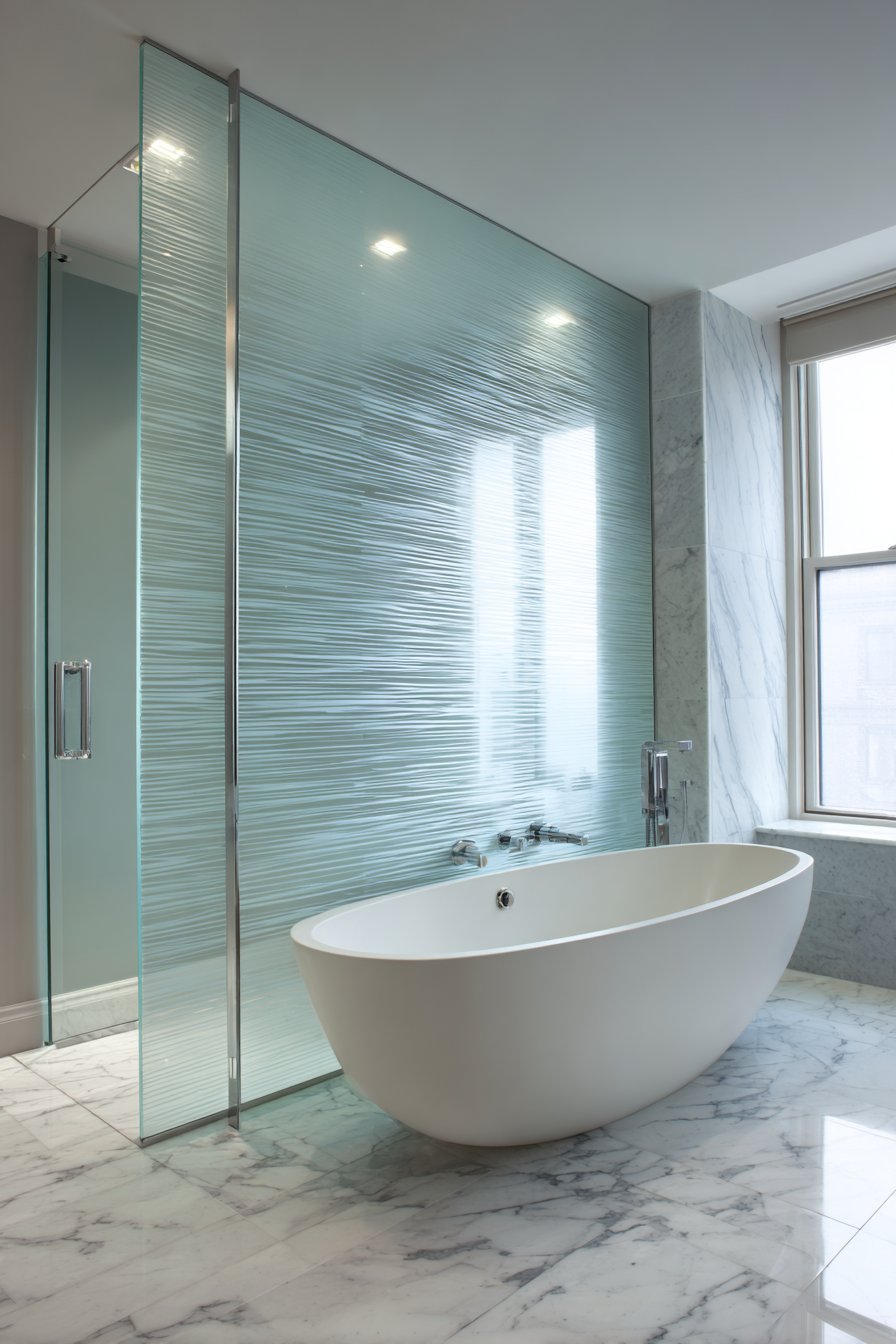
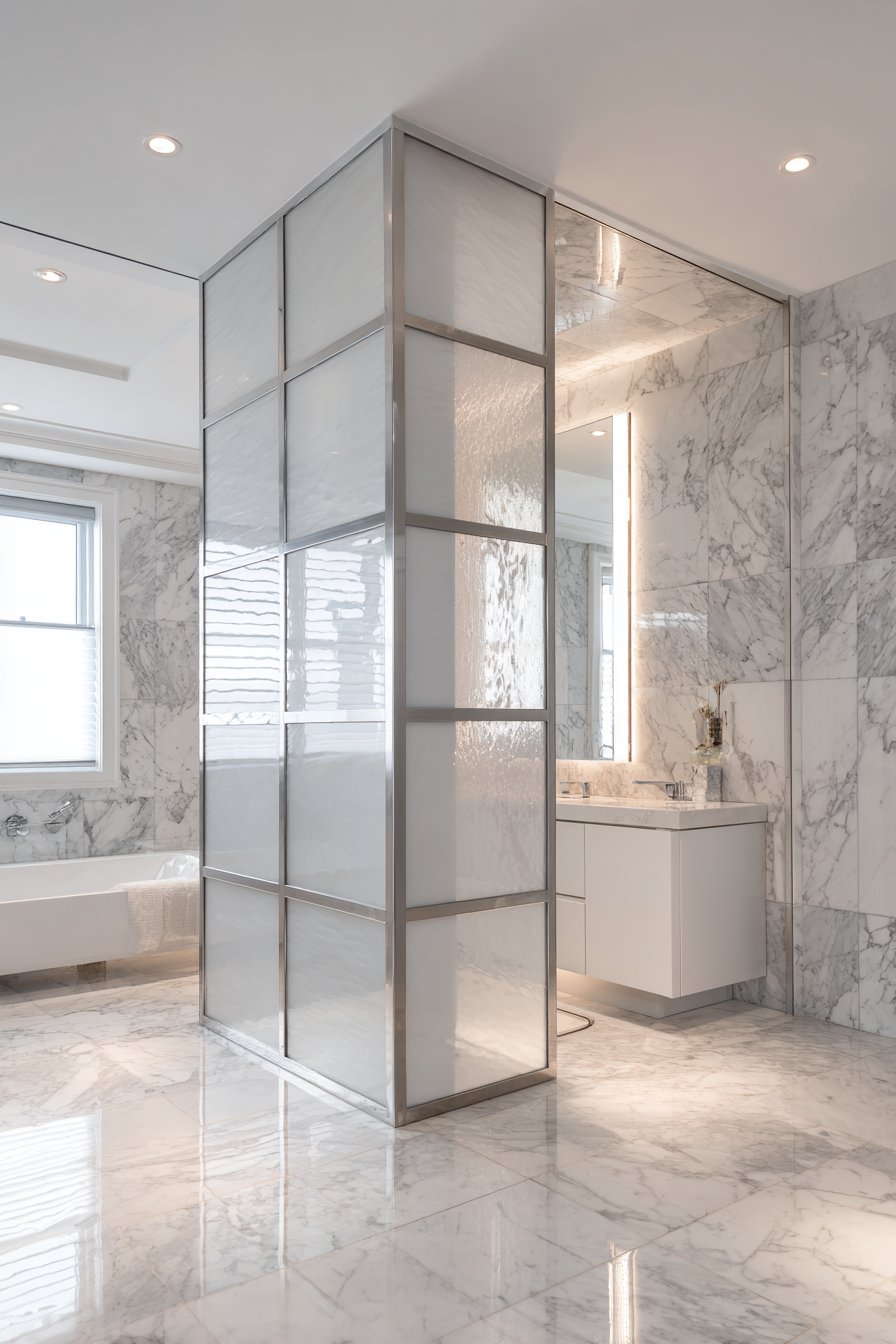
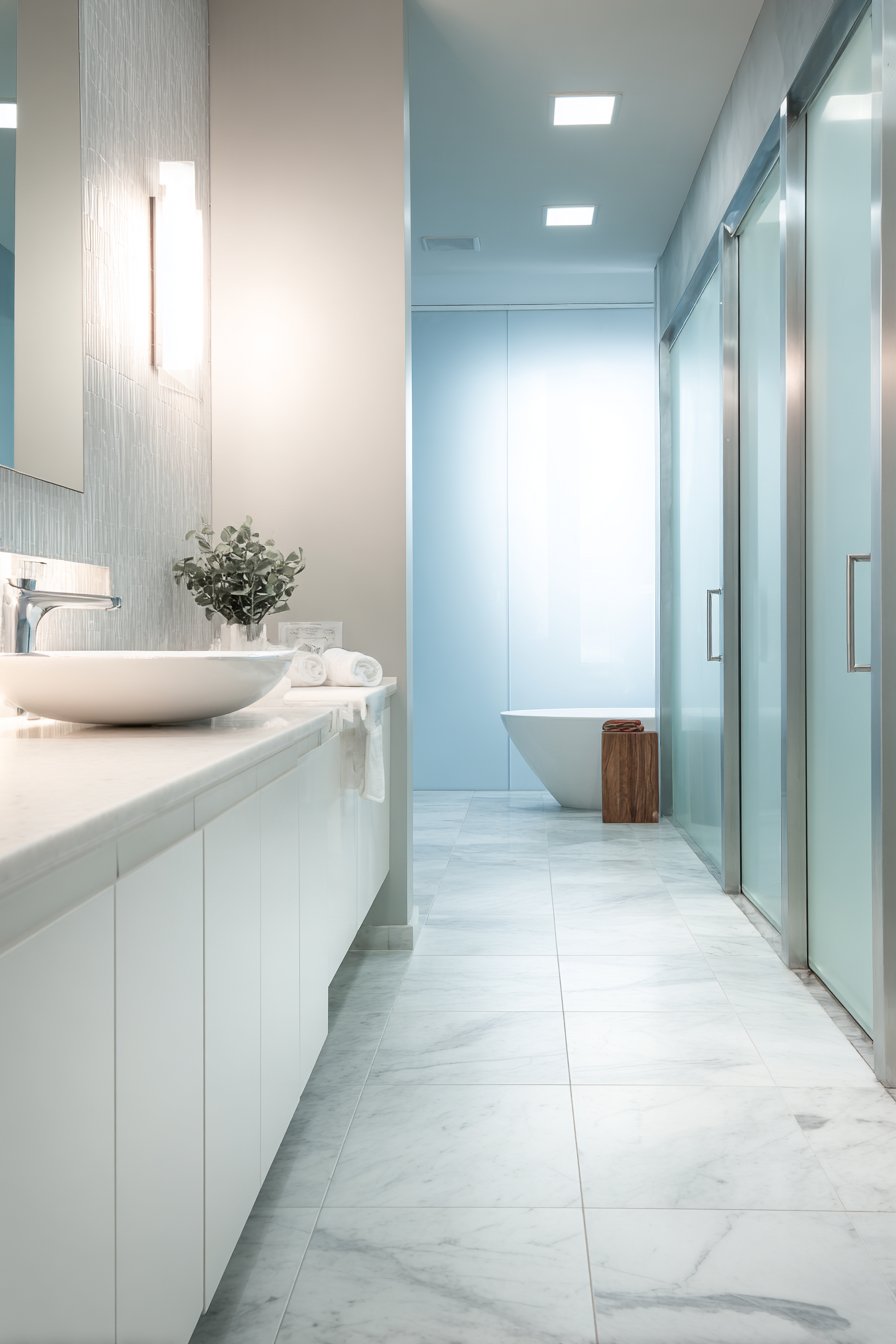
The contemporary luxury bathroom demands sophisticated solutions for creating privacy while maintaining the spa-like openness that makes these spaces feel relaxing rather than utilitarian. This elegant half wall solution uses frosted glass panels set in brushed aluminum channels to create a modern partition between the soaking tub area and the vanity zone. The frosted glass provides visual privacy while allowing natural light to filter through the translucent material, creating soft, diffused illumination that flatters skin tones and enhances the serene atmosphere essential to spa-inspired design.
Subtle etched linear patterns in the glass add visual interest without overwhelming the minimalist aesthetic, these delicate details catching and redirecting light in subtle ways that create movement and depth on the glass surface. The brushed aluminum channels provide sleek, contemporary framing that complements chrome plumbing fixtures and other metallic accents throughout the bathroom. This consistent use of cool metallic finishes creates visual continuity and reinforces the clean, contemporary aesthetic. White marble flooring with subtle gray veining enhances the spa-like atmosphere while providing luxurious, cool surfaces underfoot.
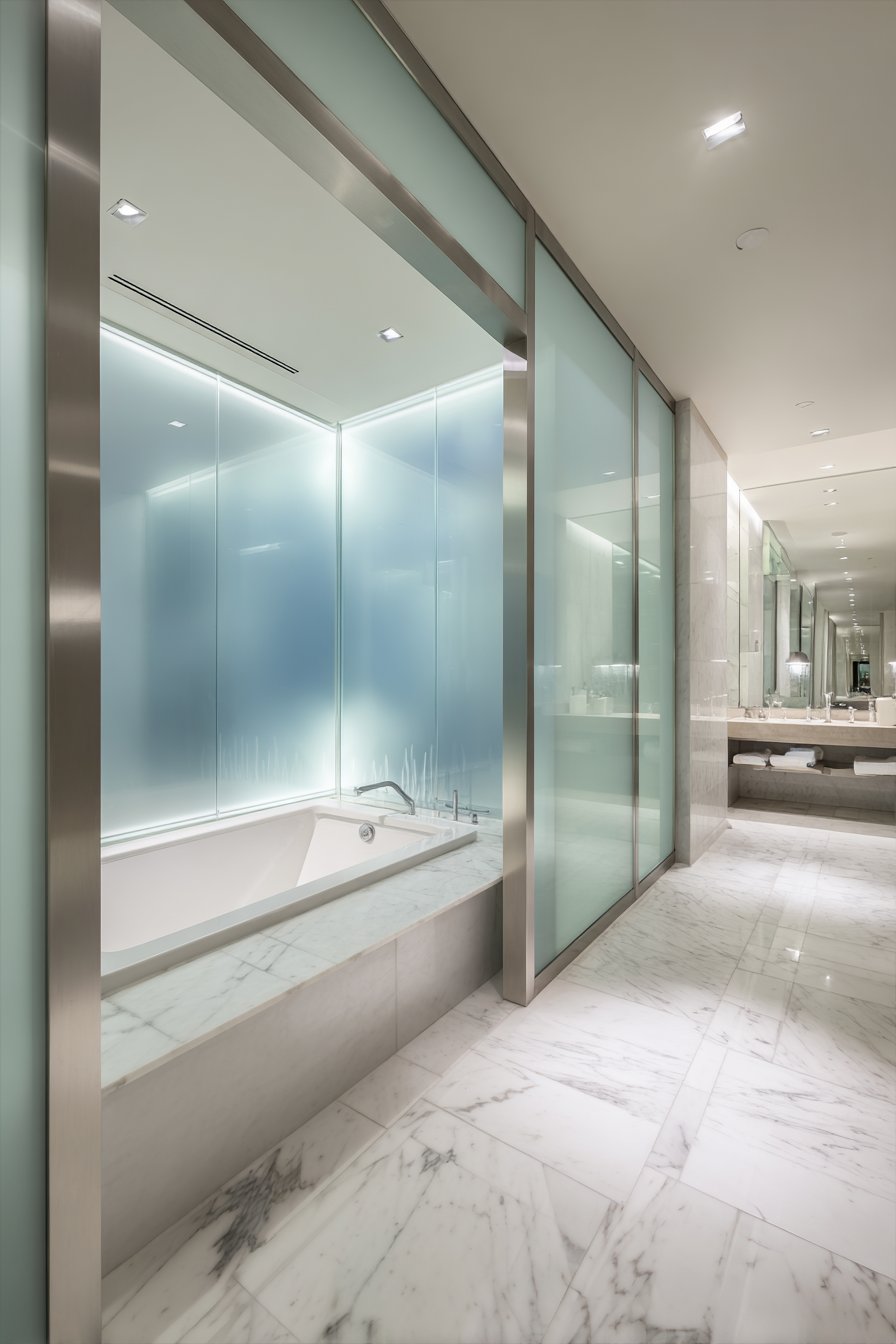
Professional interior photography with soft diffused lighting highlights the clean contemporary design and material transparency, demonstrating how frosted glass can create separation without the visual heaviness of solid walls. The way light passes through the frosted surface creates an ethereal quality, the translucent material glowing softly when backlit by windows or artificial light sources. This approach to bathroom partitioning proves that privacy and openness need not be mutually exclusive when thoughtful material selection and strategic positioning work together to serve both functional and aesthetic goals.
Key Design Tips:
- Select tempered safety glass for all bathroom applications to ensure shatter resistance in wet environments
- Use aluminum channel systems specifically designed for wet locations with proper drainage
- Install frosted glass panels with adequate spacing from water sources to prevent excessive water contact
- Choose etched patterns that are subtle enough to maintain the contemporary aesthetic without appearing dated
- Apply protective coating to brushed aluminum to resist water spots and corrosion in humid bathroom environments
- Position the partition to block direct sight lines while allowing light flow
- Incorporate adequate ventilation to prevent moisture buildup on glass surfaces
- Clean frosted glass regularly with appropriate cleaners to prevent soap scum buildup in textured surfaces
20. Art Deco Geometric Metalwork Partition
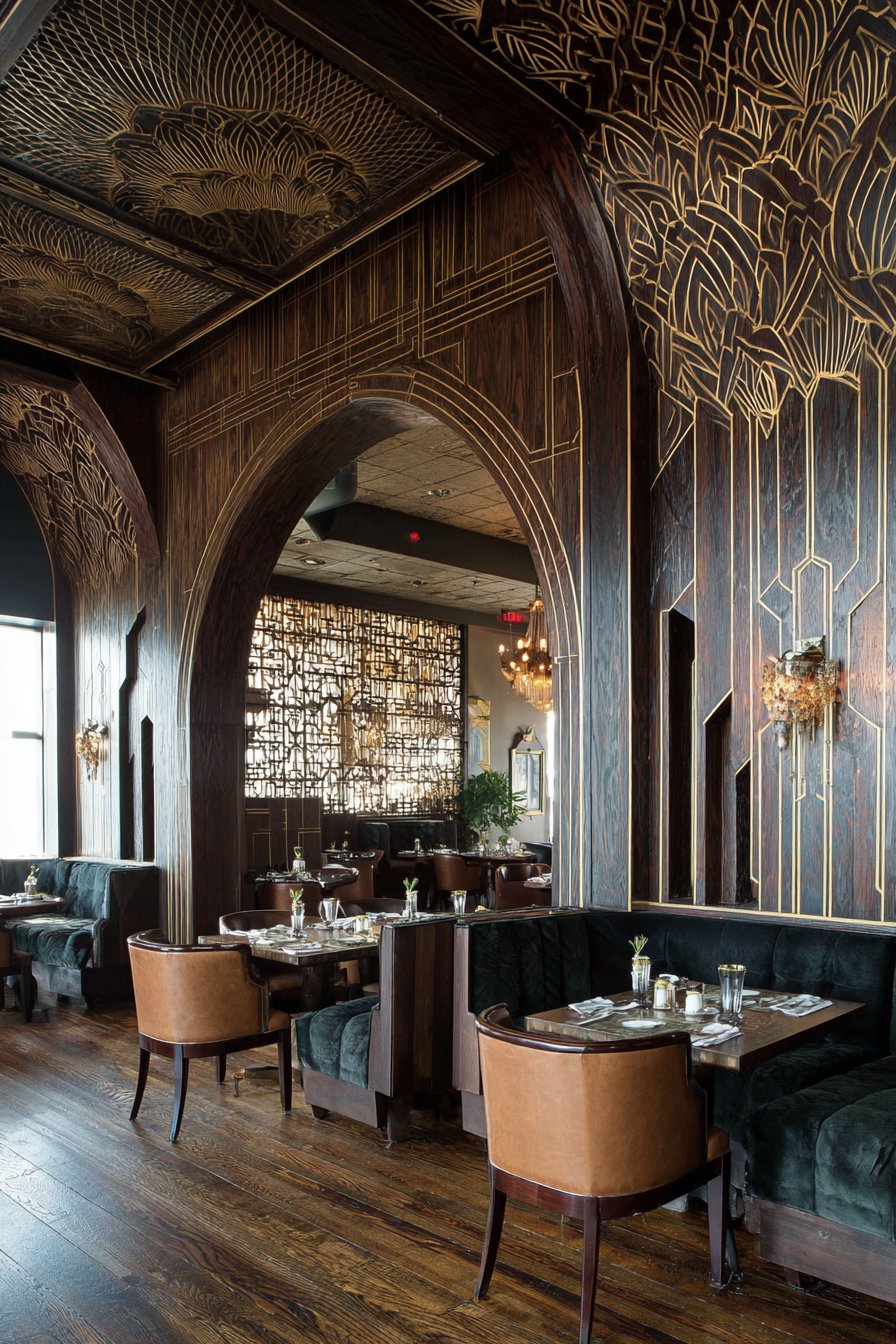
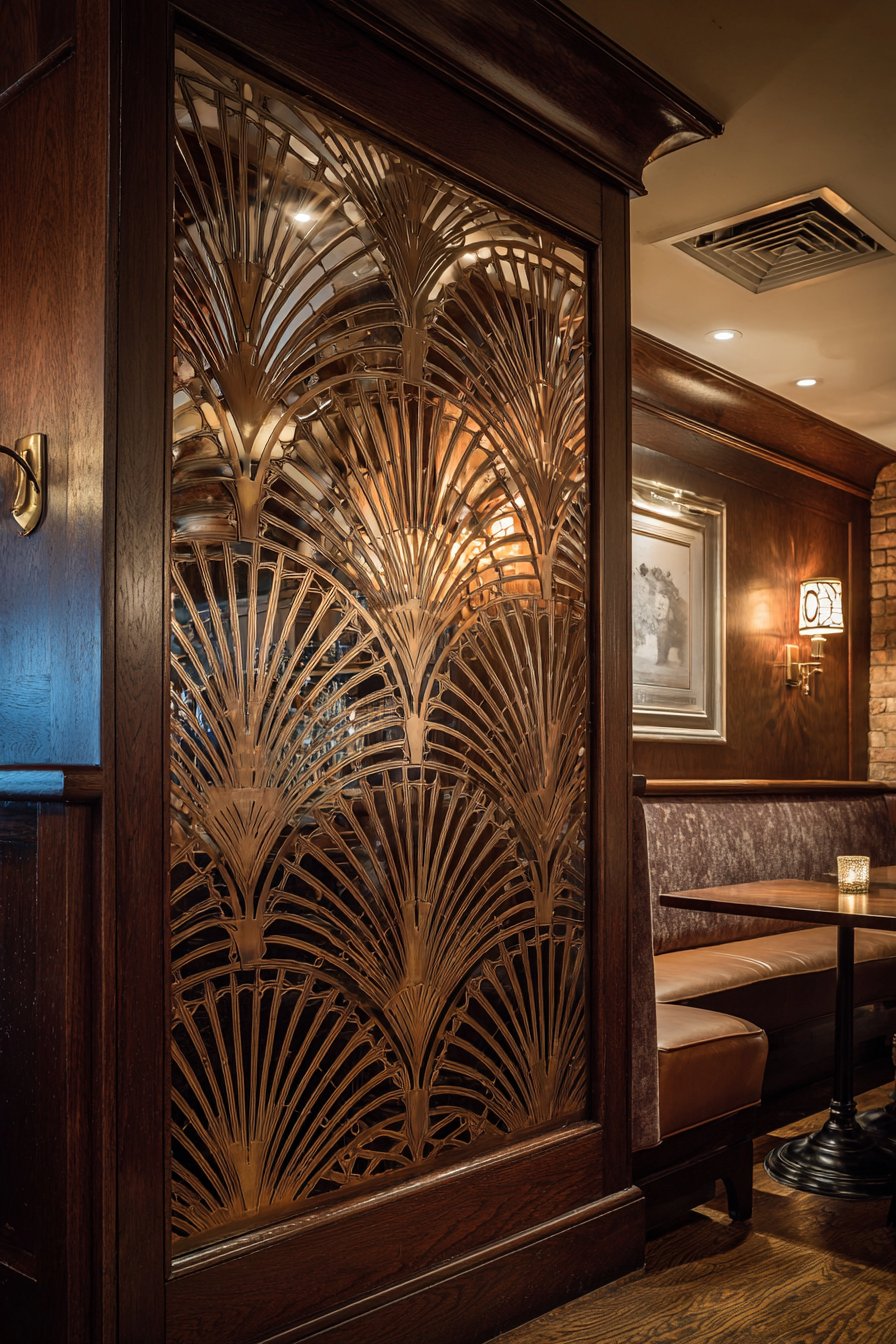
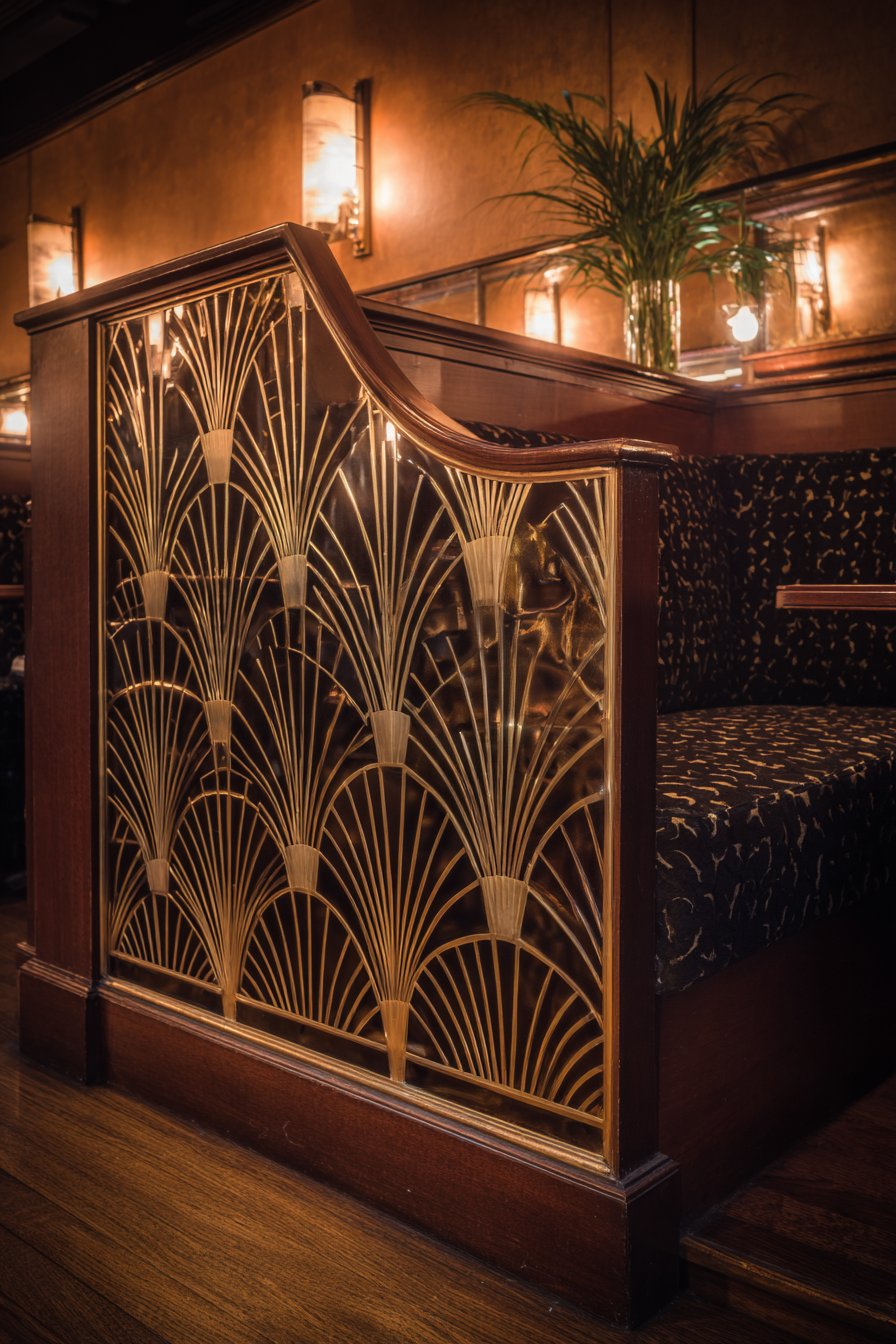
The bold geometry and luxurious materials of Art Deco design find perfect expression in this dramatic half wall featuring symmetrical fan motifs in antique brass metalwork against ebony-stained wood panels. Separating a formal dining room from an intimate cocktail lounge area, this partition celebrates the glamorous aesthetic of the 1920s and 30s through its unabashed embrace of decorative richness and geometric precision. The metalwork creates intricate patterns that cast fascinating shadows when light passes through, adding another layer of visual interest to an already complex design.
The stepped profile at the cap rail emphasizes the characteristic Art Deco love of setback designs and ziggurat forms inspired by ancient architecture. This architectural detailing creates a strong horizontal line that guides the eye across the space while the vertical metal fan motifs provide rhythmic upward movement. Velvet upholstered banquette seating backing against one side introduces sumptuous texture and jewel-tone color—perhaps deep emerald or sapphire blue—that complements the brass and ebony palette perfectly while providing comfortable seating for cocktails and conversation.
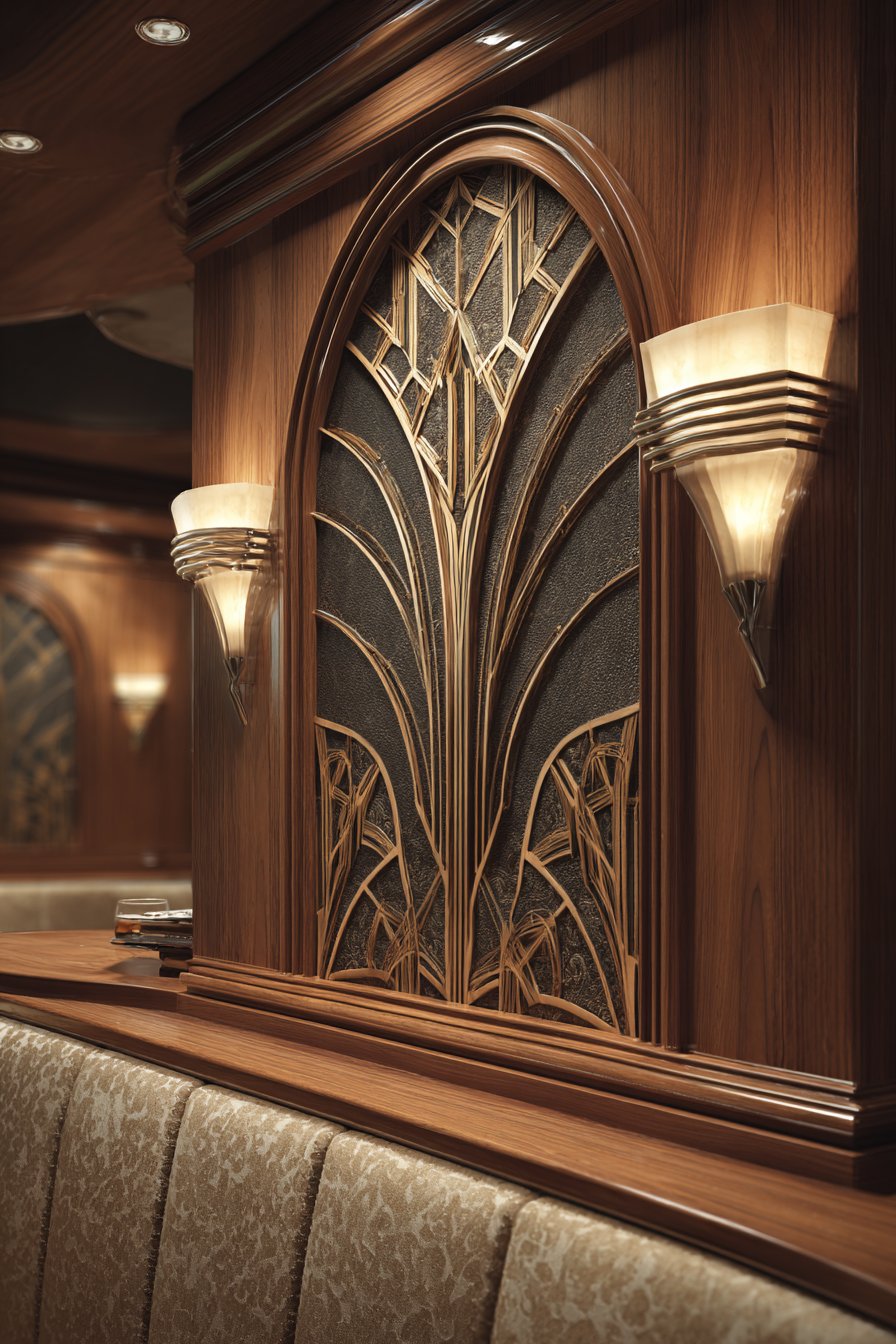
Ambient lighting from carefully positioned wall sconces creates dramatic shadows that accentuate the geometric patterns and cast the metalwork into high relief. Interior design photography captures the glamorous 1920s aesthetic with attention to ornamental details, demonstrating how period-specific design can feel fresh and exciting when executed with conviction and quality materials. The antique brass finish on the metalwork provides warm contrast to the cool ebony-stained wood, this interplay of warm and cool metallics creating the sophisticated palette that defines Art Deco’s most successful applications.
Key Design Tips:
- Create perfectly symmetrical geometric patterns—Art Deco demands precision rather than organic irregularity
- Use solid brass for metalwork rather than plated steel for authentic weight and lasting quality
- Apply ebony stain to hardwood veneers with tight, consistent grain for uniform deep black appearance
- Design the stepped cap rail with strong horizontal emphasis to reinforce Art Deco architectural principles
- Upholster seating in velvet or other luxurious fabrics in saturated jewel tones
- Install dimmable lighting to control the drama of shadow patterns on the geometric metalwork
- Select wall sconces with period-appropriate geometric designs to reinforce the Art Deco theme
- Polish brass regularly or apply protective lacquer to maintain the warm metallic finish
21. Basement Recreation Room Utility Partition
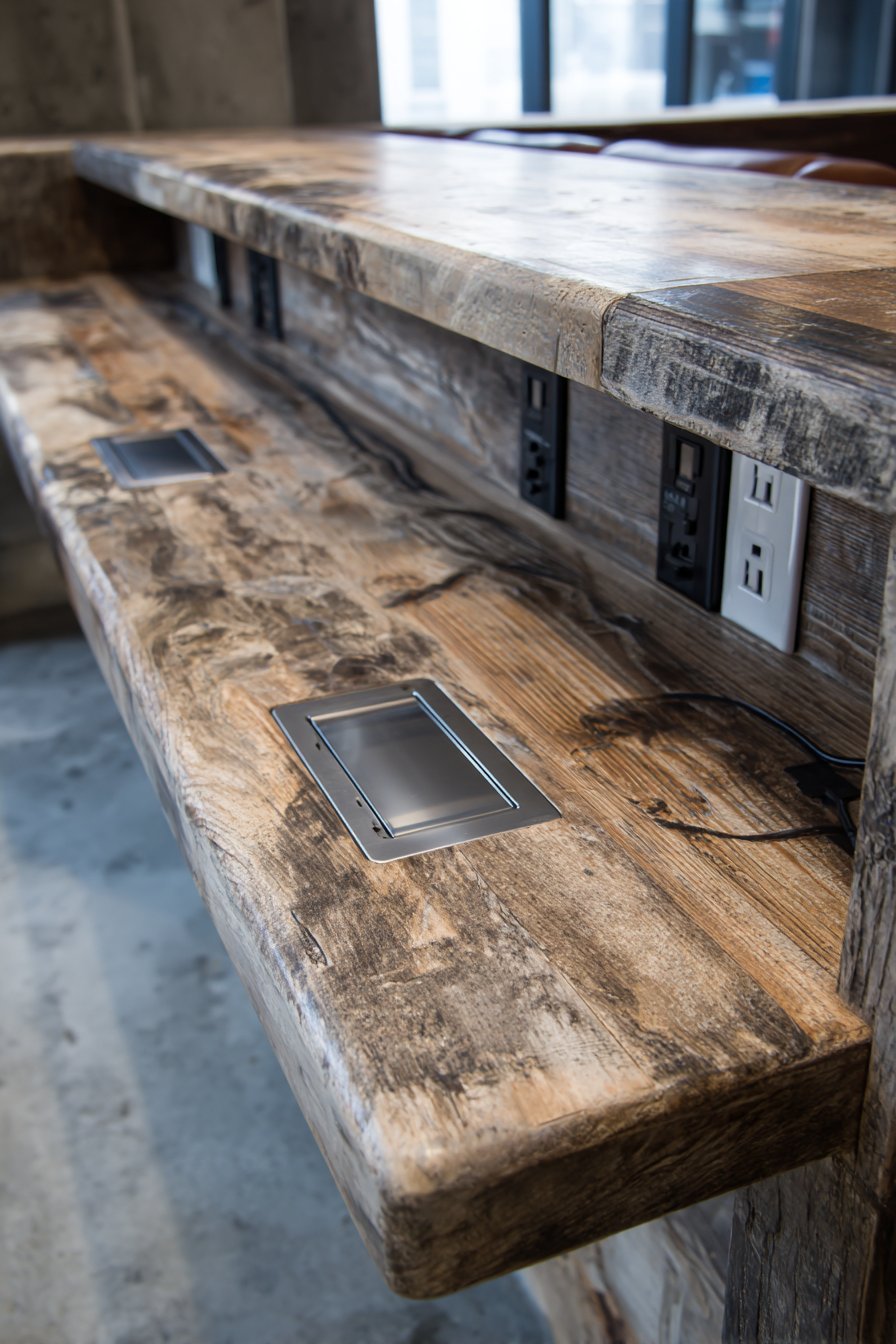
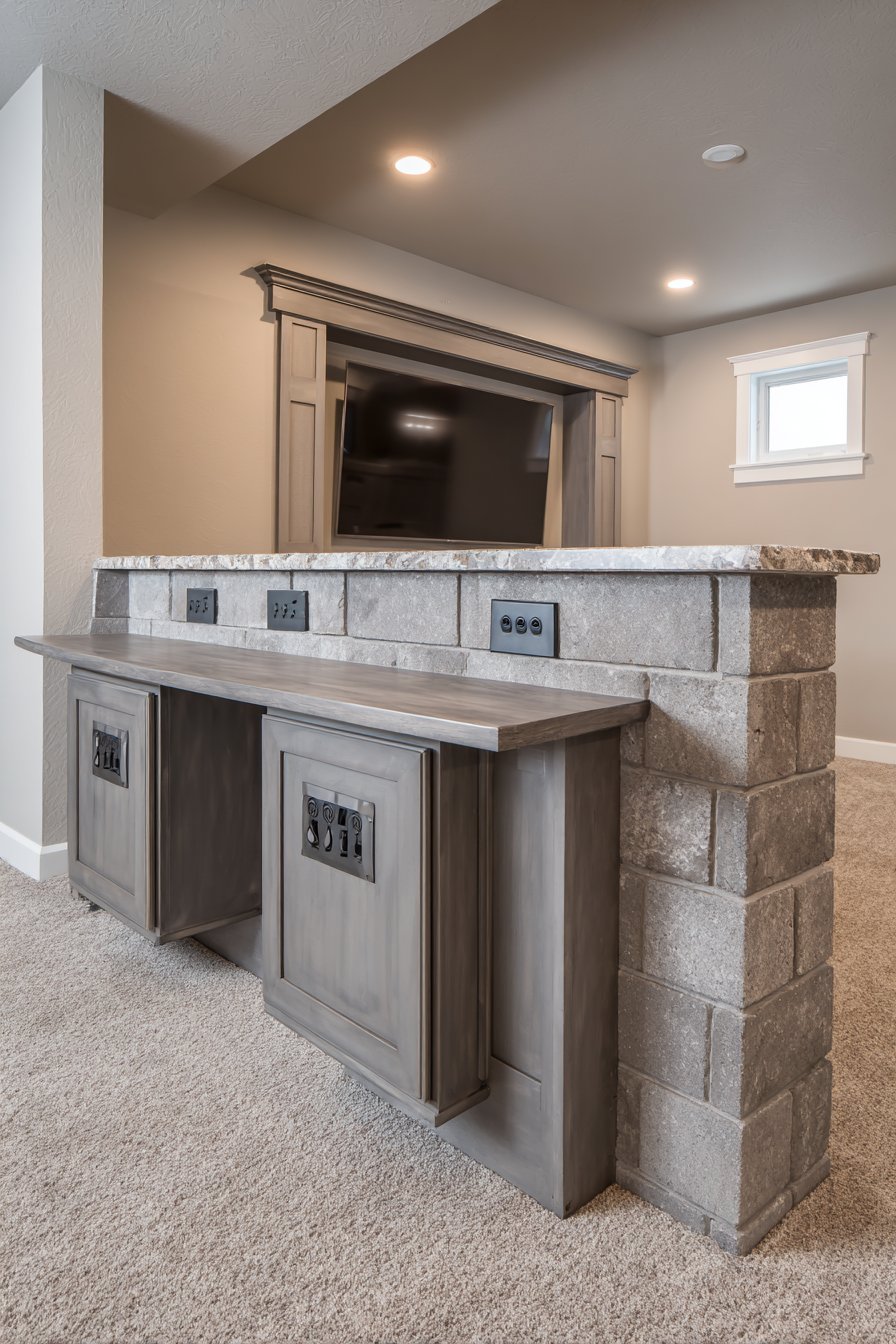
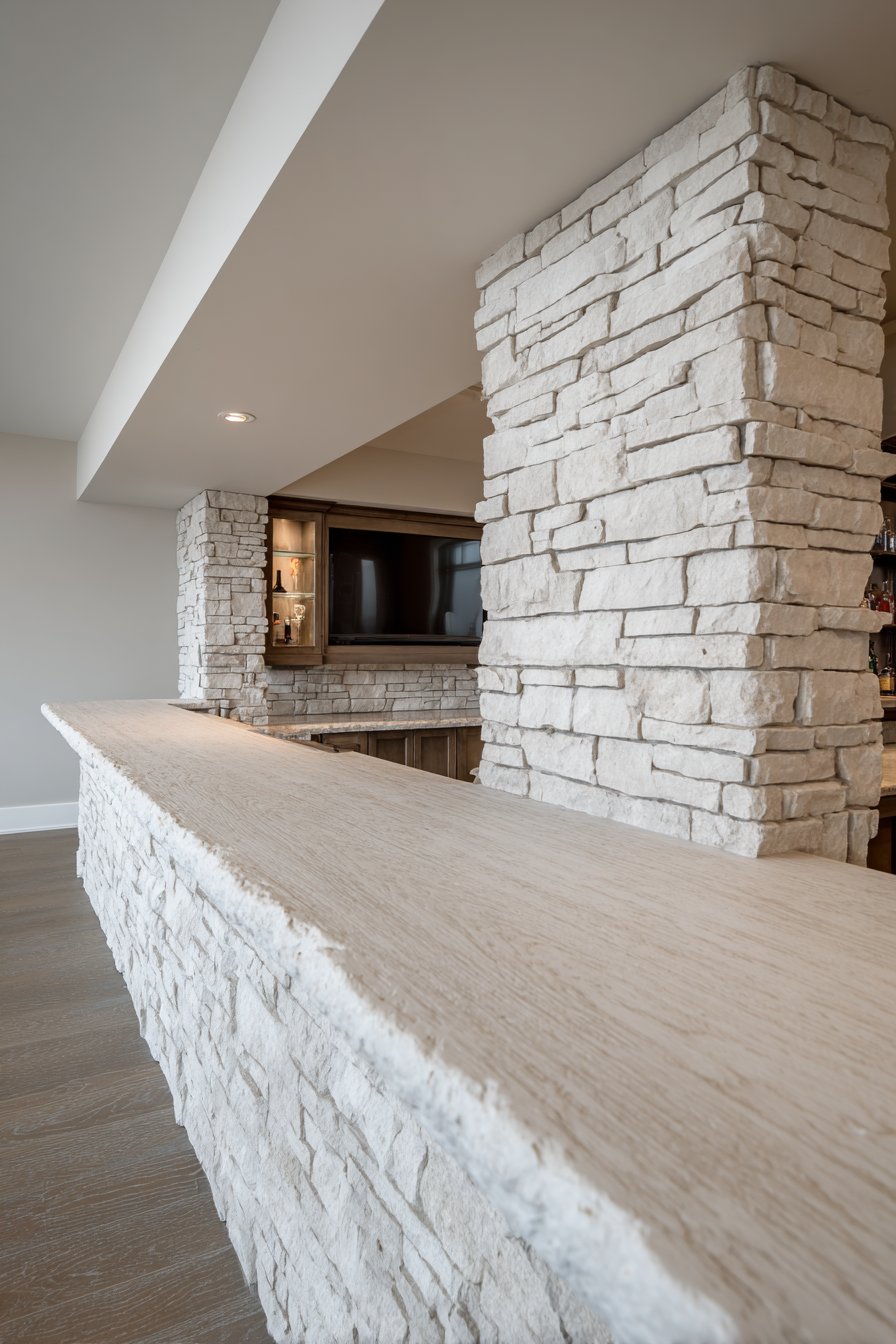
Basement spaces often require different design approaches than main-level rooms, with durability and utility taking precedence alongside aesthetics. This practical half wall designed for a basement recreation room features durable painted concrete block construction that can withstand the wear and tear of active family use. Standing 42 inches tall, the partition divides the gaming area from a dedicated home theater space, creating functional zones within the larger basement while maintaining the open feel that makes recreation rooms so appealing for family gatherings.
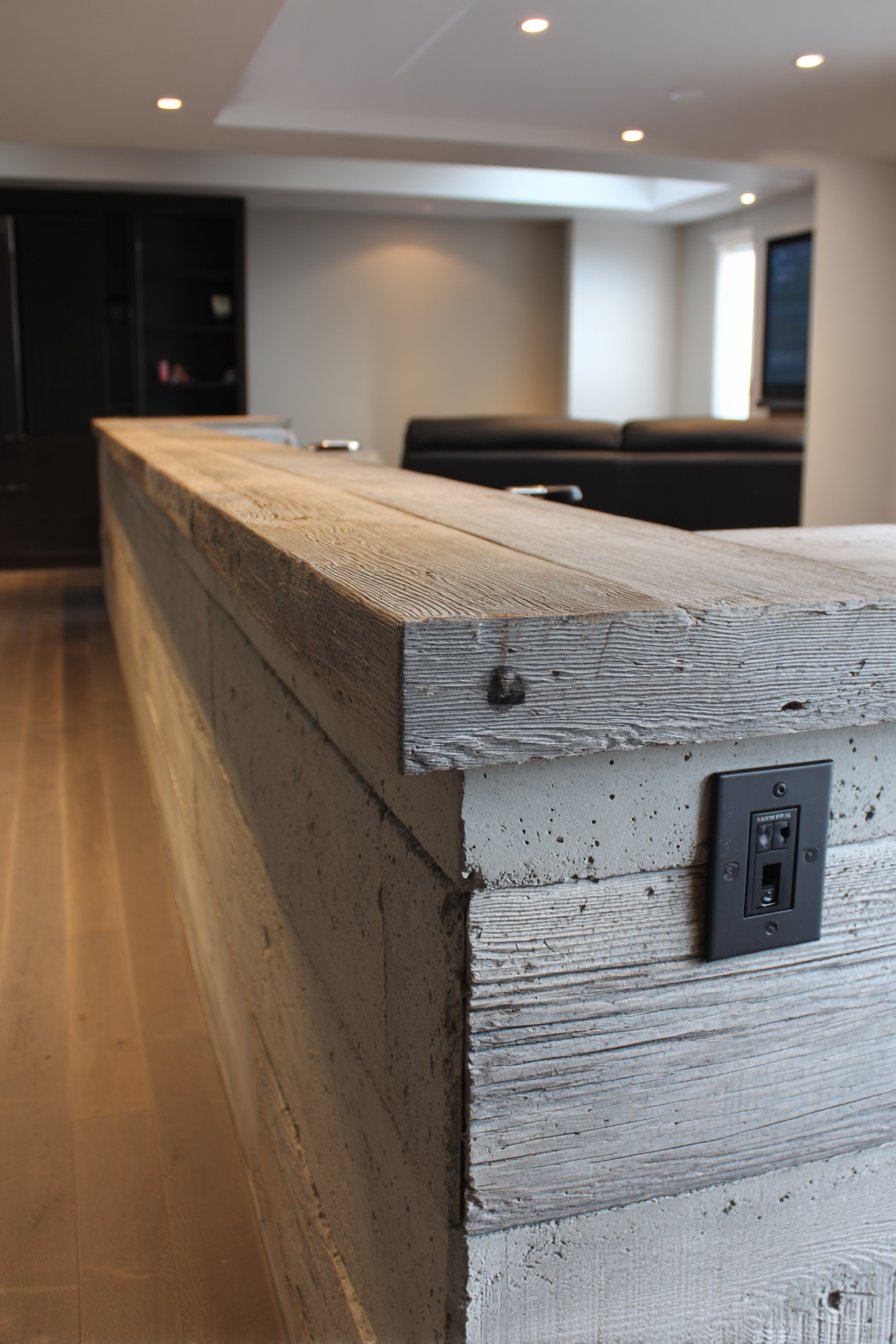
Integrated electrical outlets positioned at convenient heights along the wall face provide power for gaming consoles, charging devices, and entertainment equipment without requiring extension cords stretched across walking paths. This thoughtful electrical planning represents the kind of practical consideration that separates truly functional spaces from merely attractive ones. Cable management cutouts keep technology cords organized and concealed, maintaining a cleaner appearance while facilitating easy reconfiguration when technology inevitably changes or upgrades become necessary.
The laminate wood-grain cap rail provides a casual seating ledge and introduces warmth against the painted block base while offering durability superior to real wood in the potentially humid basement environment. The functional design prioritizes durability and utility without sacrificing aesthetic appeal, proving that practical considerations and attractive design can coexist successfully. Wide-angle interior photography with even lighting shows the smart spatial planning and practical features that make this partition ideal for hardworking family spaces where function matters as much as form.
Key Design Tips:
- Paint concrete block with masonry paint in semi-gloss or satin finish for easy cleaning and moisture resistance
- Install electrical outlets at multiple heights—lower for floor-level equipment, higher for wall-mounted components
- Use commercial-grade laminate for the cap rail in moisture-resistant core materials suitable for basement environments
- Create cable management cutouts at least 2 inches in diameter for easy cord threading
- Consider installing USB charging ports alongside traditional electrical outlets for device convenience
- Apply waterproof paint or sealer to concrete block before finish paint for moisture protection
- Position the partition to work with existing basement columns or support posts for structural efficiency
- Include adequate lighting on both sides of the partition for functional task illumination
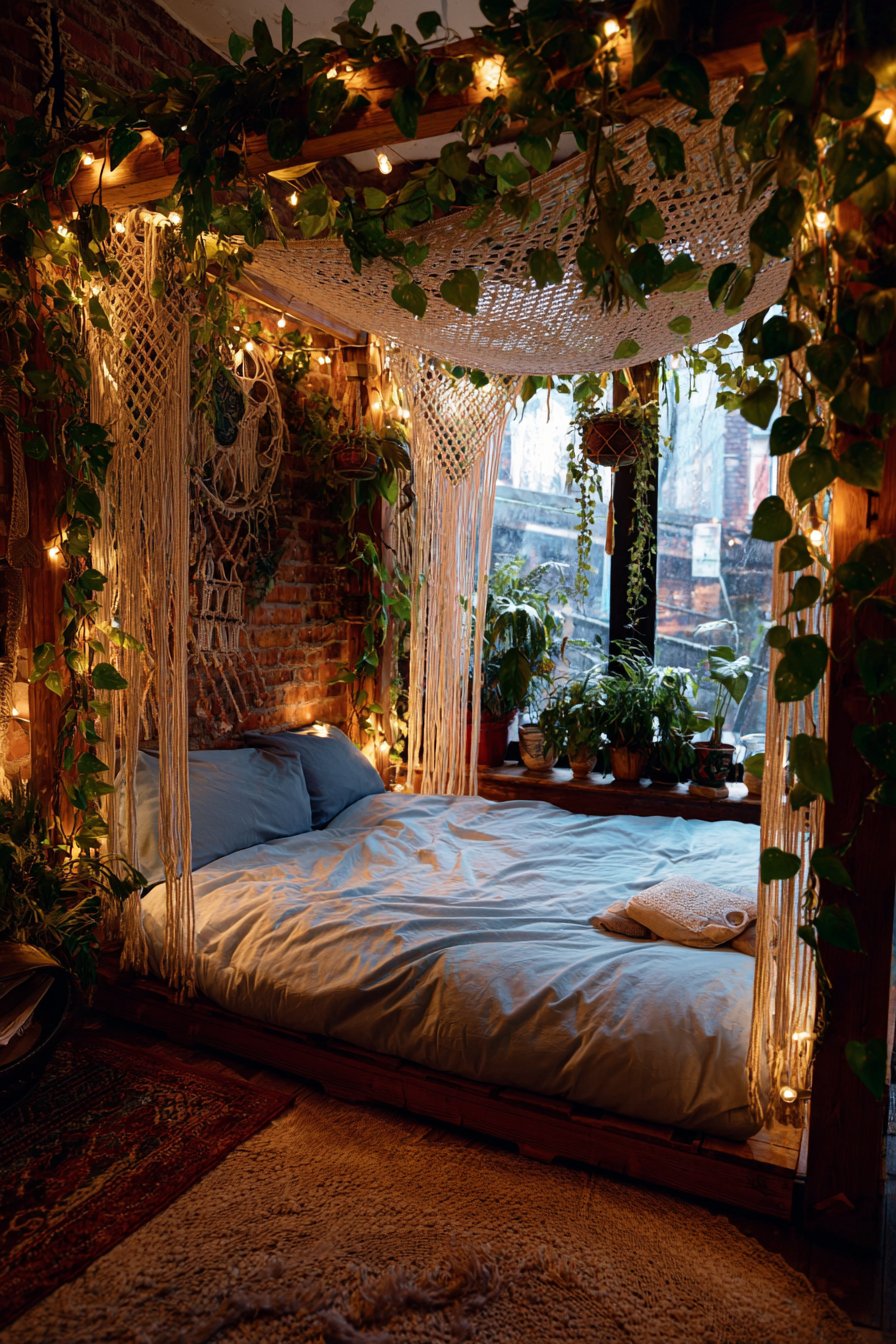
22. Bohemian Macramé Studio Apartment Divider
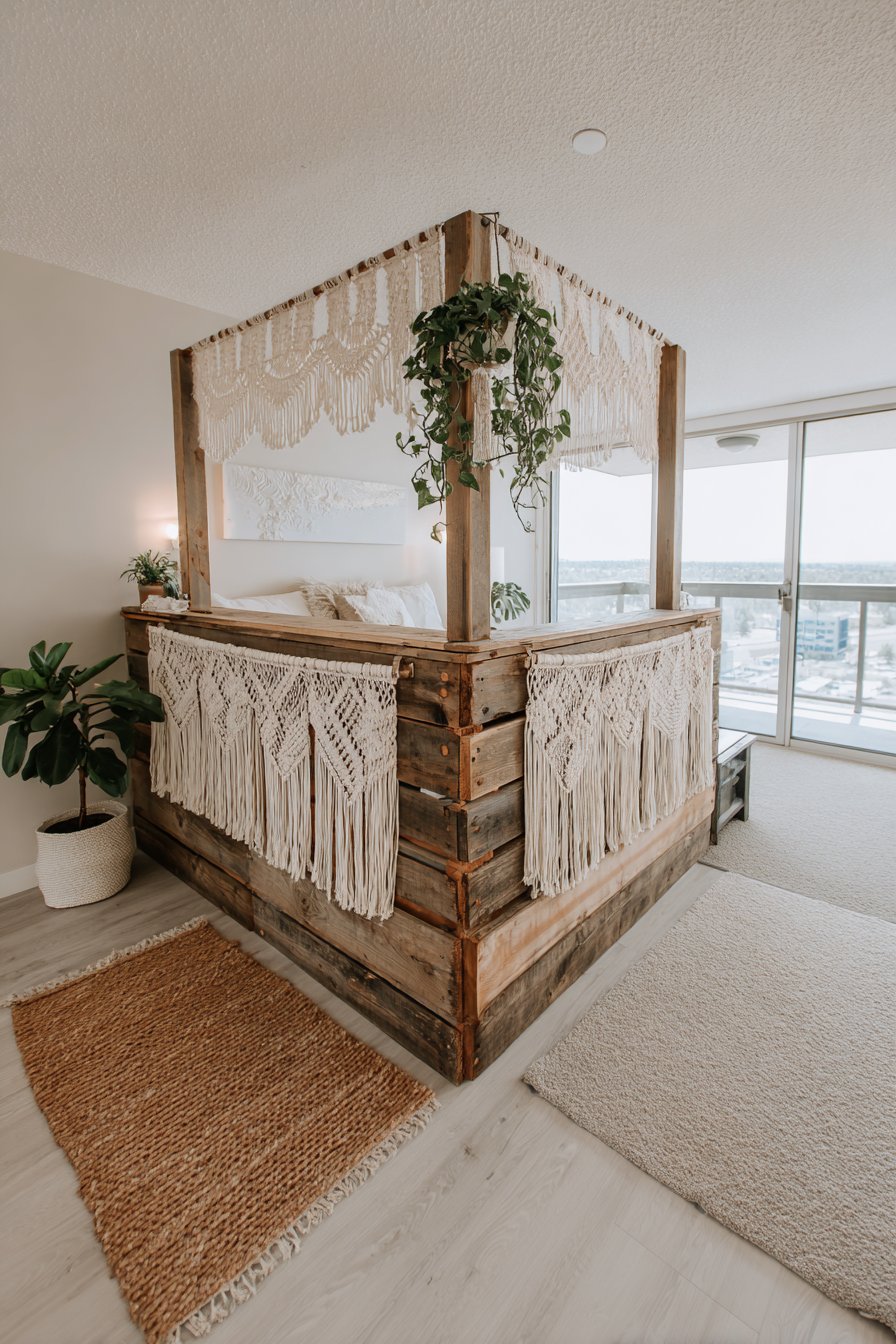
The free-spirited, eclectic aesthetic of bohemian design celebrates handcrafted artistry and global influences, making this unique half wall perfect for creative souls seeking artistic expression in their living spaces. Combining a reclaimed pallet wood base with upper sections draped in handcrafted macramé panels featuring intricate knotwork patterns, this partition creates an artistic separation between sleeping and living areas in a studio apartment. The macramé panels provide visual screening while maintaining airflow and allowing filtered light to pass through, creating gentle privacy without the claustrophobic feeling that solid walls can create in compact spaces.
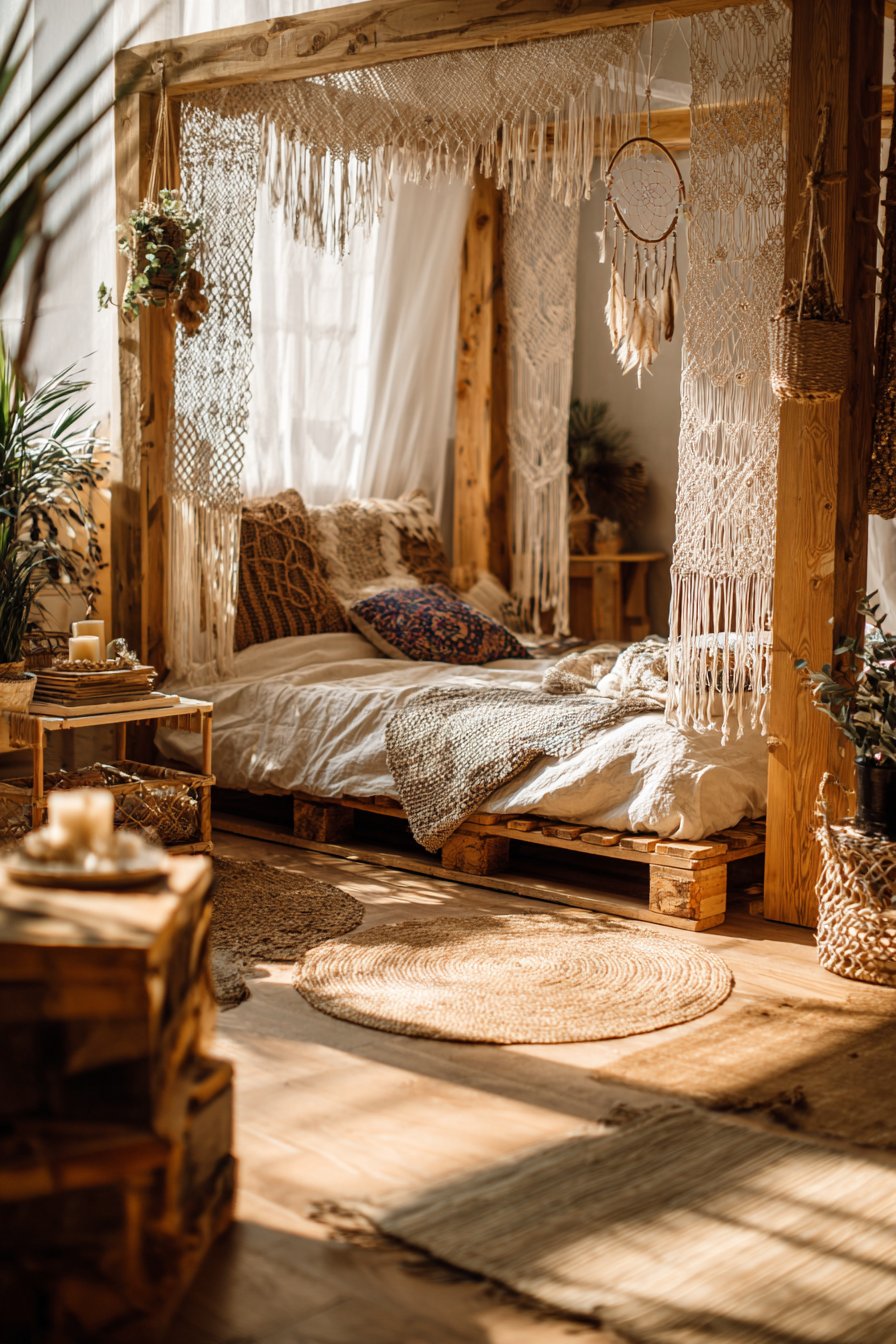
The reclaimed pallet wood base introduces rustic texture and sustainable materials while providing structural support for the decorative macramé panels. Each wood board displays its own history through nail holes, weathering, and color variation, these individual differences adding to the collected, worldly aesthetic that defines bohemian style. Hanging plants and dreamcatchers add to the eclectic atmosphere, their organic forms and cultural significance contributing layers of meaning and personality to the space. Natural fiber rugs in complementary earth tones help define each functional zone while adding warmth and texture underfoot.
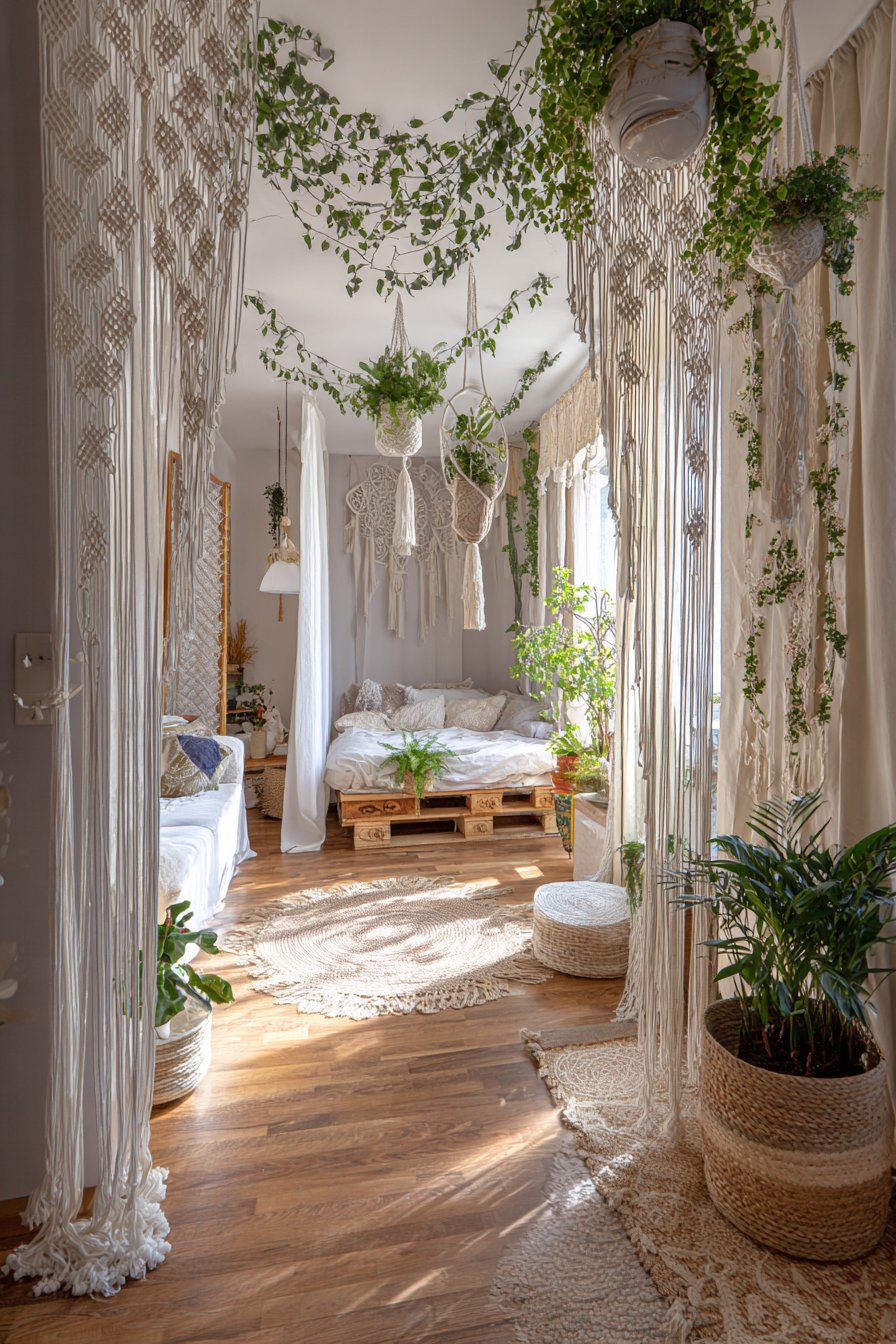
Soft natural lighting creates an inviting, artistic atmosphere that interior photography captures beautifully, emphasizing texture and creative details that make this partition a true artistic statement. The interplay between the solid wood base and the open macramé panels creates visual rhythm and prevents the partition from feeling too heavy despite its function as a room divider. This design demonstrates how bohemian aesthetics can transform purely functional elements into artistic expressions that reflect personal creativity and global design influences.
Key Design Tips:
- Create or commission macramé panels in cotton cord for authentic texture and durability
- Attach macramé securely to the wood base using hidden hardware for clean appearance
- Select reclaimed wood carefully and clean thoroughly before installation to remove splinters and debris
- Vary the macramé patterns across panels for more authentic handcrafted appearance
- Hang plants in lightweight containers to avoid stressing the macramé or wood structure
- Layer multiple natural fiber rugs in complementary colors and patterns for authentic bohemian layering
- Position the partition to maximize natural light filtering through the macramé panels
- Embrace asymmetry and collected imperfection rather than perfect uniformity
23. Colonial Panel and Spindle Hallway Divider
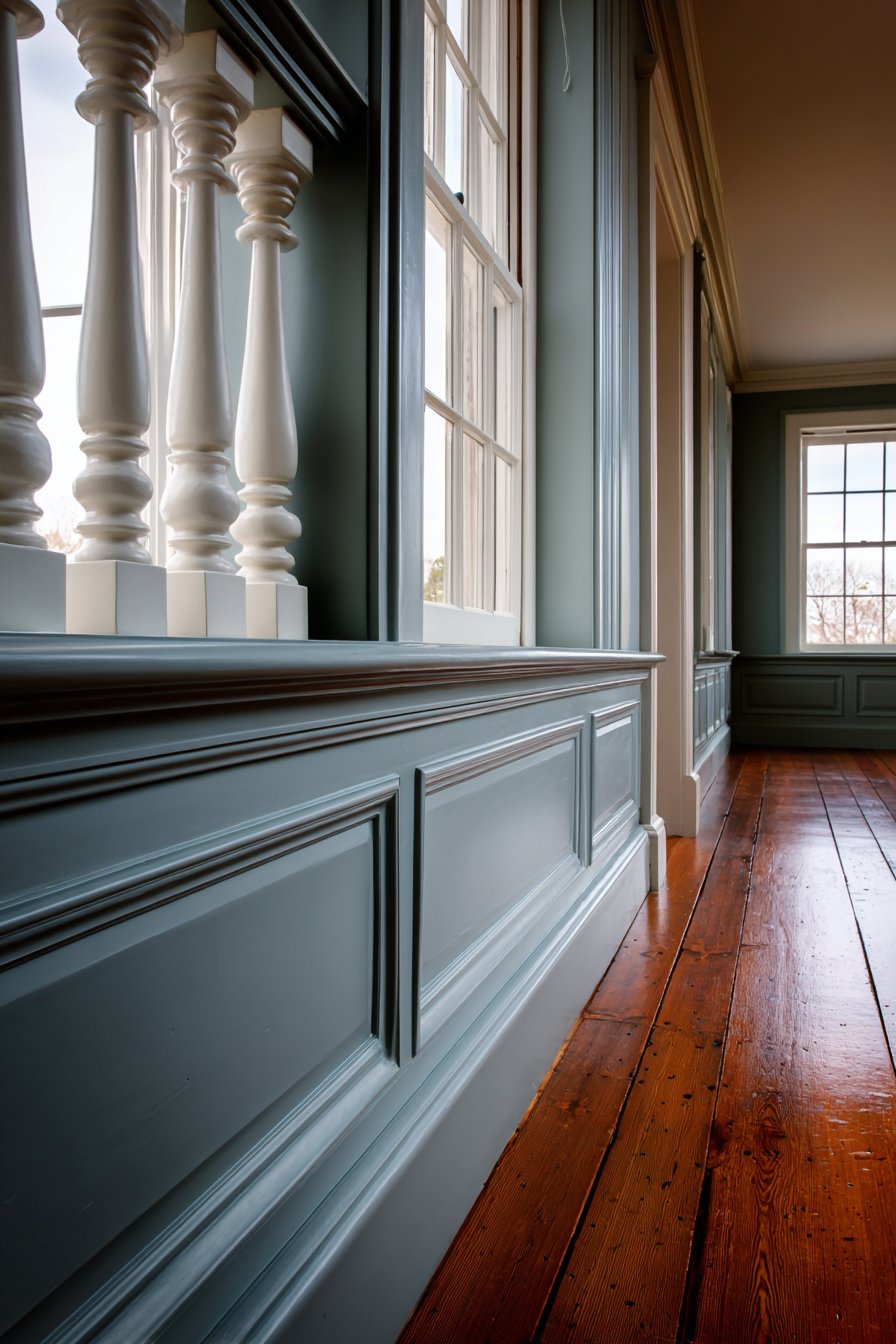
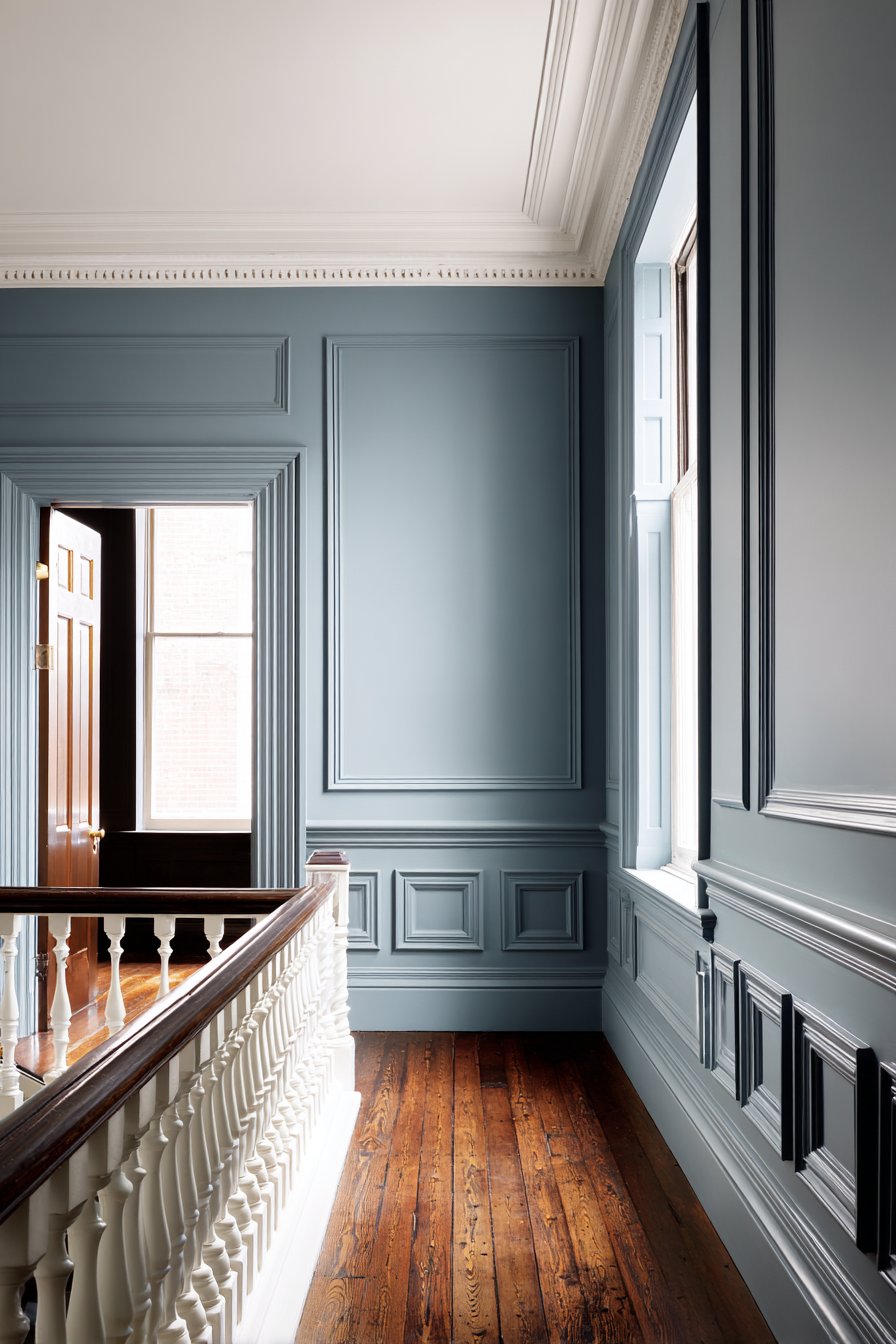
Traditional American colonial architecture emphasized proper proportion, classical detailing, and quality craftsmanship—principles beautifully embodied in this formal half wall separating a proper parlor from the main hallway. The raised panel wainscoting in the lower section painted in historic Benjamin Moore blue-gray demonstrates authentic period color choices while the upper row of evenly spaced white-painted turned balusters creates a light, open screening effect. These turned spindles represent classical woodworking tradition, their gently curved profiles showing the skill required to produce identical elements through lathe work.
Chair rail molding and baseboard details meticulously match the home’s original millwork, creating visual continuity that suggests the half wall has always been part of the architecture rather than a later addition. This attention to historical detail and craftsmanship reflects the colonial appreciation for quality execution and proper architectural proportions. The hardwood flooring in rich brown tones completes the period-appropriate aesthetic while providing durable, maintainable surfaces that will develop beautiful patina over decades of use.
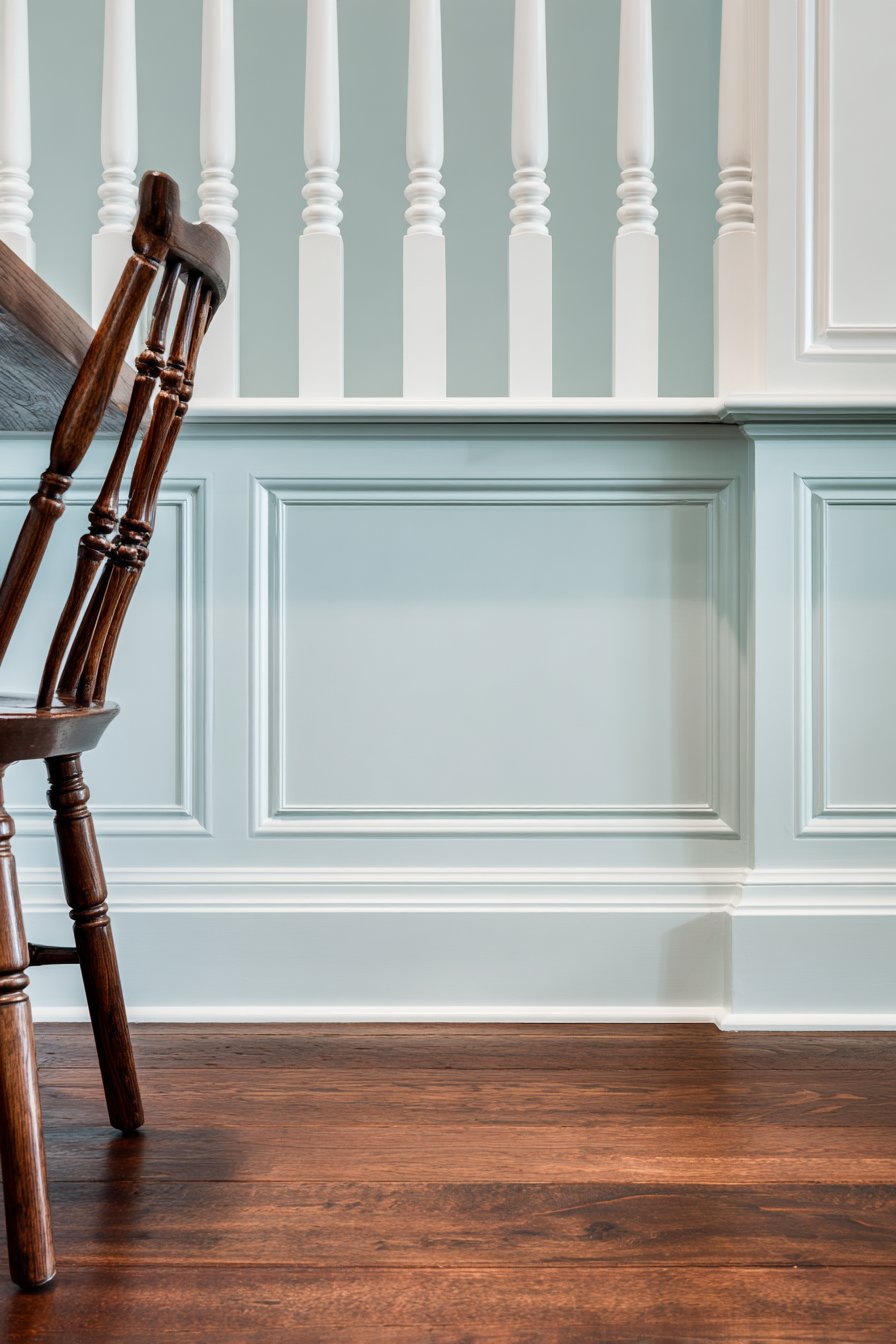
Interior photography with natural window light emphasizes traditional architectural details, capturing the subtle shadows cast by the raised panels and turned spindles that give the wall dimensional depth. The historic blue-gray paint color—carefully researched to match authentic colonial palettes—provides sophisticated color without the stark white-on-white scheme that can feel cold in formal spaces. This partition demonstrates how colonial design principles of proportion, quality materials, and honest craftsmanship create architecture that remains beautiful and relevant centuries after these principles were first established.
Key Design Tips:
- Research authentic colonial paint colors through historic preservation resources for period accuracy
- Match molding profiles exactly to existing trim for seamless integration with original architecture
- Space turned balusters according to historical building codes (typically no more than 4 inches apart)
- Use premium hardwoods like poplar or maple for painted spindles to ensure smooth finish without grain raise
- Apply multiple thin coats of paint with light sanding between coats for furniture-quality finish
- Select raised panel profiles that match the formality level of the overall home
- Stain or finish hardwood floors to complement rather than match the woodwork tones
- Maintain consistent reveal widths in all molding applications for professional appearance
24. Tropical Stacked Stone Indoor-Outdoor Partition
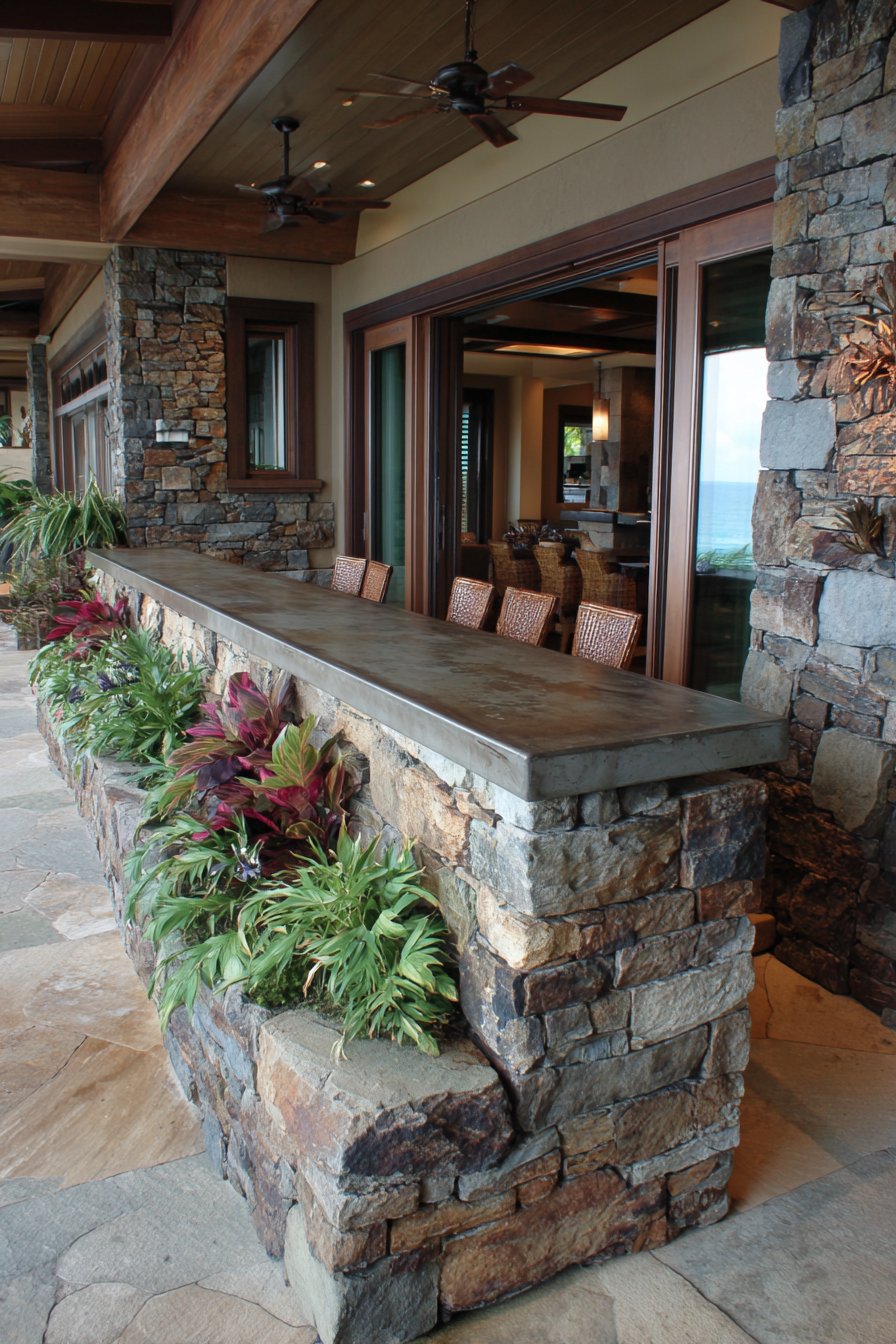
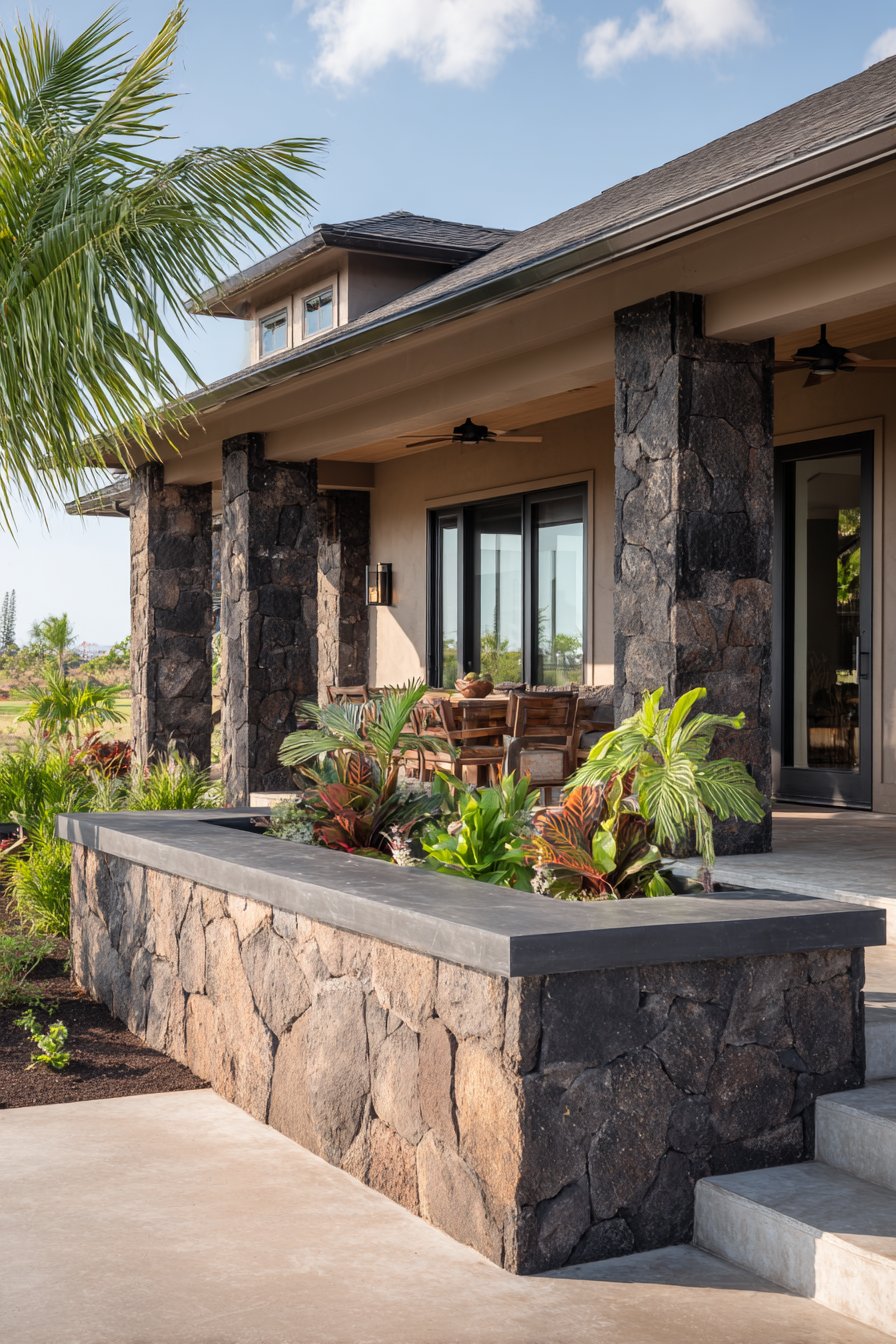
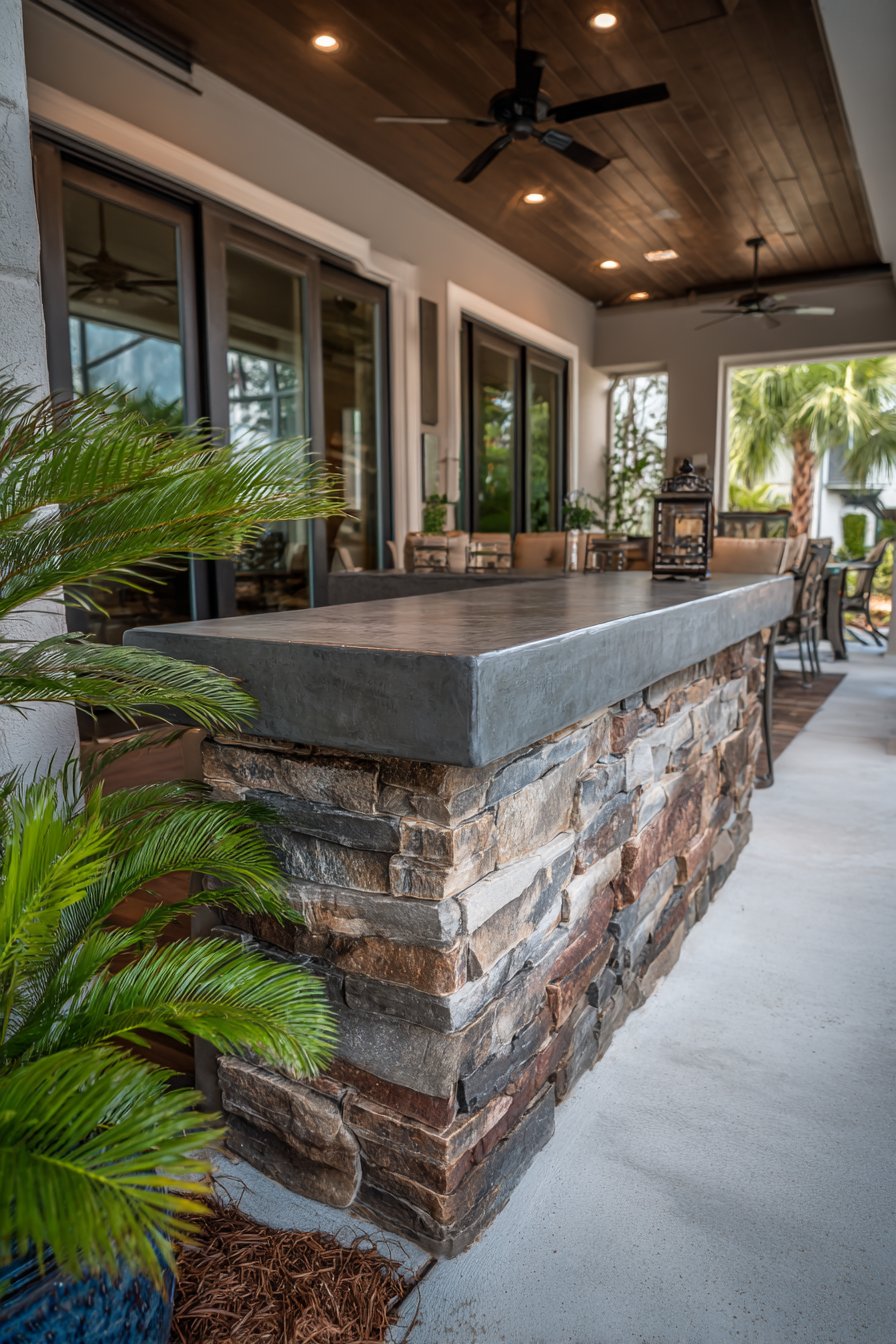
The boundary between indoor and outdoor living blurs beautifully in tropical and resort-style homes, a design philosophy perfectly embodied in this half wall using natural stone veneer in stacked ledgestone pattern. Creating textural separation between an indoor-outdoor living space and interior dining area, this partition celebrates natural materials while maintaining the flowing, connected quality essential to tropical design. The earth-tone stones in warm grays and tans with natural variation create organic visual interest, each stone’s unique shape and color contributing to an overall composition that celebrates rather than conceals nature’s irregularity.
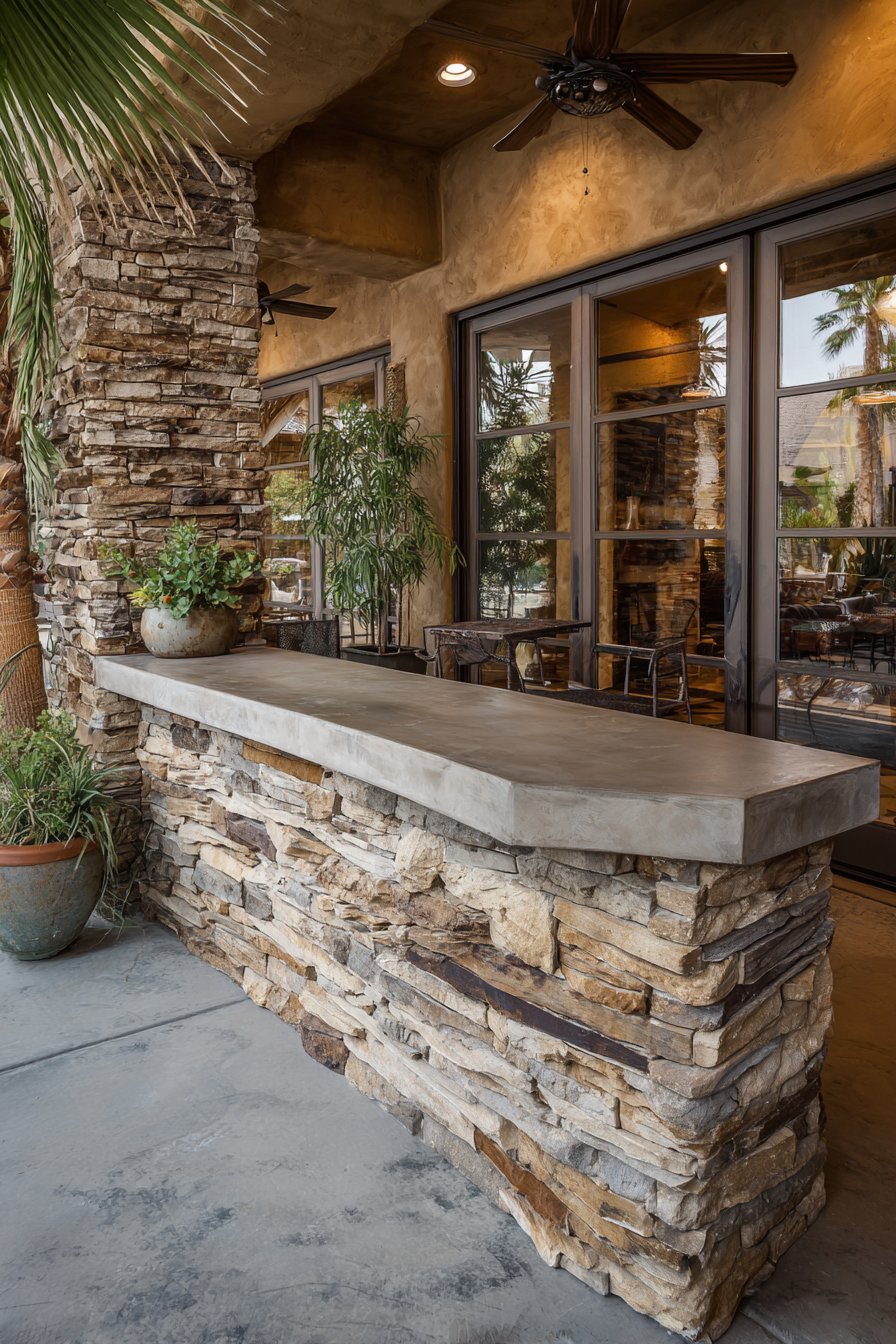
The smooth concrete cap in charcoal finish provides clean contrast to the rough stone texture below while offering a practical surface that sheds water and resists staining—important considerations in indoor-outdoor transition zones. Tropical plants flanking both sides of the partition introduce lush greenery that reinforces the connection to nature while ceiling fans circulate air, maintaining comfort in the warm climate. Large sliding glass doors visible beyond the partition blur indoor-outdoor boundaries even further, creating seamless transitions between climate-controlled interior spaces and screened outdoor living areas.
Wide-angle photography captures the resort-style ambiance and natural material richness that makes tropical design so appealing, particularly to those living in warm climates or seeking to bring vacation-style relaxation into everyday life. The varied stone textures create visual depth that changes throughout the day as shifting light emphasizes different surfaces and casts evolving shadow patterns. This approach to half wall design demonstrates how natural materials and thoughtful positioning can create architecture that feels rooted in place and climate rather than imported from incompatible design traditions.
Key Design Tips:
- Select natural stone with color variation appropriate to your regional stone types for authentic appearance
- Install stone veneer over moisture-resistant substrate suitable for high-humidity environments
- Use polymer-modified mortar for superior adhesion in indoor-outdoor transition zones
- Create the concrete cap with integral color rather than surface coating for lasting color consistency
- Position the partition to capture prevailing breezes and enhance natural ventilation
- Choose tropical plants that thrive in your specific climate and light conditions
- Seal stone surfaces with penetrating sealer to facilitate cleaning and prevent staining
- Ensure adequate drainage behind the stone veneer to prevent moisture problems
25. Scandinavian Birch Plywood Children’s Partition
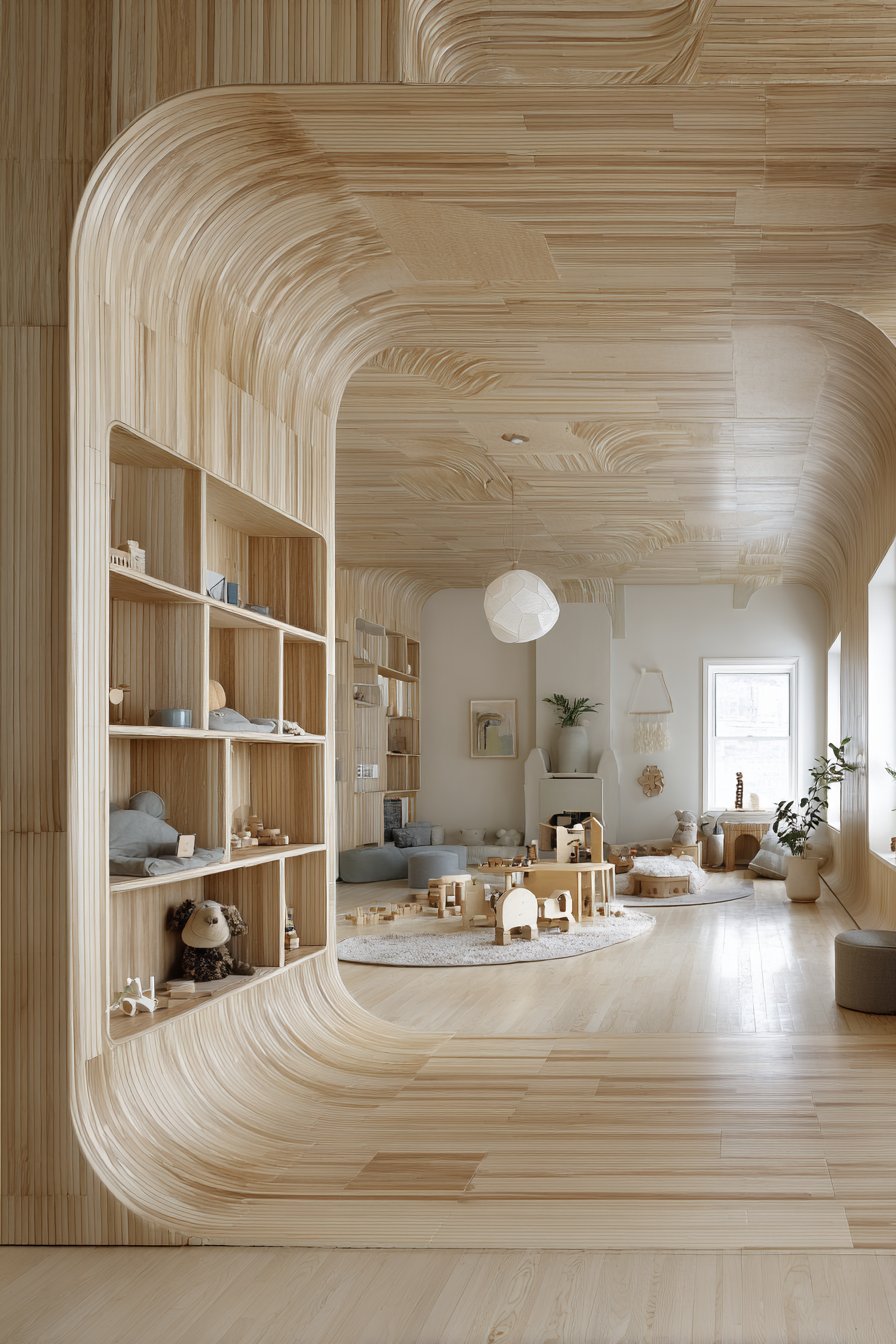
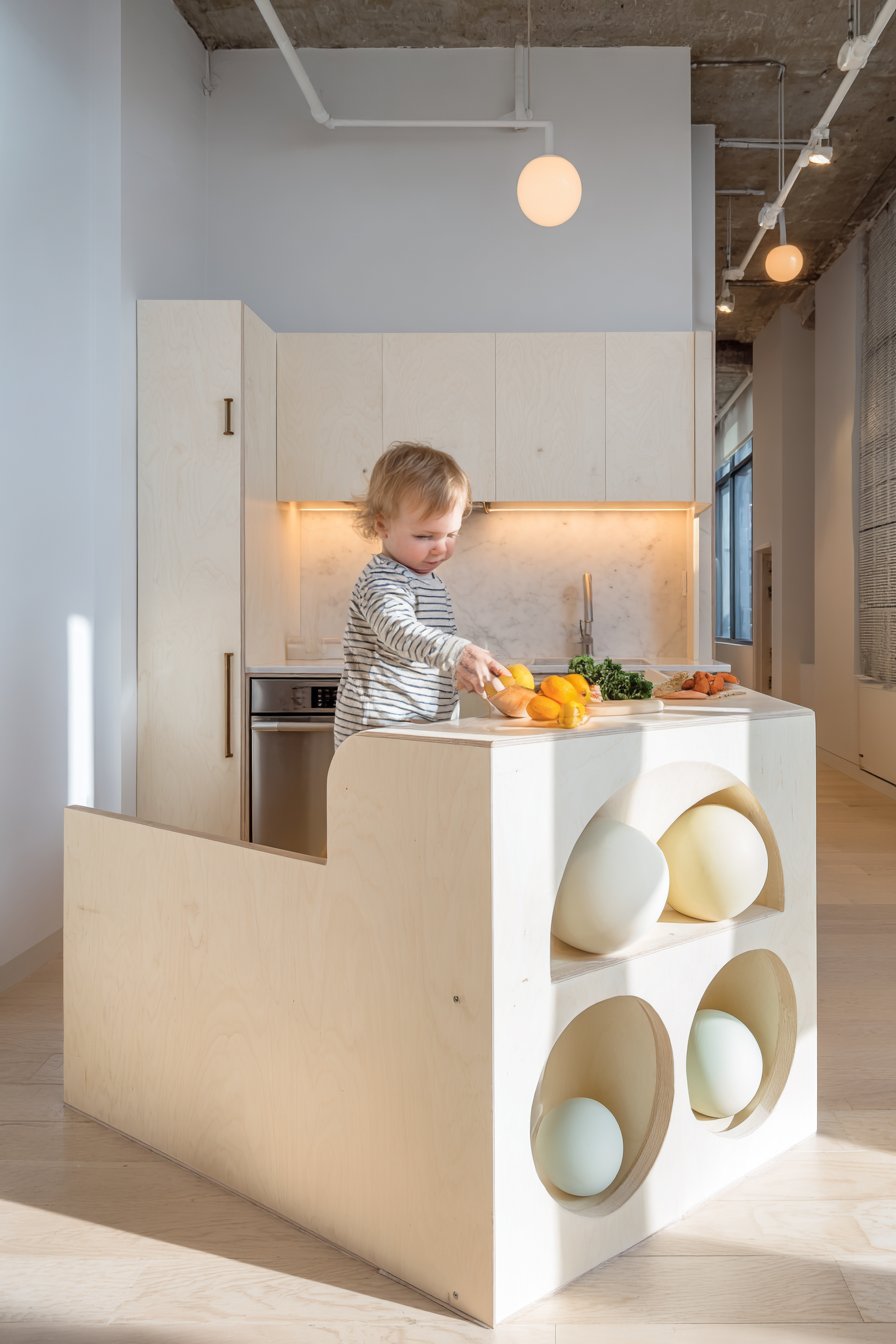
Child-friendly spaces require special design considerations that balance safety, functionality, and aesthetics while creating environments that support play and development. This Scandinavian-inspired half wall emphasizes light wood tones and functional simplicity through birch plywood construction with visible edge grain creating natural striped patterns. Separating a children’s play area from the main living space, the partition stands 36 inches tall—low enough for parental sight lines while high enough to create distinct zones. Rounded corners throughout ensure safety, eliminating sharp edges that pose hazards in active play environments.
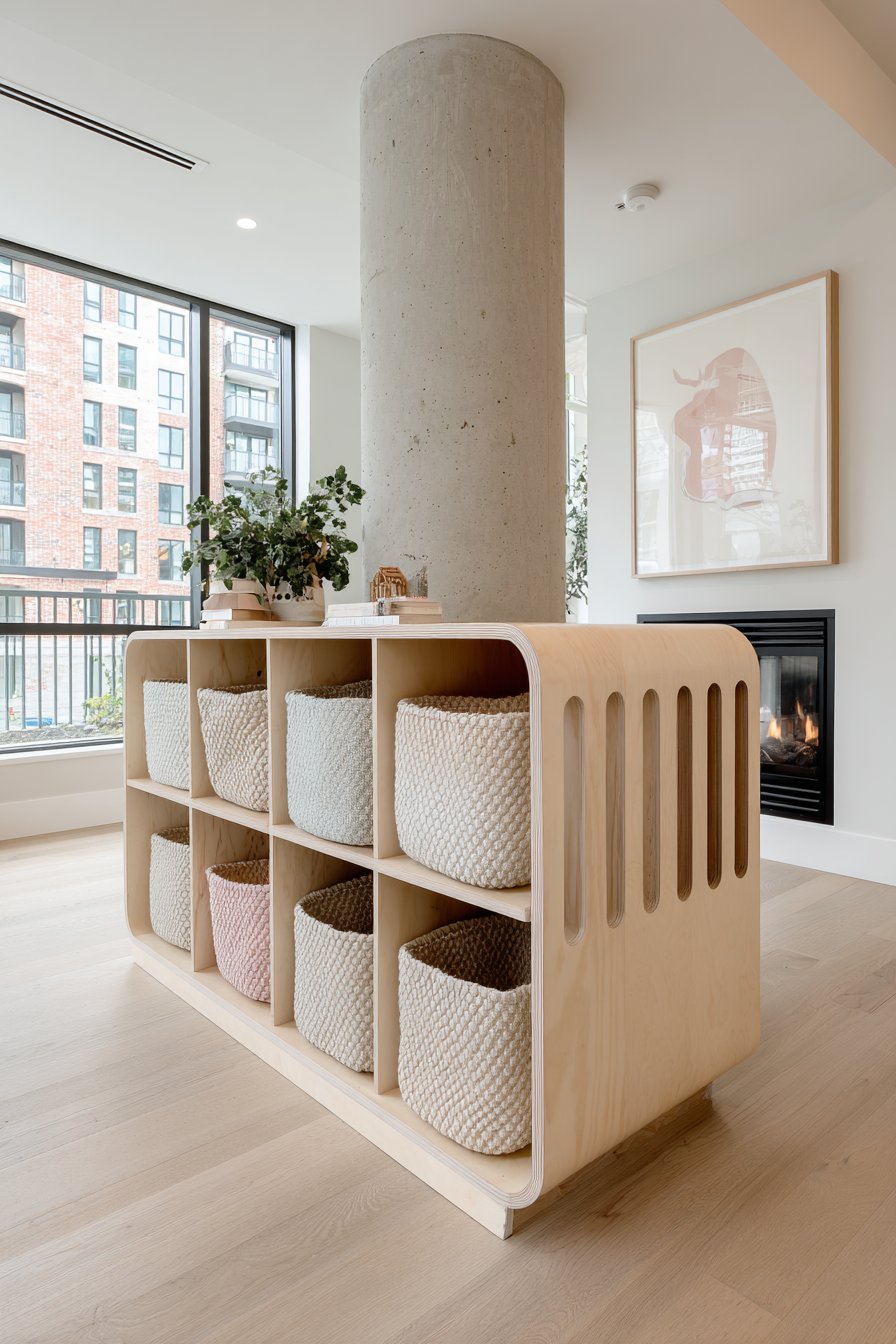
Open cubbies integrated into the base provide accessible toy storage with fabric bins in soft pastels—perhaps mint green, powder blue, and pale pink—that keep toys organized while adding gentle color appropriate to children’s spaces. These storage cubbies serve the crucial purpose of teaching organization skills while making cleanup easier and more appealing to young children. The design balances child-friendly functionality with sophisticated aesthetics, proving that children’s spaces need not sacrifice design quality or adult visual appeal to serve their younger inhabitants well.
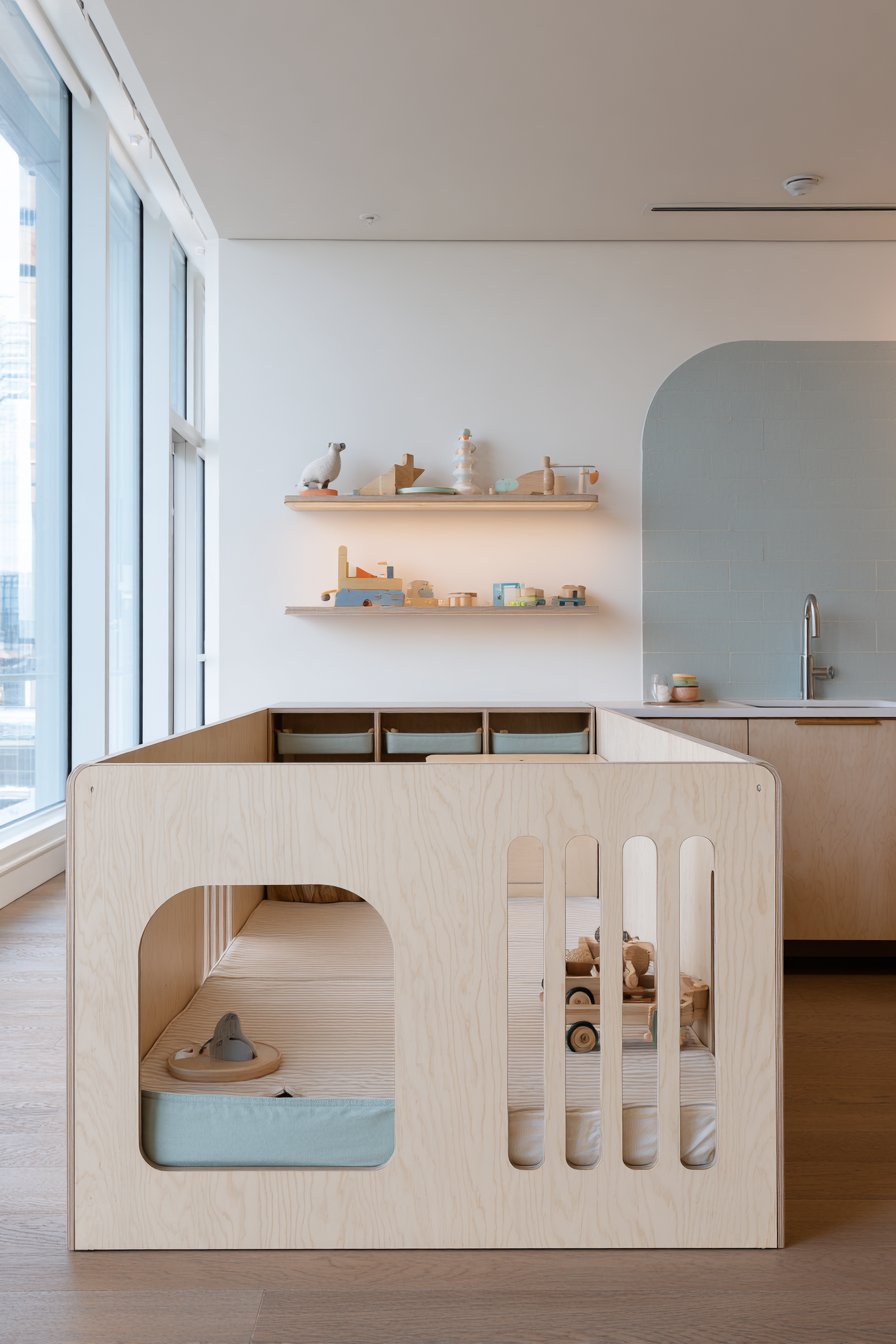
Interior photography with abundant natural light showcases the bright, airy Nordic design principles that make Scandinavian spaces feel so welcoming and optimistic. The light birch plywood reflects and multiplies available natural light, creating spaces that feel larger and more cheerful than their actual square footage might suggest. The visible plywood edge grain adds natural pattern and visual interest without requiring additional decoration or finish details. This approach demonstrates how Scandinavian design principles of simplicity, natural materials, and functional beauty create ideal environments for children that adults can appreciate equally.
Key Design Tips:
- Use Baltic birch plywood for superior quality with void-free cores and consistent appearance
- Round all corners and edges to at least 1/4 inch radius for child safety
- Apply low-VOC or zero-VOC finishes to protect wood while maintaining healthy indoor air quality
- Size cubby openings to accommodate standard storage bins for easy organization
- Install the partition securely to prevent tipping if children climb or pull on the structure
- Choose washable fabric bins that can be easily cleaned when inevitably soiled
- Position the partition to maintain clear sight lines from adult seating areas for supervision
- Use furniture-grade construction with proper joinery for durability under active use
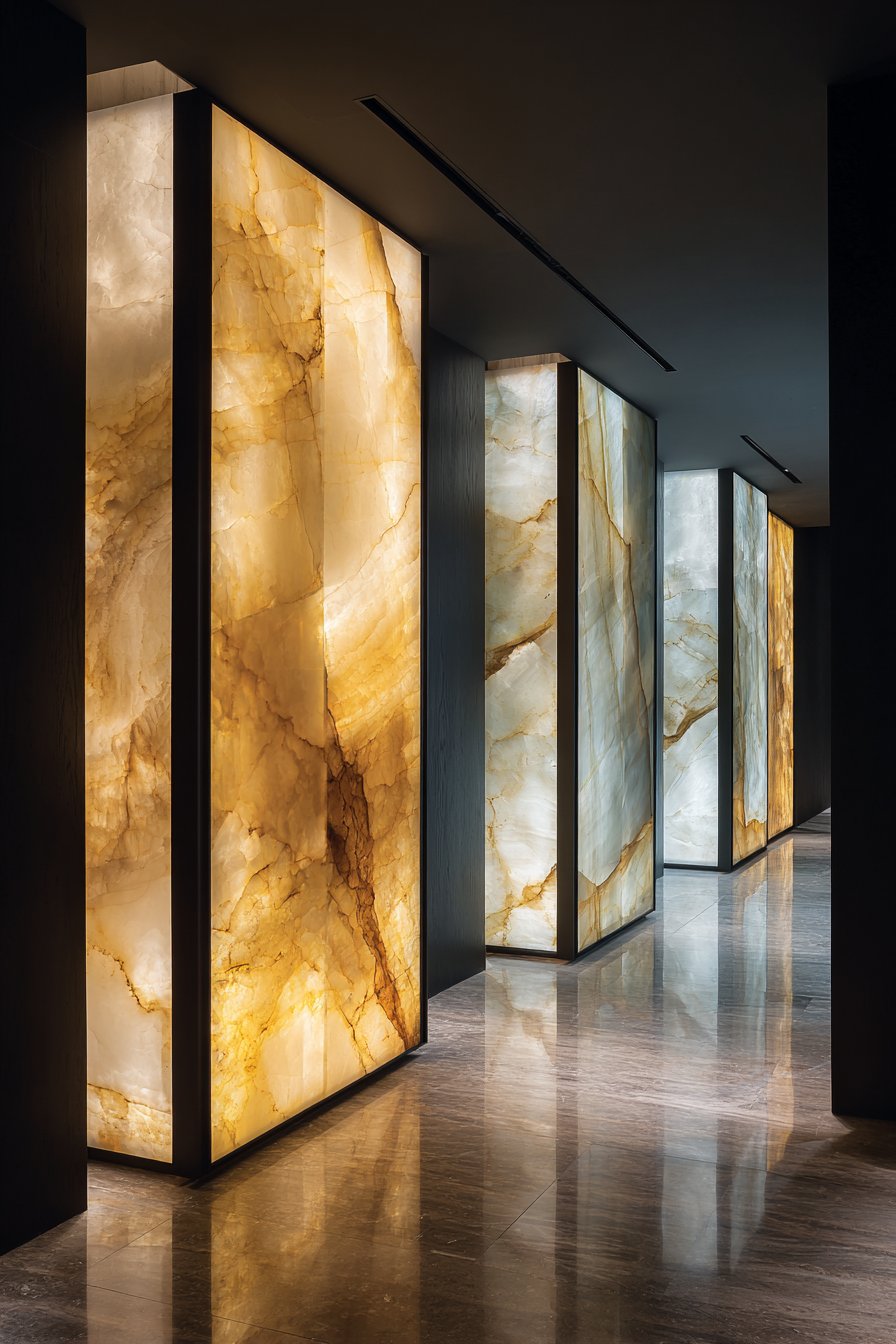
26. Luxury Backlit Onyx Master Suite Partition
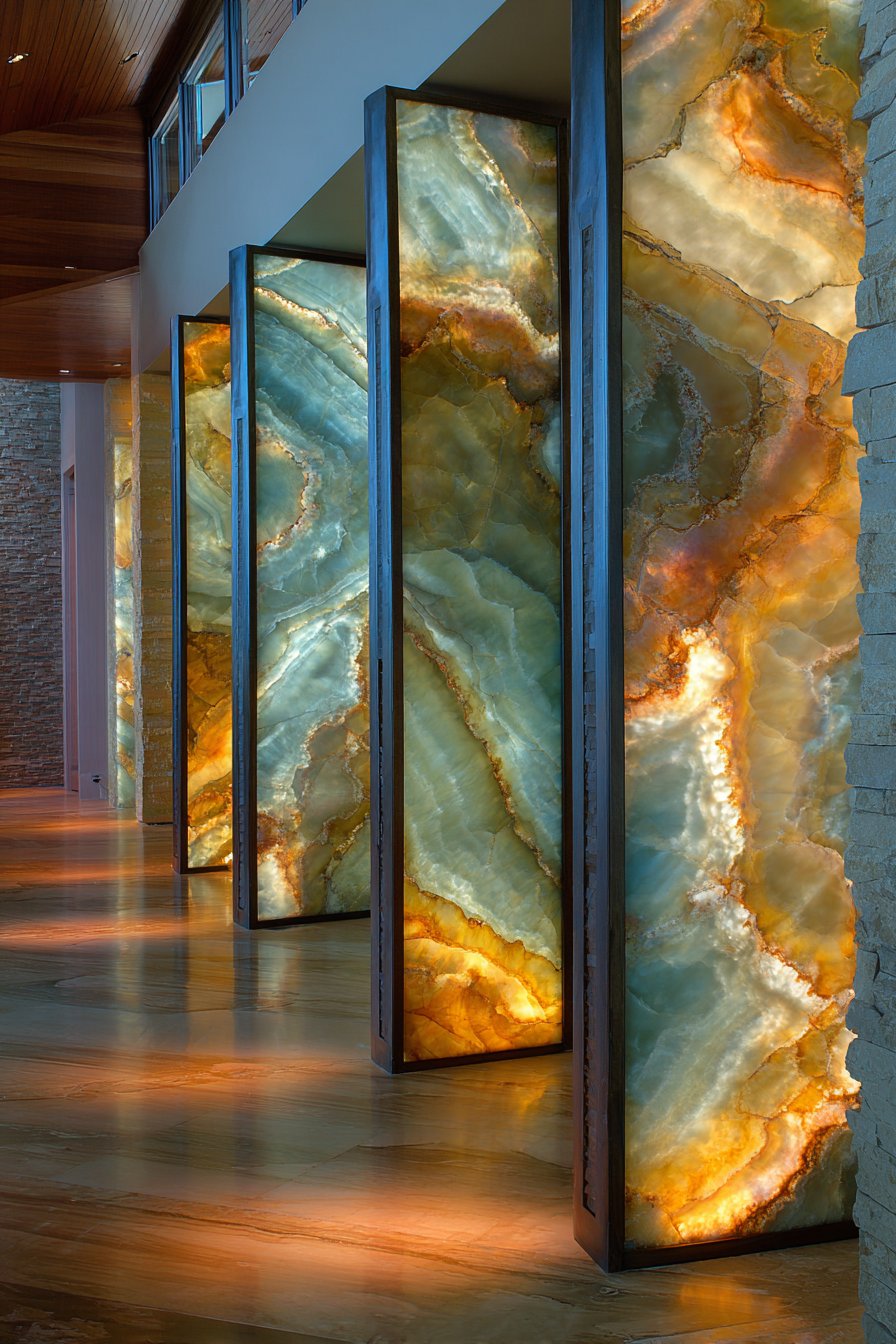
Dramatic luxury design sometimes requires bold material choices and striking visual effects, perfectly exemplified in this stunning half wall incorporating backlit onyx panels. Creating a glowing, theatrical partition between a master suite and spa bathroom, this design showcases honey-colored onyx slabs with distinctive natural veining mounted in slim dark metal frames. LED backlighting installed behind the translucent stone highlights the material’s natural patterns while creating an ethereal glow that transforms the partition into a luminous focal point rather than a simple room divider.
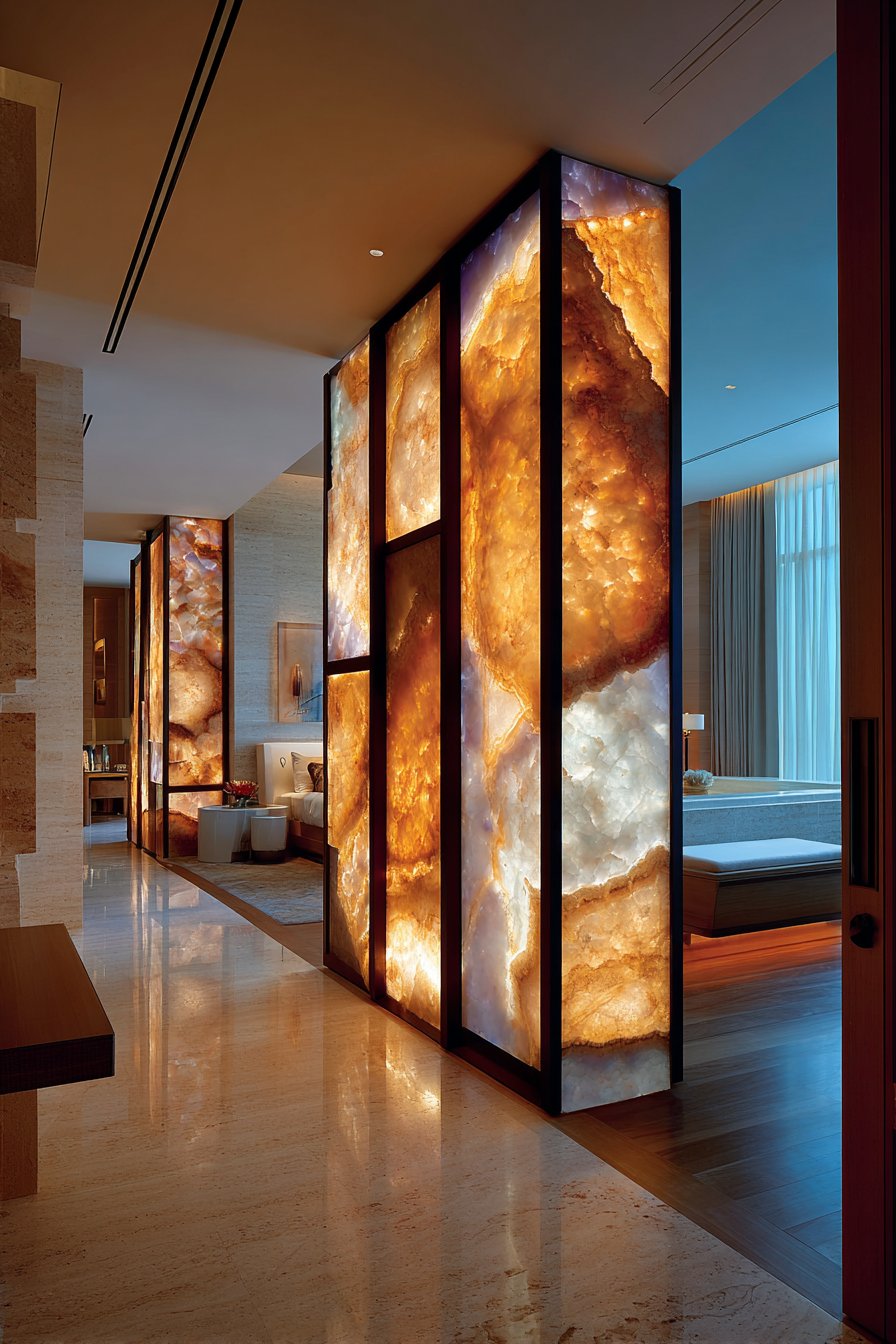
The ethereal quality created by light passing through the semi-transparent onyx creates ambiance while providing privacy—the backlit stone obscures direct sight lines while its glowing presence fills the space with warm, flattering illumination. Polished marble flooring in complementary honey and cream tones extends throughout both the bedroom and bathroom, creating visual continuity while providing luxurious, cool surfaces underfoot. Minimal furnishings in simple, refined profiles allow the dramatic onyx partition to command attention without competition from busy or ornate secondary elements.
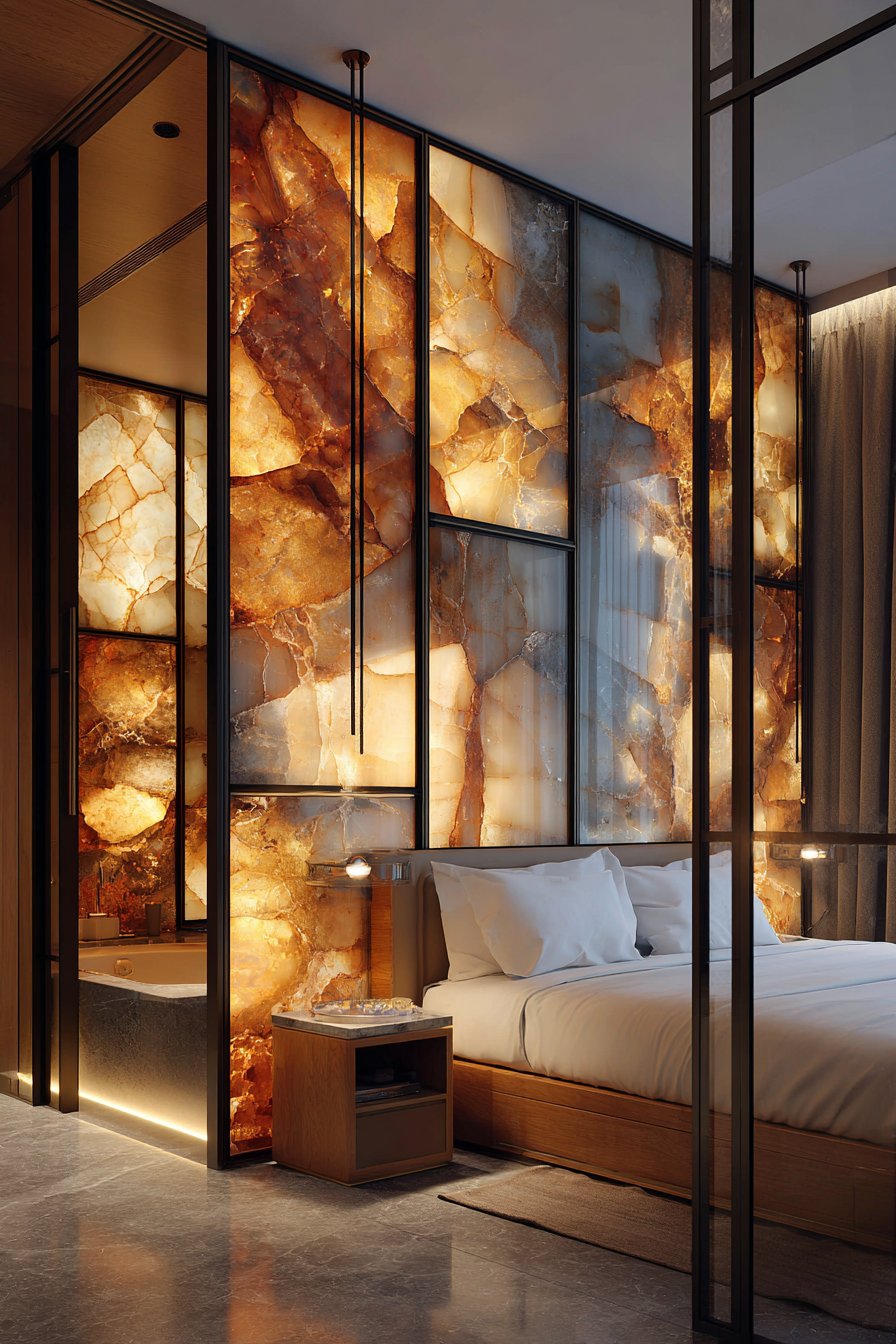
Professional interior photography with carefully controlled lighting emphasizes the luminous material quality and sophisticated design, demonstrating how natural stone can transcend its traditional role as structural material to become decorative art. The natural veining patterns within the onyx create unique compositions in each panel, these geological formations representing millions of years of mineral deposition now revealed and celebrated through backlighting. This approach to half wall design proves that when budgets allow for premium materials and dramatic effects, the results can transform ordinary spatial divisions into extraordinary architectural moments.
Key Design Tips:
- Select onyx slabs with translucency adequate for backlighting effects—test samples with light behind before committing
- Use LED strip lighting designed for backlit applications with even light distribution
- Install onyx panels with adequate air space behind for heat dissipation from LED lighting
- Choose slim metal frames that minimize visual obstruction while providing necessary structural support
- Consider the color temperature of LED lighting—warm white typically complements honey-colored onyx best
- Apply protective sealer to onyx surfaces to prevent staining while maintaining translucency
- Install dimming controls to adjust the backlight intensity for different times of day and moods
- Budget appropriately—backlit onyx represents a significant material investment requiring professional installation
27. Urban Loft Corrugated Metal Partition
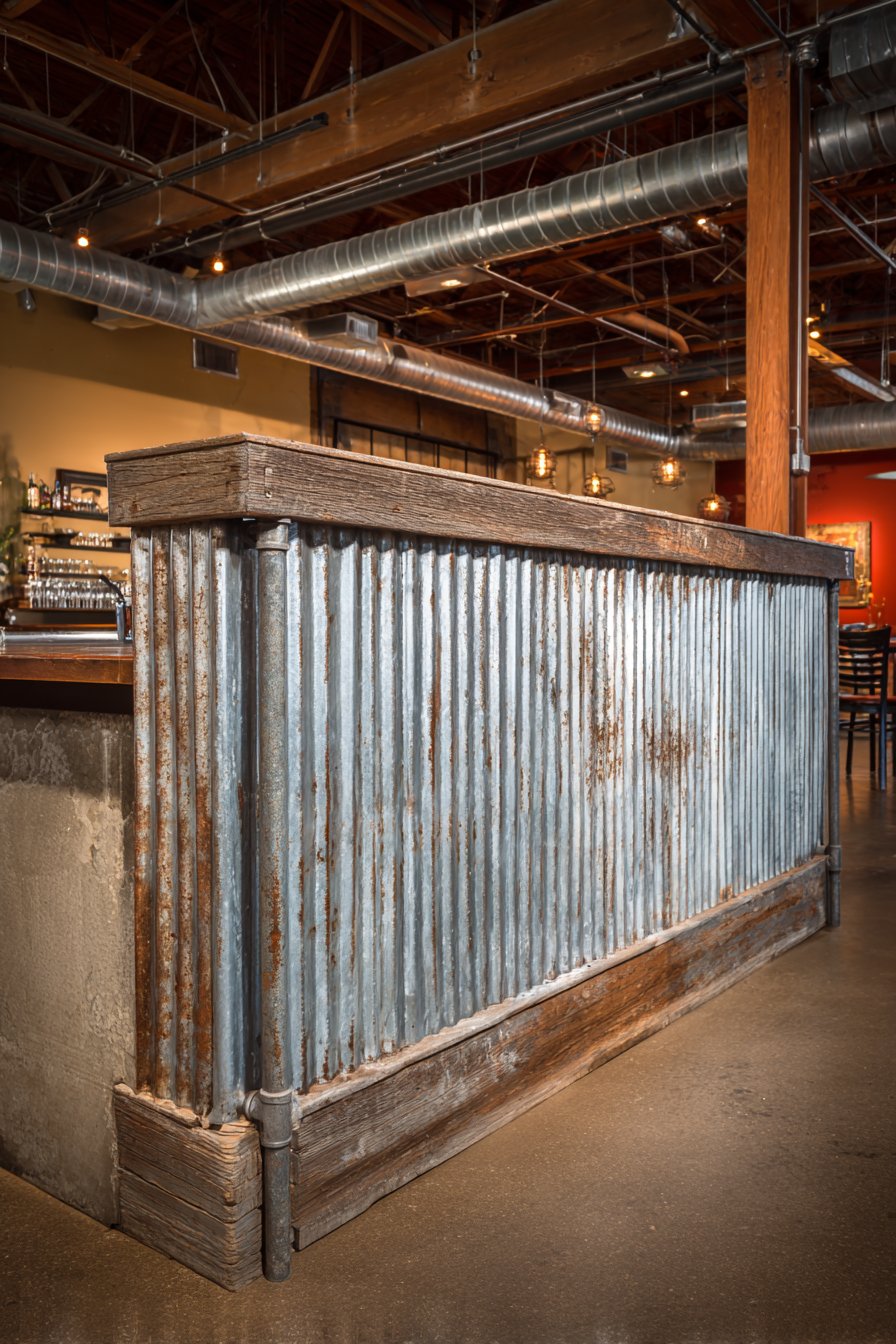
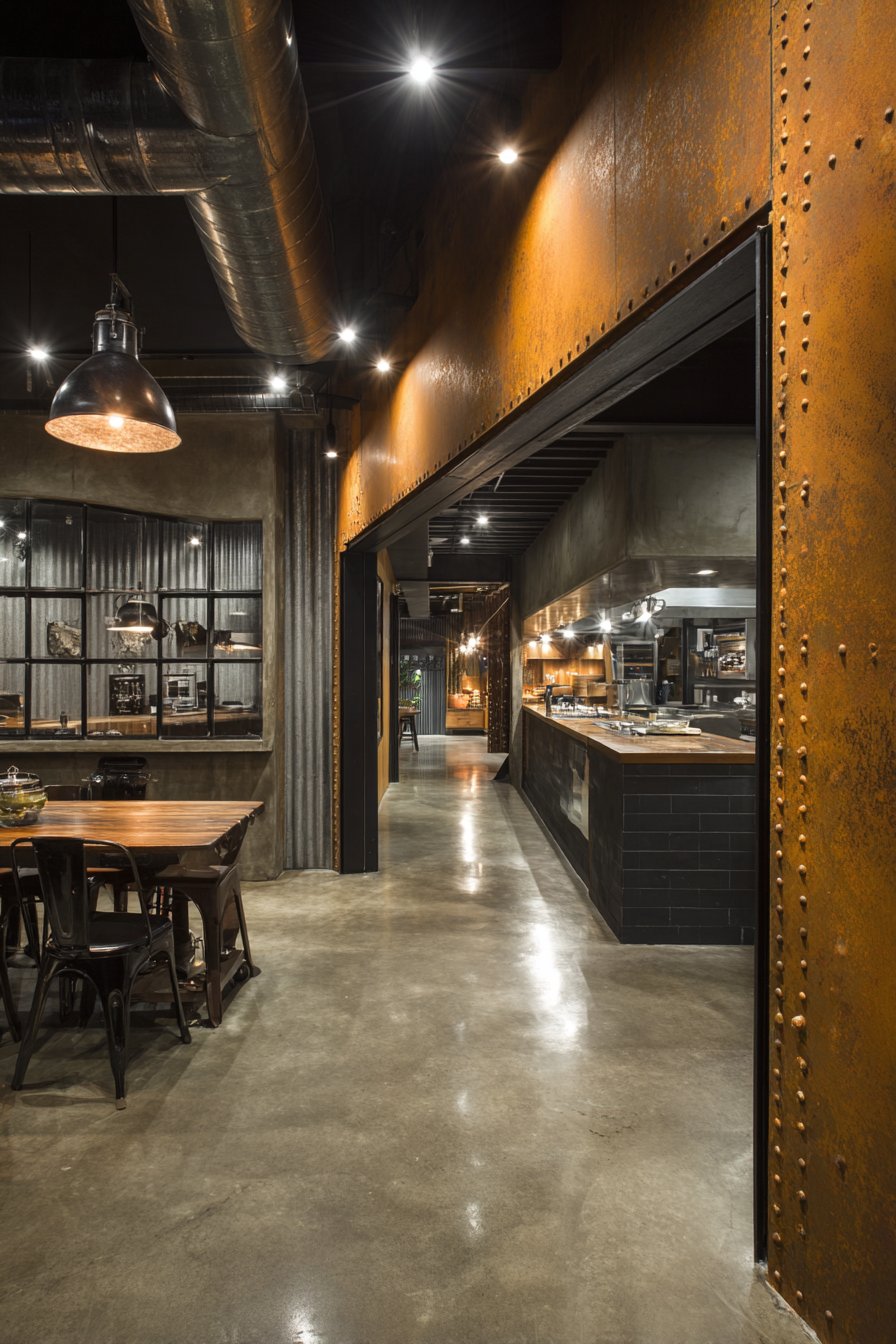
Industrial materials find new life in residential applications when selected and installed with design sensitivity, as demonstrated by this urban-industrial partition using corrugated metal panels in weathered zinc finish. Creating a distinctly city-loft aesthetic, this half wall separates the kitchen prep area from the dining space in a converted warehouse apartment. Standing 40 inches high, the corrugated panels showcase exposed rivets and authentic patina that celebrate industrial manufacturing processes rather than concealing them behind finished surfaces.
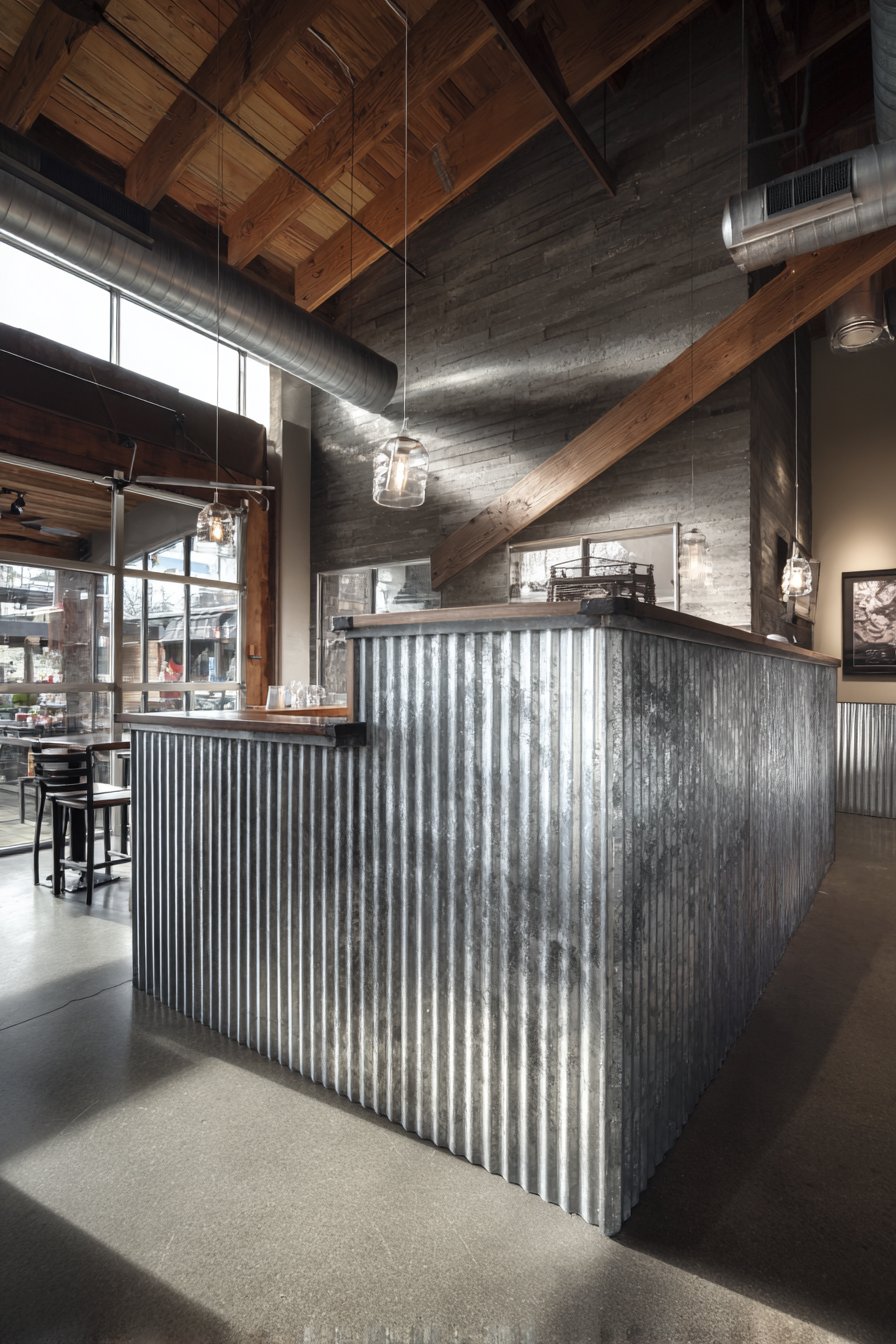
Steel pipe framework supports the structure with visible welds that serve as honest expressions of construction method rather than defects to be hidden. This celebration of industrial joinery and structural elements represents the core philosophy of industrial design—finding beauty in utility and honoring the materials and methods of manufacturing and construction. Concrete flooring and exposed ductwork visible overhead enhance the raw aesthetic, creating a cohesive industrial environment where each element reinforces the urban loft character.
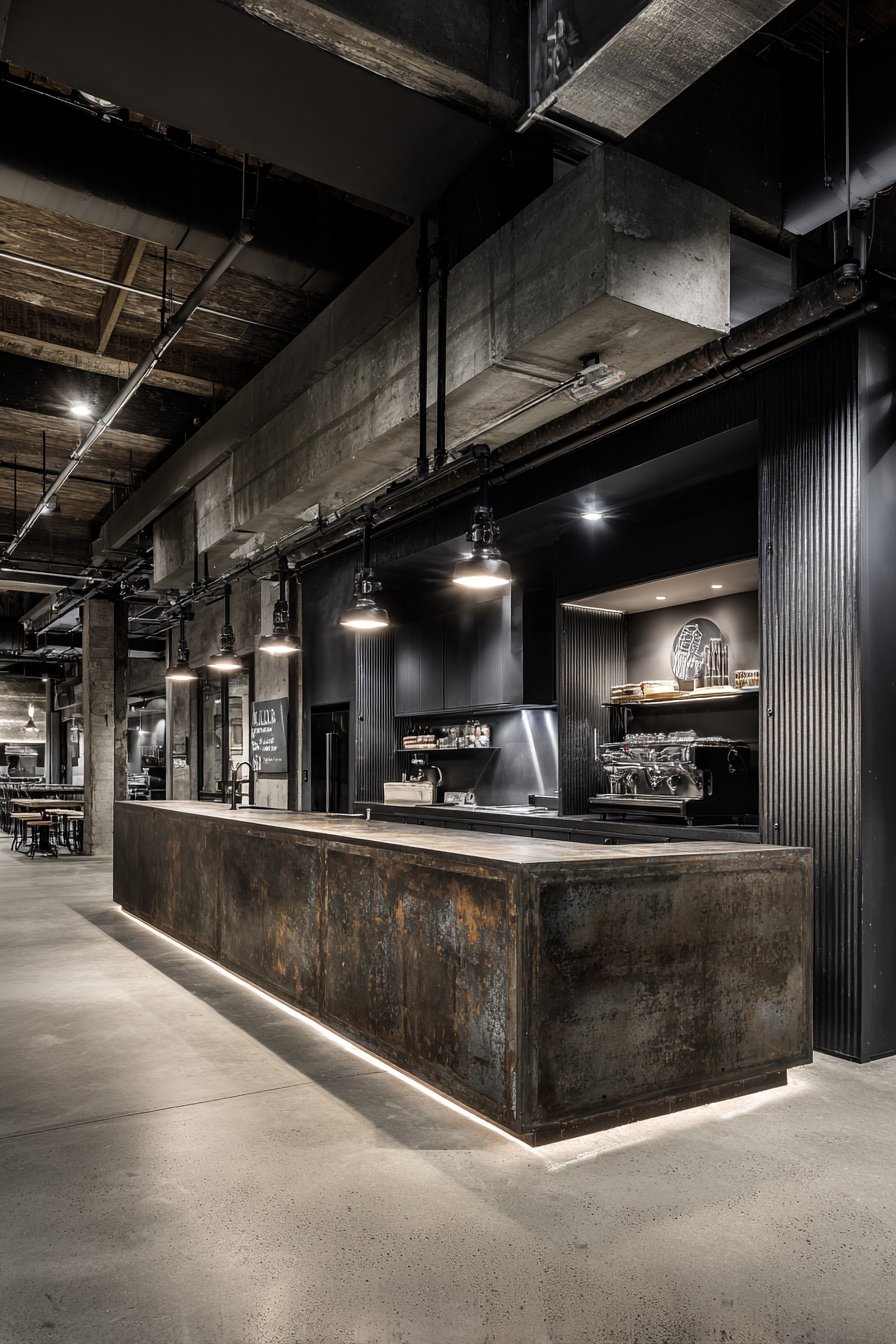
Interior photography with dramatic side lighting emphasizes the industrial materials and urban loft character, casting strong shadows that accentuate the dimensional corrugation pattern and highlight the texture of the weathered zinc finish. The interplay between smooth concrete surfaces and textured metal panels creates visual contrast that keeps the industrial palette interesting despite its limited color range. This design demonstrates how industrial materials originally developed for utilitarian purposes can be repurposed in residential settings to create distinctive, character-rich spaces that celebrate urban living and manufacturing heritage.
Key Design Tips:
- Source authentic industrial materials rather than residential reproductions for genuine character and patina
- Seal weathered metal finishes to stabilize the patina and prevent further oxidation or staining
- Use actual steel pipe (1-1/2 to 2-inch diameter) for framework rather than hollow decorative versions
- Leave welds visible but grind smooth any sharp edges or protrusions for safety
- Install corrugated metal with the corrugations running vertically for visual height or horizontally for width emphasis
- Protect concrete floors with penetrating sealer to prevent staining and facilitate cleaning
- Ensure adequate structural support—metal panels and pipe framework can be surprisingly heavy
- Embrace authentic industrial fasteners like hex bolts rather than trying to hide all hardware
28. Victorian Carved Mahogany Library Divider
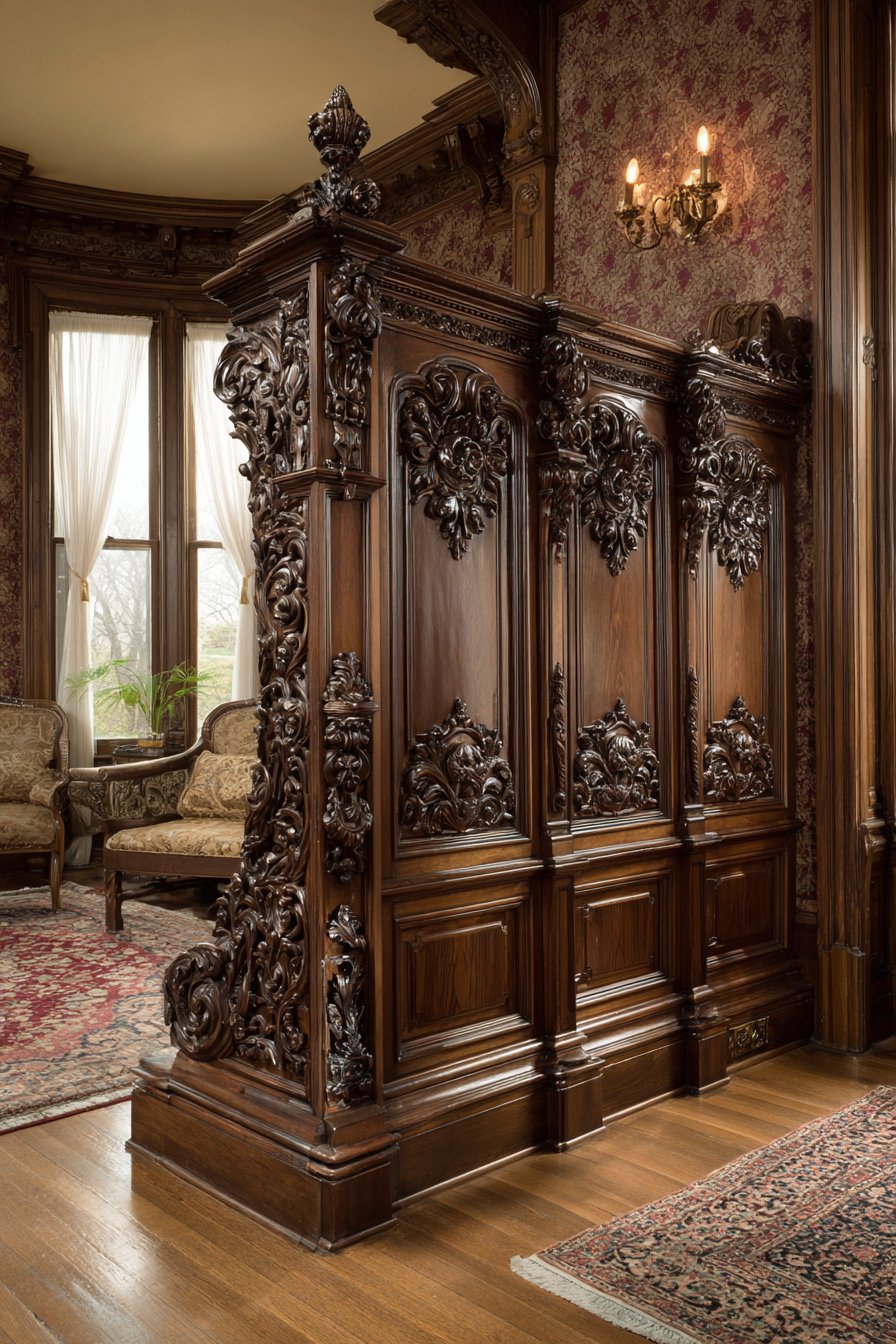
The ornate elegance of Victorian design celebrated skilled craftsmanship and rich materials, principles beautifully embodied in this elaborate half wall dividing a library from a sitting room in a historic home. The partition showcases intricate acanthus leaf carvings in the panels and posts, these classical motifs requiring exceptional woodcarving skill to execute. Deep mahogany finish emphasizes the rich, warm tones of this premium hardwood while the high-gloss surface treatment creates depth and luminosity. Turned finials at corner supports provide vertical emphasis while demonstrating additional woodworking techniques central to Victorian millwork.
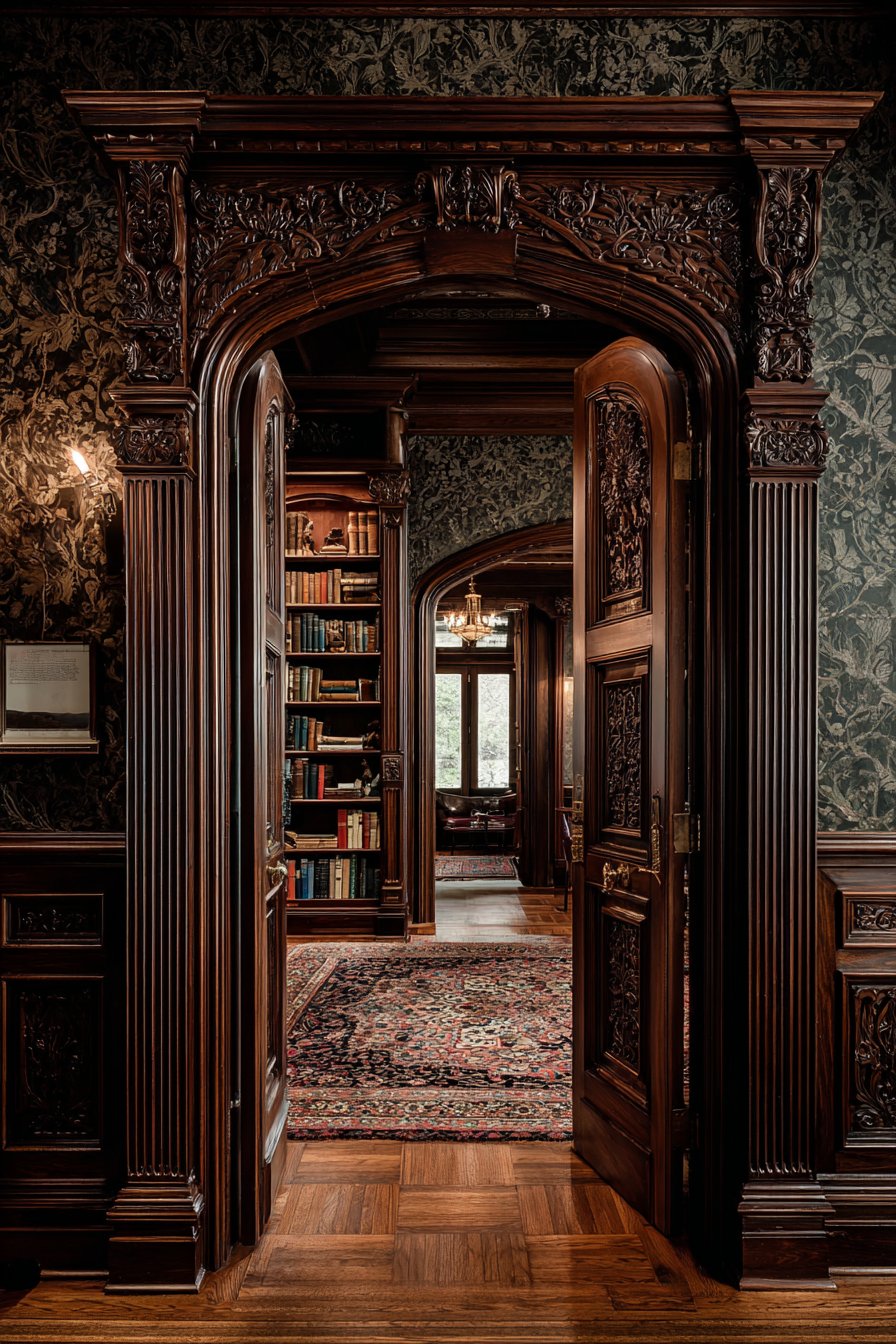
Deep jewel-tone wallpaper visible in the library beyond—perhaps ruby red damask or forest green botanical patterns—complements the dark wood while introducing pattern and color appropriate to Victorian interiors. Persian rugs in similar rich colors and ornate patterns complete the elegant setting, their wool pile adding warmth and luxury underfoot while their intricate designs provide additional layers of visual interest. Period furnishings including tufted leather seating and carved occasional tables reinforce the historical authenticity and create cohesive Victorian ambiance throughout both adjacent spaces.
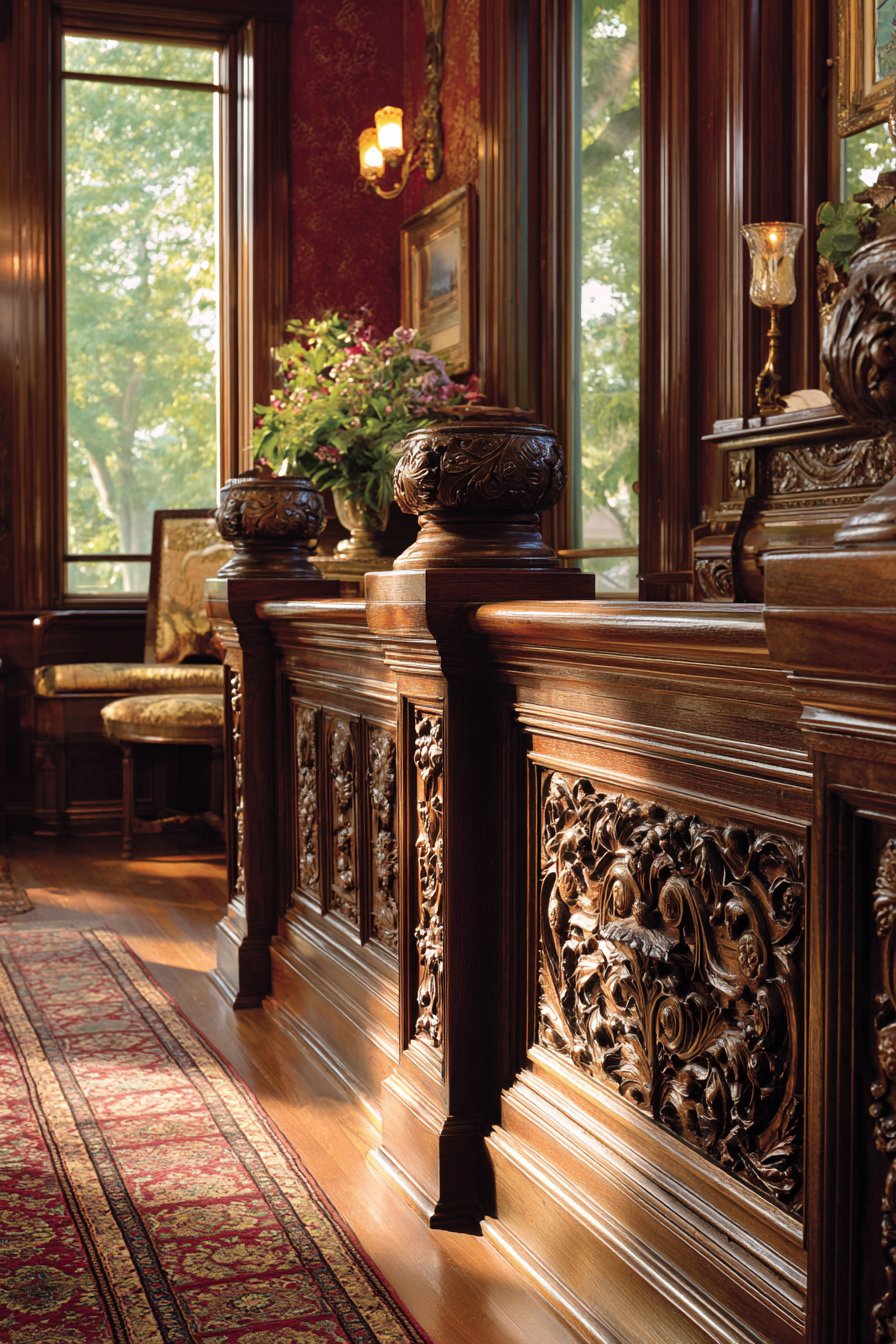
Natural light from tall windows creates depth and highlights the fine woodcarving details, emphasizing the dimensional quality of the acanthus leaf carvings and showing how light plays across the carved surfaces differently throughout the day. Interior design photography captures the historic grandeur and craftsmanship that defines Victorian design at its finest, demonstrating how period-appropriate detailing and premium materials create architecture that remains impressive and valuable more than a century after construction. This partition represents Victorian design philosophy perfectly—celebrating abundance, skilled craftsmanship, and unabashed decorative richness rather than the restraint that would characterize later design movements.
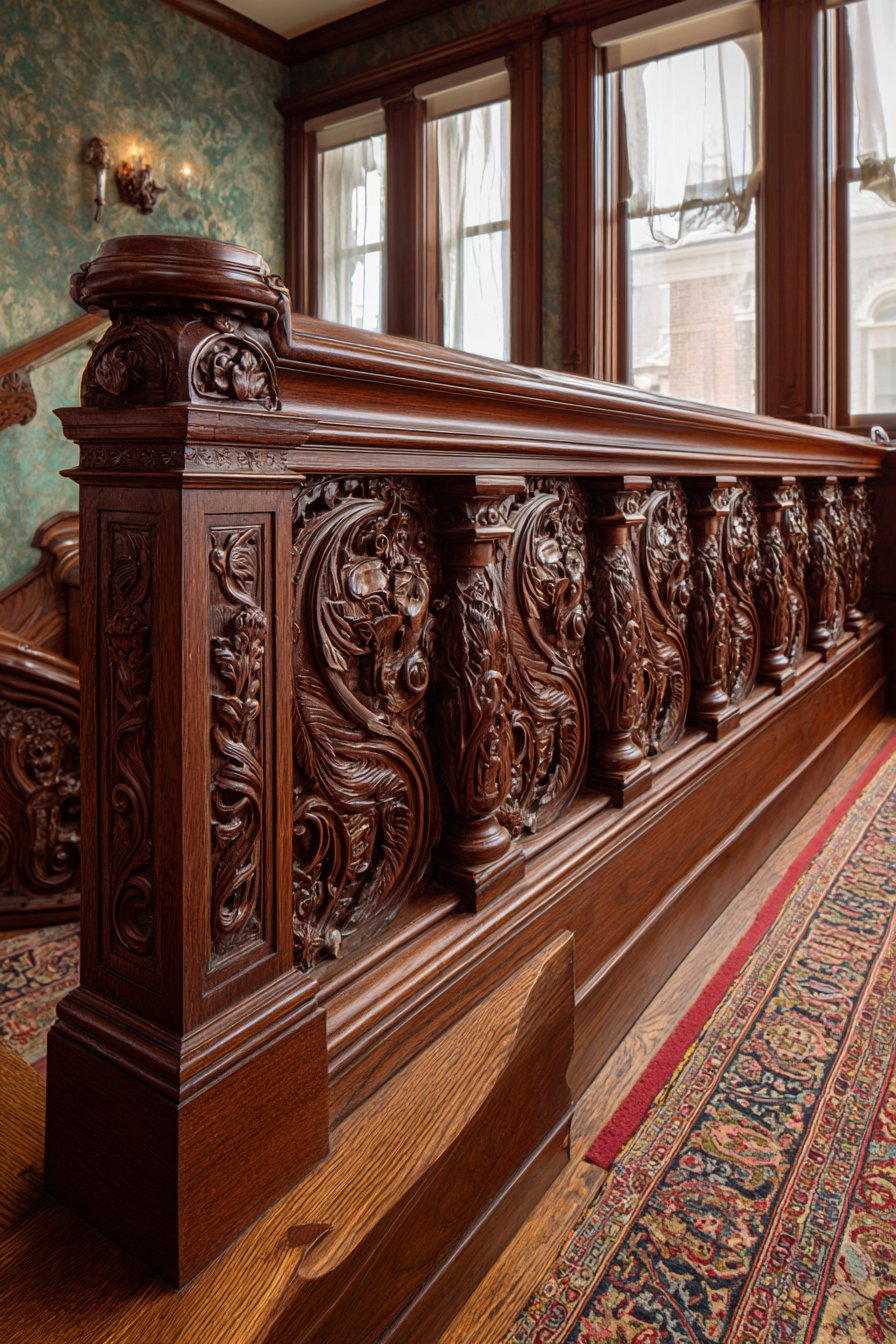
Key Design Tips:
- Commission custom woodcarving from skilled artisans for authentic Victorian detailing—machine carving lacks depth and refinement
- Select genuine mahogany rather than stained substitutes for authentic color depth and grain figure
- Apply multiple coats of high-gloss finish with careful rubbing out between coats for furniture-quality surfaces
- Research authentic Victorian carving patterns rather than relying on contemporary interpretations
- Choose turned finials with substantial scale appropriate to the overall partition height and mass
- Coordinate the wood finish with other millwork and furniture in adjacent spaces for visual harmony
- Use period-appropriate hardware if the partition includes any functional elements like gates or panels
- Maintain the high-gloss finish regularly to preserve depth and prevent dulling
29. Contemporary Sculptural Concrete Partition
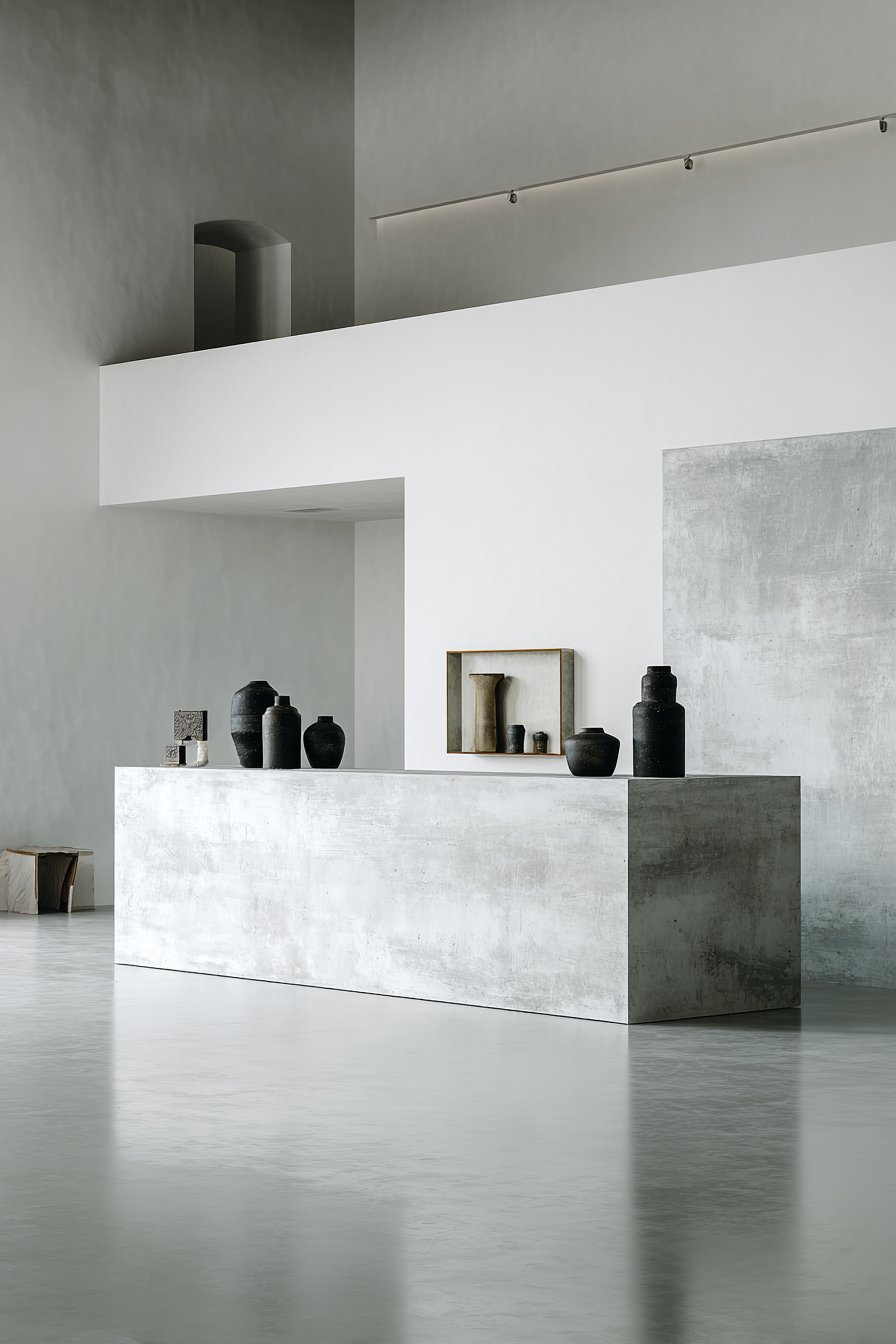
Modern architecture sometimes demands bold, sculptural elements that make strong statements while serving practical purposes. This minimalist half wall using poured concrete with smooth troweled finish creates exactly such a sculptural partition in a contemporary gallery-like space. The clean geometric form in light gray concrete with subtle surface variation from the forming process demonstrates how this industrial material can achieve refined, sophisticated results when executed with precision and care. Standing 44 inches tall, the monolithic structure divides the entry from the living area while its substantial mass and minimal form create strong architectural presence.
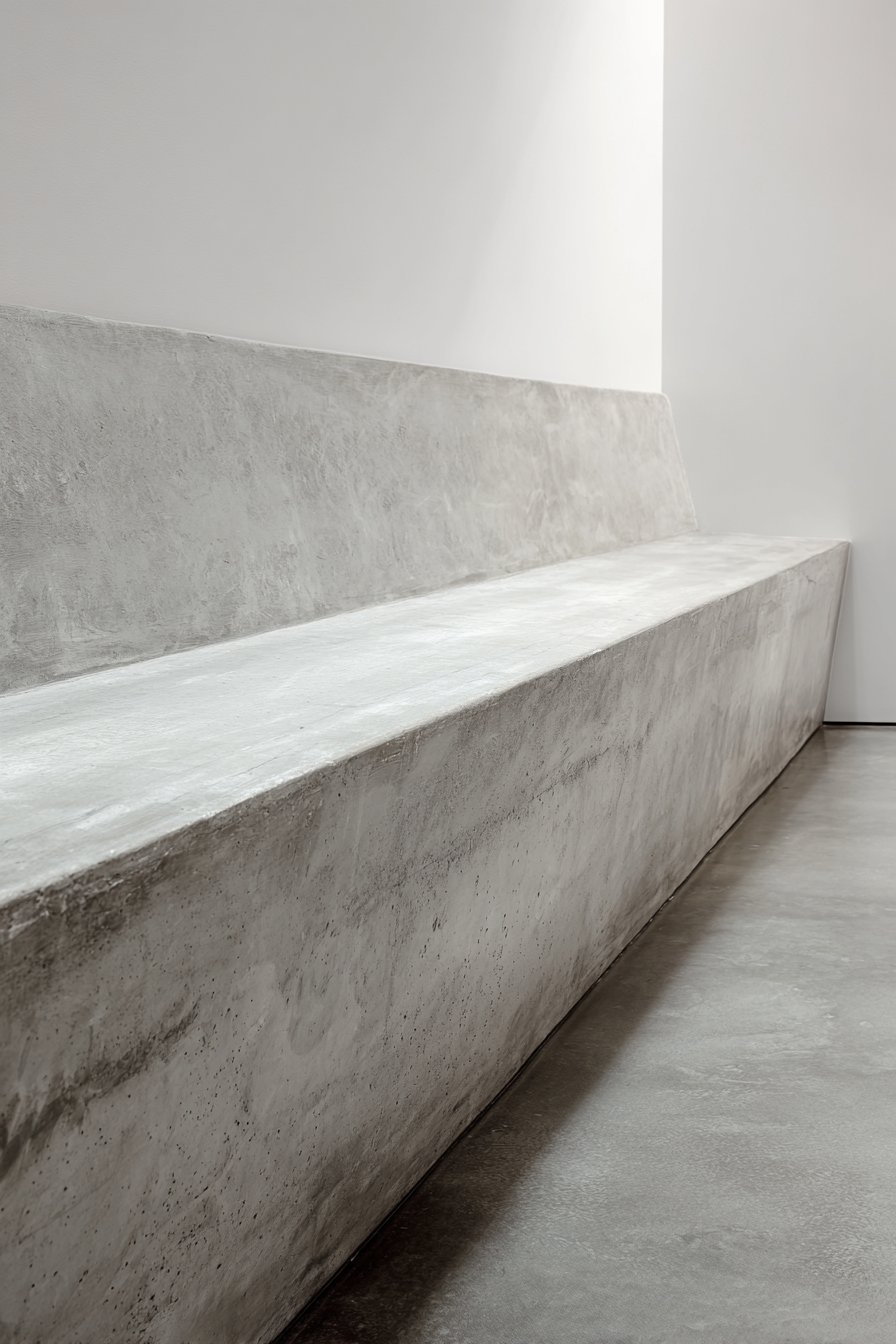
The concrete serves dual purposes—acting as a room divider while providing a display ledge for carefully selected sculptural objects that enhance rather than detract from the concrete’s minimalist beauty. This integration of functional display space demonstrates how good design can layer multiple purposes into single elements, maximizing utility while maintaining aesthetic clarity. Polished concrete floors extending throughout create material continuity while their reflective surface adds subtle visual interest without introducing pattern or color that would complicate the minimal palette. White walls surrounding the partition emphasize the architectural statement, providing neutral backdrop that allows the concrete form to command full attention.
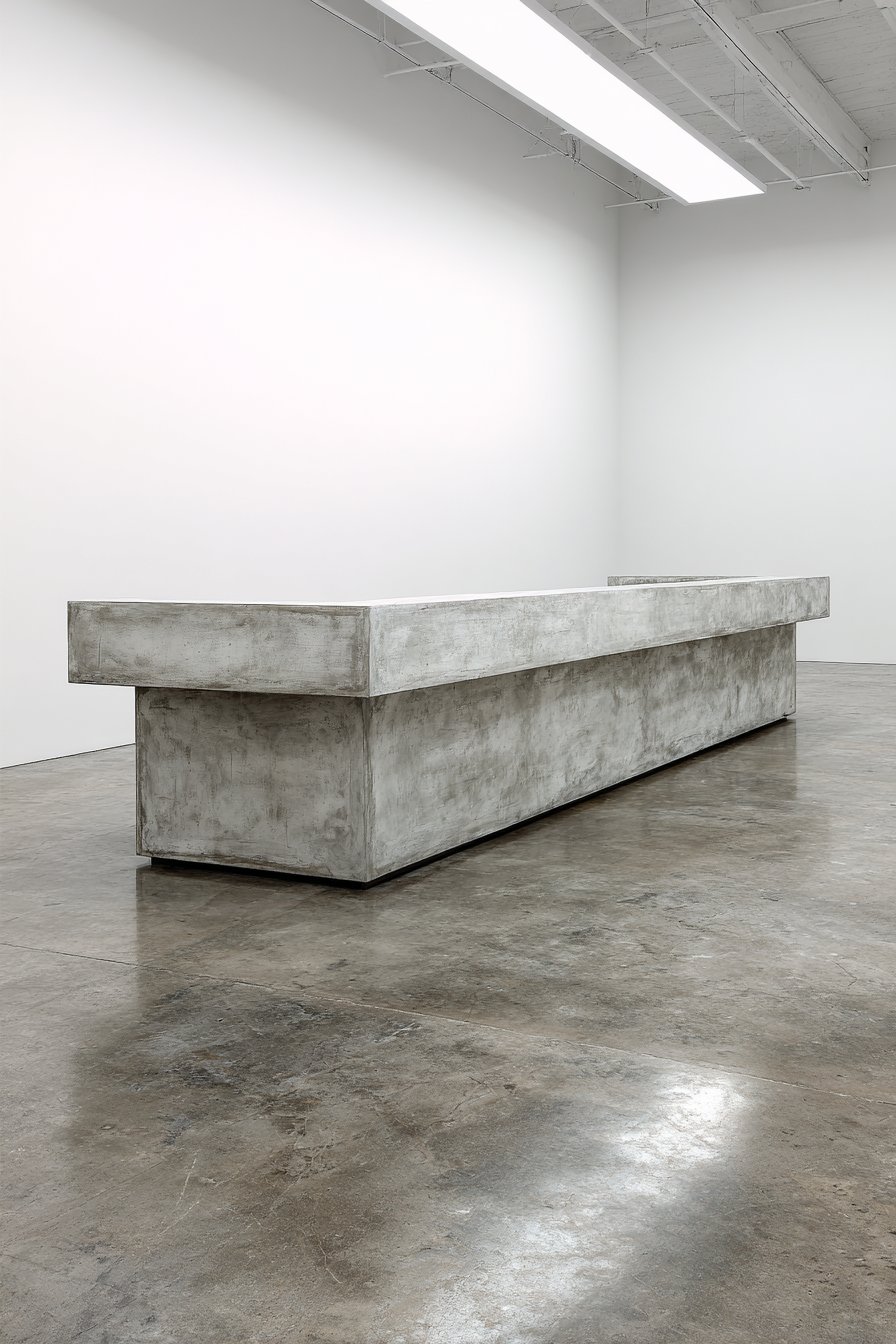
Professional interior photography with precise lighting highlights the material’s subtle texture and modern monumentality, capturing how light plays across the smooth concrete surface and creates gentle shadows that accentuate the geometric purity. The slight surface variations from the forming and finishing process add organic texture that prevents the concrete from appearing artificial or too perfect, these subtle imperfections honoring the material’s handcrafted nature. This approach to half wall design demonstrates how contemporary architecture can create powerful spatial experiences through simple forms, honest materials, and exceptional execution rather than relying on decorative elaboration or complex geometry.
Key Design Tips:
- Hire experienced concrete artisans familiar with architectural concrete work for best results
- Create smooth surfaces through careful troweling and multiple passes with progressively finer tools
- Consider adding integral color to the concrete mix for consistent color throughout rather than surface treatments
- Design formwork carefully to achieve clean edges and precise geometric profiles
- Seal concrete surfaces with penetrating sealer to protect against staining while maintaining matte appearance
- Allow adequate curing time before removing forms to prevent surface damage or defects
- Embrace minor surface variations as character marks rather than defects requiring correction
- Plan for substantial weight—poured concrete requires proper structural support and foundation
Why These Half Wall Ideas Represent the Best Design Solutions
The twenty-nine half wall concepts presented throughout this article represent the finest approaches to spatial division because they honor fundamental design principles while demonstrating remarkable versatility across architectural styles and functional requirements. Each design solution addresses the core challenge that half walls must solve—creating definition and separation without sacrificing the openness, light flow, and visual connection that make modern living spaces so appealing. From the contemporary kitchen bar partition with its waterfall quartz countertop to the Victorian carved mahogany library divider with its intricate acanthus leaf details, every design demonstrates how thoughtful material selection, appropriate proportions, and careful detailing can transform simple room dividers into architectural features worthy of attention and appreciation.
These half wall ideas excel because they recognize that effective spatial division requires more than merely installing a physical barrier—it demands consideration of traffic patterns, sight lines, natural light flow, acoustic separation, and the psychological impact of creating boundaries within shared spaces. The traditional wainscoting entrance divider maintains formal elegance while welcoming guests, the modern glass-paneled office partition provides workspace focus without isolation, and the rustic reclaimed barn wood divider celebrates authentic materials while defining distinct zones. Each solution responds to specific functional requirements while contributing positively to the overall aesthetic experience of the home. The best half walls serve multiple purposes simultaneously—the contemporary kitchen partition functions as breakfast bar and storage, the built-in shelving partition provides display space while dividing rooms, and the living wall partition improves air quality while creating natural separation.
Material authenticity represents another crucial factor that distinguishes superior half wall designs from mediocre attempts. The exposed brick loft partition celebrates the building’s industrial heritage through honest materials, the Japanese bamboo zen partition honors traditional construction methods and natural materials, and the Southwestern adobe-style partition embraces regional building traditions and climate-appropriate techniques. These designs succeed because they work with materials’ inherent properties rather than fighting against them—glass provides transparency and light transmission, concrete offers monolithic mass and sculptural potential, wood delivers warmth and natural beauty, and stone contributes texture and organic variation. The materials chosen for each half wall align with the overall design aesthetic and functional requirements rather than being selected arbitrarily or purely for trendy appeal.
The versatility demonstrated across these twenty-nine concepts proves that half walls can adapt to virtually any design style, spatial constraint, or functional requirement without sacrificing quality or effectiveness. Whether your home embodies farmhouse simplicity, mid-century modern elegance, coastal casual charm, or Art Deco glamour, appropriate half wall solutions exist that will enhance rather than compromise your chosen aesthetic. The Scandinavian minimalist white partition demonstrates that less can indeed be more when execution is flawless, while the eclectic mixed-material artistic partition proves that bold creativity and unexpected combinations can yield exciting results when guided by confident design vision. From luxury applications like the backlit onyx master suite partition to practical basement recreation room utility partitions, these designs span the full range of budgets, skill levels, and aesthetic preferences.
Functionality integrated with beauty distinguishes truly excellent half wall designs from purely decorative installations that fail to serve practical purposes. The modern farmhouse shiplap partition incorporates coat hooks for mudroom storage, the French country sage green divider displays copper cookware within easy reach, and the contemporary partition with built-in shelving provides essential storage while dividing spaces. This marriage of form and function represents design thinking at its best—recognizing that homes must work efficiently for daily life while also creating beauty and joy for their inhabitants. The best half walls enhance how we live rather than merely how spaces look, contributing to smoother traffic flow, better organization, improved acoustics, and more comfortable spatial relationships.
Proper proportion and scale represent critical but often overlooked factors in half wall success. Each design presented maintains appropriate relationships between height, thickness, length, and the surrounding architectural context. A half wall that’s too tall blocks sight lines and light flow, defeating its purpose, while one that’s too short fails to create adequate definition or presence. The 36-42 inch height range appearing throughout these designs represents the sweet spot where half walls provide sufficient separation without creating barriers, allow visual connection while defining distinct zones, and offer practical surfaces without dominating spaces. The thickness of each partition also receives careful consideration—substantial enough to feel permanent and intentional but not so massive as to consume excessive floor area or create awkward proportions.
These half wall ideas represent the best design solutions because they’ve been thoughtfully developed with attention to every detail that contributes to successful execution. From the selection of premium materials like quarter-sawn oak and hand-selected natural stone to the specification of proper installation methods and appropriate finishes, each design provides a complete roadmap for achieving professional results. The key design tips accompanying each concept offer practical guidance addressing common challenges and ensuring that DIY enthusiasts and professional contractors alike can execute these designs successfully. This comprehensive approach—considering aesthetics, functionality, materials, proportions, and technical execution—separates truly excellent half wall designs from superficial concepts that may look appealing in renderings but fail when translated into built reality.
Conclusion
Half walls represent one of interior design’s most versatile and valuable tools for creating functional, beautiful living spaces that balance openness with definition. Throughout this comprehensive exploration of twenty-nine distinctive half wall ideas, we’ve discovered how these architectural elements can adapt to serve countless purposes while honoring diverse aesthetic preferences and practical requirements. From establishing subtle boundaries between adjacent spaces to providing valuable storage and display opportunities, from celebrating premium materials and skilled craftsmanship to demonstrating how creative thinking can transform simple partitions into artistic statements, half walls offer homeowners remarkable opportunities to enhance both the functionality and beauty of their homes.
The key takeaway from this extensive survey is that successful half wall design requires thoughtful consideration of materials, proportions, functional requirements, and aesthetic goals rather than relying on formulaic approaches or trendy solutions that may quickly feel dated. Whether you’re drawn to the timeless elegance of traditional wainscoting, the clean simplicity of Scandinavian minimalism, the bold drama of Art Deco geometry, or the rustic charm of reclaimed materials, appropriate half wall solutions exist that will serve your spaces well while reflecting your personal style. The most effective designs integrate seamlessly with their architectural context while making positive contributions to spatial flow, natural light distribution, and the overall living experience.
As you contemplate implementing half wall ideas in your own home, remember that the best results come from careful planning that considers how the partition will function within your daily routines, how it will interact with existing architectural elements, and how it will contribute to the atmosphere you’re trying to create. Don’t hesitate to adapt and customize the concepts presented here to suit your specific circumstances—combine elements from multiple designs, adjust proportions to fit your unique spatial constraints, and select materials that resonate with your aesthetic preferences and budget realities. The twenty-nine ideas explored throughout this article should serve as inspiration and starting points rather than rigid formulas, encouraging you to experiment, take creative risks, and ultimately create half walls that transform your house into a more beautiful, functional, and personally meaningful home.
