
A well-organized kitchen is the heart of a functional home, where culinary creativity meets daily practicality. In today’s fast-paced world, the kitchen serves not only as a space for meal preparation but as a gathering place for families, a workspace for aspiring chefs, and often the most frequented room in the house. Yet, despite its importance, the kitchen can quickly become cluttered and chaotic without proper organization systems in place. The difference between a frustrating cooking experience and an enjoyable one often comes down to how efficiently your kitchen is organized—from the placement of your most-used utensils to the accessibility of your pantry staples.
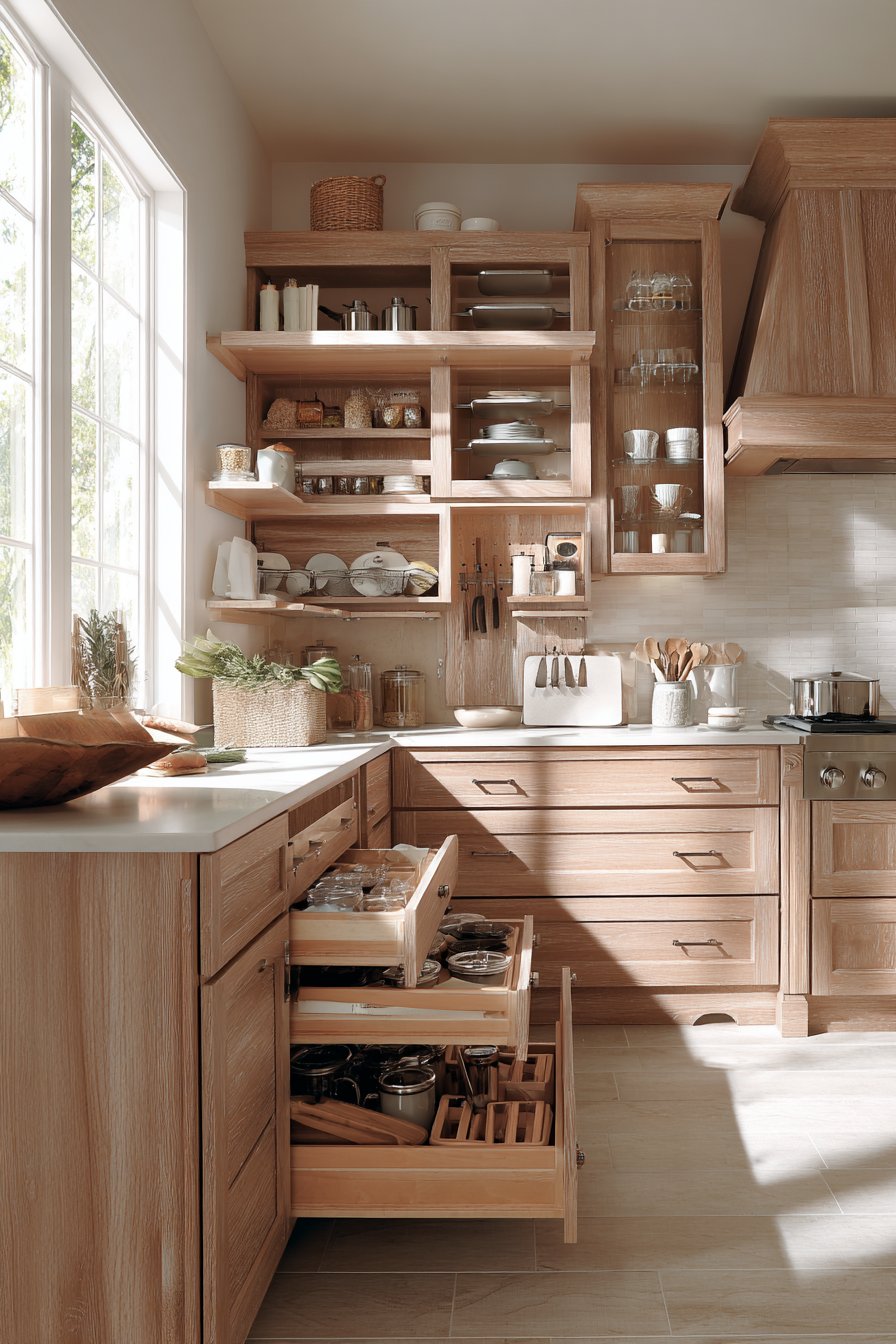
The art of kitchen organization extends far beyond simple tidiness; it’s about creating systems that work with your lifestyle, maximizing every inch of available space, and designing solutions that are both functional and aesthetically pleasing. Whether you’re working with a compact galley kitchen or a spacious culinary paradise, the principles of effective organization remain the same: everything should have a designated place, frequently used items should be easily accessible, and your organizational systems should simplify rather than complicate your daily routines. Modern kitchen organization embraces a variety of approaches, from minimalist drawer dividers to elaborate pantry systems, each designed to address specific storage challenges while maintaining visual harmony.
This comprehensive guide explores thirty-one innovative kitchen organization ideas that will revolutionize how you interact with your culinary space. From practical drawer organizers and clever cabinet solutions to creative wall-mounted systems and specialized storage zones, each concept has been carefully selected to address common kitchen storage challenges. These ideas span various design aesthetics—from rustic farmhouse charm to sleek contemporary minimalism—ensuring that you’ll find solutions that not only optimize your kitchen’s functionality but also complement your personal style. Whether you’re embarking on a complete kitchen renovation or simply looking to implement small changes that make a big impact, these organization strategies will help you create a kitchen that works as beautifully as it looks.
1. Streamlined Drawer Dividers for Utensil Management
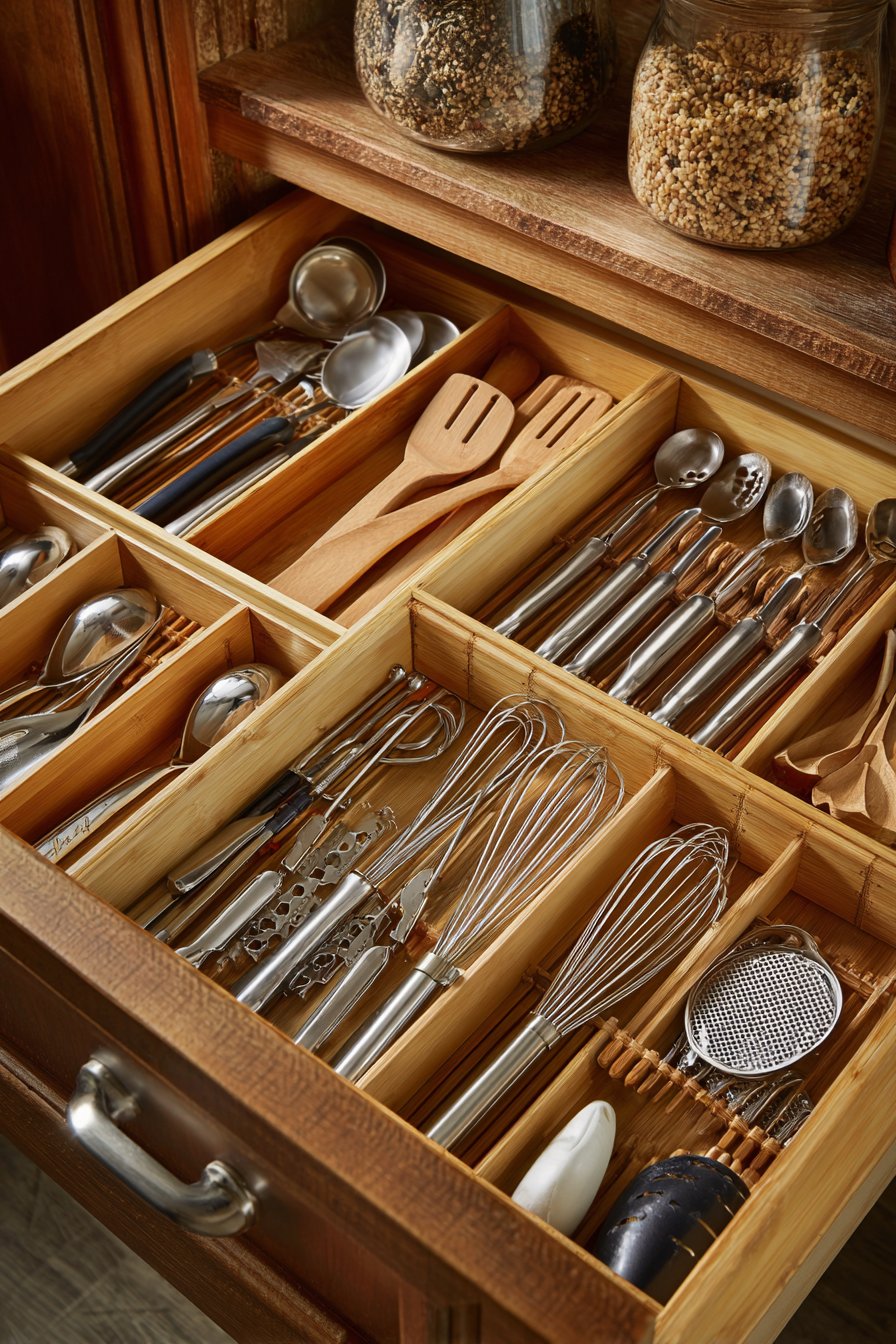
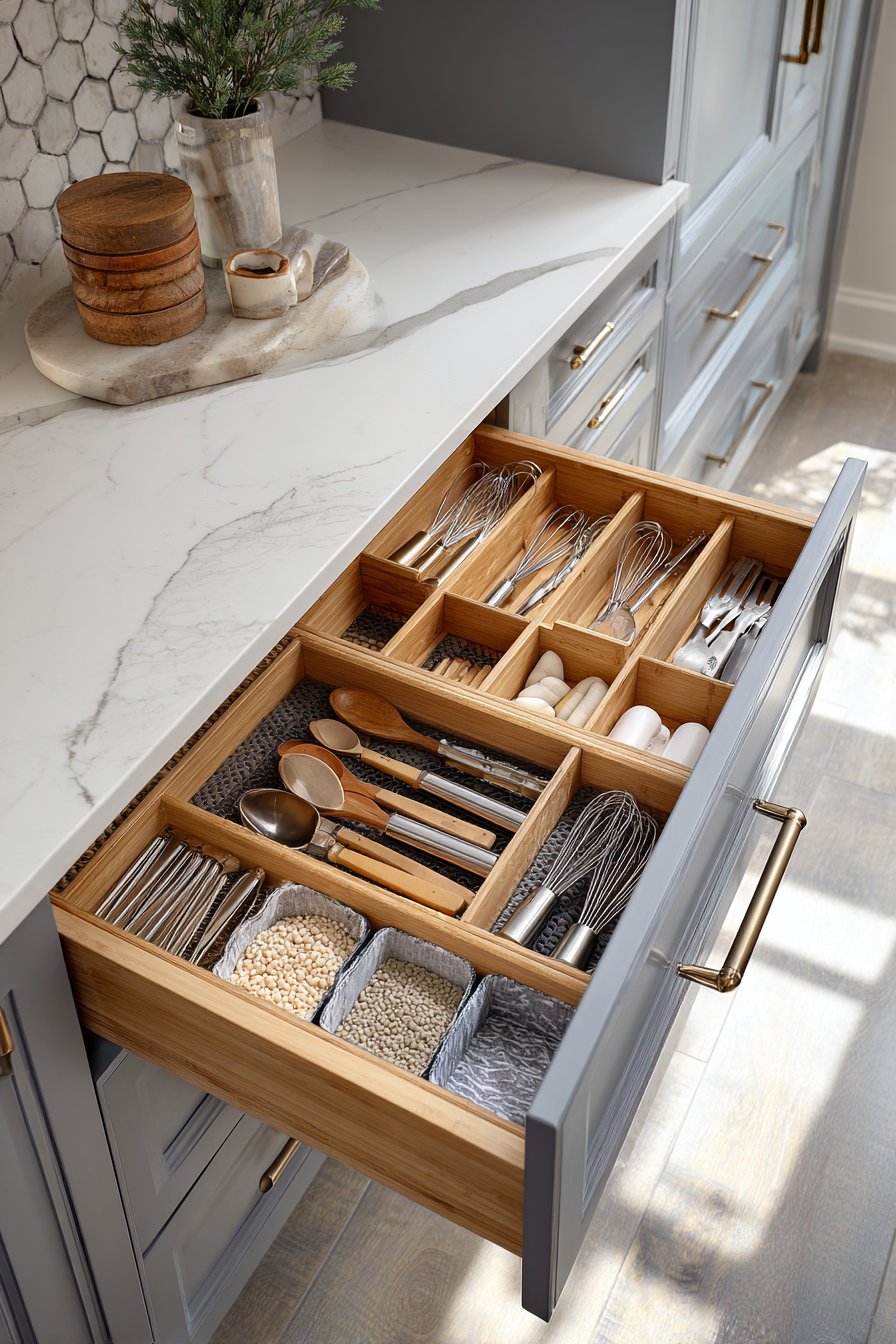
The foundation of kitchen organization begins with the humble utensil drawer, transformed through the implementation of custom bamboo dividers that create designated spaces for every cooking tool. This system features adjustable compartments with non-slip liners, ensuring that spatulas, whisks, measuring spoons, and other essential implements remain securely in place even during the busiest meal preparations. The natural wood grain of bamboo adds warmth and organic beauty to what might otherwise be a purely utilitarian space, while chrome drawer pulls provide a sophisticated finishing touch that complements modern kitchen aesthetics.
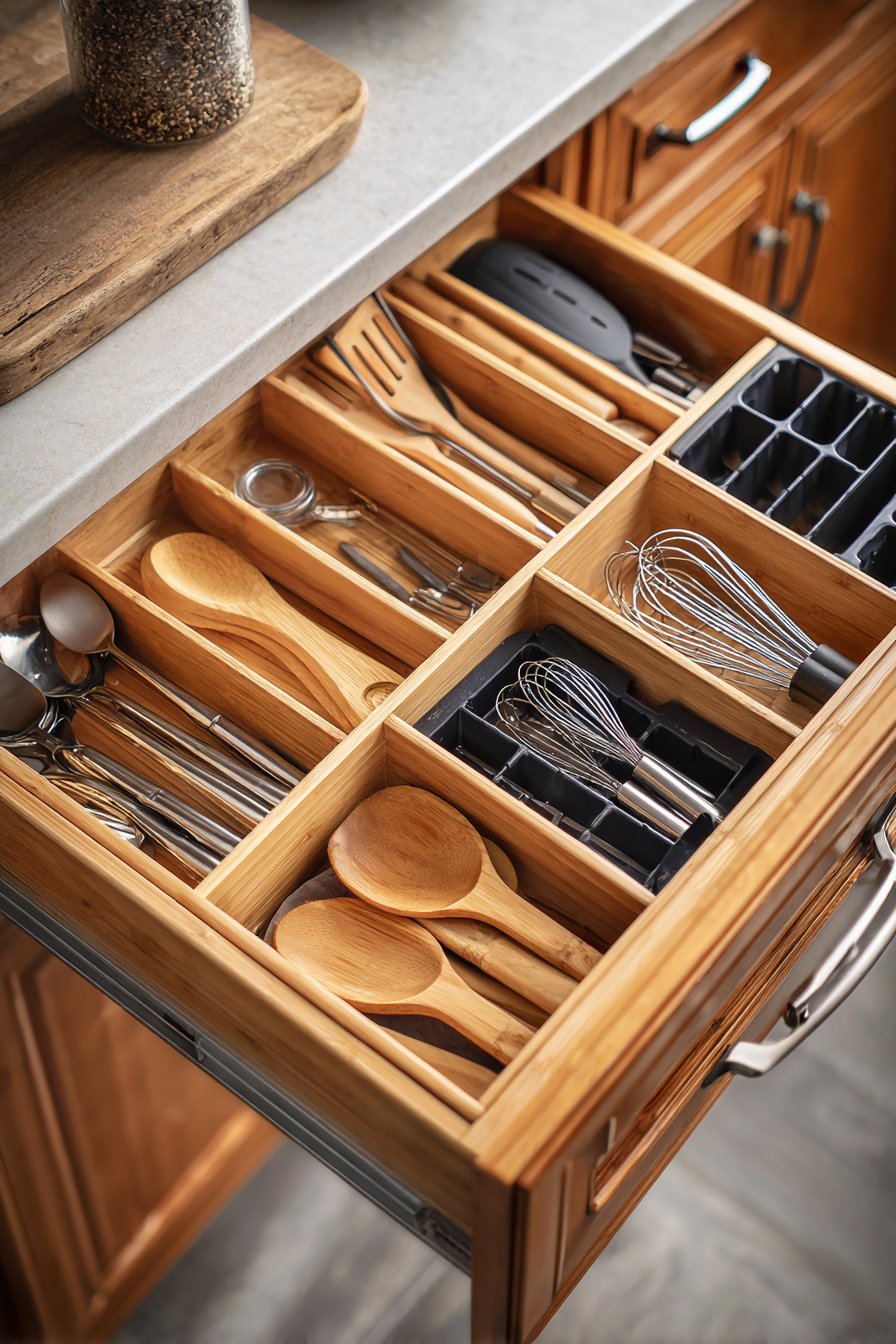
The beauty of this organizational approach lies in its flexibility and customization potential. Unlike fixed drawer organizers that force you to adapt your tools to predetermined spaces, adjustable bamboo dividers allow you to create compartments that perfectly fit your specific collection of kitchen implements. The non-slip liners prevent the frustrating sliding and shifting that often occurs with traditional organizers, keeping everything exactly where you placed it. This level of organization not only saves time during cooking—no more rummaging through a jumbled drawer searching for the right tool—but also protects your utensils from damage caused by friction and tangling.
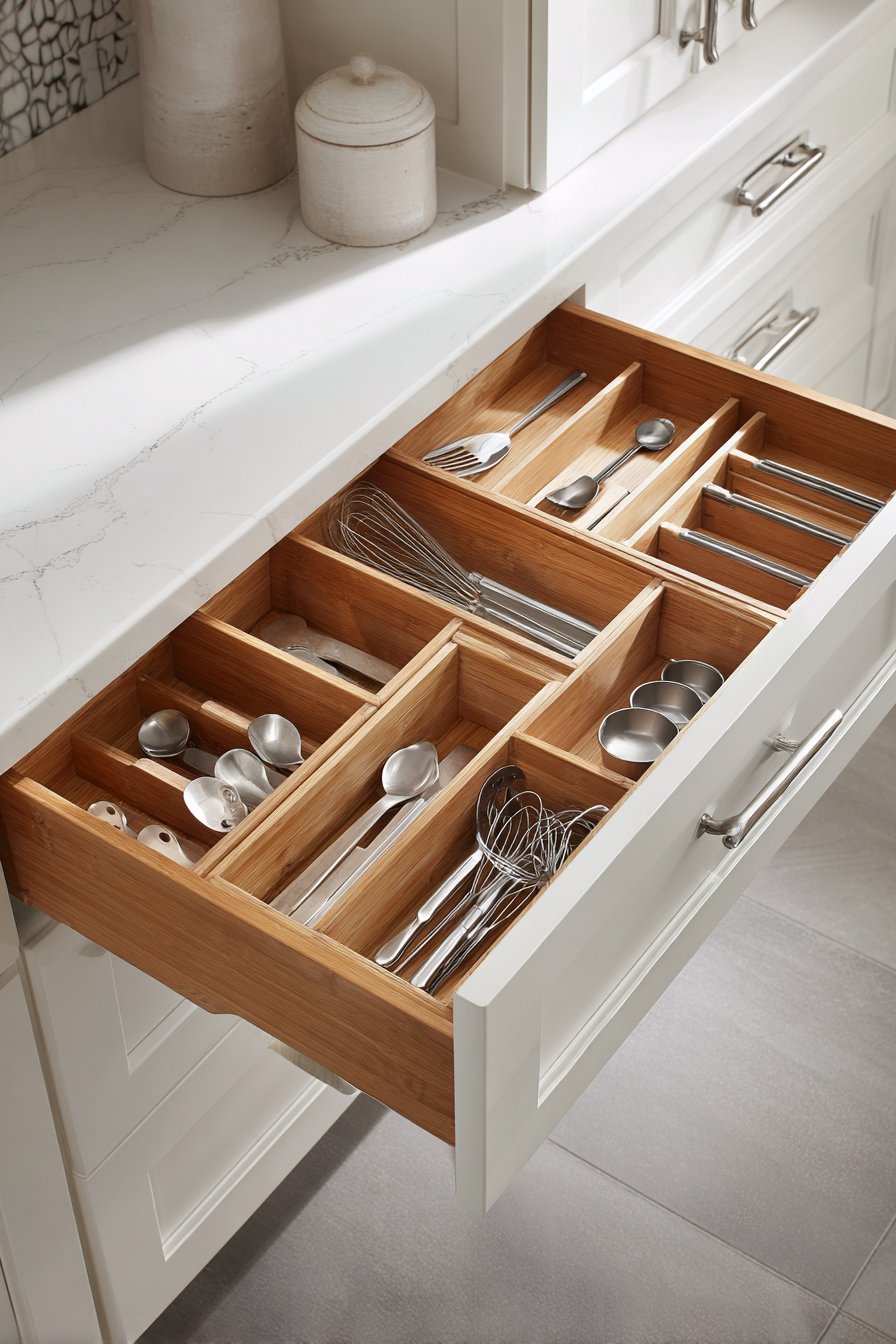
Proper lighting plays a crucial role in the functionality of drawer organization systems. When captured with professional interior design photography techniques, soft overhead lighting highlights both the functional organization and the natural material textures, creating subtle shadows that emphasize the satisfying order within. This attention to visual presentation isn’t merely aesthetic; good lighting within drawers (whether natural or artificial) makes it easier to quickly identify and retrieve the tools you need, particularly in deeper drawers where items might otherwise be obscured in shadow.
Key Design Tips:
- Invest in adjustable bamboo dividers that can be reconfigured as your utensil collection evolves
- Use non-slip liners to prevent tools from shifting and creating disorder
- Group utensils by function rather than size for more intuitive access during cooking
- Consider the depth of your drawers when selecting dividers to maximize vertical space
- Clean and reorganize drawers seasonally to eliminate unused items and maintain efficiency
2. Transparent Pantry Storage with Labeled Containers
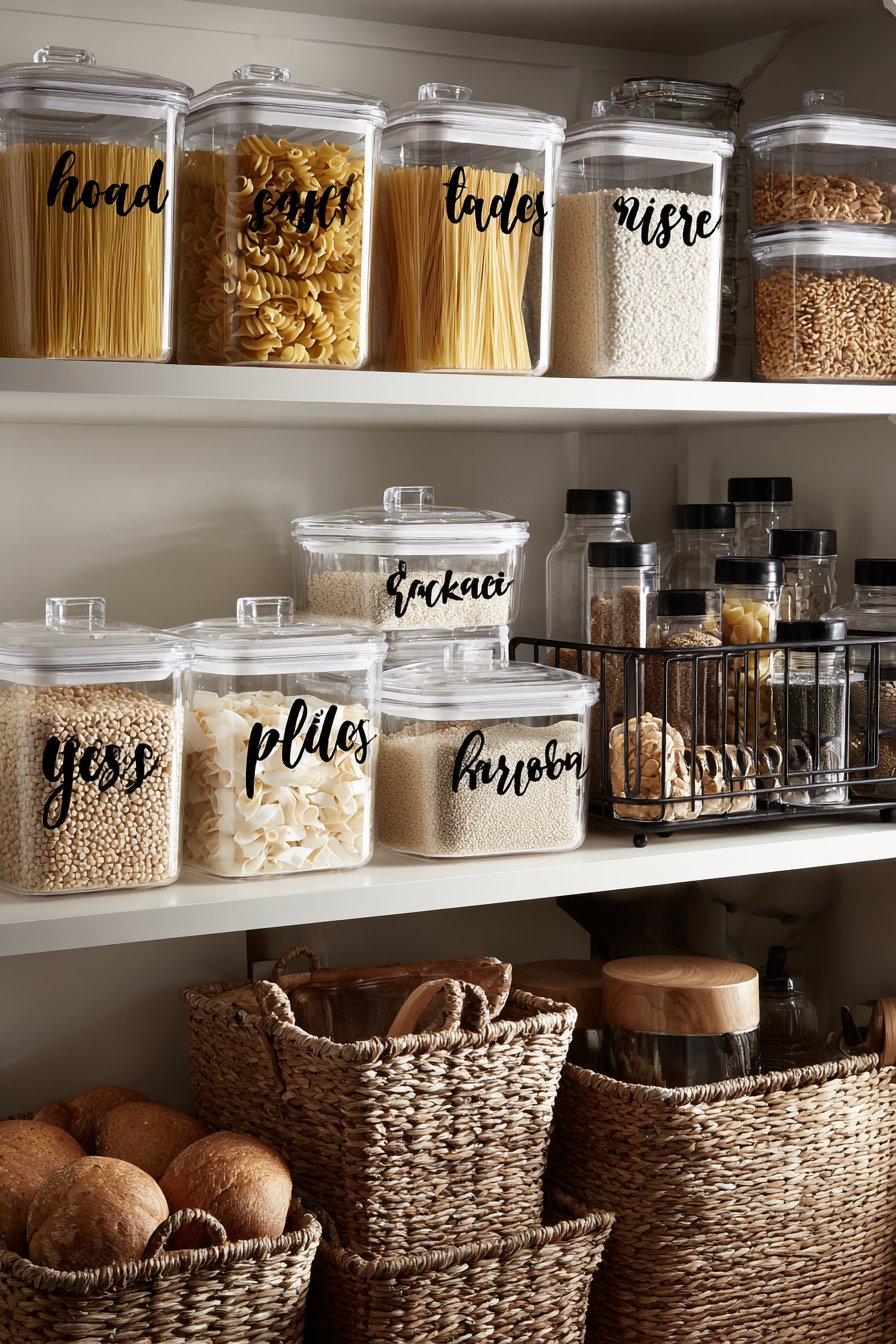
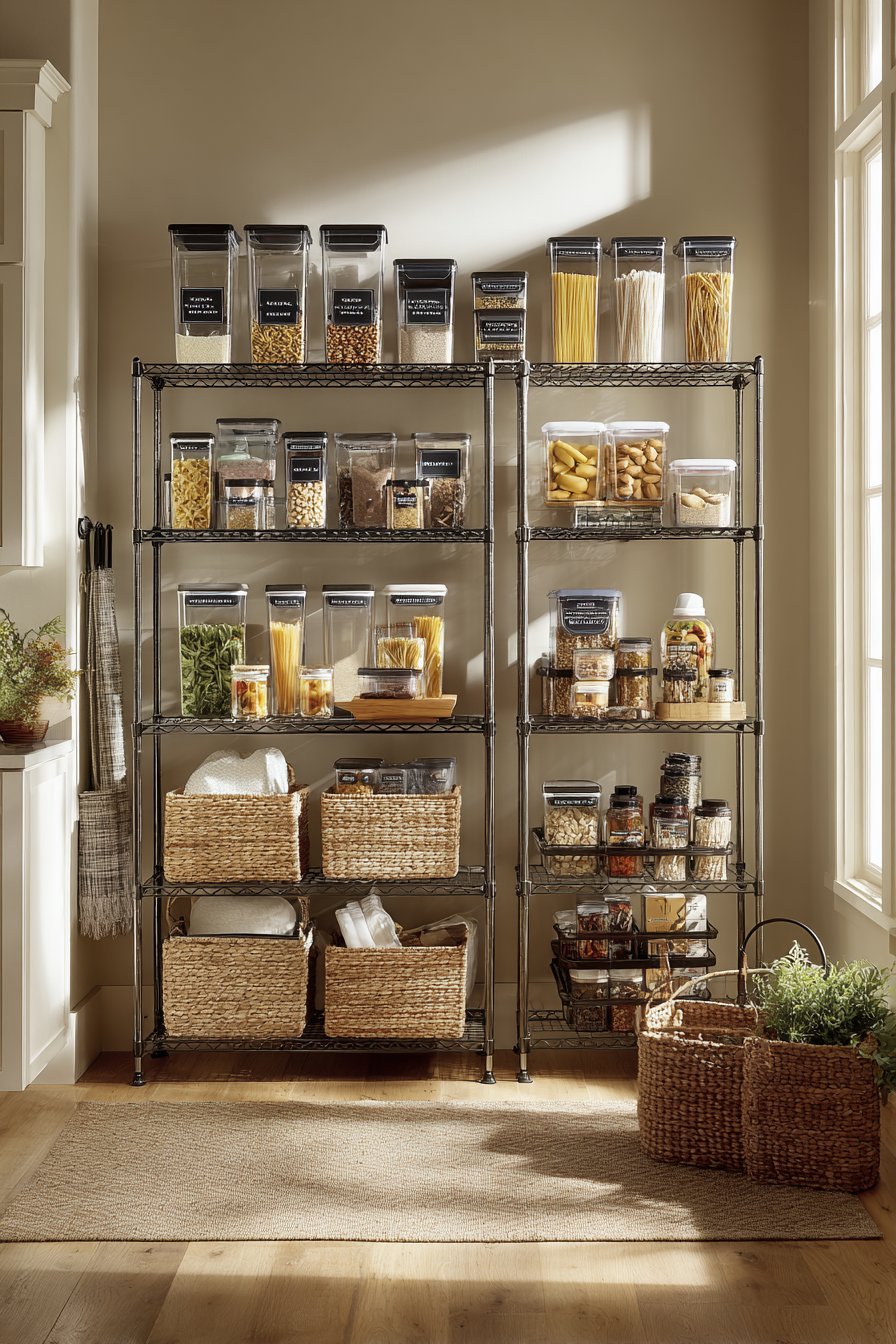
A well-designed pantry featuring clear acrylic storage containers represents the pinnacle of both functional organization and visual satisfaction. This comprehensive system utilizes containers of varying sizes, each elegantly labeled with black text, creating a cohesive look that transforms pantry storage from chaotic to curated. Wire shelving units maximize vertical space efficiently, providing proper air circulation while storing pasta, grains, baking ingredients, and other dry goods in airtight containers that preserve freshness. Woven baskets on lower shelves add textural contrast while organizing snacks and produce, creating a multi-layered approach to pantry management.
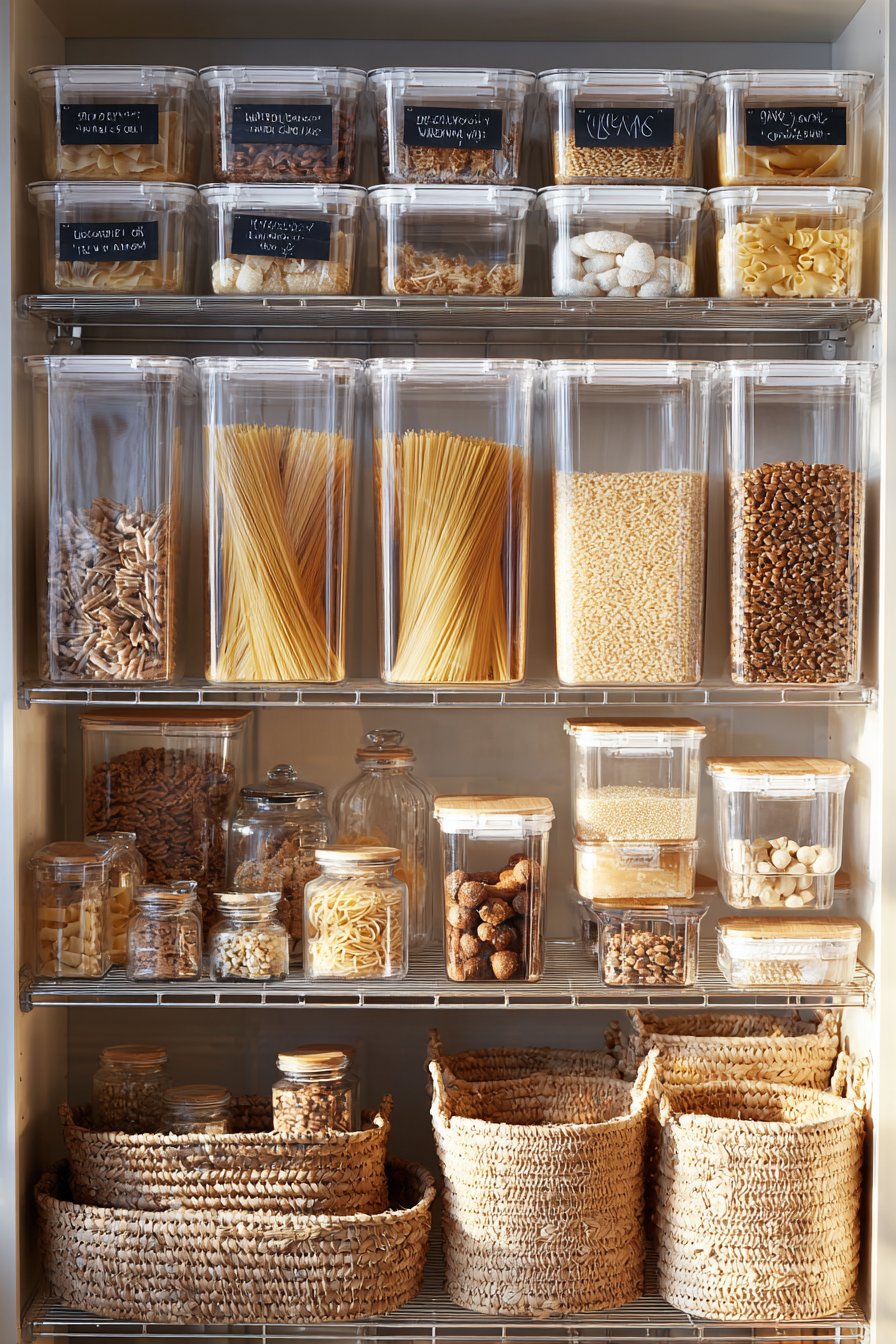
The psychological impact of a well-organized pantry cannot be overstated. Clear containers allow you to see exactly what you have at a glance, preventing the common problem of duplicate purchases and food waste. When every ingredient is visible and properly labeled, meal planning becomes intuitive rather than overwhelming. The uniform appearance of matching containers creates visual calm, even when the pantry is fully stocked, while the varied sizes accommodate everything from small quantities of specialty ingredients to bulk purchases of frequently used staples.
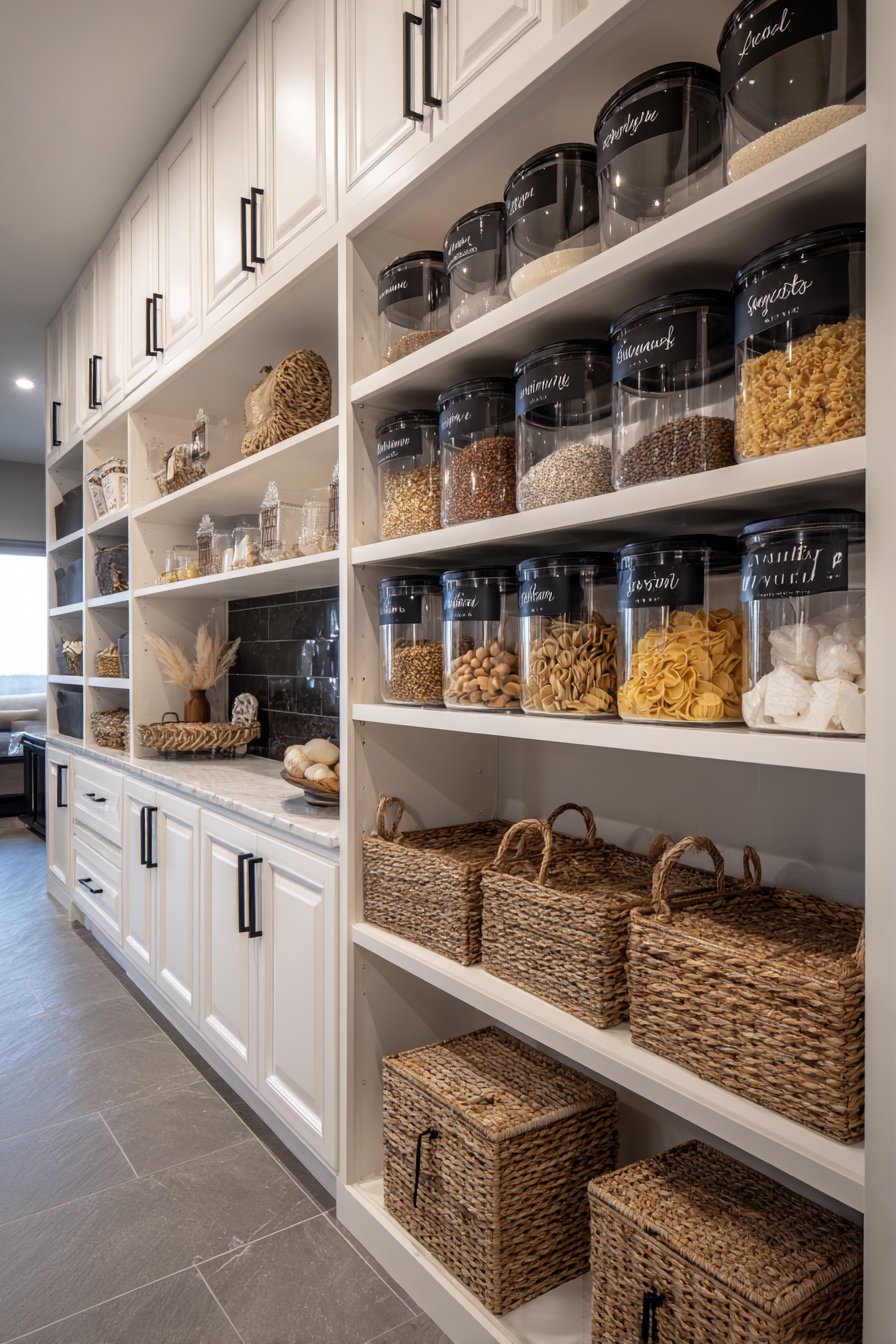
Wide-angle interior photography captures the entire pantry system with balanced natural lighting filtering from an adjacent room, emphasizing the practical accessibility and visual harmony of this organizational approach. The interplay between the industrial aesthetic of wire shelving, the modern clarity of acrylic containers, and the organic warmth of woven baskets creates a design that is both highly functional and genuinely beautiful. This combination of materials and organizational strategies represents contemporary kitchen design at its finest—where form follows function without sacrificing style.
Key Design Tips:
- Choose square or rectangular containers over round ones to maximize shelf space efficiency
- Label containers on multiple sides for easy identification from any angle
- Group items by category (baking supplies, breakfast items, snacks) for logical organization
- Utilize wire shelving to prevent dust accumulation and improve visibility
- Incorporate baskets for items that don’t require airtight storage or benefit from ventilation
- Measure your pantry shelves before purchasing containers to ensure optimal fit
3. Floating Shelves with Curated Display Storage
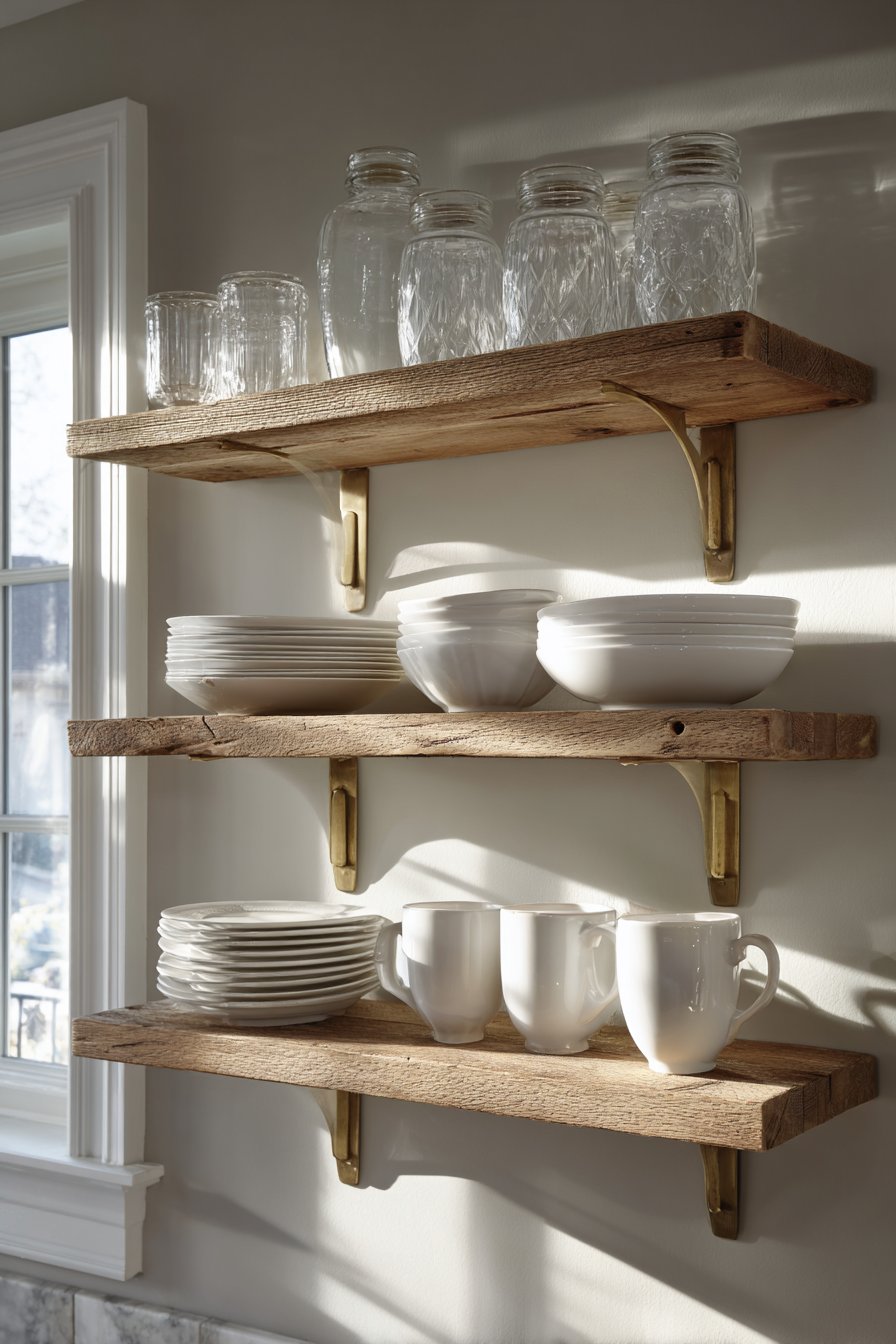
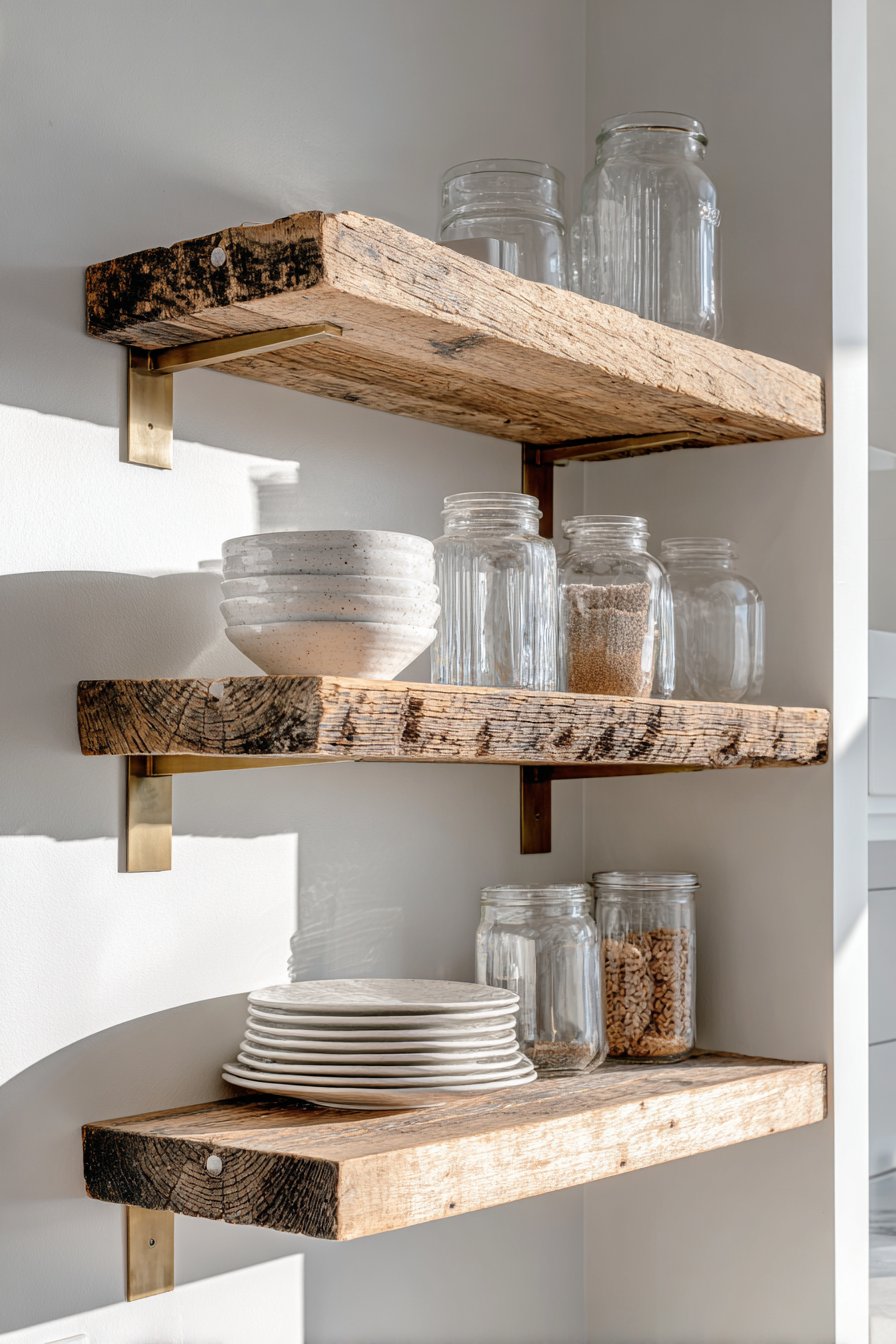
Open floating shelves crafted from reclaimed wood with visible grain texture offer an elegant solution for storing frequently used items while adding architectural interest to kitchen walls. This organization idea showcases white ceramic dishes, glass storage jars, and minimalist kitchenware arranged by frequency of use, creating both functional storage and an attractive display. Brushed brass shelf brackets add industrial charm while providing sturdy support, and the soft grey wall paint creates a sophisticated backdrop that allows the organized items to shine. Natural daylight from nearby windows creates gentle highlights on the arranged items, emphasizing the thoughtful curation of everyday essentials.
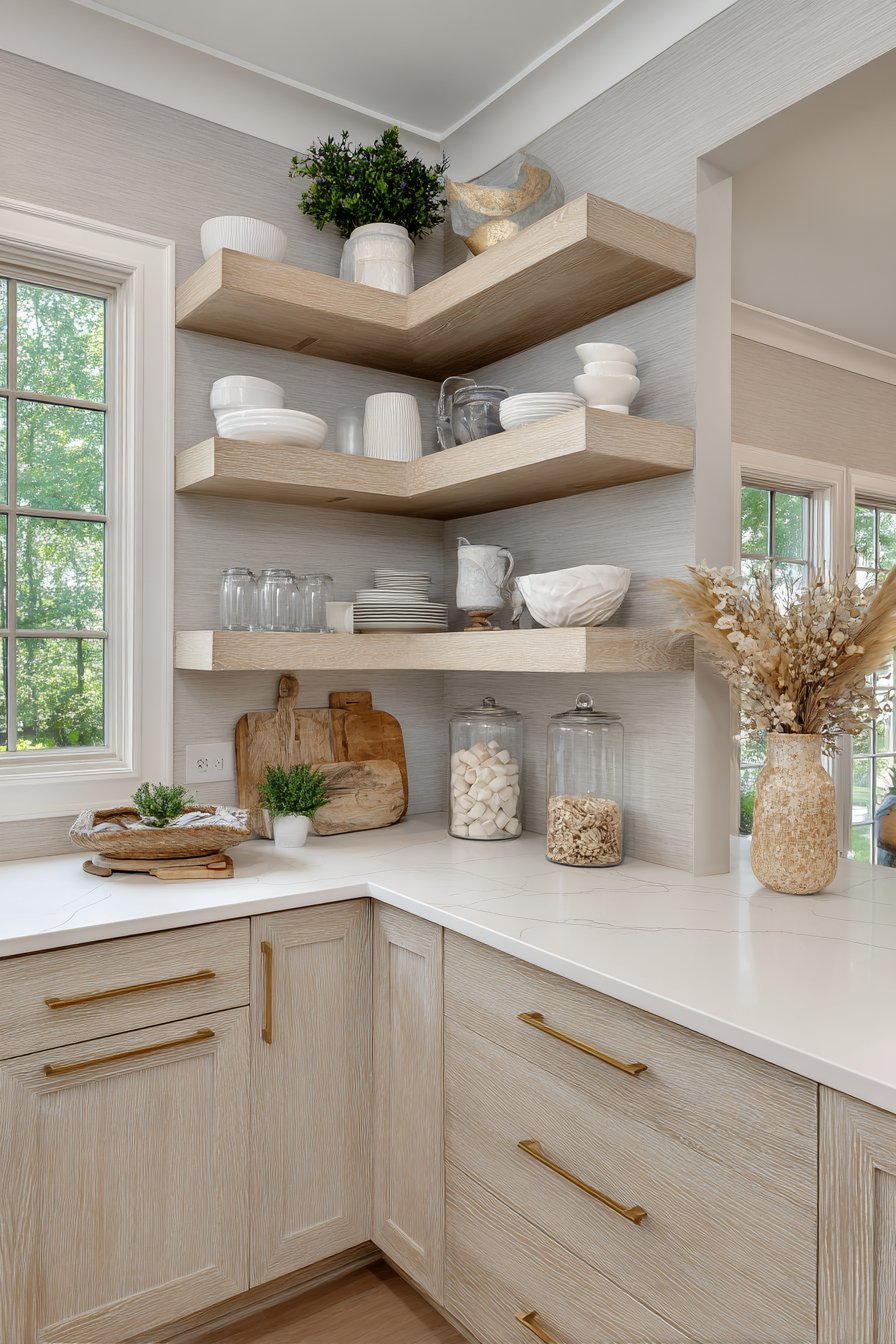
The success of open shelving as an organizational strategy depends entirely on thoughtful editing and consistent maintenance. Unlike closed cabinets that can hide disorder, open shelves demand discipline—only the items you truly use and appreciate should earn a place on these prominent displays. This constraint, however, becomes a design advantage, encouraging mindful consumption and forcing regular evaluation of what deserves valuable kitchen real estate. The visible grain texture of reclaimed wood adds character and history to the space, telling a story that mass-produced cabinetry simply cannot match.
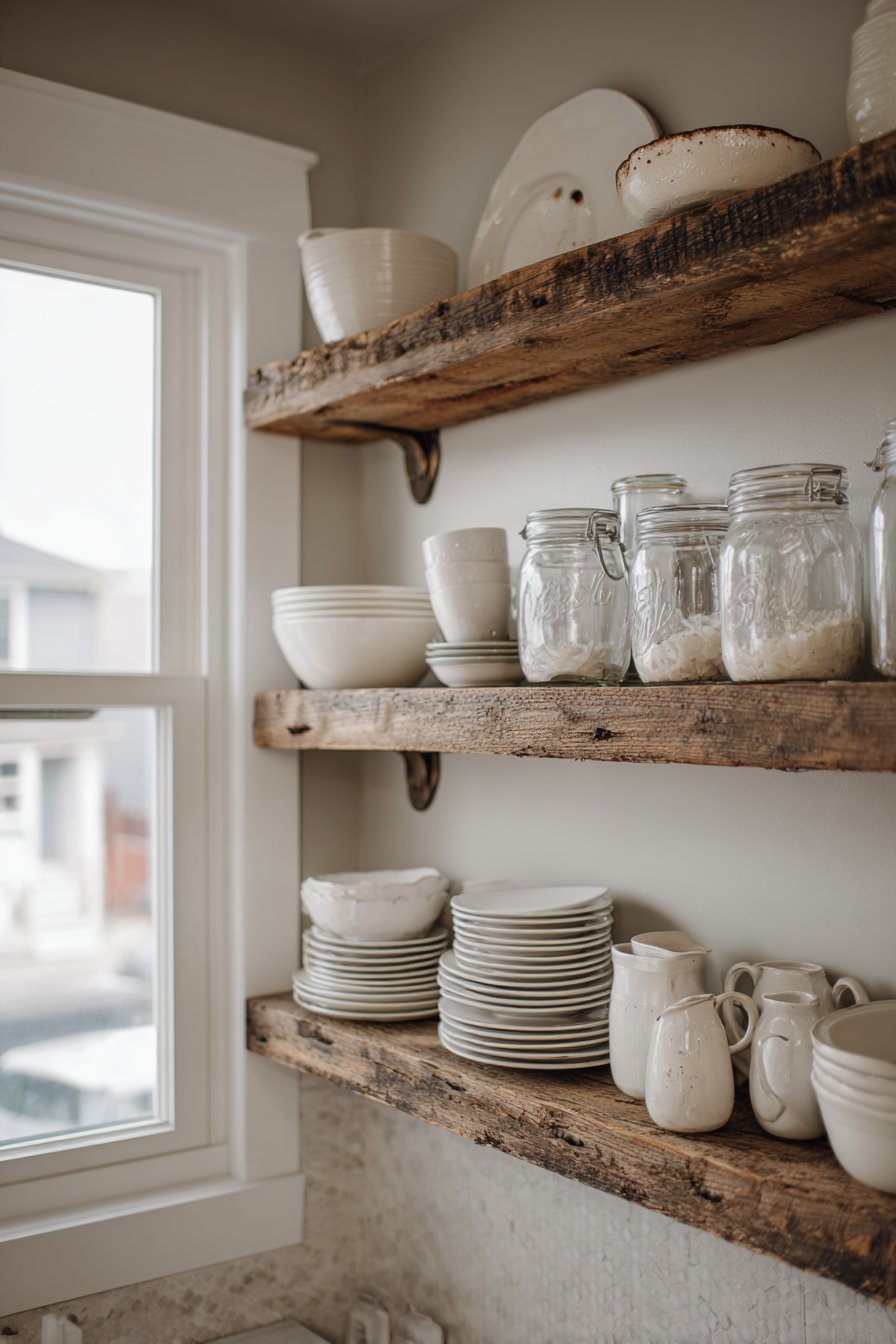
Professional interior photography perspectives focus on the functional beauty and material details of this organizational approach. The combination of rustic wood, contemporary brass hardware, and minimalist displayed items creates a design tension that feels current yet timeless. This type of organization works particularly well in kitchens where frequently used items like everyday dishes, glasses, and coffee supplies benefit from immediate accessibility. The key is maintaining the fine balance between functional storage and aesthetic display—too cluttered and the shelves become chaotic; too sparse and they lose their practical purpose.
Key Design Tips:
- Arrange items by height, placing taller pieces at the back and shorter items in front
- Maintain visual consistency through color coordination or matching container styles
- Leave some negative space to prevent shelves from appearing overcrowded
- Dust open shelves weekly to maintain their attractive appearance
- Rotate seasonal items to keep displays fresh and relevant
- Use shelf brackets that complement your kitchen’s hardware for design cohesion
4. Specialized Pull-Out Spice Organization
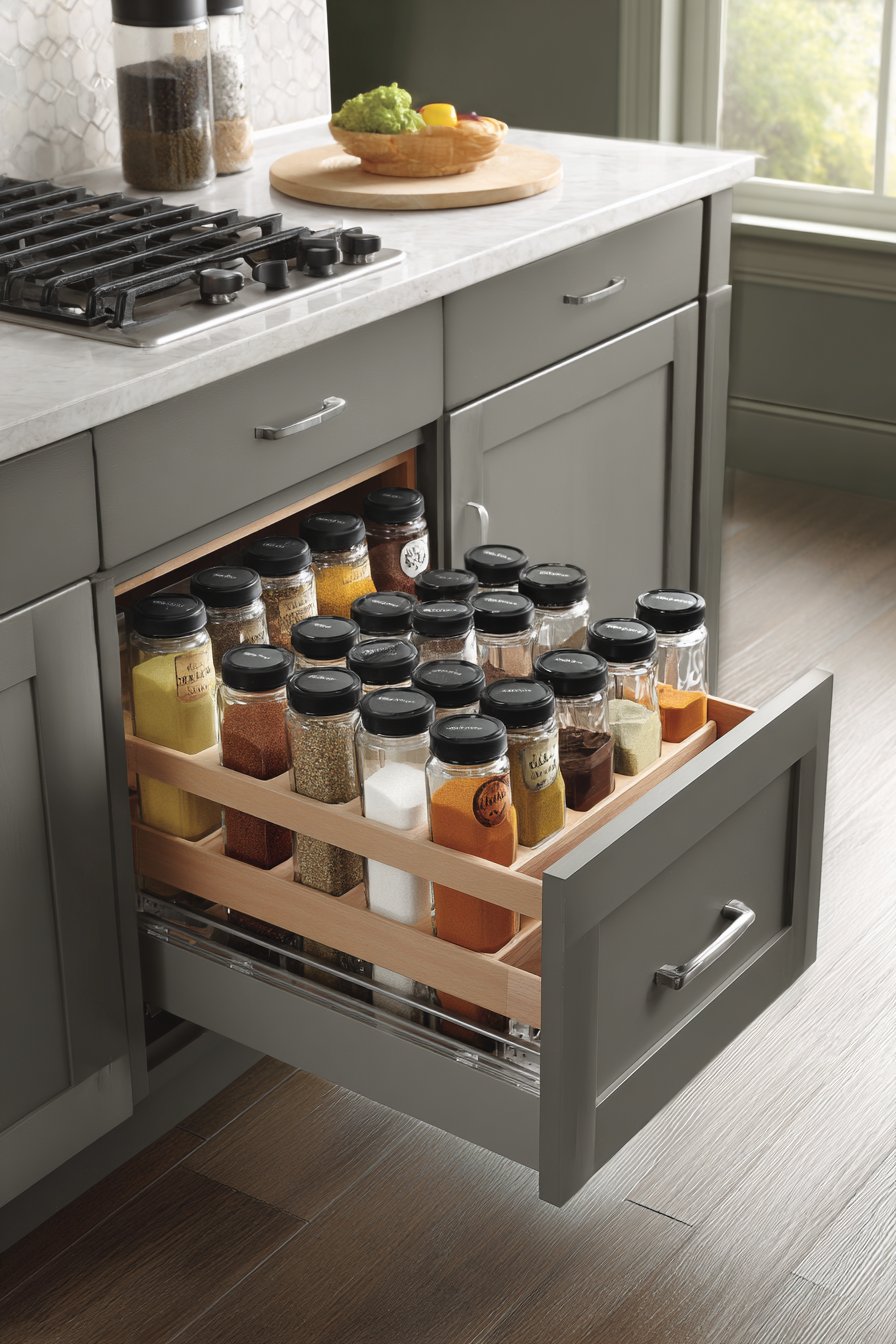
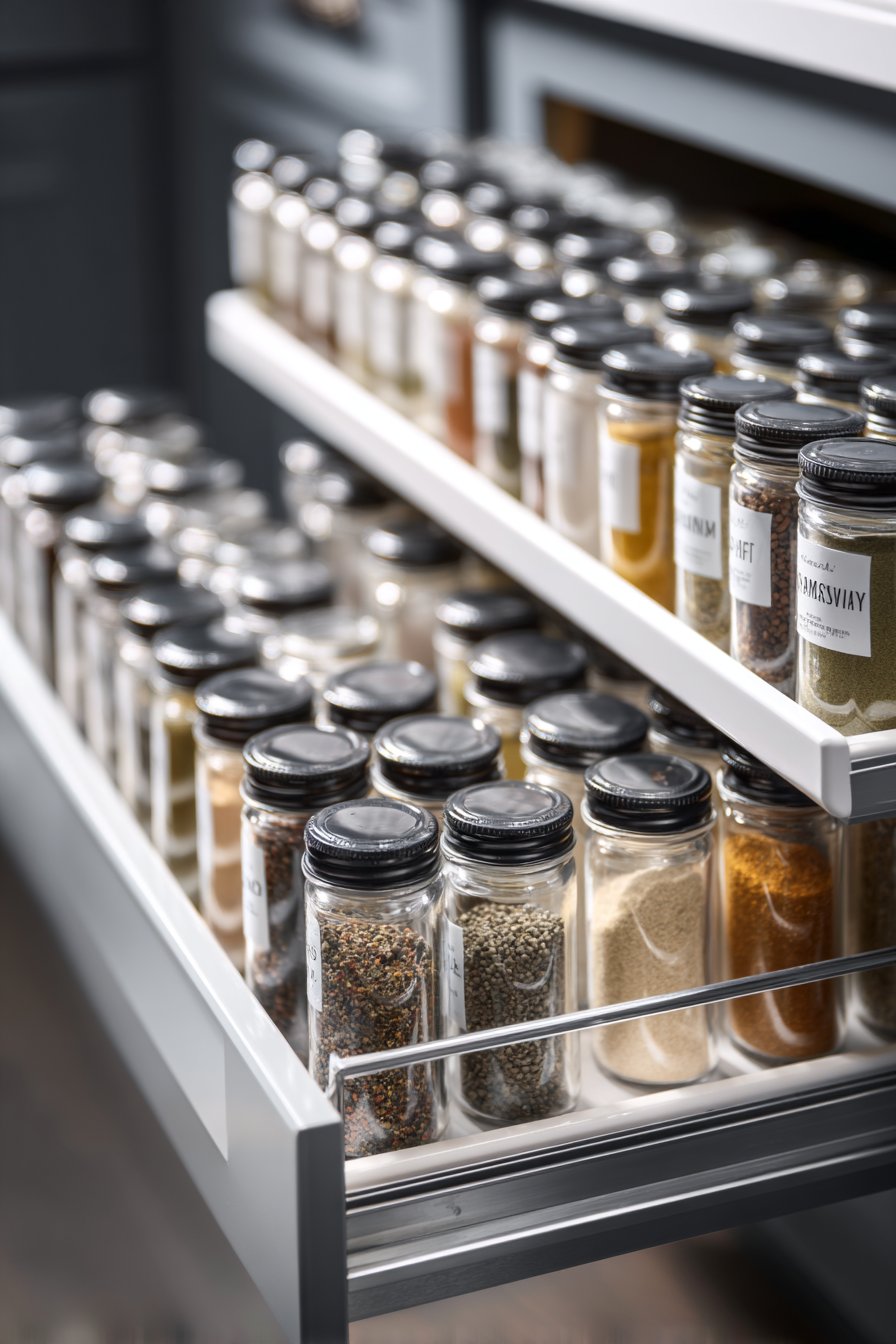
A custom-built spice rack integrated into a narrow pull-out cabinet between the stove and countertop exemplifies the intelligent use of typically wasted kitchen space. This innovative organization idea features uniform glass spice jars with black lids arranged in tiered rows, each clearly labeled for instant identification. The cabinet interior features white coating that reflects light, making spices easily visible even in the narrow space. This detail shot with soft artificial lighting emphasizes the clever use of what would otherwise be a dead zone in kitchen design, transforming it into one of the most frequently accessed and appreciated organizational features.
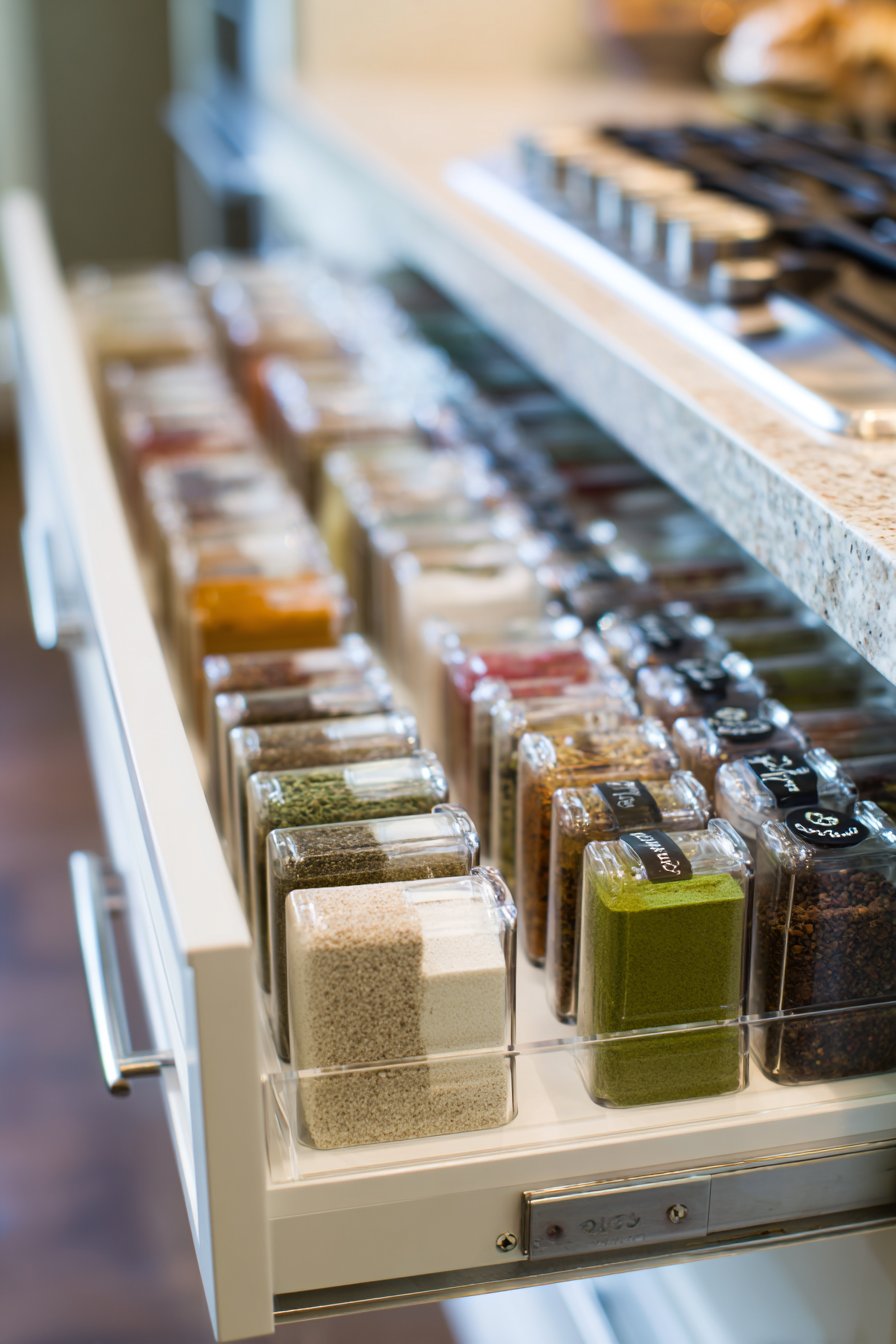
The proximity to the cooking surface makes this organizational solution extraordinarily practical during meal preparation. Rather than reaching into a deep cabinet or walking to a distant pantry, spices are literally at your fingertips, reducing cooking time and improving the flow of culinary work. The tiered arrangement ensures that every spice jar is visible and accessible—no more excavating through multiple layers to find that elusive cumin or smoked paprika. The uniform glass jars with matching black lids create visual cohesion while allowing you to see exactly how much of each spice remains, facilitating timely restocking.
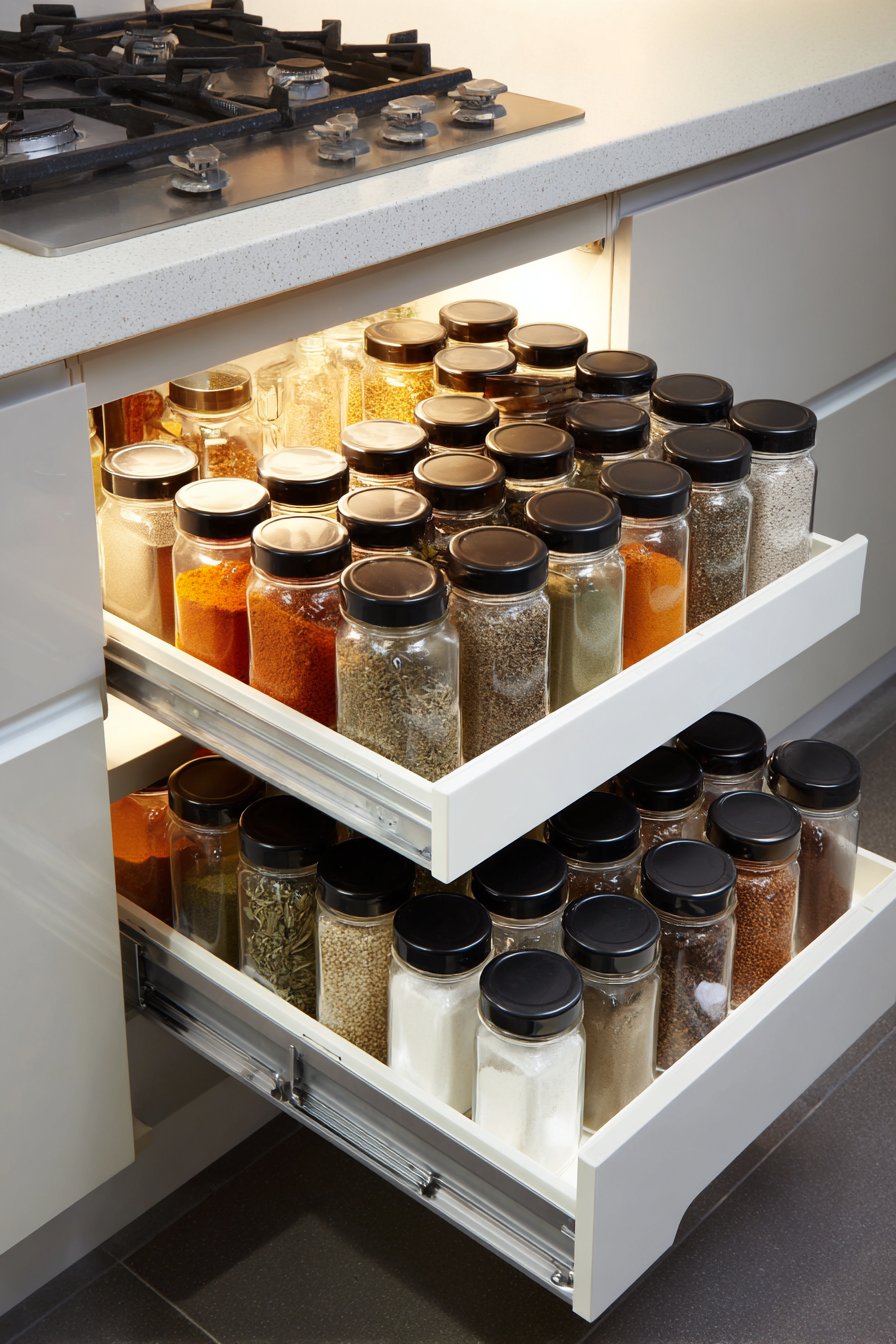
This type of specialized organization represents a growing trend in contemporary kitchen design: creating dedicated zones for specific tasks or ingredients. Rather than storing everything in general-purpose cabinets, modern kitchens increasingly feature specialized storage that addresses particular needs—in this case, the need for immediate access to cooking spices during food preparation. The white interior coating serves a practical purpose beyond aesthetics, bouncing available light throughout the narrow cabinet and making label reading easier even in low-light conditions.
Key Design Tips:
- Install pull-out spice racks within arm’s reach of your primary cooking surface
- Use uniform containers to create visual order and maximize space efficiency
- Label jar tops as well as fronts for easy identification when looking down into drawers
- Arrange spices alphabetically or by frequency of use depending on your cooking style
- Consider magnetic spice jars for additional storage on refrigerator sides or metal backsplashes
- Replace spices annually to ensure optimal flavor and potency
5. Under-Sink Cabinet Transformation
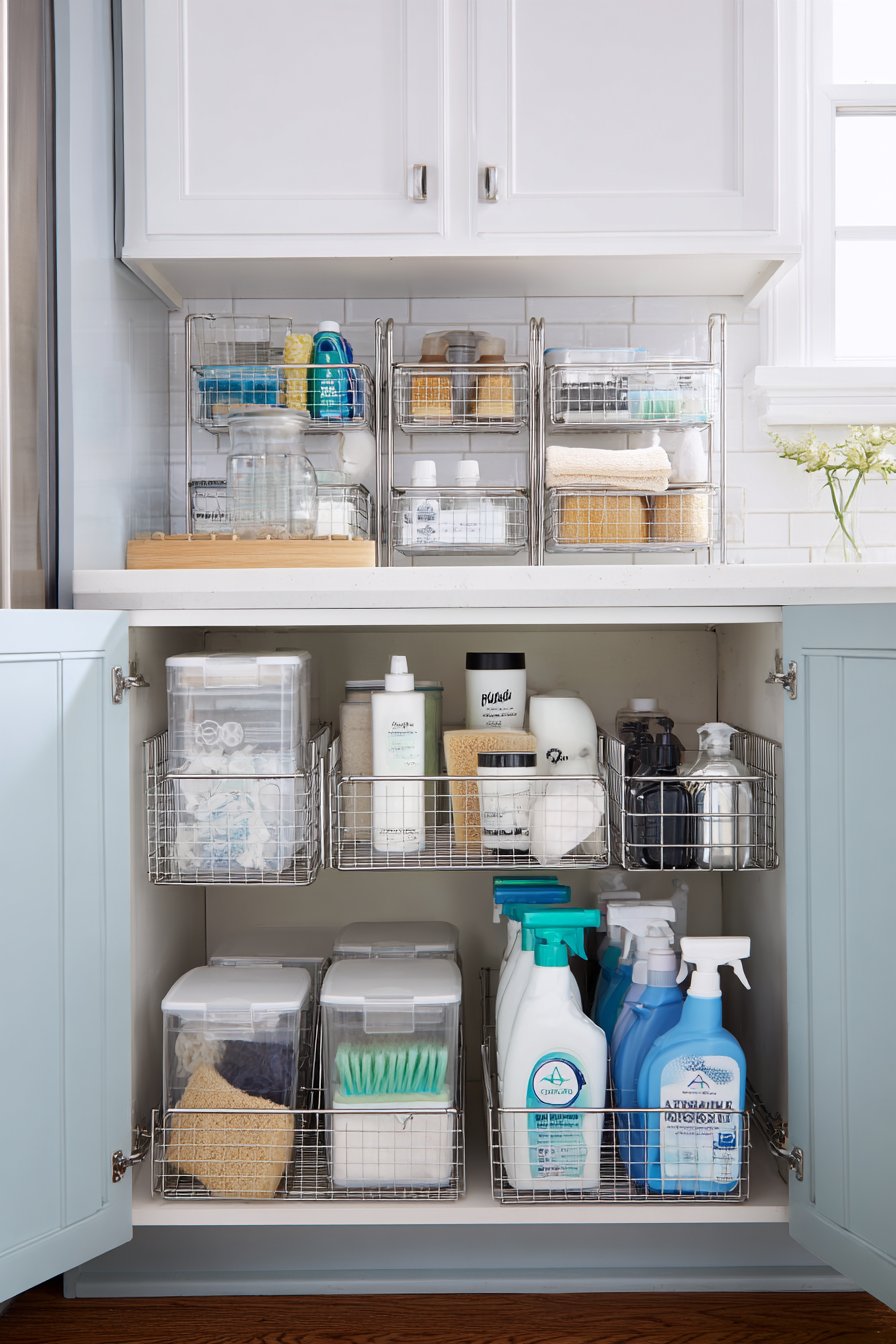
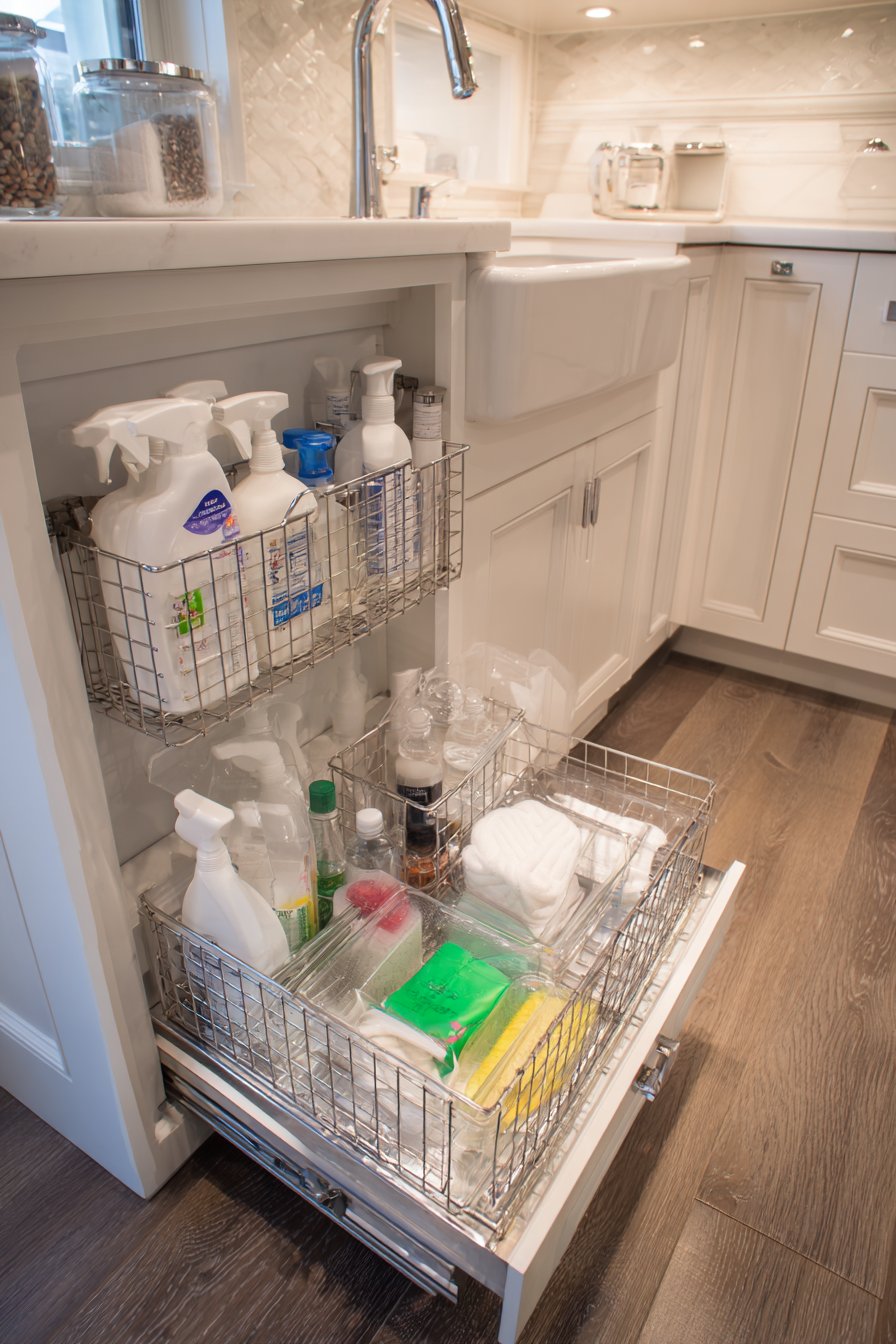
The area beneath the kitchen sink notoriously becomes a chaotic catchall for cleaning supplies, trash bags, and various household necessities. However, this organization idea demonstrates how stackable sliding drawers, pull-out waste bins, and mounted cleaning supply caddies can transform this awkward space into a model of efficiency. Chrome wire organizers maximize the challenging cabinet space that must work around plumbing, while white interior coating keeps the area bright and appealing. The practical arrangement includes designated spaces for dish soap, sponges, scrub brushes, and cleaning products, with everything easily accessible yet neatly contained.
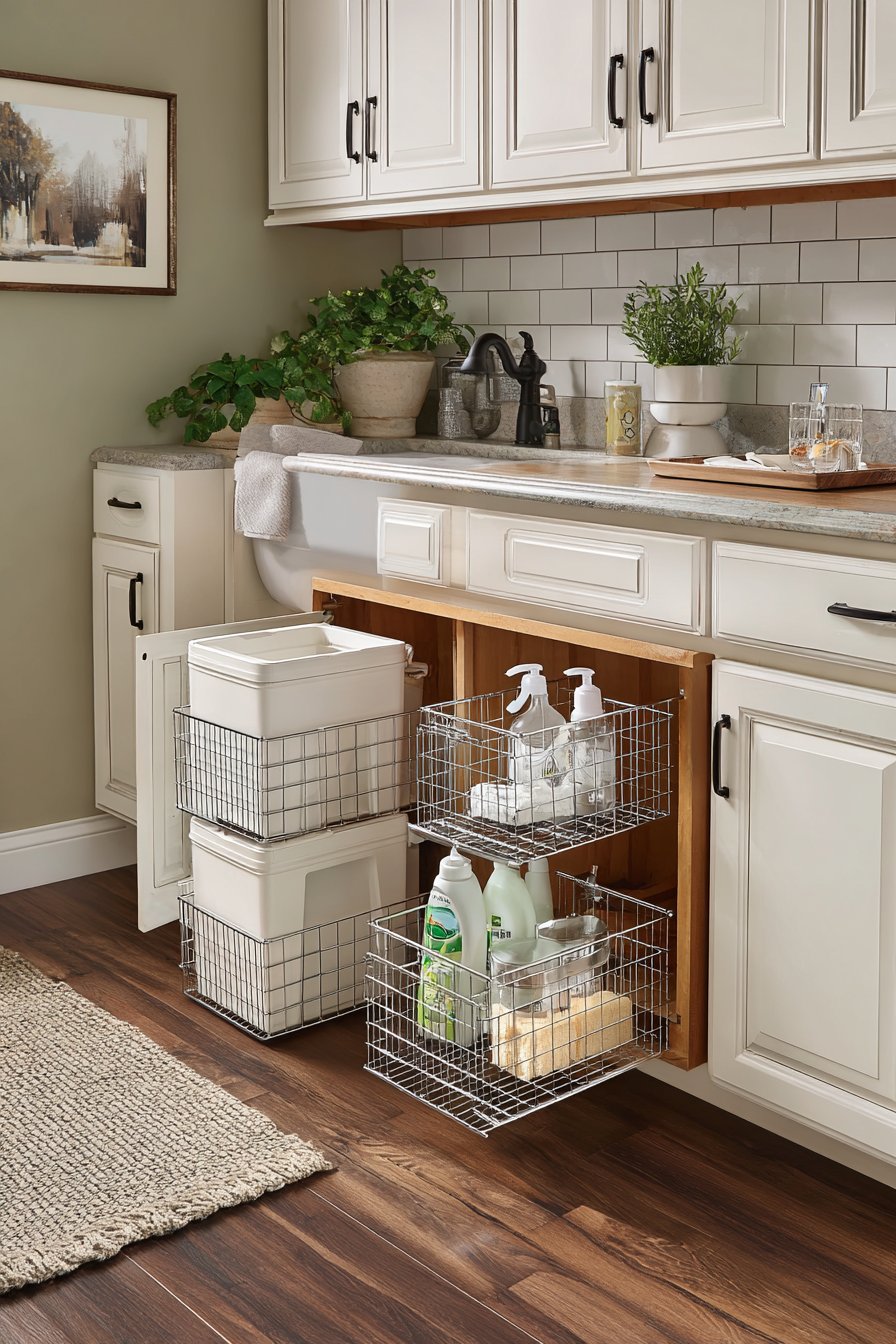
Interior design photography with balanced exposure captures the functional transformation of typically chaotic under-sink areas with attention to material details. The chrome wire construction of organizers allows water from damp cleaning cloths to drip through rather than pooling, preventing mold and mildew issues common in this high-moisture environment. Pull-out drawers eliminate the need to crouch and reach to the back of the cabinet—a particularly appreciated feature for those with mobility challenges or back problems. This organizational system proves that even the most problematic kitchen spaces can become exemplars of thoughtful design.
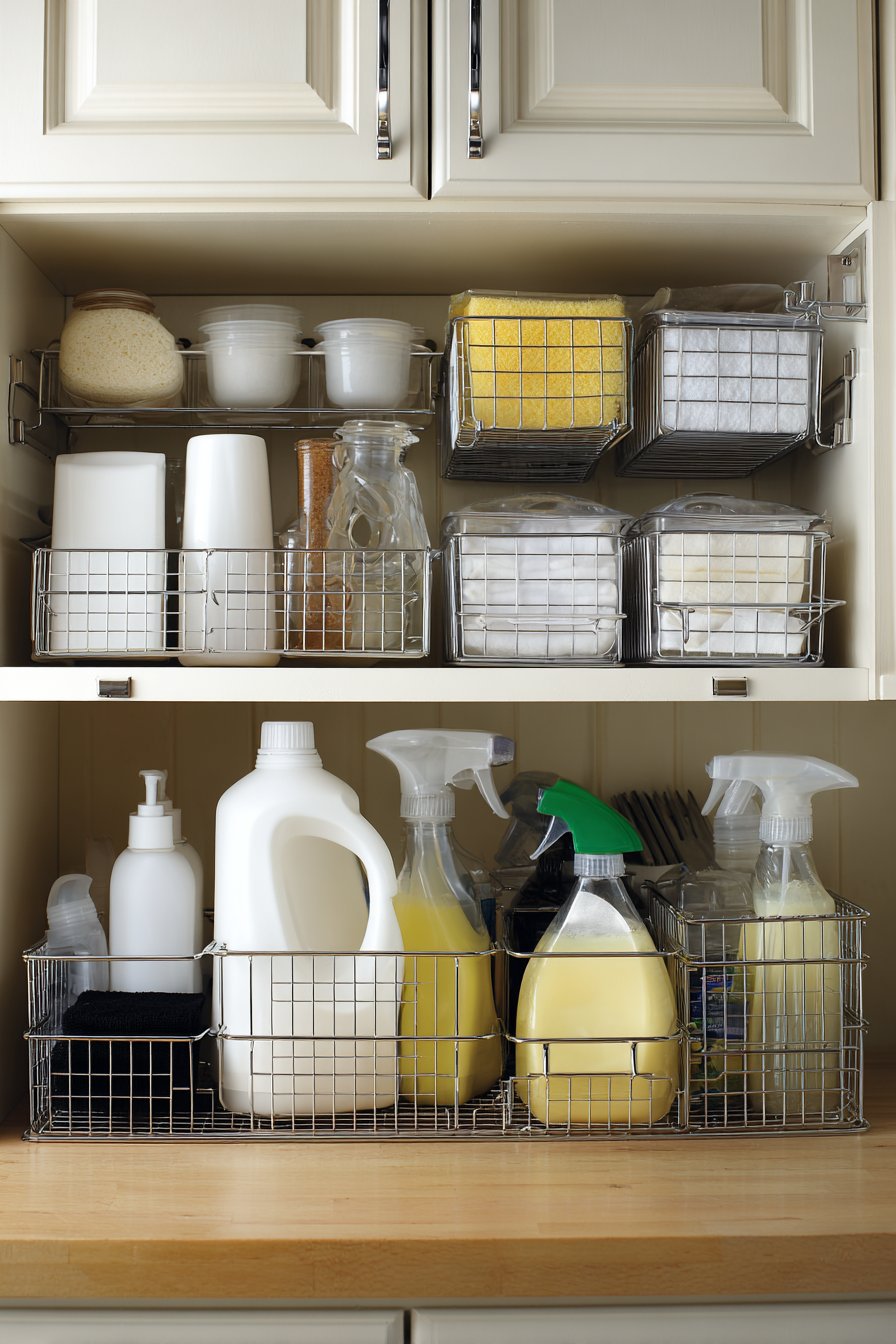
The psychology of organizing under-sink cabinets extends beyond mere tidiness to address practical household management. When cleaning supplies are properly organized and visible, you’re more likely to notice when products are running low, preventing the frustration of discovering mid-task that you’re out of dish soap. The separation of cleaning products from trash receptacles reduces the risk of contamination, while mounted caddies keep spray bottles upright and ready for use. This comprehensive approach to under-sink organization represents a small investment of time and money that pays dividends in daily convenience and efficiency.
Key Design Tips:
- Measure around plumbing before purchasing under-sink organizers to ensure proper fit
- Use expandable shelf organizers to create two levels of storage in tall cabinets
- Install pull-out trash bins on slides for easy access and concealment
- Attach cleaning supply caddies to cabinet doors to maximize vertical space
- Line the cabinet bottom with waterproof mat to protect against leaks and spills
- Store only frequently used cleaning supplies under the sink; relocate occasional-use products elsewhere
6. Kitchen Island with Deep Drawer Organization
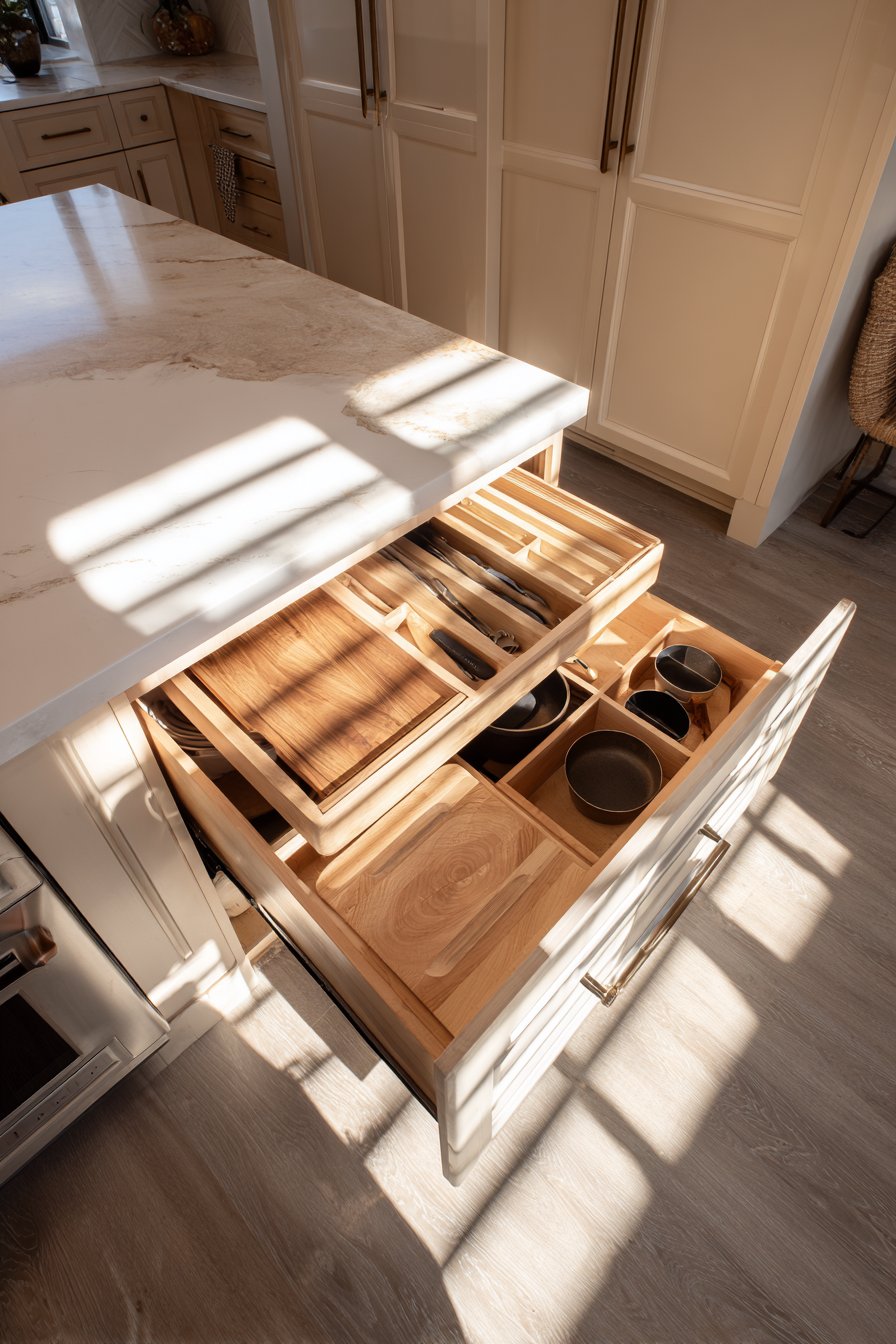
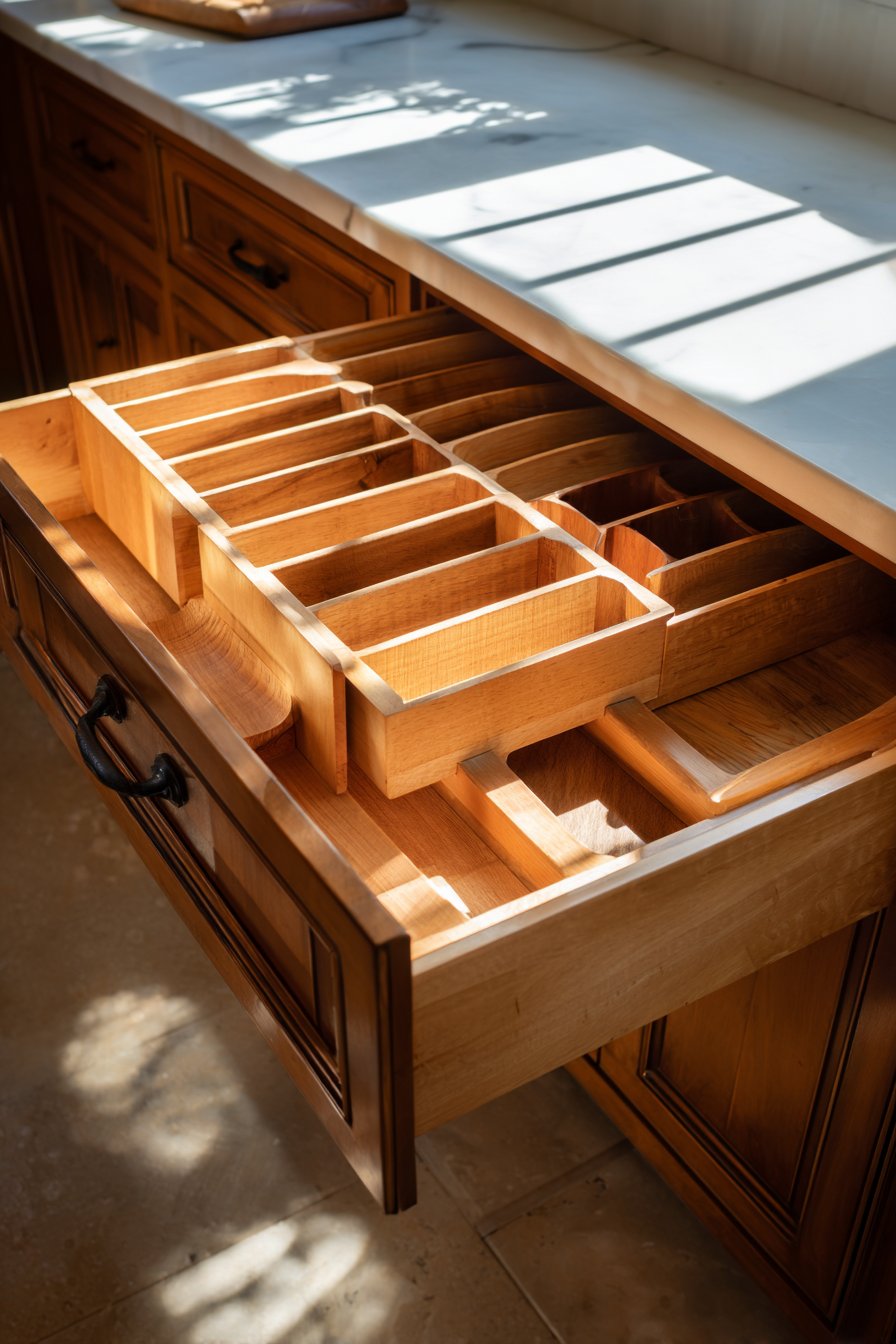
A large kitchen island with deep drawers containing custom organization systems for pots, pans, and lids represents the ultimate in accessible cookware storage. Vertical dividers keep baking sheets and cutting boards upright and easily retrievable, eliminating the precarious stacking that makes accessing lower items nearly impossible. The drawer features soft-close mechanisms that prevent slamming and natural maple wood construction with visible grain that adds warmth to the kitchen aesthetic. Wide-angle photography shows the open drawer from above, with natural light creating shadows that emphasize the thoughtful compartmentalization and practical storage solutions.
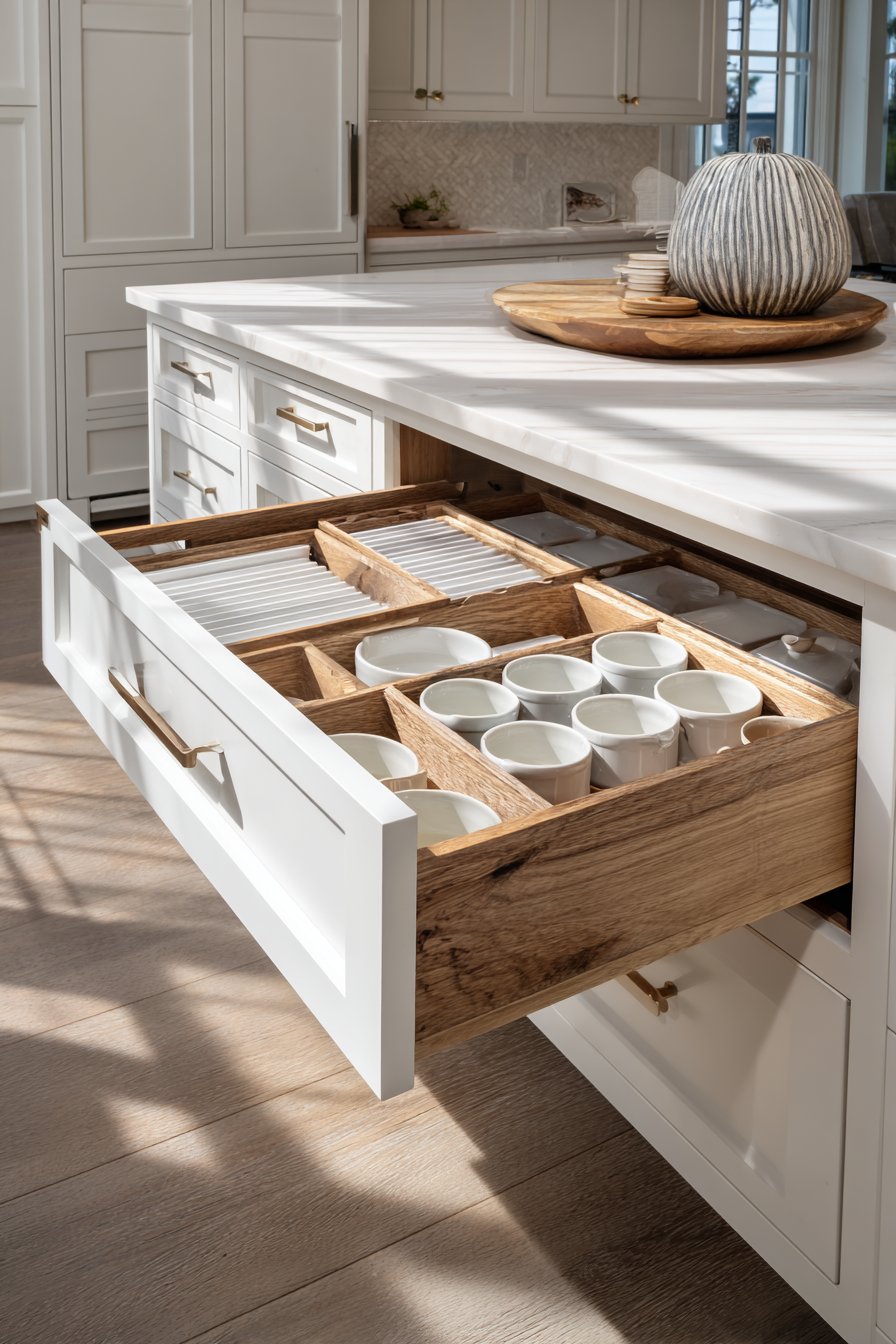
The depth of island drawers provides opportunities unavailable in standard base cabinets. Rather than nesting pots and pans—which inevitably means removing multiple items to access the one you need—deep drawers with proper dividers allow you to store each piece individually and upright. This organizational approach dramatically reduces the noise and chaos of cookware storage, protecting non-stick surfaces from scratching and making it possible to grab exactly what you need without disturbing other items. The natural maple construction with soft-close mechanisms represents an investment in both functionality and longevity, as quality drawer hardware withstands the repeated opening and closing that kitchen drawers endure daily.
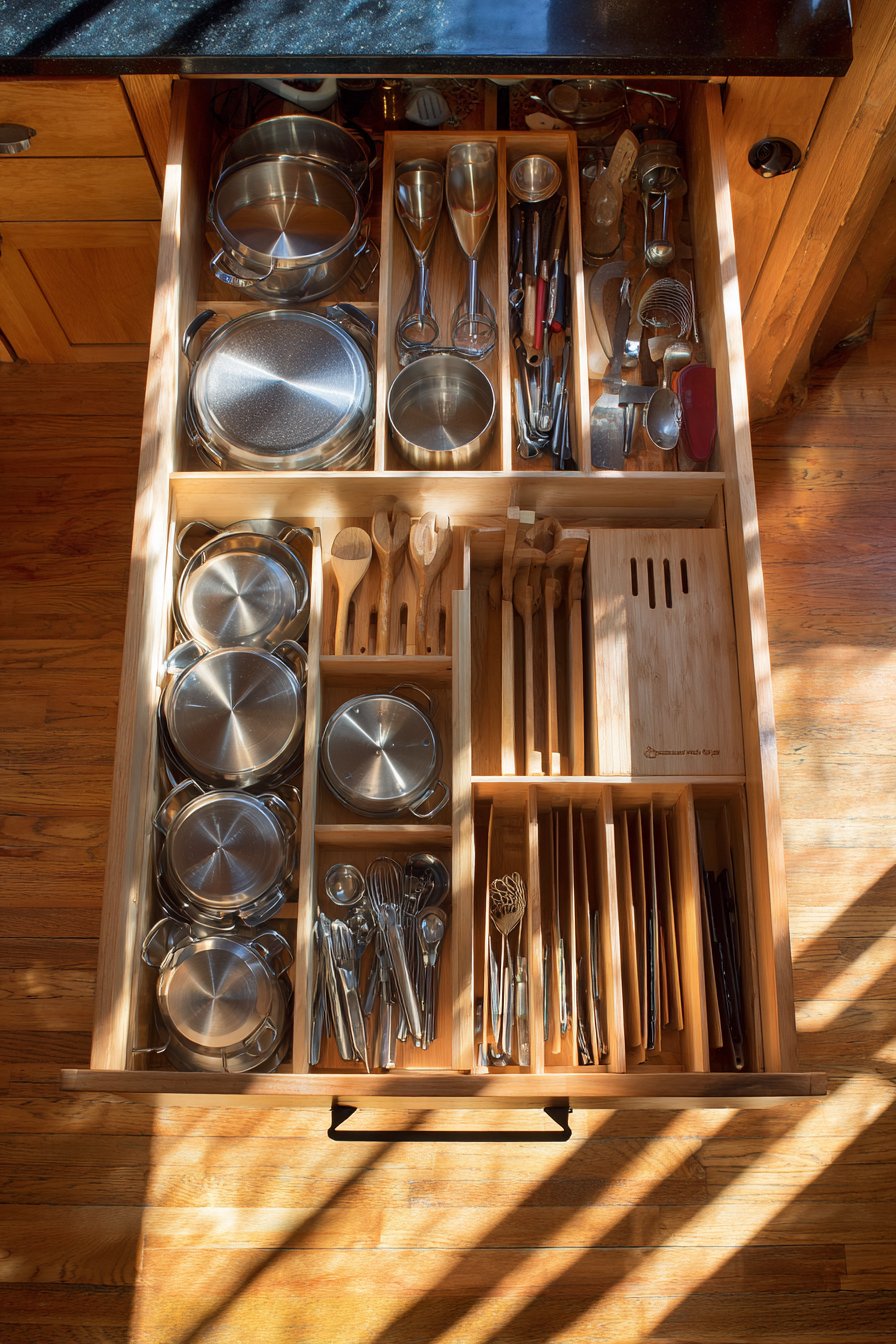
Custom organization systems for kitchen islands demonstrate the value of planning storage solutions during kitchen design rather than retrofitting solutions afterward. When drawers are built with specific organizational purposes in mind, they can be sized perfectly for the items they’ll contain. The vertical dividers for baking sheets, for example, require careful consideration of both width and height to accommodate various sizes while maximizing space efficiency. This proactive approach to organization creates a kitchen that functions seamlessly from day one, rather than requiring years of trial and error to achieve optimal storage solutions.
Key Design Tips:
- Install deep drawers in islands specifically for large pot and pan storage
- Use adjustable dividers that can be reconfigured as your cookware collection changes
- Store pot lids separately using vertical dividers or specialized lid organizers
- Place your most frequently used cookware in the most accessible drawer positions
- Consider felt-lined dividers to protect high-quality cookware finishes
- Ensure drawer slides are heavy-duty enough to support the weight of cast iron and stainless steel cookware
7. Pegboard Wall Organization System
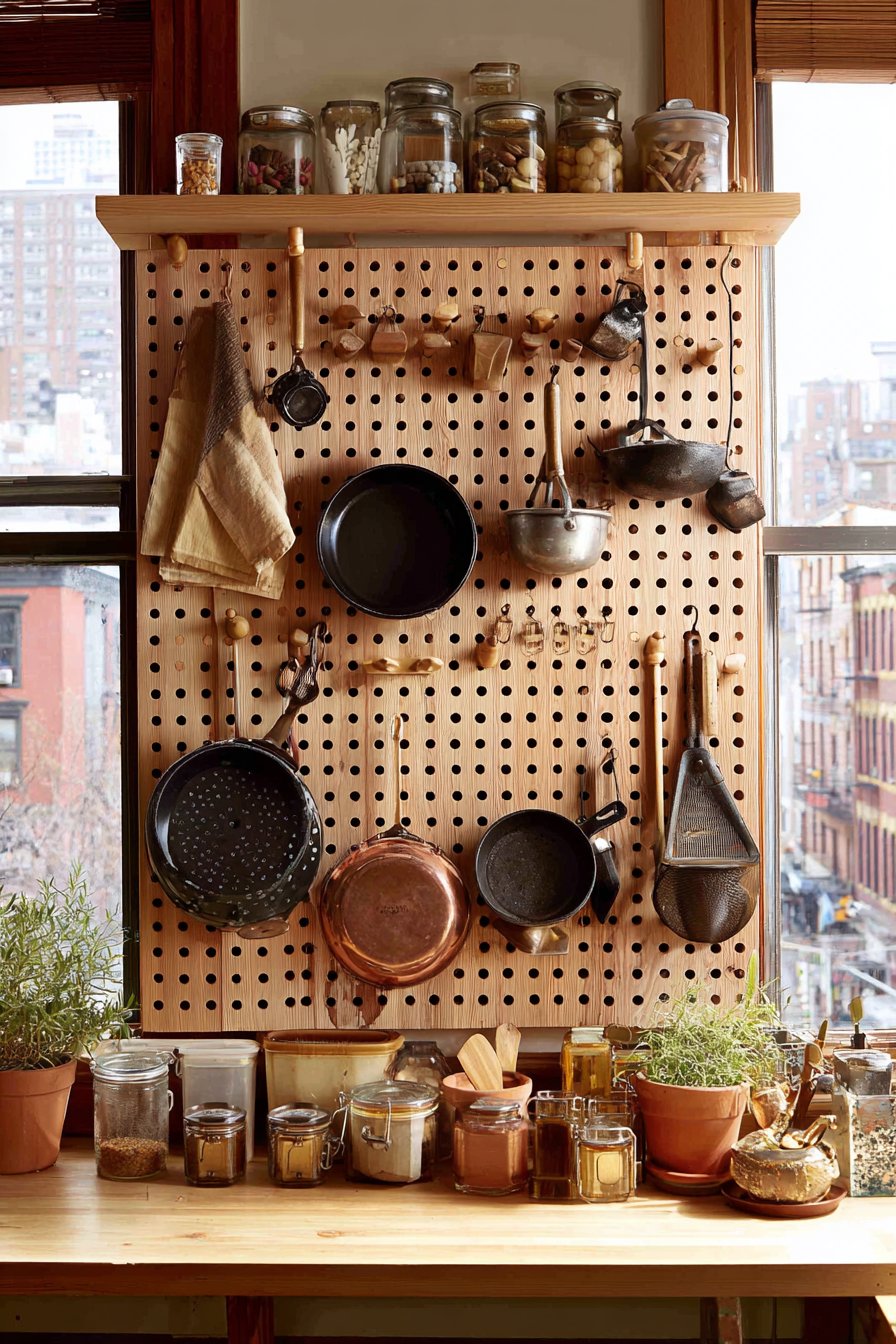
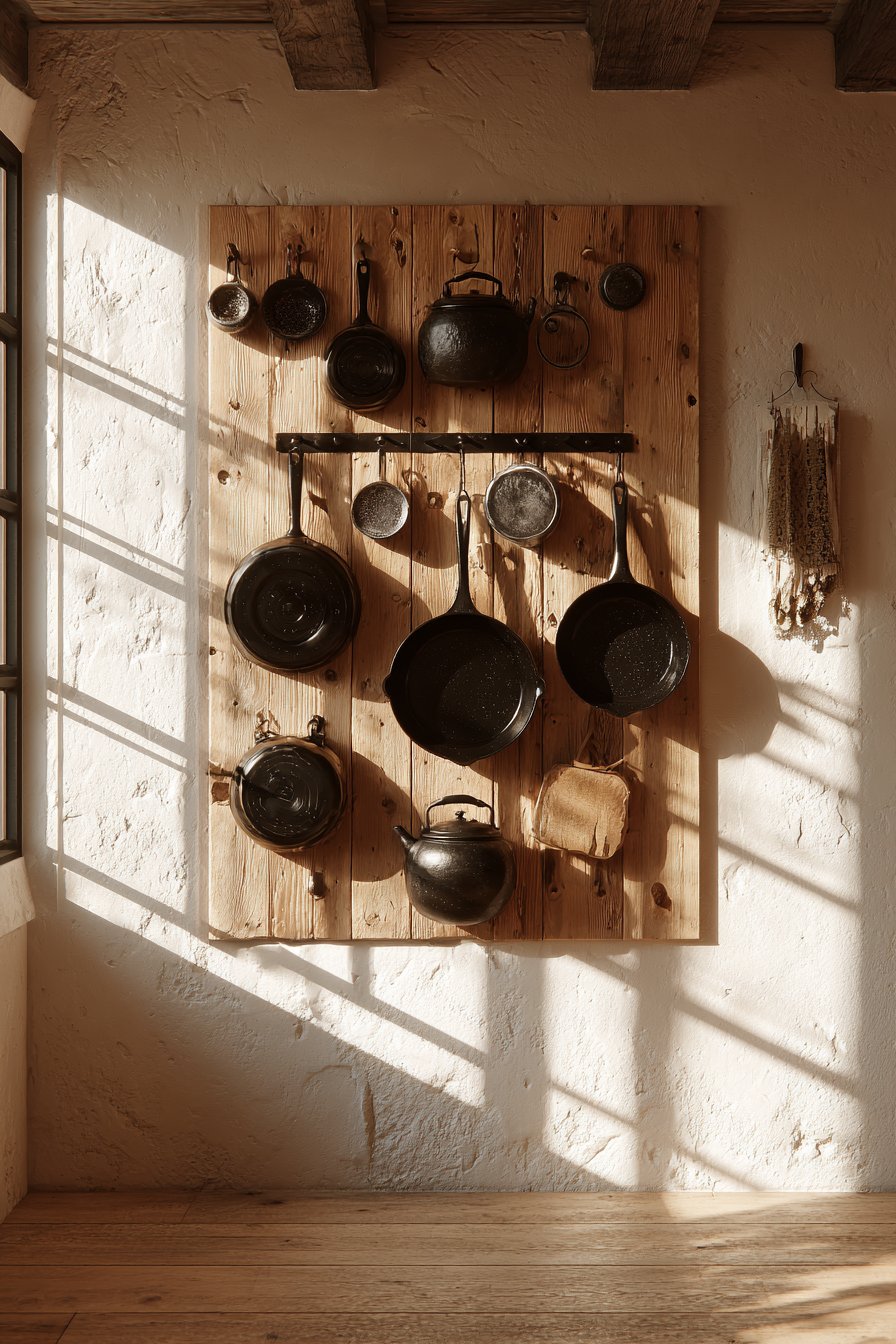
A pegboard system with natural wood finish offers dynamic, customizable storage for frequently used cooking utensils, pots, and pans. This organization idea features brass hooks and wooden pegs creating visual interest while maintaining functionality, with the arrangement including hanging measuring cups, spatulas, and small cast iron skillets within easy reach of food preparation areas. Soft diffused lighting from nearby windows highlights the textures of wood and metal, creating an aesthetic that feels both rustic and intentional. Interior photography style captures the organized display with attention to the interplay of materials and the practical accessibility of frequently used items.
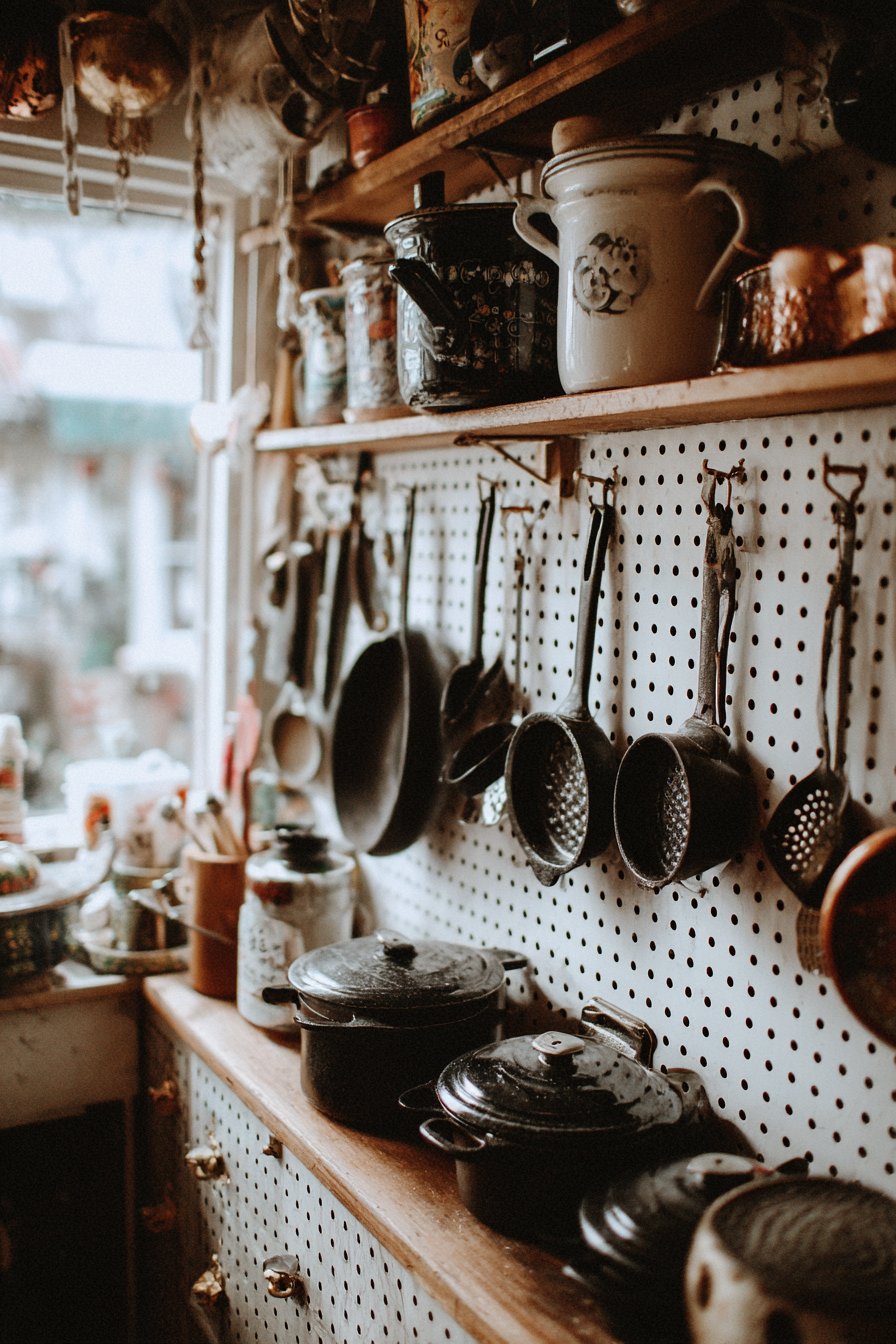
The genius of pegboard organization lies in its infinite adaptability. Unlike fixed hooks or shelving, pegboards allow you to reconfigure your storage arrangement as your needs evolve, adding hooks where needed and removing them when circumstances change. This flexibility makes pegboards particularly valuable in kitchens that serve multiple cooks with different preferences, or in households where kitchen tool collections grow and change over time. The natural wood finish adds warmth and organic beauty, elevating pegboard organization from purely utilitarian to genuinely attractive.
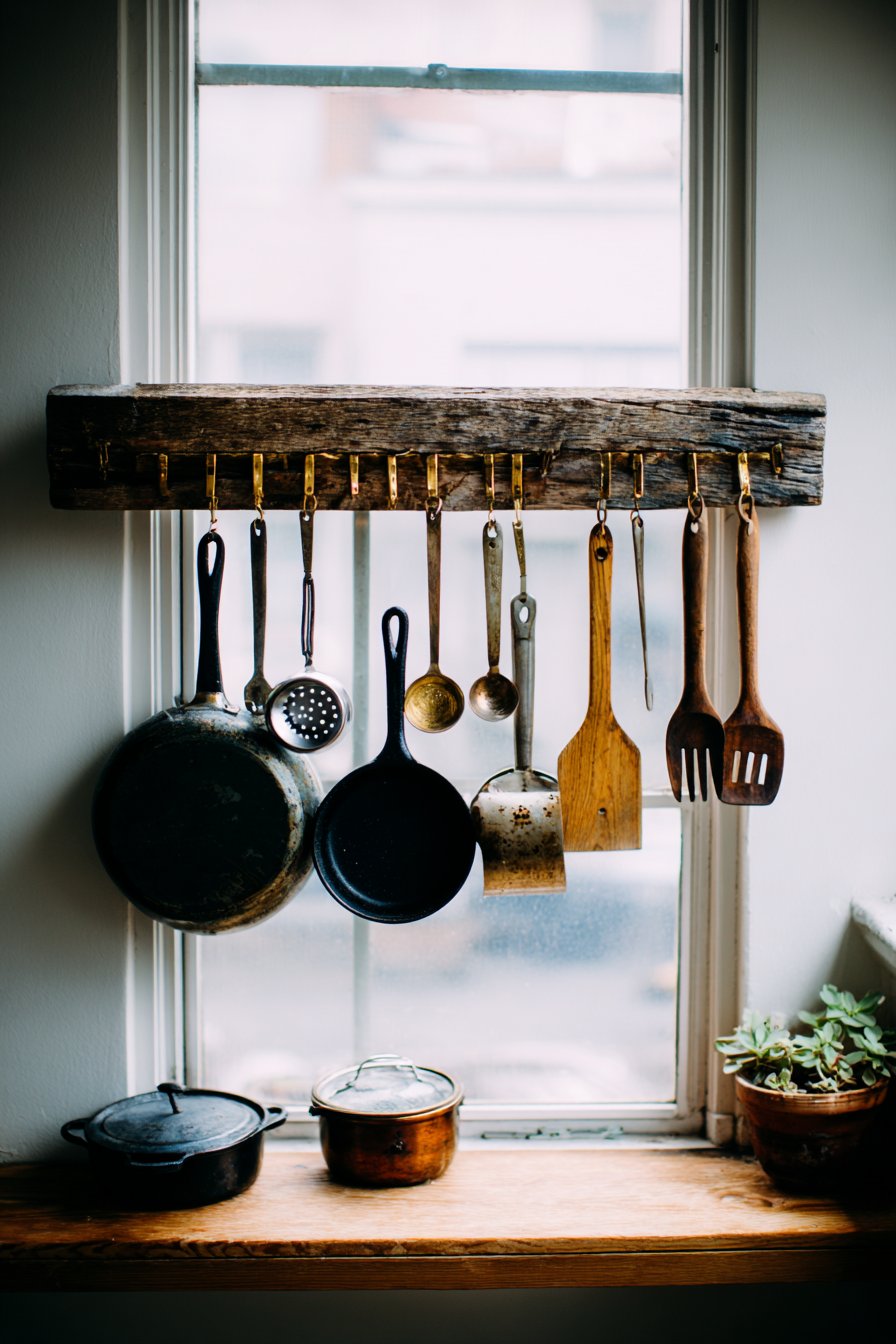
Pegboard systems work best when thoughtfully arranged rather than randomly loaded with hooks. Professional interior designers recommend grouping items by function—all baking tools together, all pots in one section—and arranging items by frequency of use, with daily essentials at optimal reaching height and occasional-use items higher or lower. The combination of brass hooks and wooden pegs creates visual variety while serving different functional needs: brass hooks for hanging pots by their handles, wooden pegs for items with hanging holes. This attention to both aesthetic and functional details transforms a simple pegboard into a kitchen focal point.
Key Design Tips:
- Install pegboards near your primary prep area for maximum convenience
- Outline tool positions with paint markers to maintain organized arrangements
- Mix hook styles and sizes to accommodate various item types
- Leave adequate spacing between items to prevent overcrowding
- Consider pegboard depth when selecting—thicker boards support heavier items
- Seal natural wood pegboards to protect against kitchen moisture and stains
8. Dedicated Coffee and Tea Station
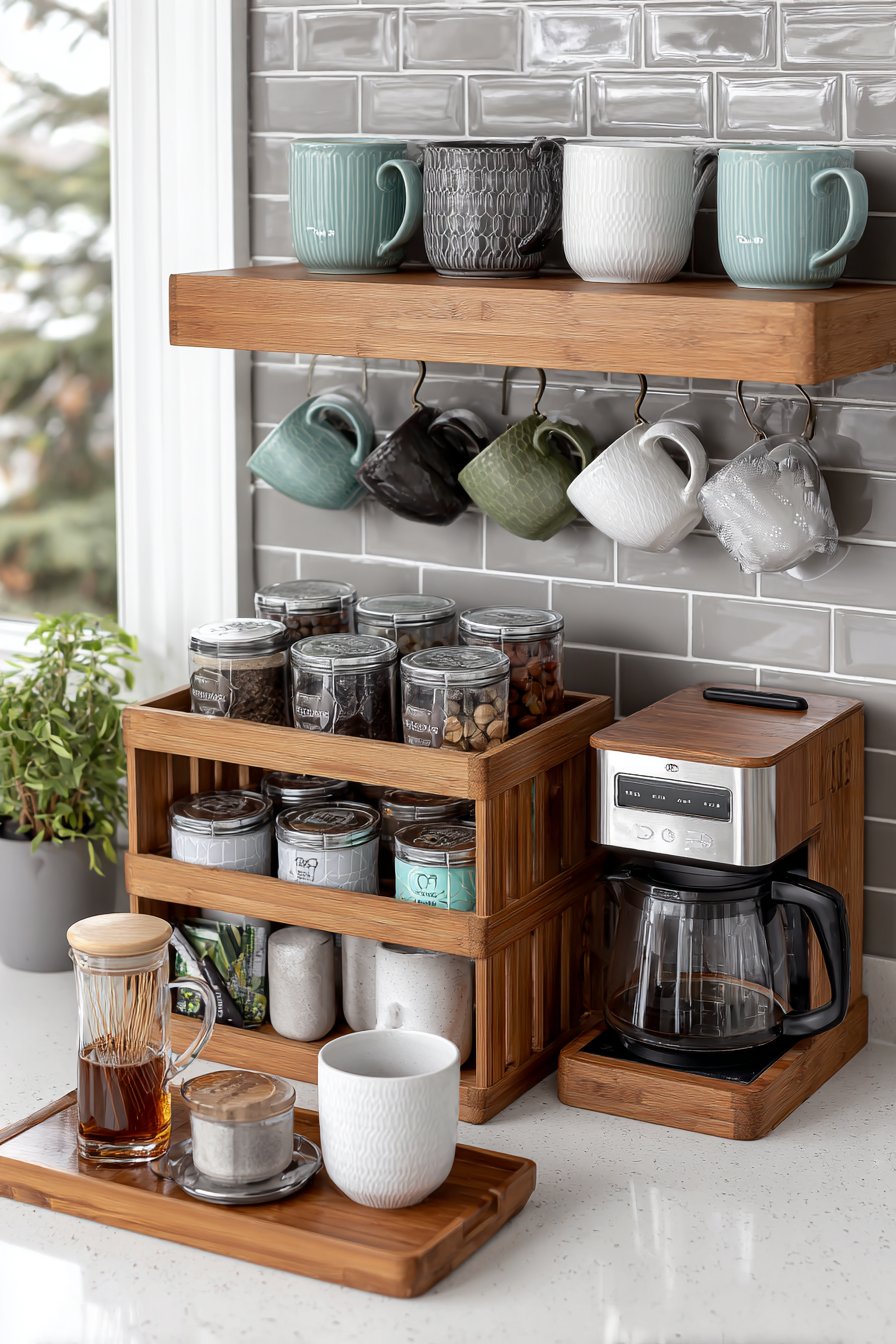
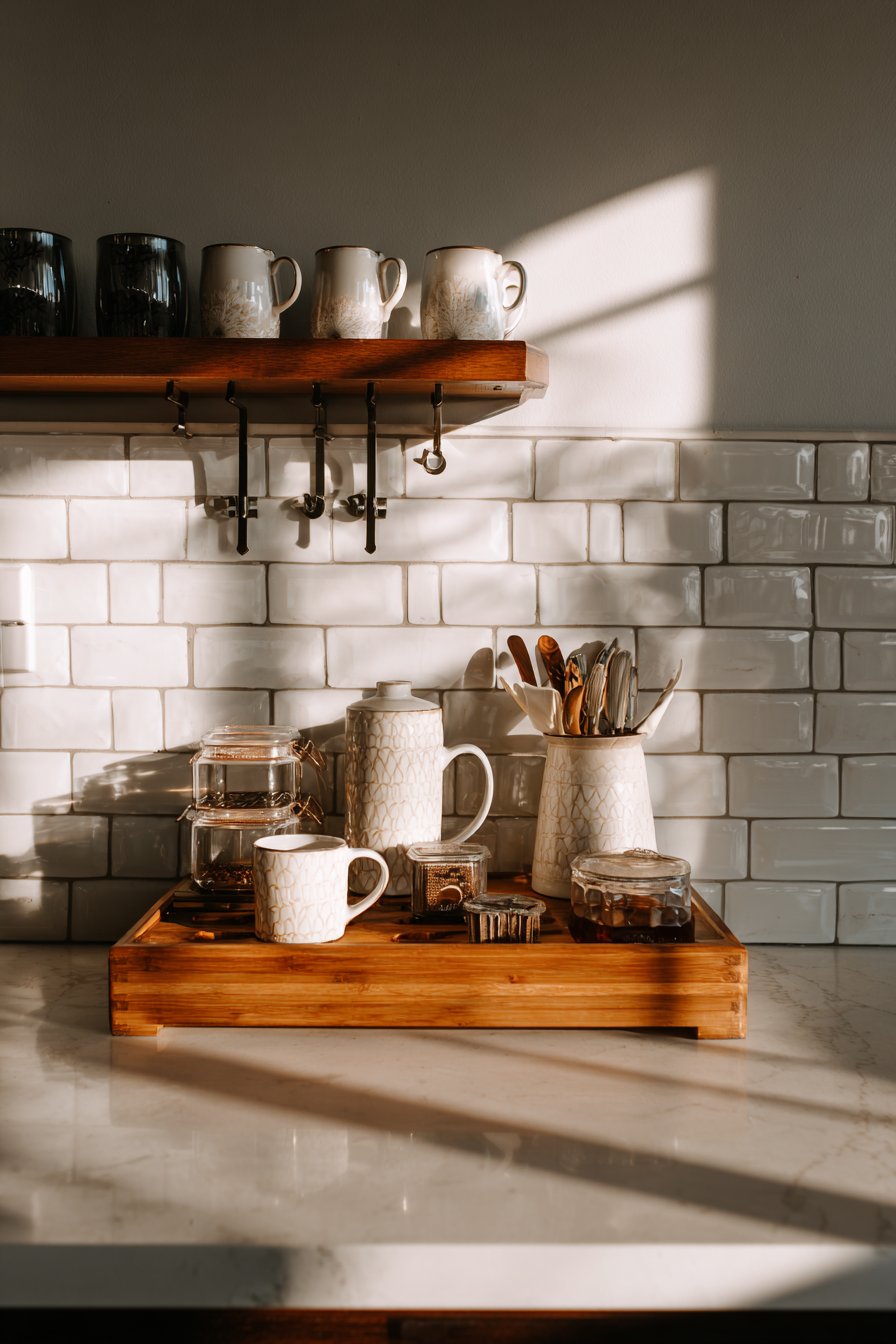
A custom coffee and tea station with tiered bamboo organizers holding various coffee pods, tea bags, and brewing accessories creates a designated zone for morning rituals and afternoon pick-me-ups. This organization idea includes a small tray corralling sugar, honey, and stirrers while wall-mounted cup hooks display favorite mugs within easy reach. Light grey subway tile backsplash provides a clean, modern backdrop that doesn’t compete with the functional display. Natural morning light creates gentle shadows, captured with professional interior photography techniques that emphasize the cozy functionality and material warmth of this specialized storage zone.
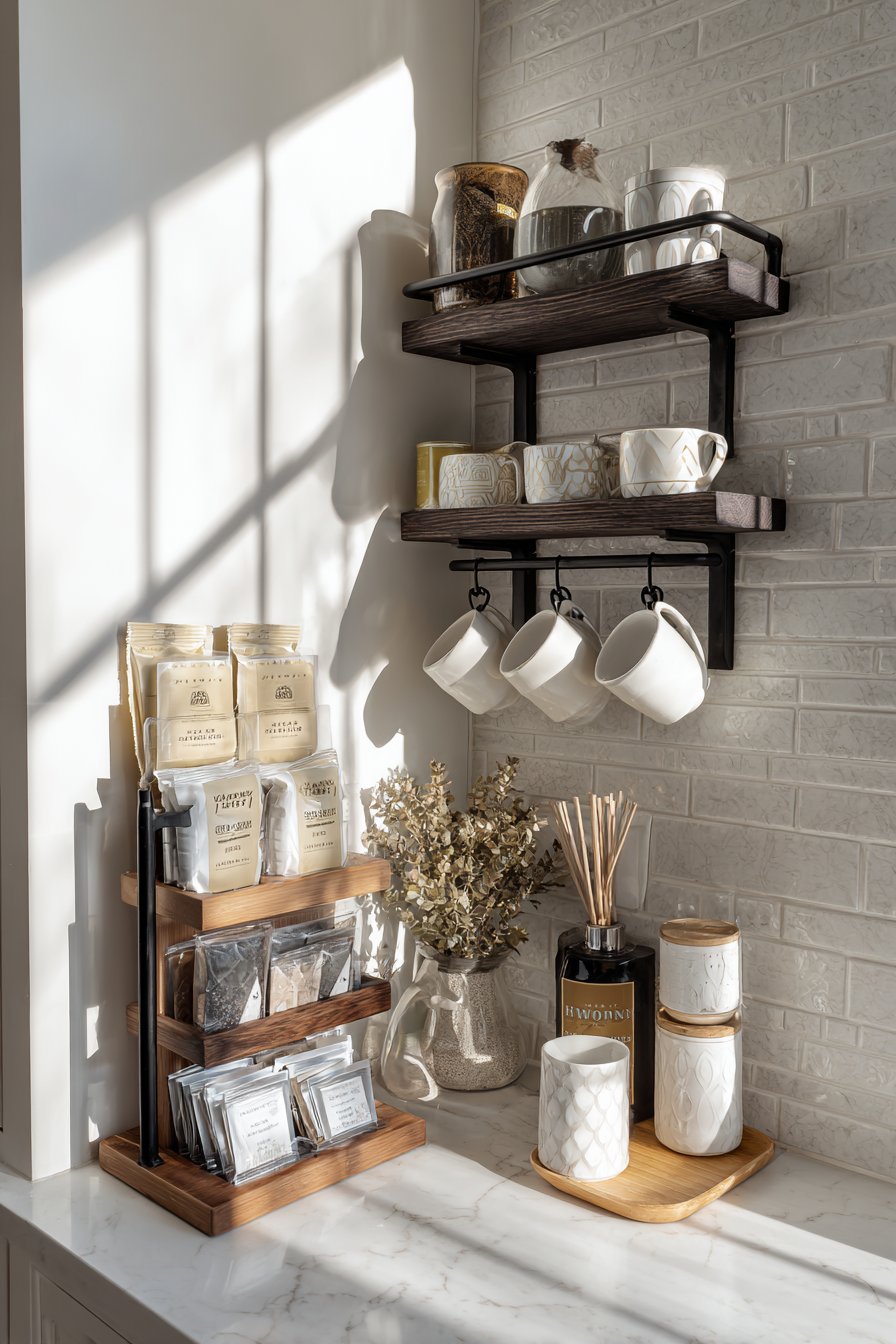
The psychological benefit of a dedicated beverage station extends beyond mere organization to create a sense of ritual and intentionality around daily coffee and tea preparation. When everything needed for your morning coffee is gathered in one location—beans or pods, filters, sweeteners, stirrers, and mugs—the process becomes streamlined and meditative rather than frantic. The tiered bamboo organizers maximize vertical space while keeping everything visible, preventing the common frustration of discovering you’re out of coffee only after you’ve started brewing. Wall-mounted cup hooks transform favorite mugs into both functional storage and personal expression, as the displayed mugs often reflect personality, memories, and aesthetic preferences.
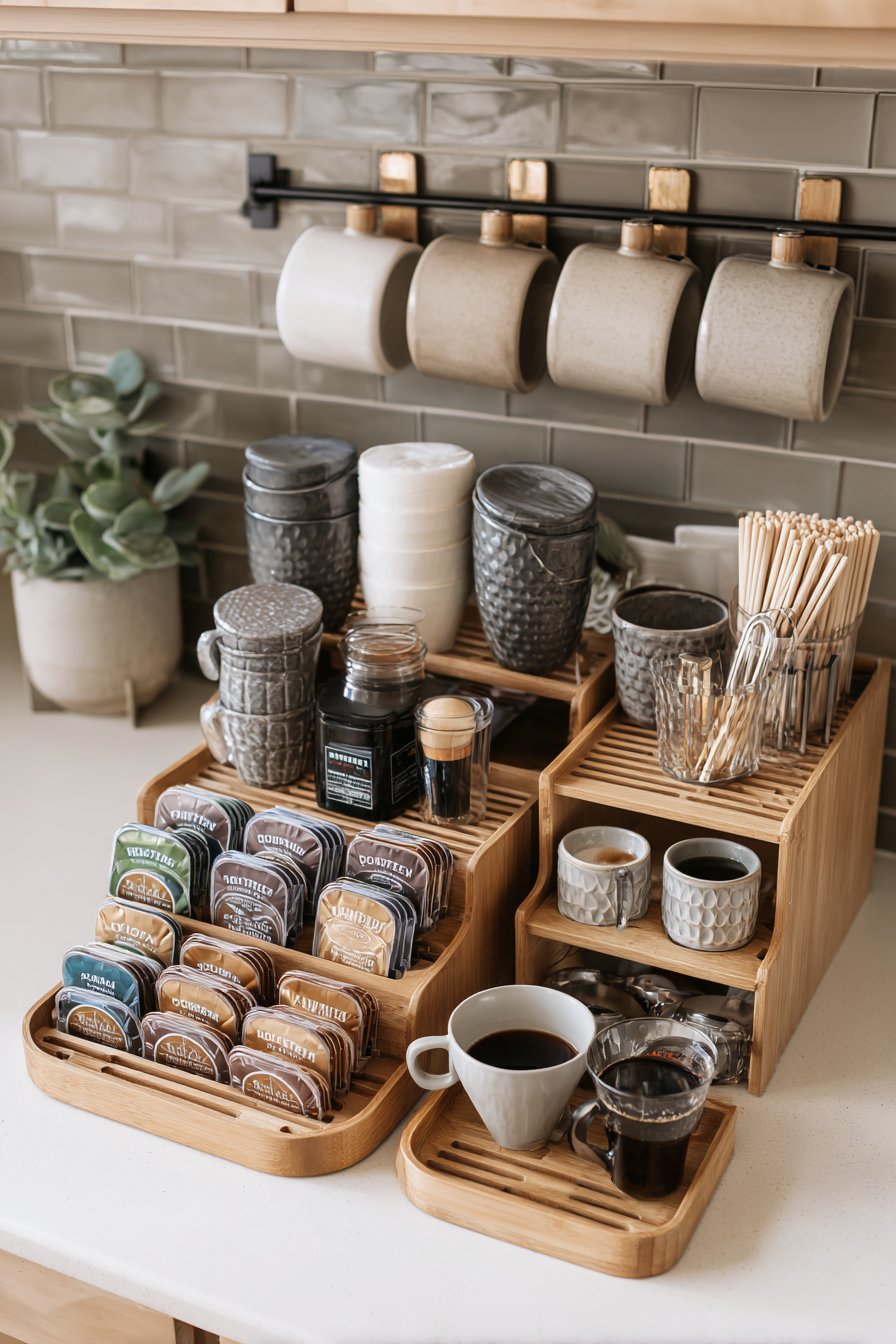
This organizational concept works equally well in compact kitchen corners or as part of larger butler’s pantry installations. The key is creating sufficient storage for all beverage-related items while maintaining enough counter space for actual drink preparation. The light grey subway tile backsplash not only provides a washable surface behind the coffee maker but also creates visual continuity with other kitchen finishes. Natural morning light enhances this space because beverage stations are typically used during early hours, making the most of dawn illumination while setting a peaceful tone for the day ahead.
Key Design Tips:
- Locate beverage stations near water sources and electrical outlets
- Use tiered organizers to maximize visibility and accessibility of supplies
- Install cup hooks at varying heights to accommodate different mug sizes
- Include a small tray or container for sweeteners, stirrers, and tea accessories
- Consider a small drawer nearby for extra supplies like filters and backup pods
- Keep countertops clear except for the coffee maker and daily essentials
9. Vertical Dividers for Flat Items
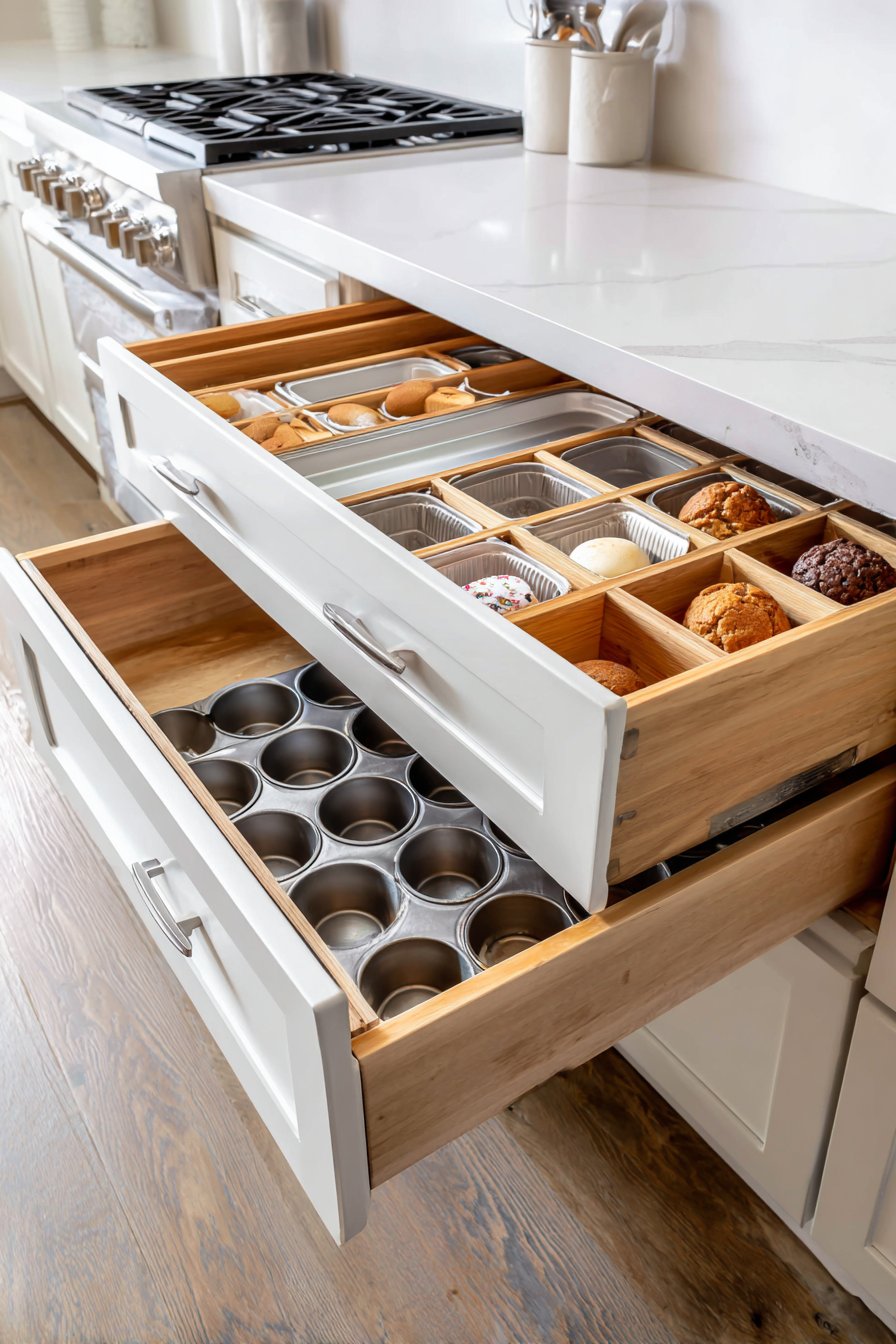
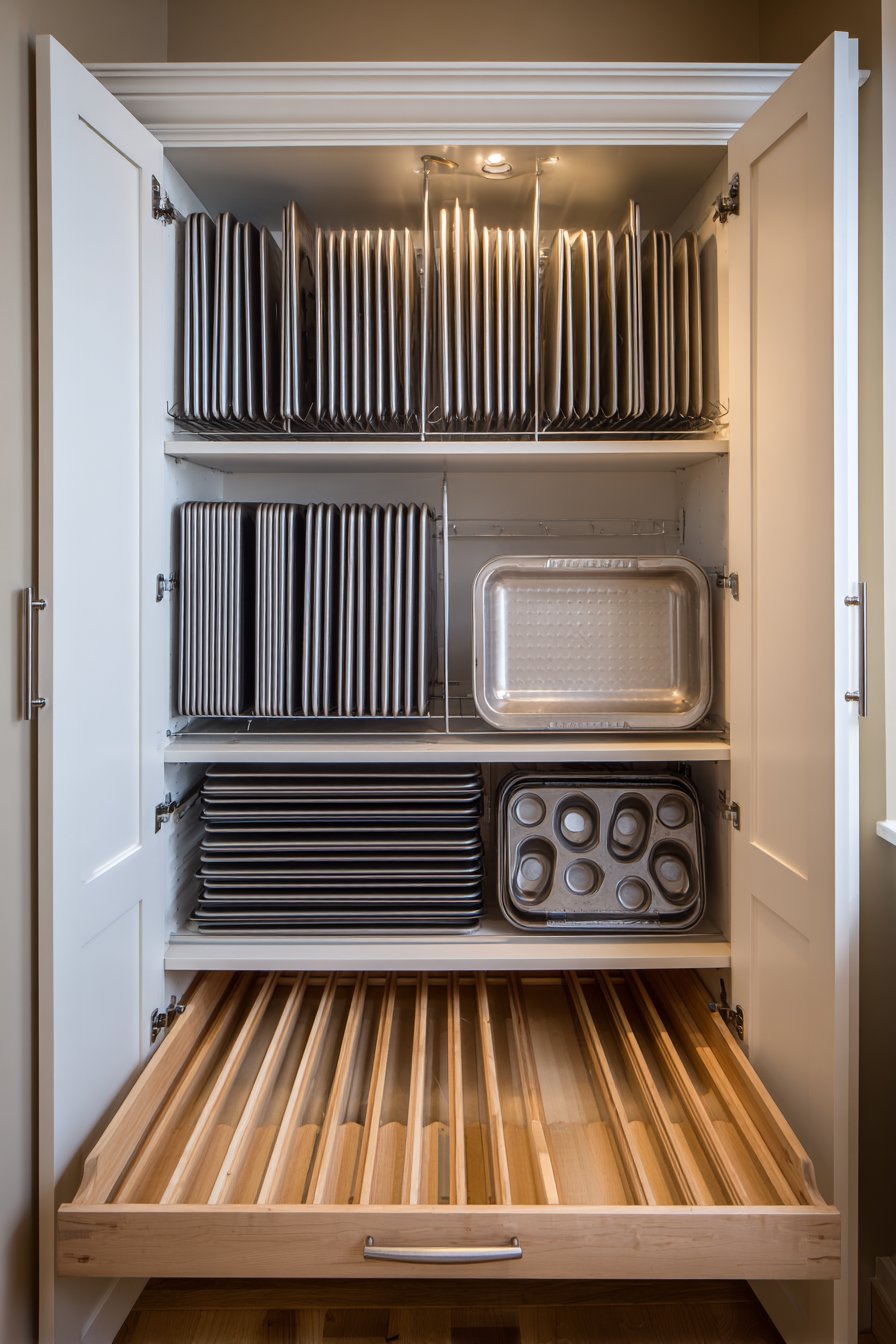
Deep cabinets with vertical dividers storing baking sheets, cutting boards, muffin tins, and cooling racks in organized sections solve one of the most persistent kitchen storage challenges. The cabinet interior is painted white with adjustable wooden dividers creating custom compartments sized perfectly for flat cookware items. Pull-out functionality allows easy access to items stored at the back without requiring acrobatic reaching or unstacking multiple items. Detail-focused interior photography with balanced lighting shows the clever solution for typically difficult-to-organize flat items that resist traditional stacking methods.
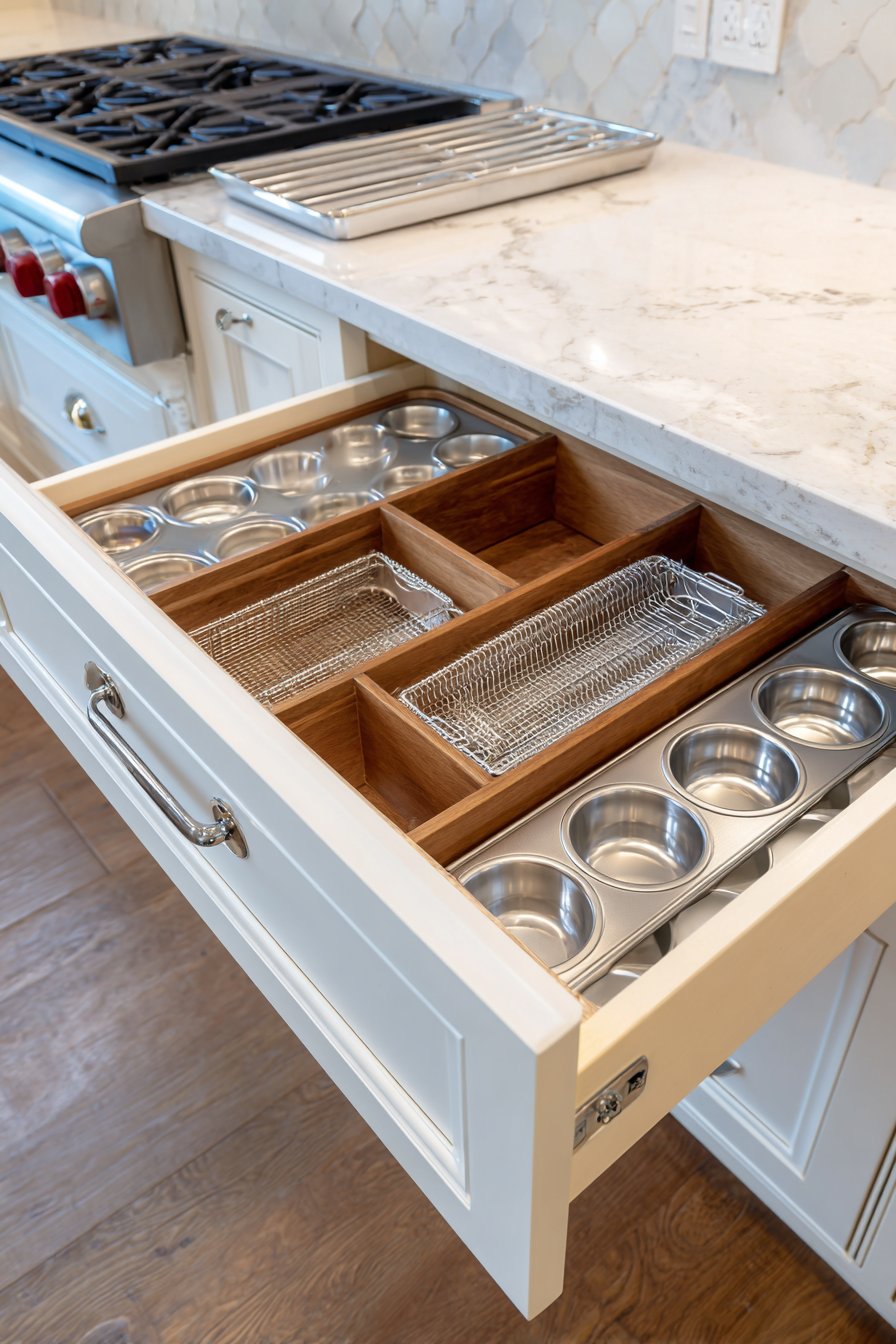
The frustration of accessing a baking sheet from the bottom of a stack—requiring removal of half a dozen other items—disappears with proper vertical divider organization. This storage approach treats each flat item as a file in a filing cabinet, allowing you to slide out exactly what you need without disturbing other contents. The white interior paint maximizes visibility even in deep cabinets, while adjustable dividers accommodate various item widths from narrow cutting boards to wide rimmed baking sheets. This organizational system represents thoughtful problem-solving applied to a universal kitchen challenge.
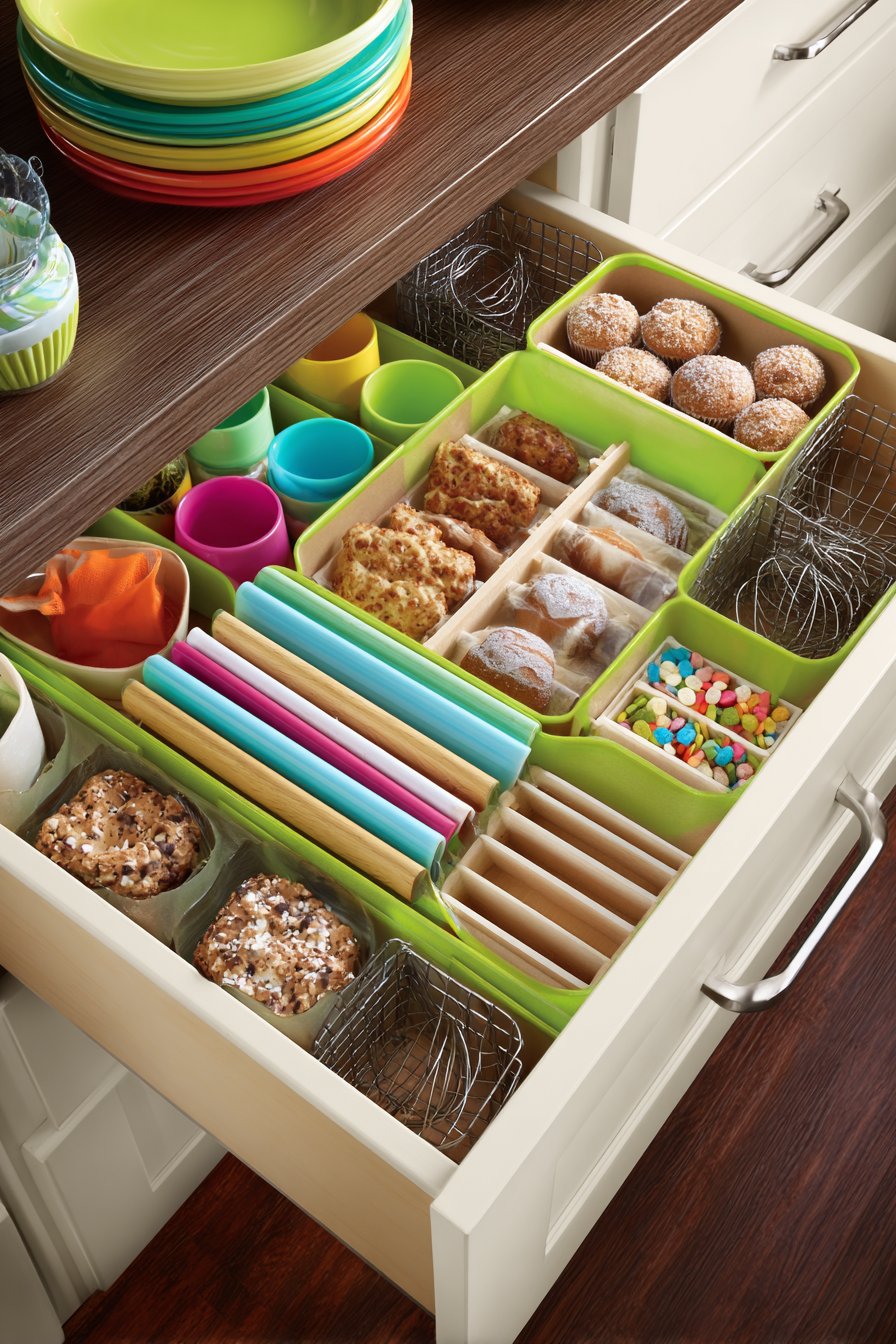
Pull-out functionality elevates vertical divider organization from good to exceptional. Rather than simply creating vertical slots in a stationary cabinet, installing the entire divider system on heavy-duty slides transforms accessibility. This feature particularly benefits deep cabinets where items stored toward the back would otherwise require stretching and fumbling to retrieve. The natural wood dividers add warmth while providing sturdy separation between items, preventing the shifting and sliding that can occur with metal dividers. This combination of vertical organization and pull-out accessibility creates a storage solution that feels almost luxurious in its convenience.
Key Design Tips:
- Install vertical dividers in cabinets adjacent to ovens for convenient baking sheet access
- Space dividers to accommodate your largest items while minimizing wasted space
- Use pull-out cabinet systems for deep cabinets to improve back-item accessibility
- Label divider sections if multiple people use the kitchen to maintain organization
- Store the most frequently used items in the most accessible positions
- Consider felt-lined dividers for expensive or delicate cutting boards and bakeware
10. Magnetic Knife Strip Storage
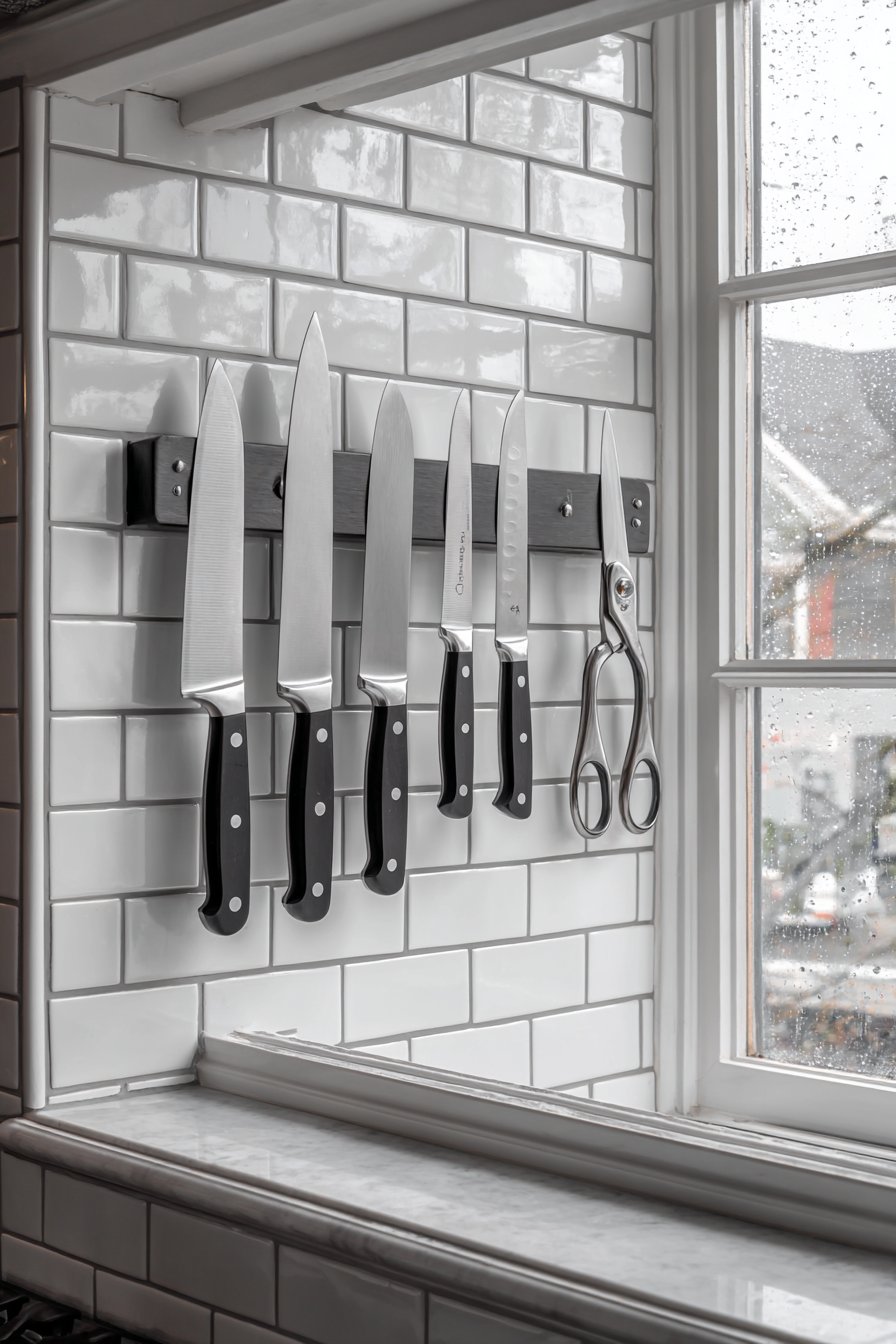
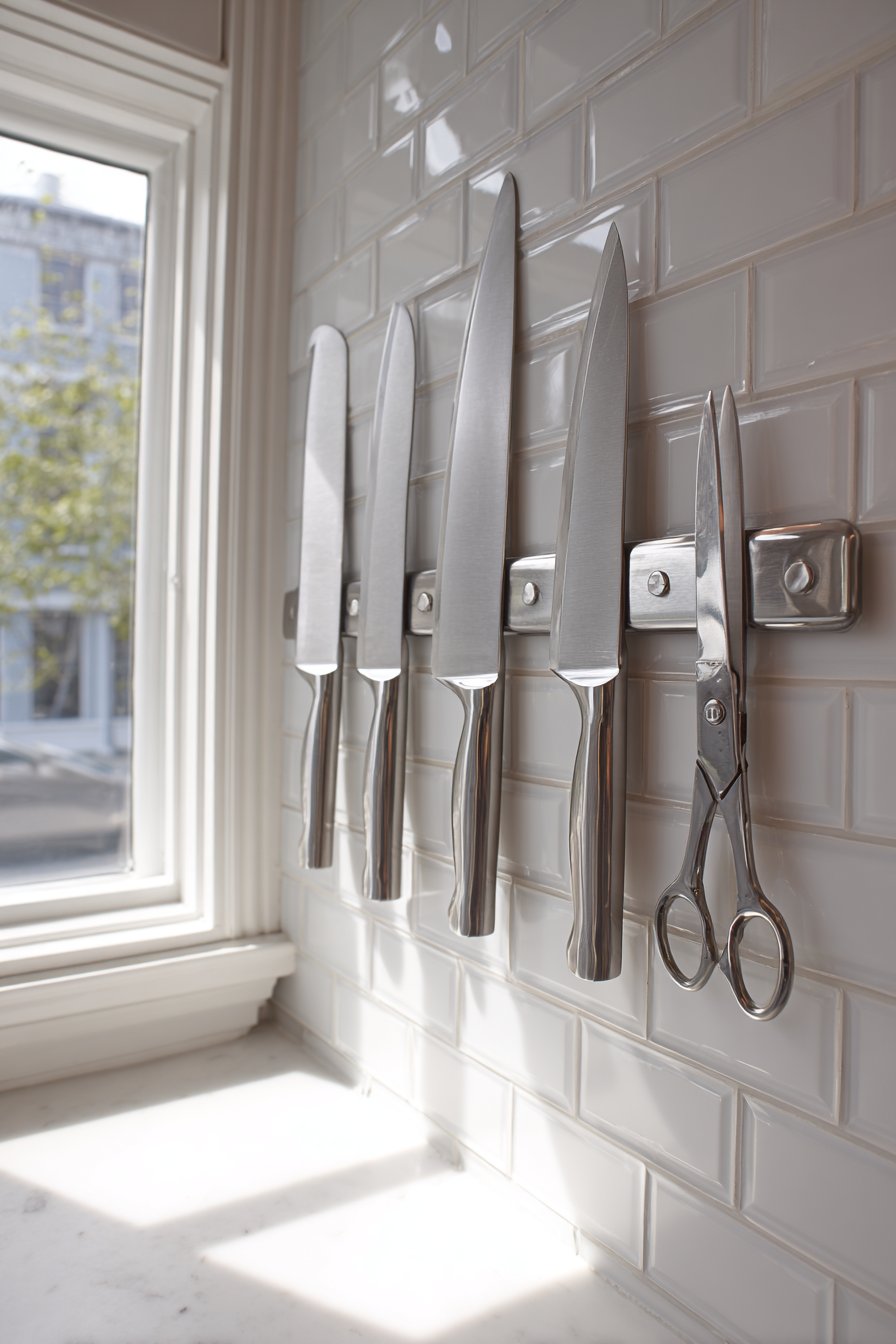
Magnetic knife strips mounted on tiled kitchen walls provide safe, visible storage for chef’s knives, paring knives, and kitchen shears within easy reach of food preparation areas. This organization idea features brushed stainless steel strips against white subway tiles with grey grout, creating a professional aesthetic that wouldn’t look out of place in a restaurant kitchen. Natural light from nearby windows highlights the clean organization and professional quality of the blade storage. Interior design photography captures the practical wall-mounted solution with attention to safety considerations and accessibility benefits.
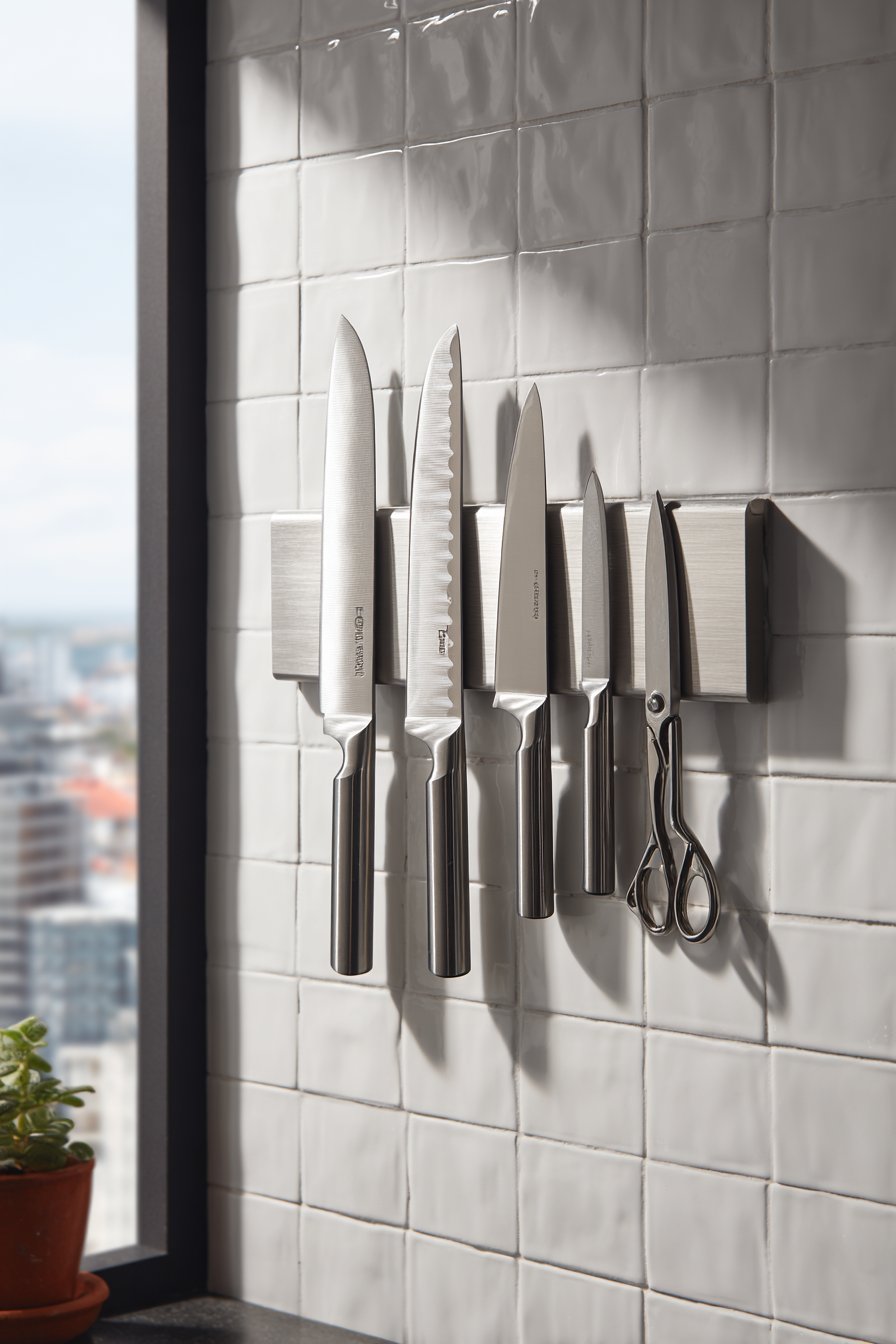
The advantages of magnetic knife strips over traditional knife blocks are numerous and significant. Knife blocks occupy valuable counter space, hide blade edges where you cannot assess their sharpness or cleanliness, and can harbor bacteria in their narrow slots. Magnetic strips, conversely, mount to walls or backsplashes, keeping knives visible and immediately accessible while consuming zero counter space. The brushed stainless steel finish coordinates with professional-grade appliances and fixtures while providing strong magnetic hold that securely grips knife blades without risk of falling. The visual display of knife collection also encourages proper knife maintenance, as dulled blades or damaged edges become immediately apparent.
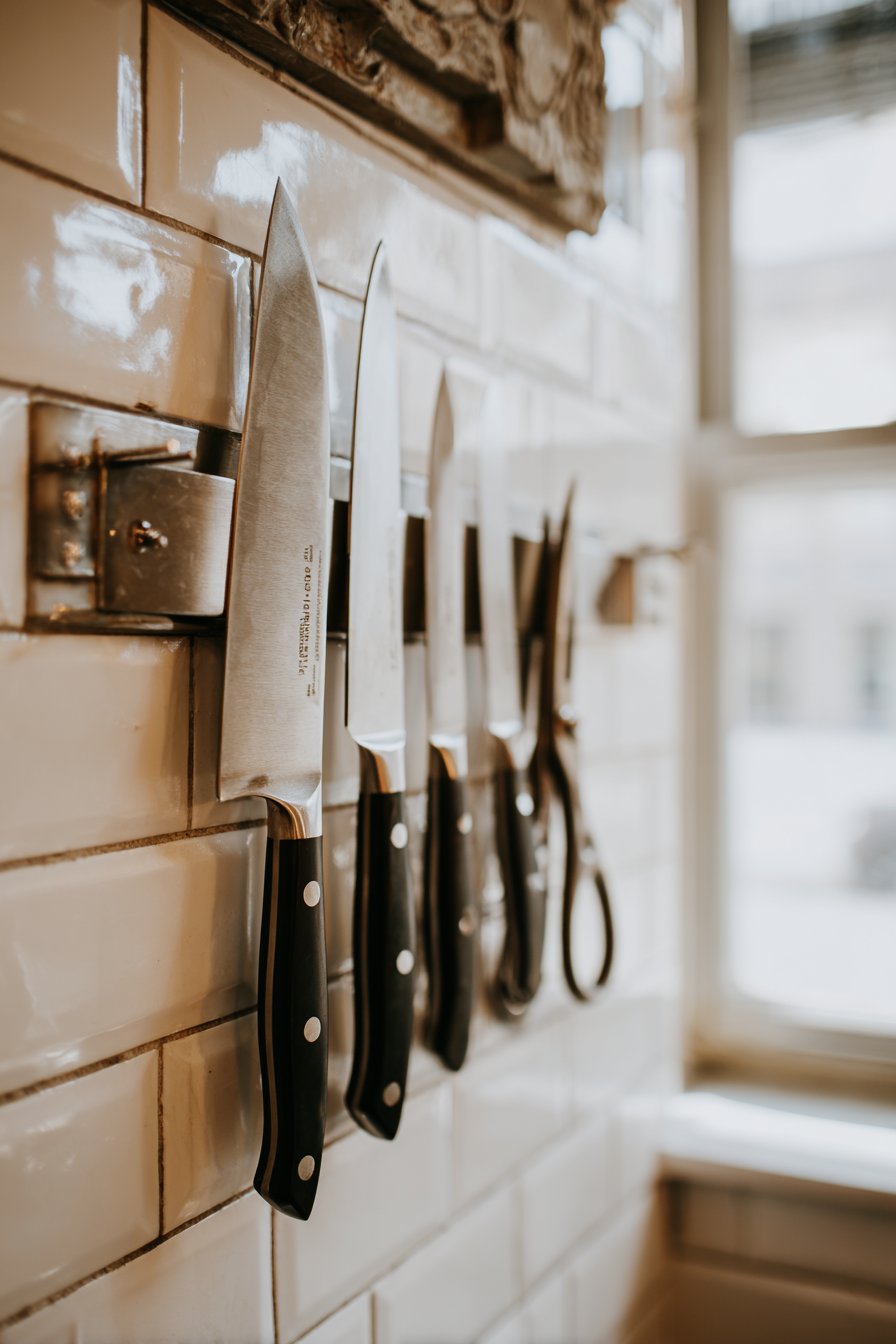
Proper magnetic strip installation requires careful consideration of both height and location. Strips should be mounted high enough to keep knife edges well above the reach of children, yet low enough for comfortable adult access during food preparation. Location matters tremendously—positioning strips within the primary prep zone means knives are exactly where needed, when needed, reducing unnecessary movement during cooking. The white subway tile backdrop with grey grout creates a classic, timeless aesthetic that complements virtually any kitchen style while providing an easy-to-clean surface behind the knife storage.
Key Design Tips:
- Mount magnetic strips 6-8 inches above countertop height for optimal access
- Install strips on walls or backsplashes, never on cabinet faces that might swing open
- Position strips away from the stove to prevent heat damage to knife handles
- Clean magnetic strips weekly with a damp cloth to remove cooking residue
- Arrange knives by size with largest blades on one end for visual harmony
- Ensure strips are strong enough to hold your heaviest knives securely
11. Food Container Drawer Organization
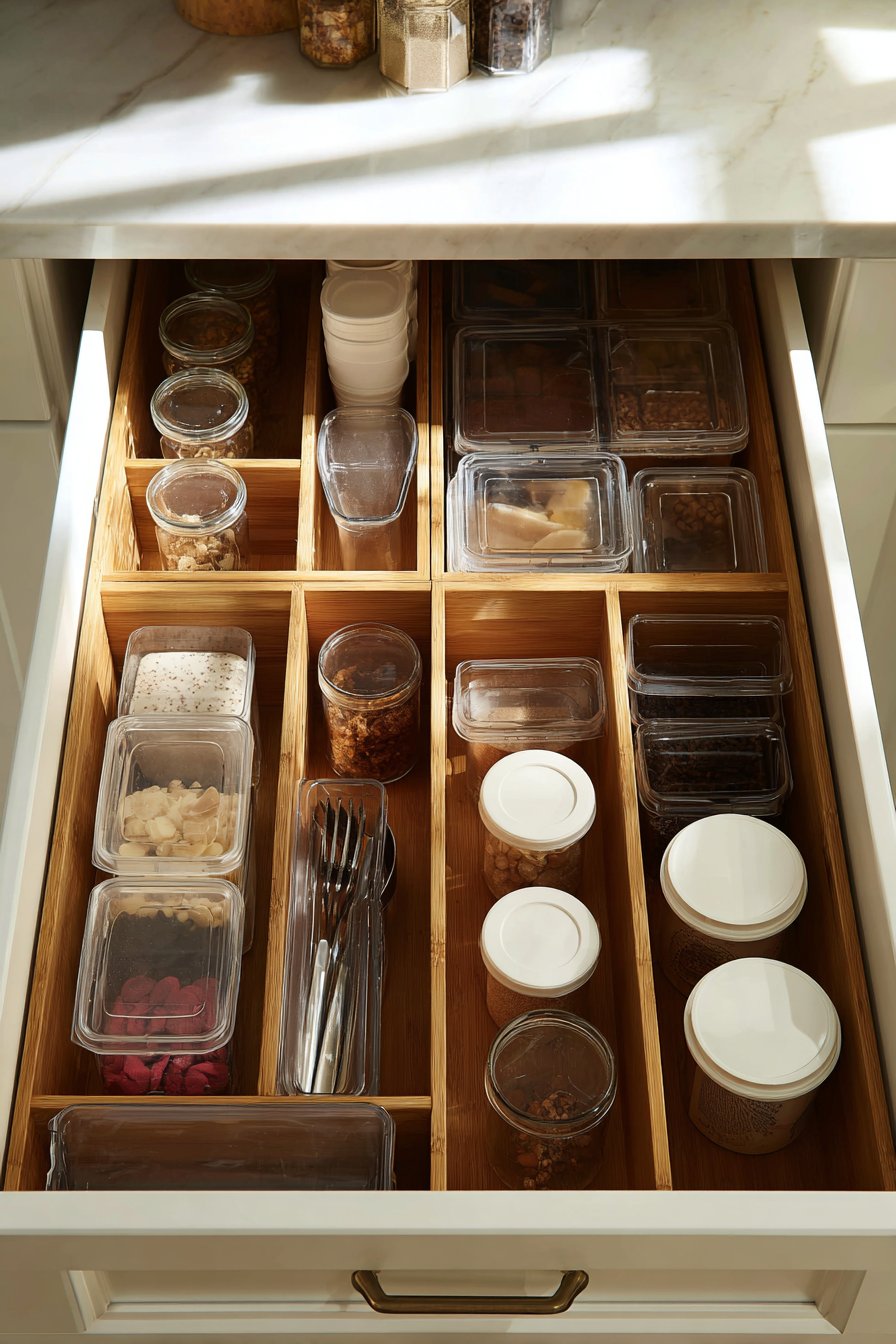
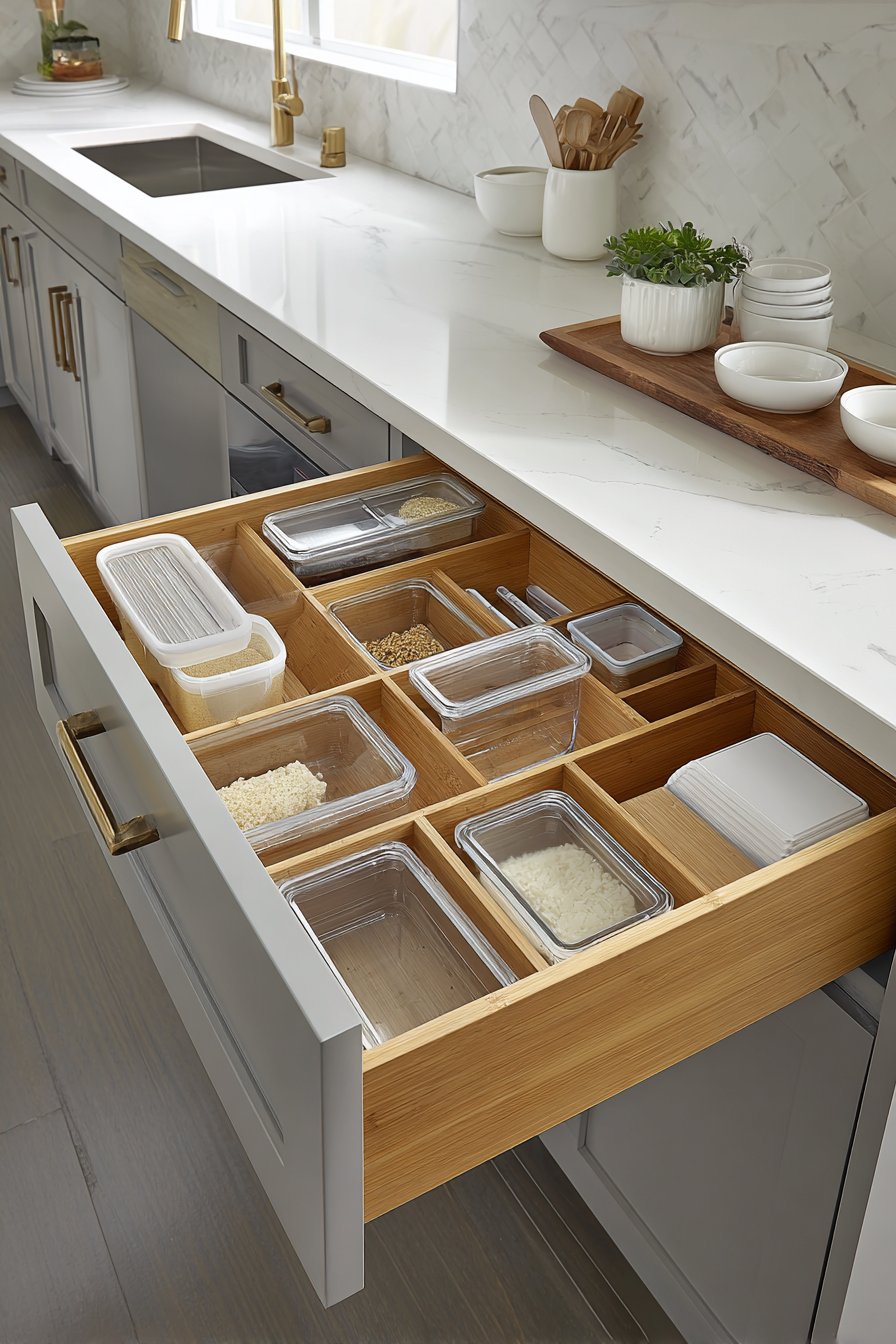
A drawer dedicated exclusively to food storage containers with matching lids, organized by size using drawer dividers, eliminates the universal frustration of mismatched container-lid combinations. Clear plastic and glass containers nest efficiently while lids stand upright in a separate compartment, allowing quick visual assessment of available options. The bamboo dividers create clean sections within the white drawer interior, maintaining order even with frequent access. Overhead natural lighting captured with professional interior photography shows the satisfying organization and practical accessibility of the storage system.
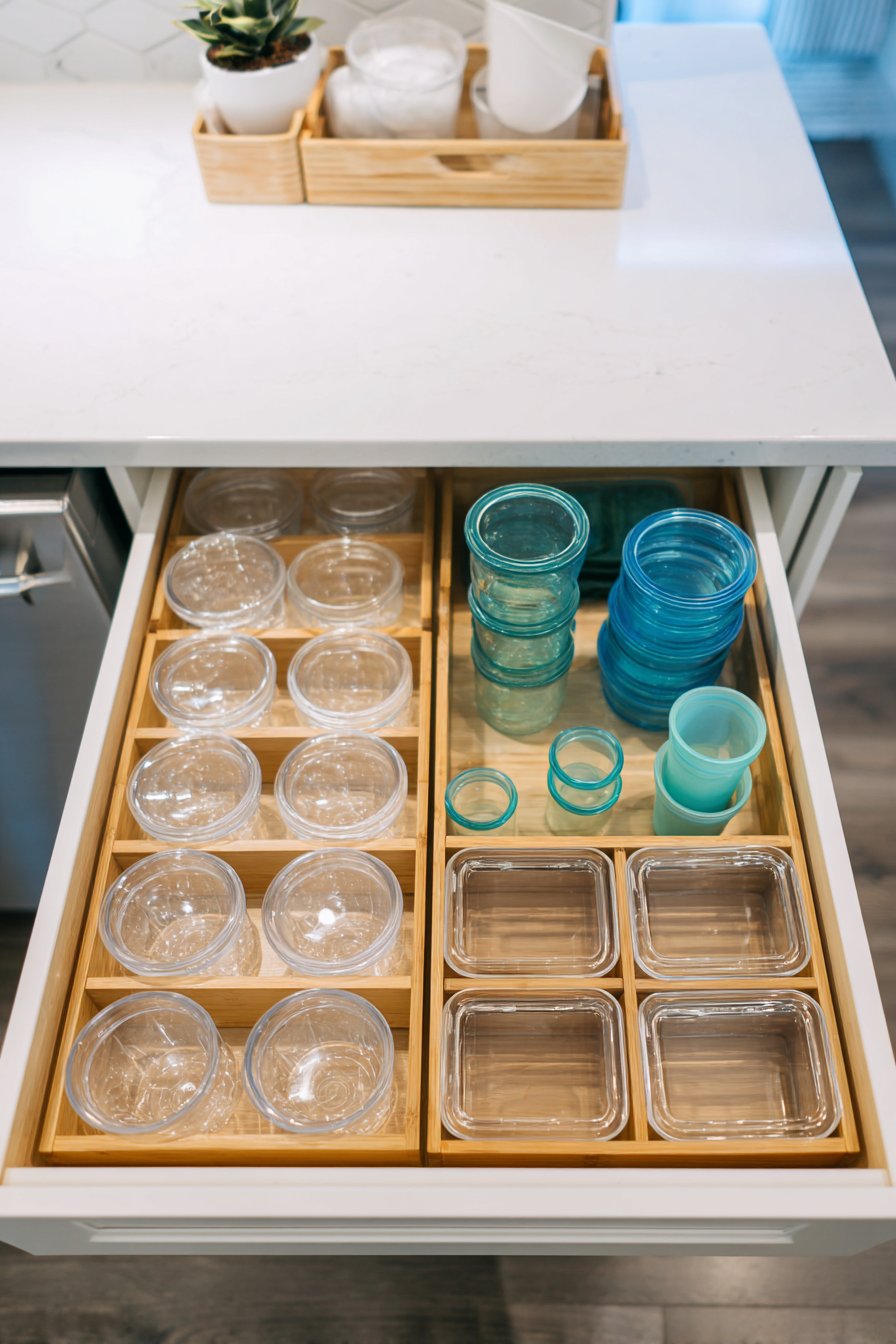
The chaos of food storage containers represents a common kitchen pain point, with many households accumulating mismatched pieces that never quite fit together. This organizational approach solves multiple problems simultaneously: nesting containers by size conserves space dramatically, standing lids upright makes them immediately identifiable and accessible, and dedicated dividers prevent the reorganization drift that occurs with daily use. The combination of clear plastic and glass containers allows you to see contents at a glance in the refrigerator, reducing food waste by keeping leftovers visible rather than forgotten in the back of opaque containers.
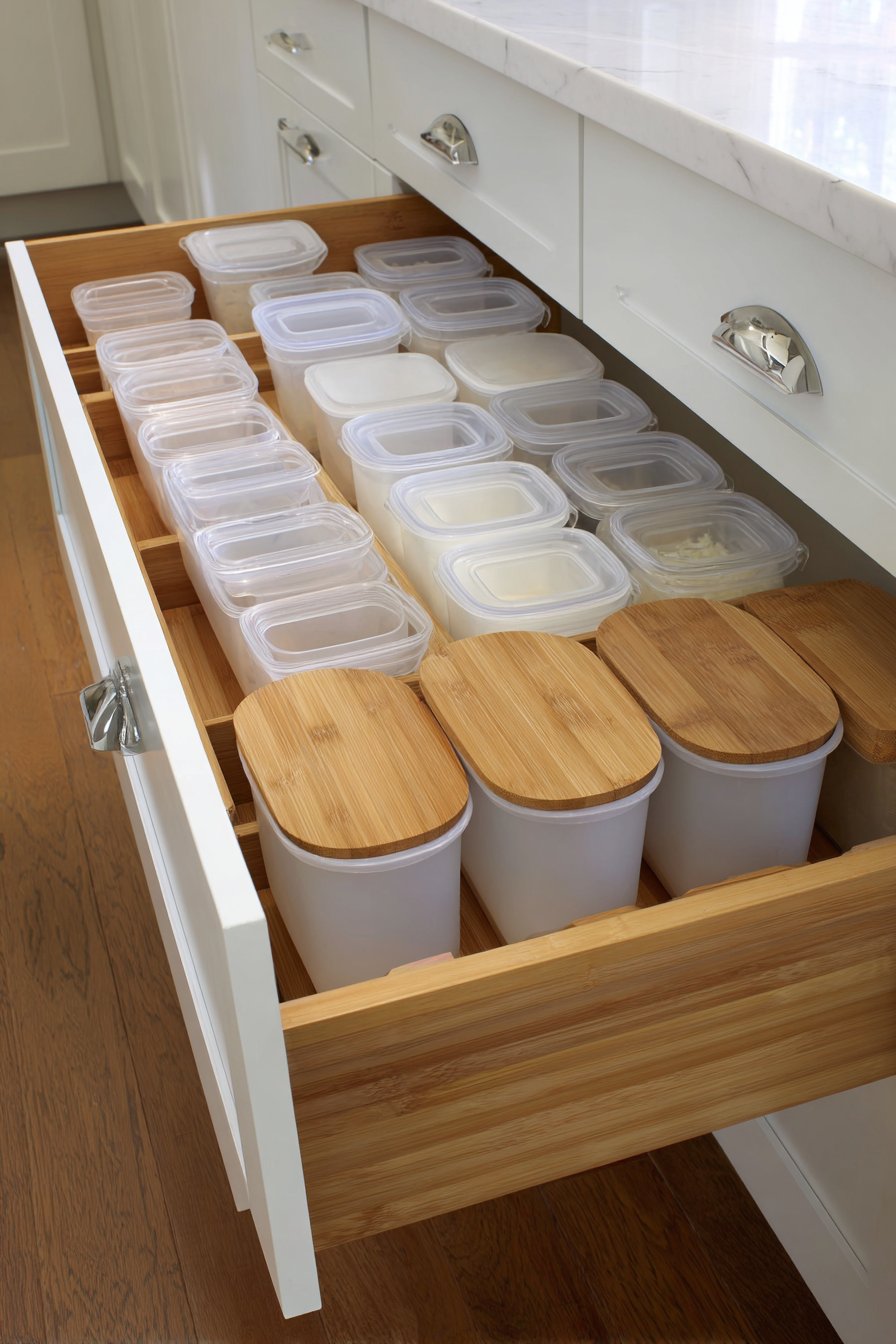
Bamboo dividers within white drawer interiors create an aesthetic that elevates functional storage into something genuinely pleasing to encounter. Each time you open the drawer, you’re greeted with order rather than chaos—a small but meaningful contribution to kitchen peace of mind. The overhead natural lighting in professional photography emphasizes the satisfying geometric arrangement of nested containers and upright lids, but the real beauty lies in the daily convenience of knowing exactly where to find the right container for any storage need. This organizational system represents the philosophy that every item deserves a proper home, and that time invested in creating those homes pays dividends in daily efficiency.
Key Design Tips:
- Purchase food storage containers in sets with matching lids to simplify organization
- Nest containers by size to maximize drawer space efficiency
- Store lids vertically using tension rods or commercial lid organizers
- Eliminate mismatched or damaged containers to maintain system integrity
- Place the most frequently used container sizes at the front of the drawer
- Consider drawer inserts specifically designed for food container organization
12. Appliance Garage with Roll-Up Door
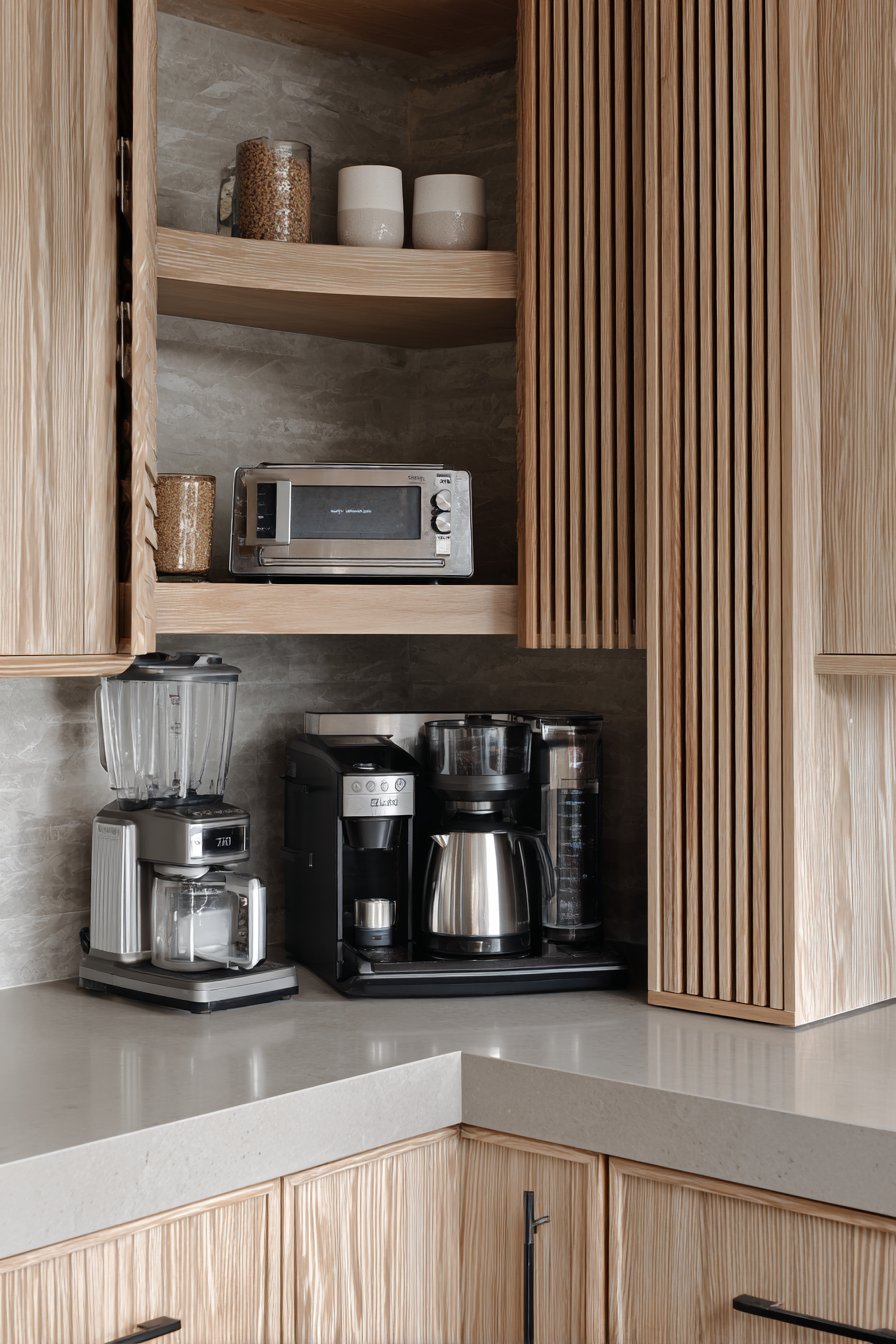
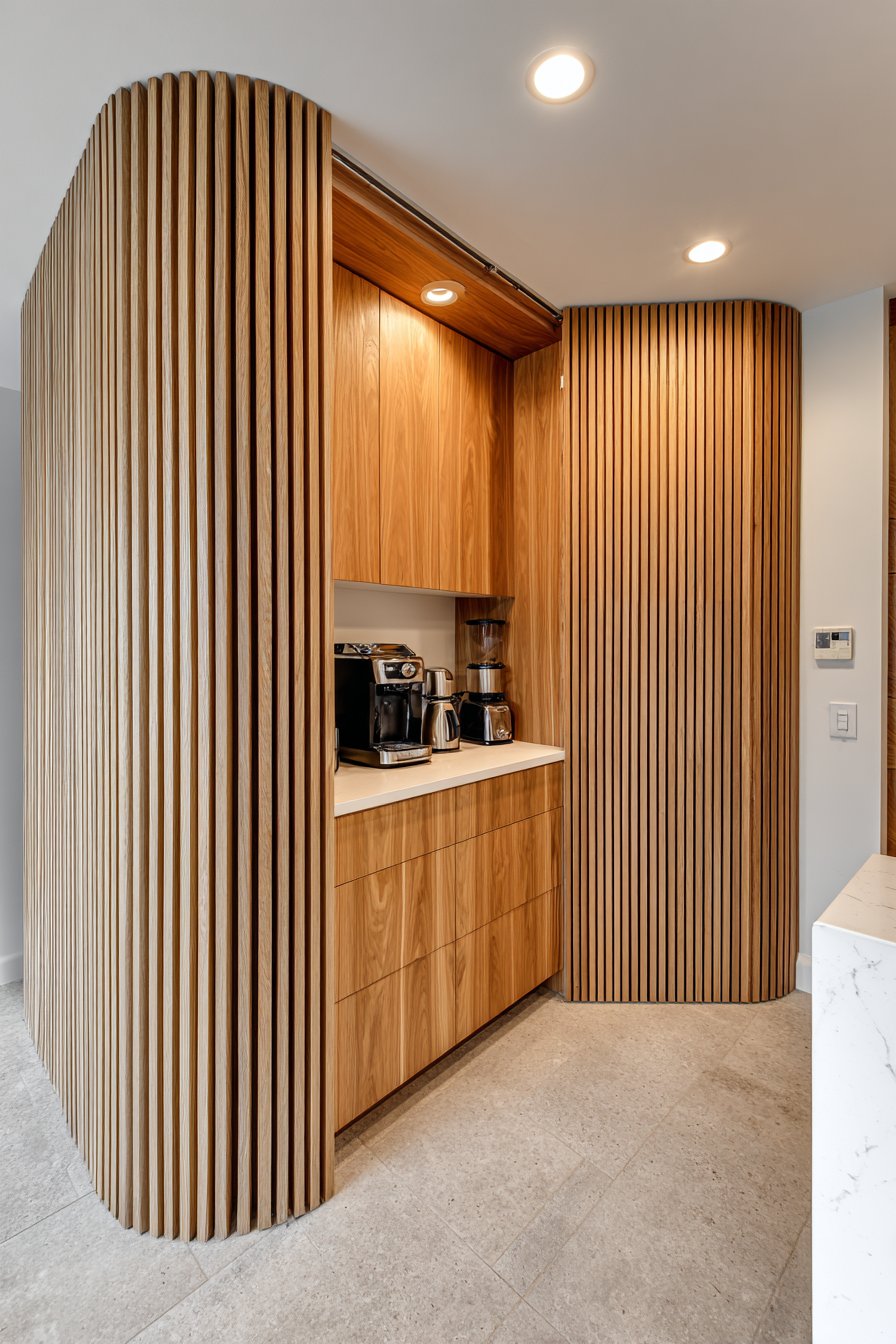
A custom-built appliance garage featuring a roll-up tambour door in natural oak conceals countertop appliances including toasters, coffee makers, and blenders while maintaining their accessibility. Interior outlets allow appliances to remain plugged in while hidden behind the closed door, eliminating the daily hassle of cord management. The surrounding quartz countertop in soft grey complements the warm wood tones, creating visual harmony between concealed storage and exposed surfaces. Wide-angle interior photography with balanced exposure shows both closed and partially open states, emphasizing the clean countertop appearance and functional storage capabilities.
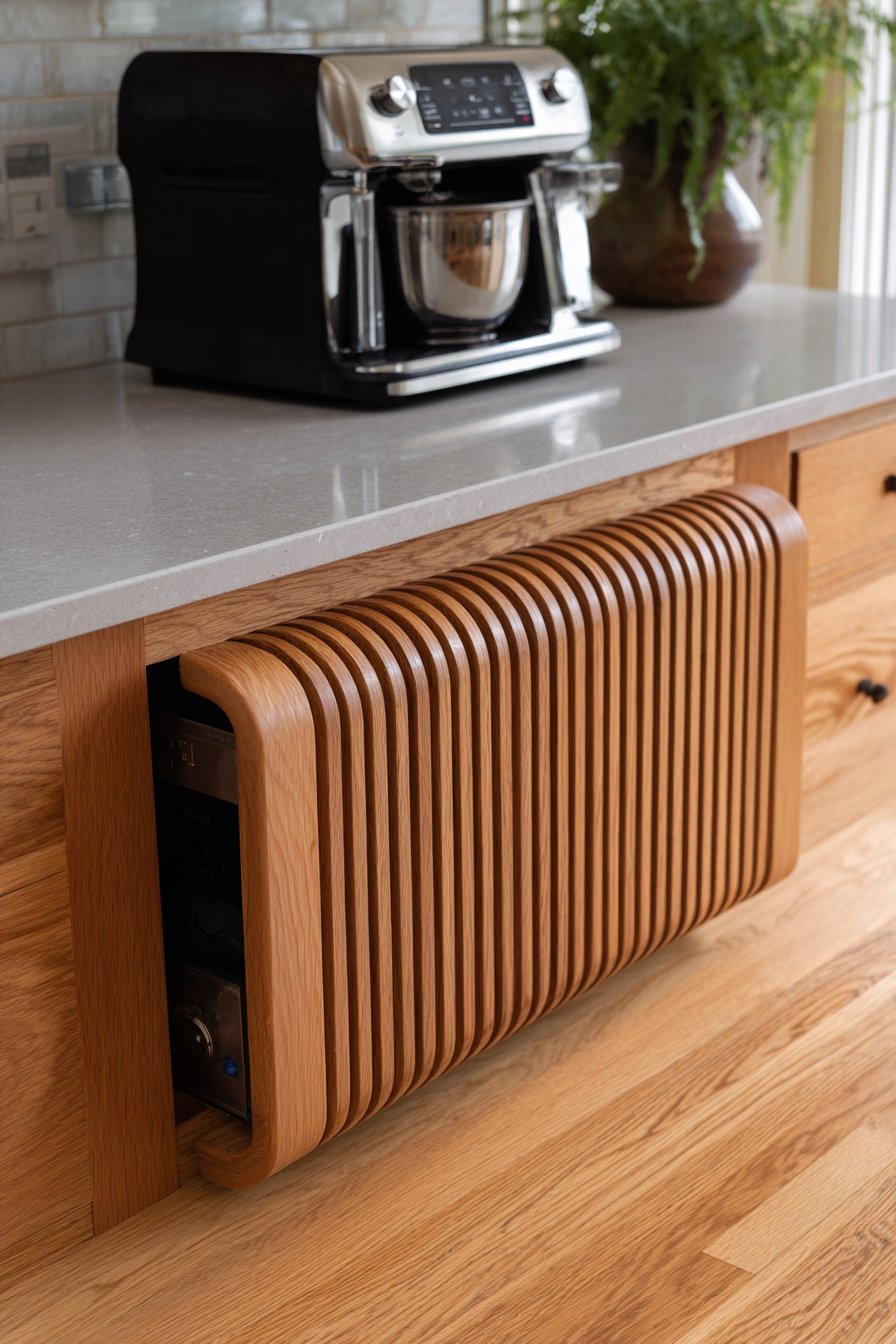
The appliance garage concept addresses a fundamental tension in kitchen design: the desire for clean, uncluttered countertops versus the impracticality of constantly retrieving and repacking frequently used appliances. By creating a dedicated space with interior electrical outlets, appliances remain perpetually plugged in and ready to use, while the roll-up door provides instant concealment when appliances aren’t in active use. The natural oak construction adds organic warmth to the kitchen while coordinating with other wood tones in cabinetry or flooring. The tambour door slides smoothly upward and disappears into the cabinet structure, requiring no clearance space that traditional hinged doors demand.
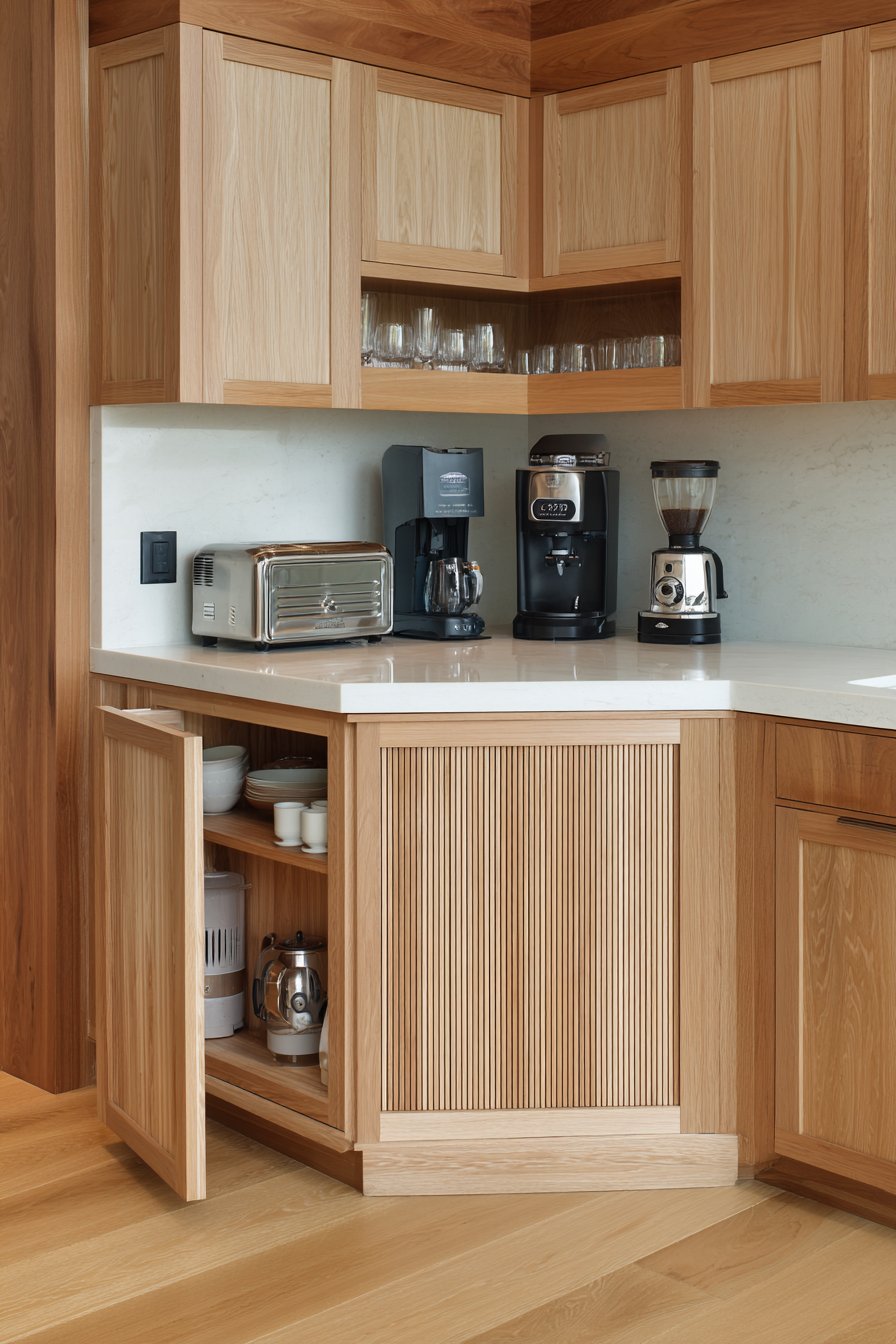
Professional interior photography captures this organizational feature in both closed and open positions to fully communicate its functionality. When closed, the appliance garage appears as seamless cabinetry, maintaining the kitchen’s clean lines and uncluttered aesthetic. When open, the specialized storage reveals itself as thoughtfully designed infrastructure that makes daily kitchen tasks more efficient. The soft grey quartz countertop extends into the appliance garage interior, creating visual continuity and providing a durable, easy-to-clean surface for appliance use. This design represents contemporary kitchen organization at its finest—where storage solutions enhance rather than compromise aesthetic goals.
Key Design Tips:
- Install GFCI outlets inside appliance garages for safety and code compliance
- Size appliance garages to accommodate your specific appliances with clearance for ventilation
- Consider pocket doors or bi-fold doors if tambour doors don’t suit your style
- Include interior lighting activated by door opening for improved visibility
- Ensure adequate depth for appliances plus several inches for cords and steam clearance
- Plan appliance garage locations near areas where those appliances will be primarily used
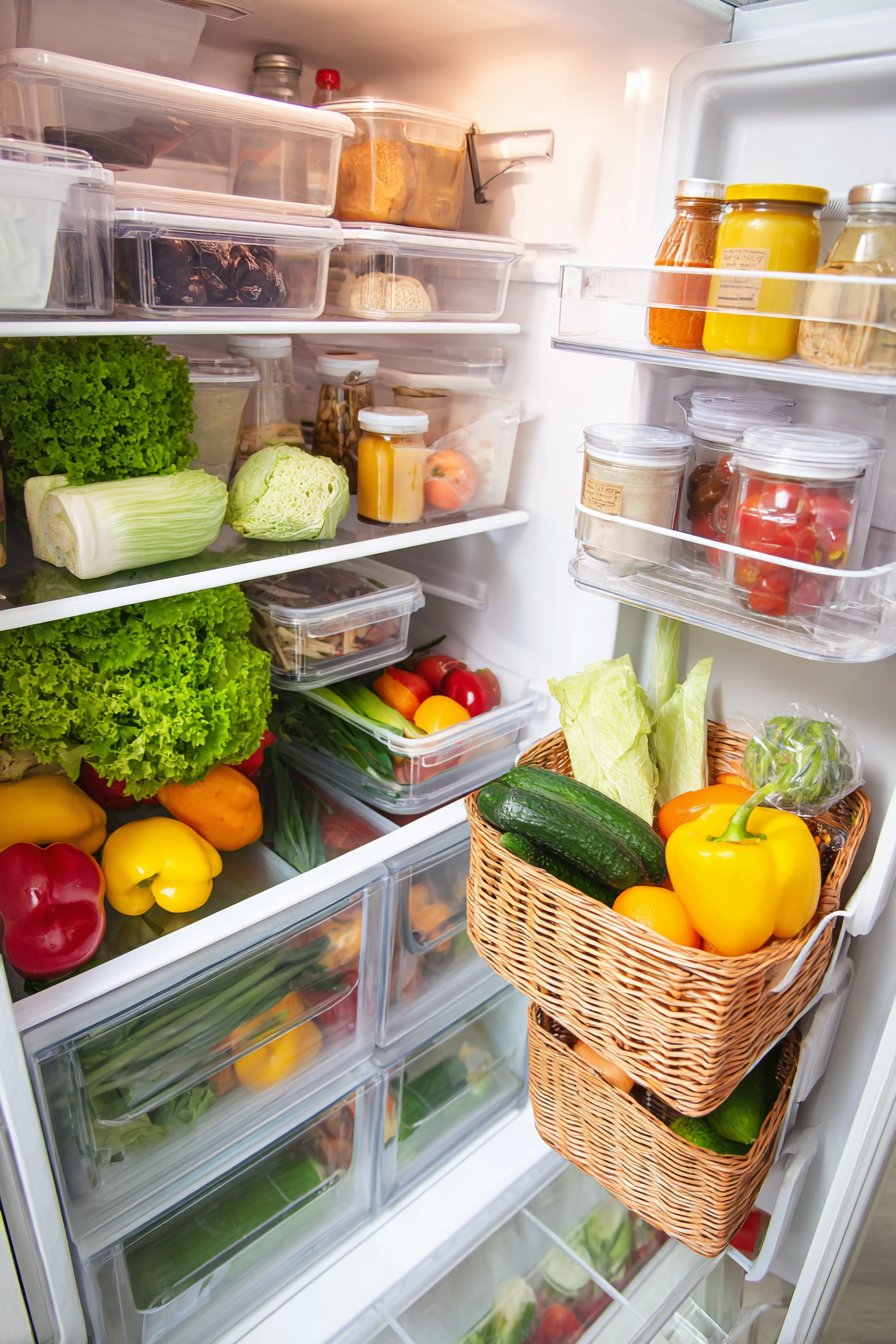
13. Refrigerator Interior Organization
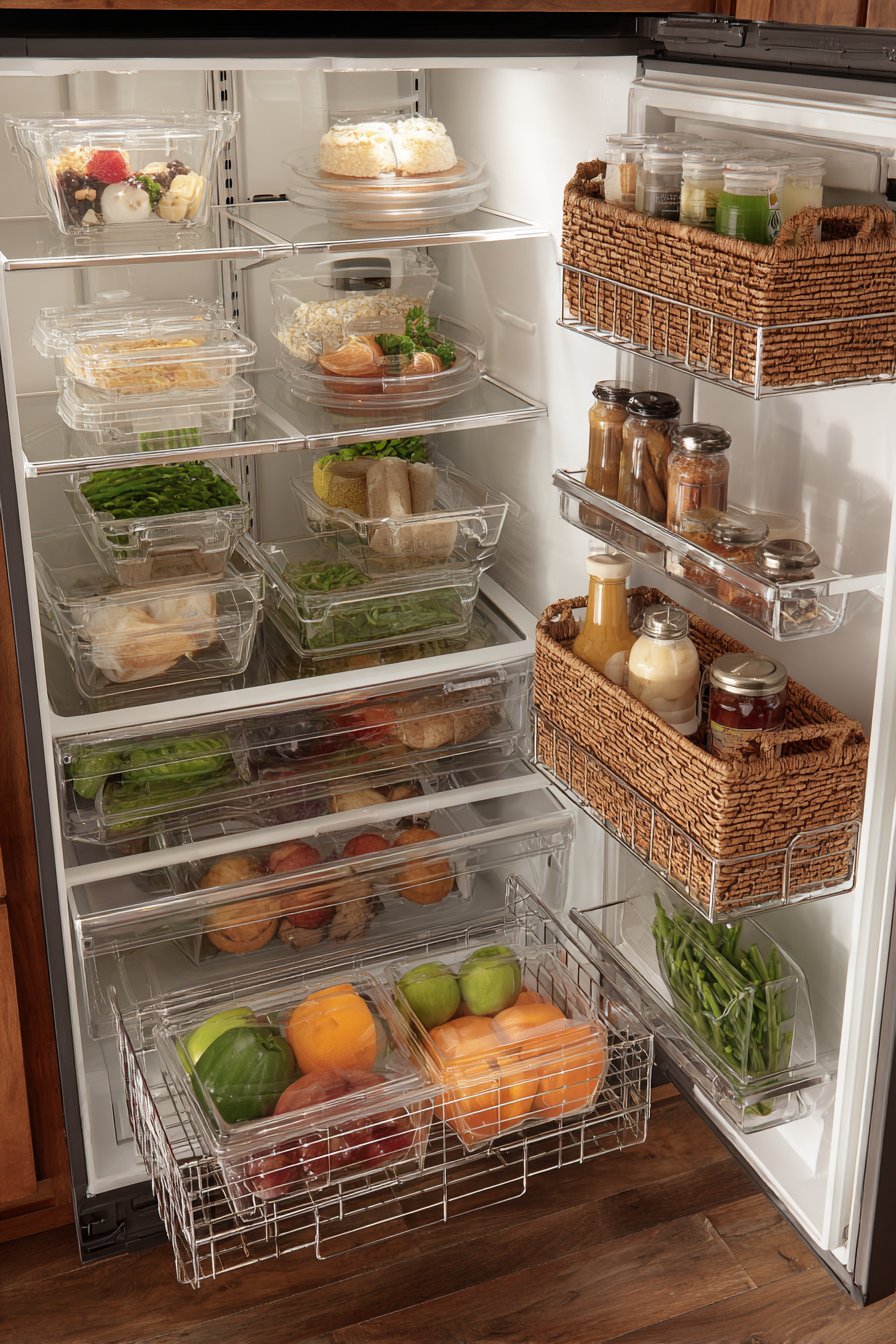
A well-organized refrigerator interior with clear acrylic bins, lazy Susans for condiments, and labeled sections for different food categories transforms food storage from chaotic to systematic. Wire baskets in crisper drawers keep produce visible and accessible while allowing air circulation. Consistent storage containers create visual harmony while maximizing space efficiency by eliminating awkward gaps between oddly shaped packages. Interior detail photography with soft refrigerator lighting highlights the practical organization system that reduces food waste and improves accessibility.
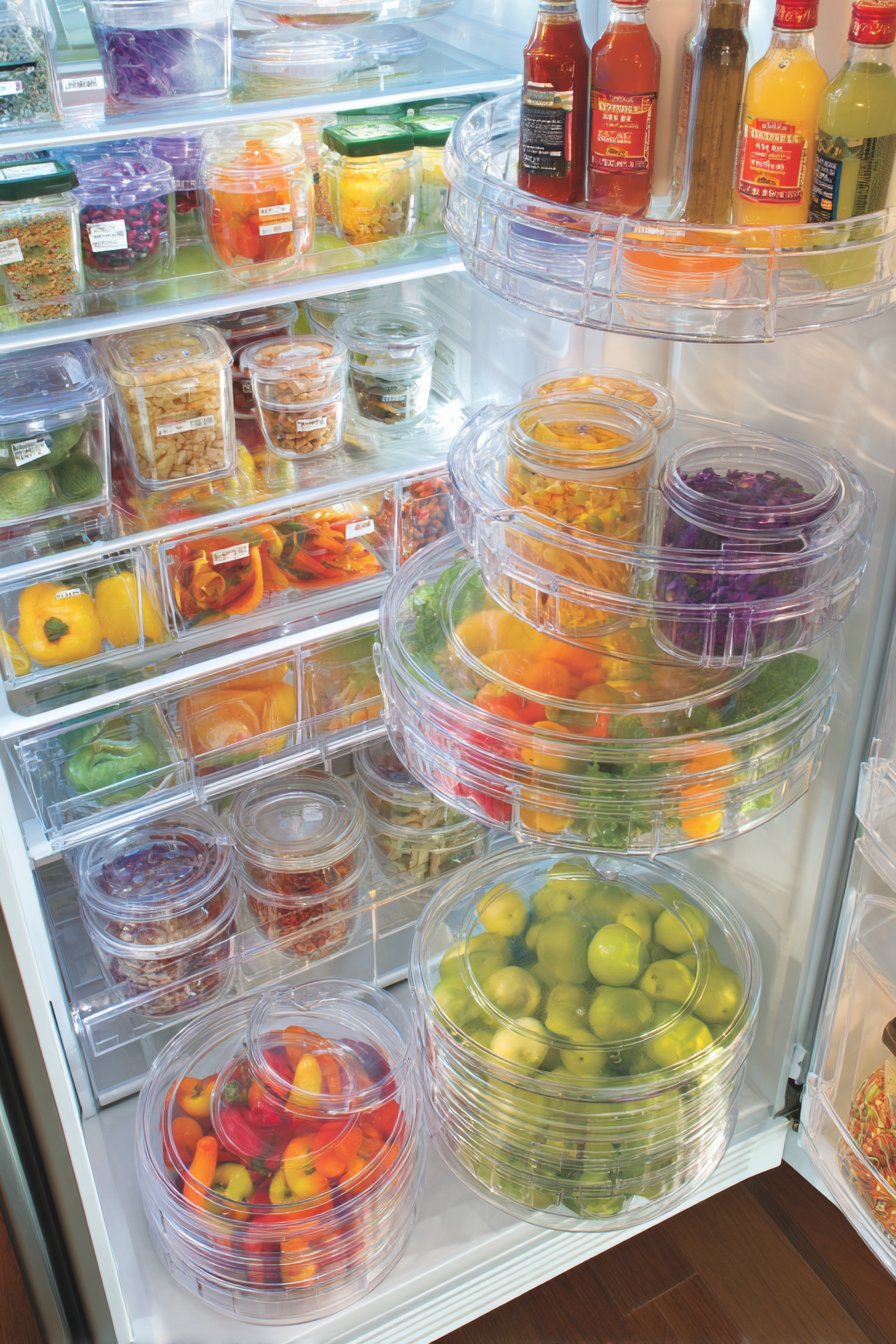
Refrigerator organization deserves as much attention as any other kitchen storage area, yet it’s often overlooked in organizational planning. The clear acrylic bins group similar items—all dairy products together, all breakfast items in one location—making it effortless to assess what you have and what needs repurchasing. Lazy Susans revolutionize condiment storage by allowing access to items at the back without excavating through layers of bottles and jars. Labeled sections, whether permanent labels on bins or removable labels on shelves, help maintain organizational systems even when different household members are restocking groceries.
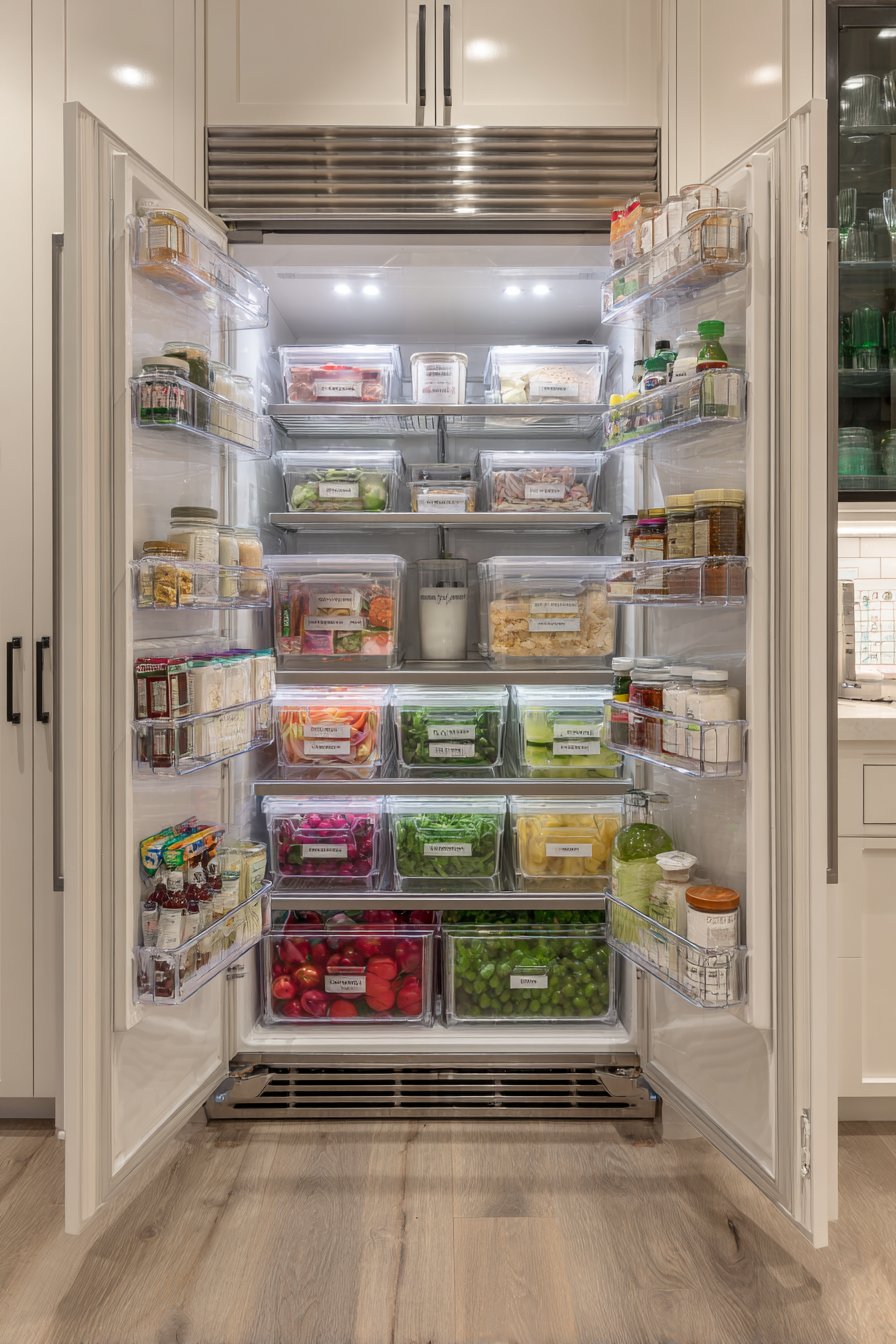
Wire baskets in crisper drawers represent a simple but brilliant solution to the common problem of produce forgotten and spoiling in drawer depths. By elevating produce in wire baskets, everything remains visible from above, and air circulation helps prevent premature spoilage. The consistent storage containers for leftovers and meal prep create a professional appearance while serving practical purposes: uniform heights stack efficiently, clear materials show contents instantly, and proper sealing preserves freshness. This comprehensive approach to refrigerator organization makes meal planning easier, reduces grocery spending by preventing duplicate purchases, and minimizes food waste by keeping all items visible and accessible.
Key Design Tips:
- Measure refrigerator dimensions before purchasing organizational bins and containers
- Group foods by category using labeled bins or designated shelves
- Use lazy Susans on deep shelves to improve back-item accessibility
- Implement a “first in, first out” system to reduce food waste
- Clean and reorganize refrigerator weekly during grocery restocking
- Adjust shelf heights to accommodate taller items without wasting vertical space
14. Walk-In Pantry Comprehensive System
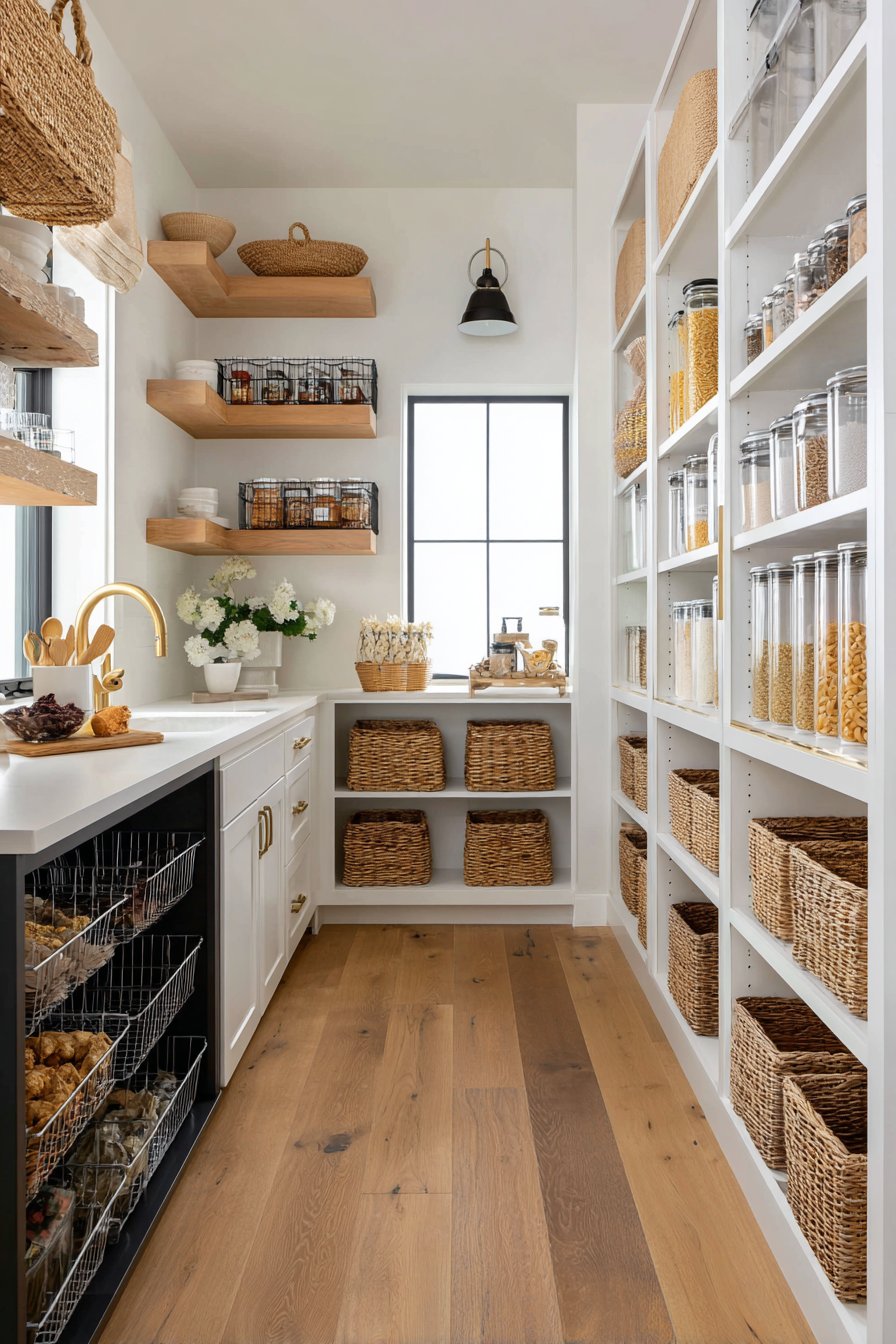
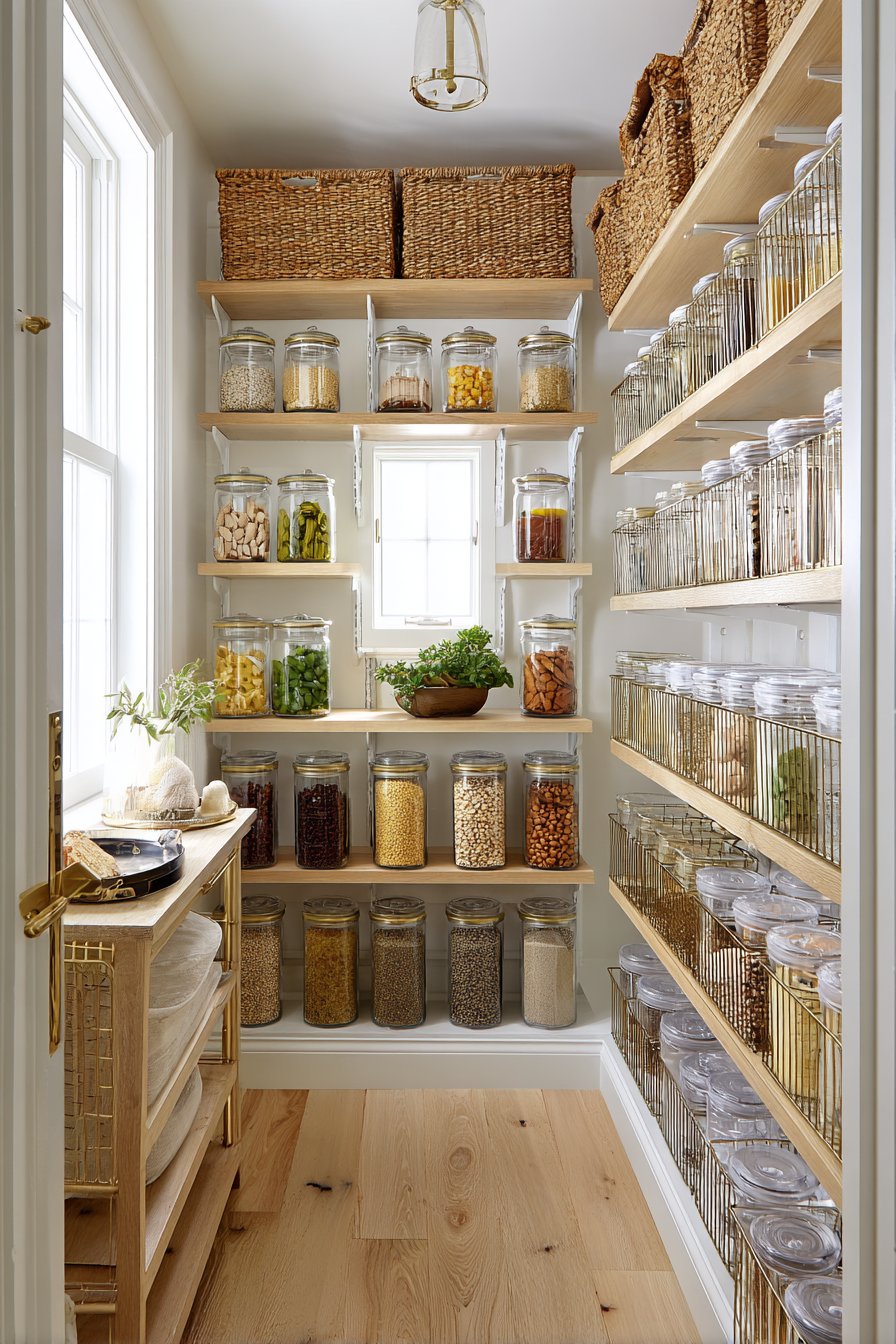
A walk-in pantry with floor-to-ceiling shelving systems, including wire baskets on runners for root vegetables, clear container storage for bulk items, and designated zones for baking supplies, canned goods, and snacks, represents the pinnacle of kitchen organization. Natural wood shelving complements white walls while brass hardware adds warmth and sophisticated detailing. Wide-angle interior photography with natural light from a small window captures the comprehensive organization system with attention to accessibility and visual order, demonstrating how proper planning transforms pantry spaces into efficient food storage systems.
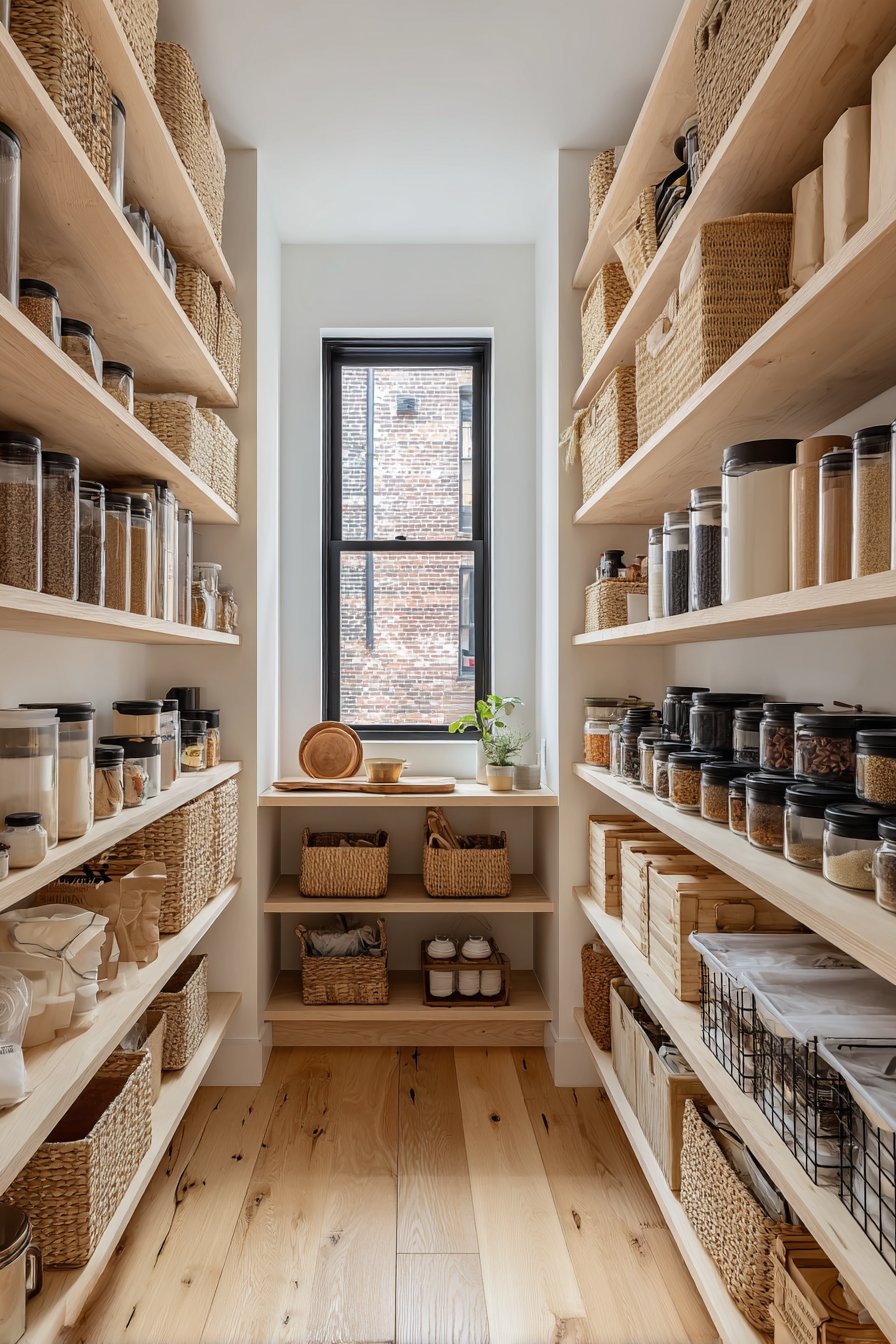
The luxury of a walk-in pantry lies not merely in square footage but in the organizational possibilities that sufficient space enables. Floor-to-ceiling shelving maximizes vertical storage while designated zones create intuitive navigation—you know exactly where to find baking chocolate or where to store newly purchased pasta without searching or deliberation. Wire baskets on runners bring deep pantry shelves into the practical realm, allowing you to pull entire baskets forward to access items at the back. This functionality particularly benefits root vegetable storage, where ventilation prevents premature sprouting while visibility prevents items from being forgotten until spoiled.
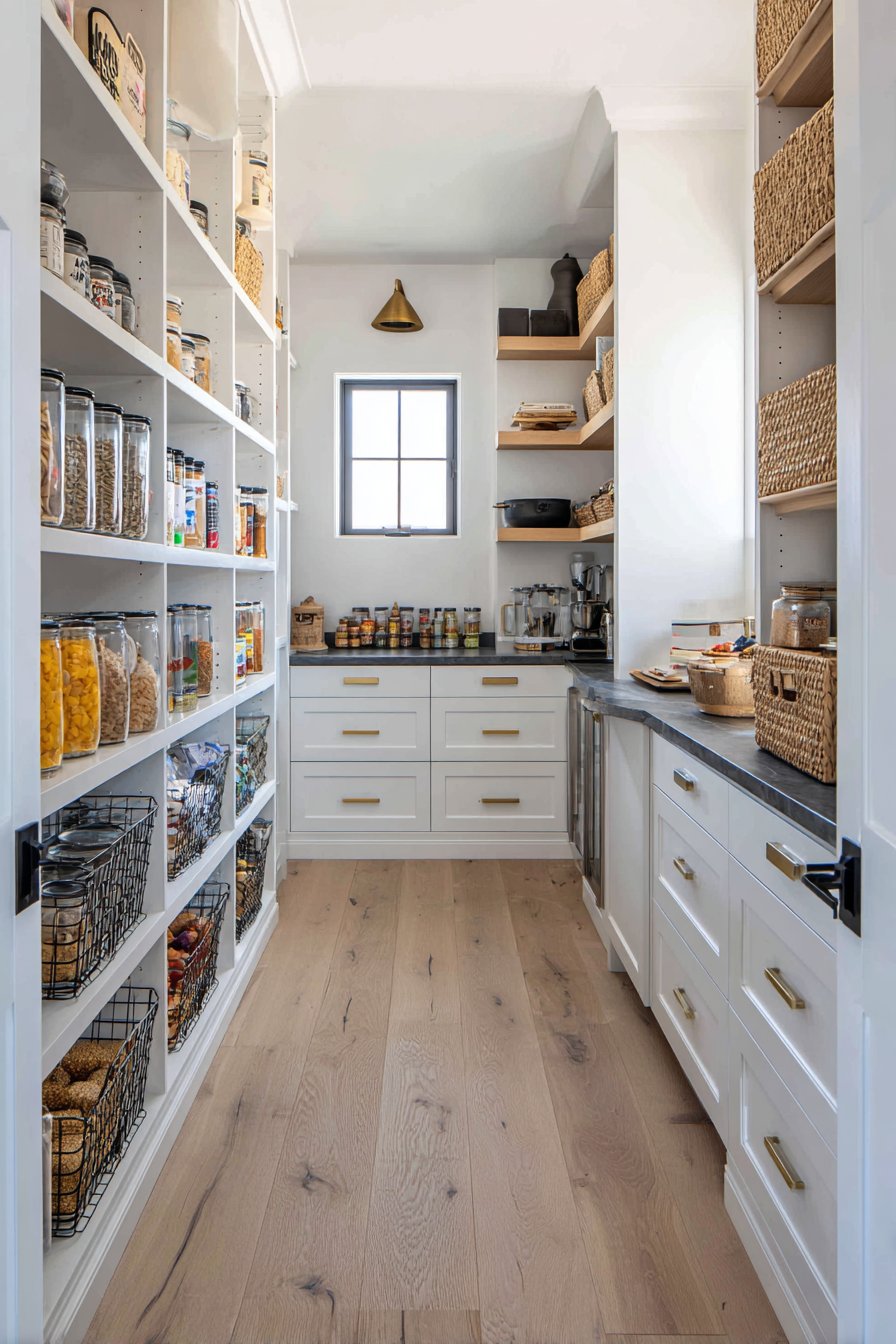
Natural wood shelving against white walls creates a warm, inviting atmosphere that elevates pantry organization from purely functional to genuinely pleasant. The brass hardware on basket runners and shelf supports adds elegant detailing that makes the pantry feel like designed space rather than utilitarian storage. The small window bringing natural light into the pantry serves both practical and aesthetic purposes: natural light makes reading labels easier and creates a more pleasant environment for the time spent selecting ingredients and putting away groceries. This comprehensive approach to pantry design demonstrates that organization systems can be both highly functional and beautiful when planned with care and attention to detail.
Key Design Tips:
- Install shelving at varying depths to accommodate different product sizes efficiently
- Use the highest shelves for infrequently used items or overflow storage
- Implement pull-out baskets or drawers for deep shelves to improve accessibility
- Create zones for different food categories with optional labels for multi-person households
- Include a fold-down countertop for meal prep or package opening if space allows
- Install motion-sensor lighting if natural light is limited
15. Slim Rolling Cart for Narrow Spaces
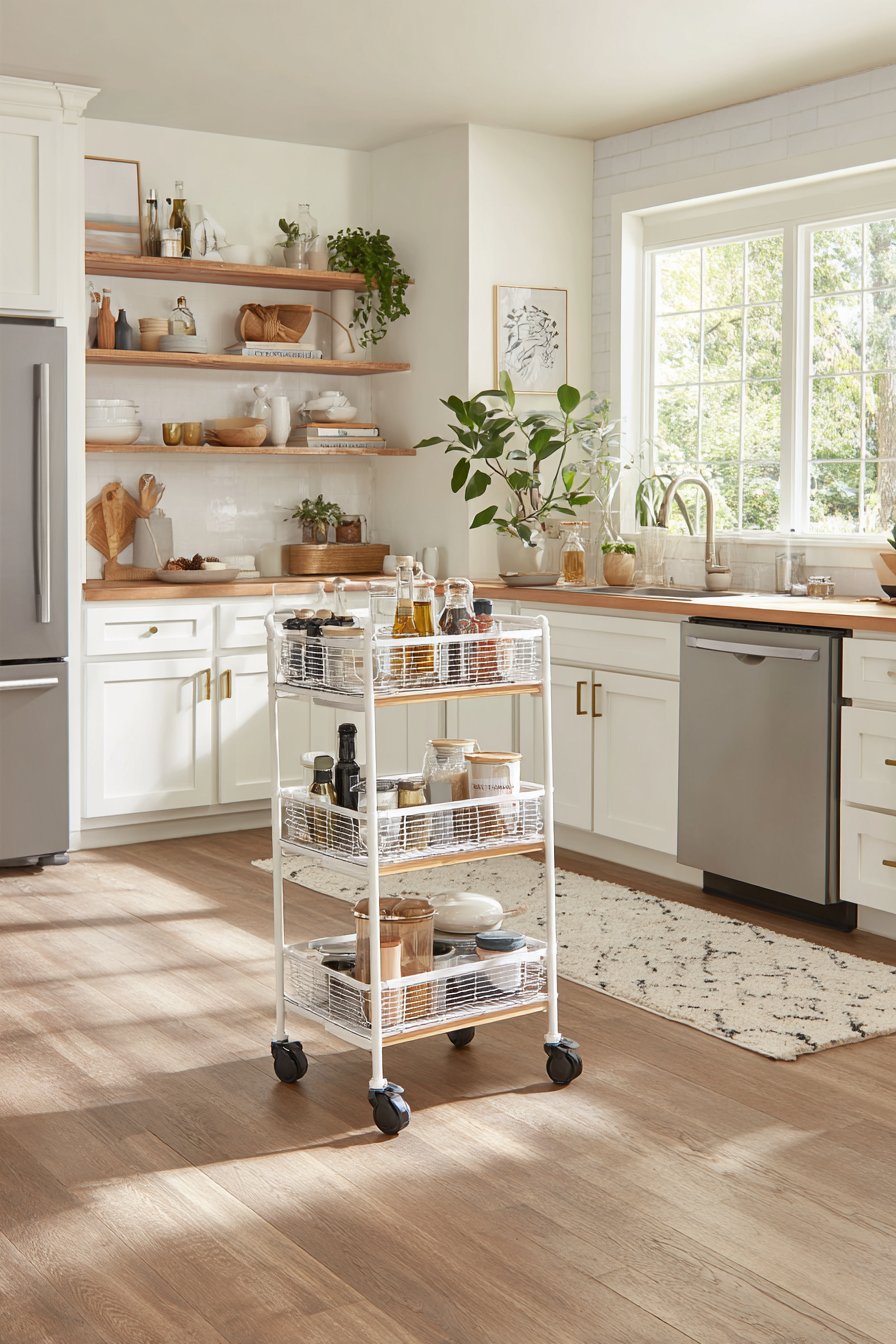
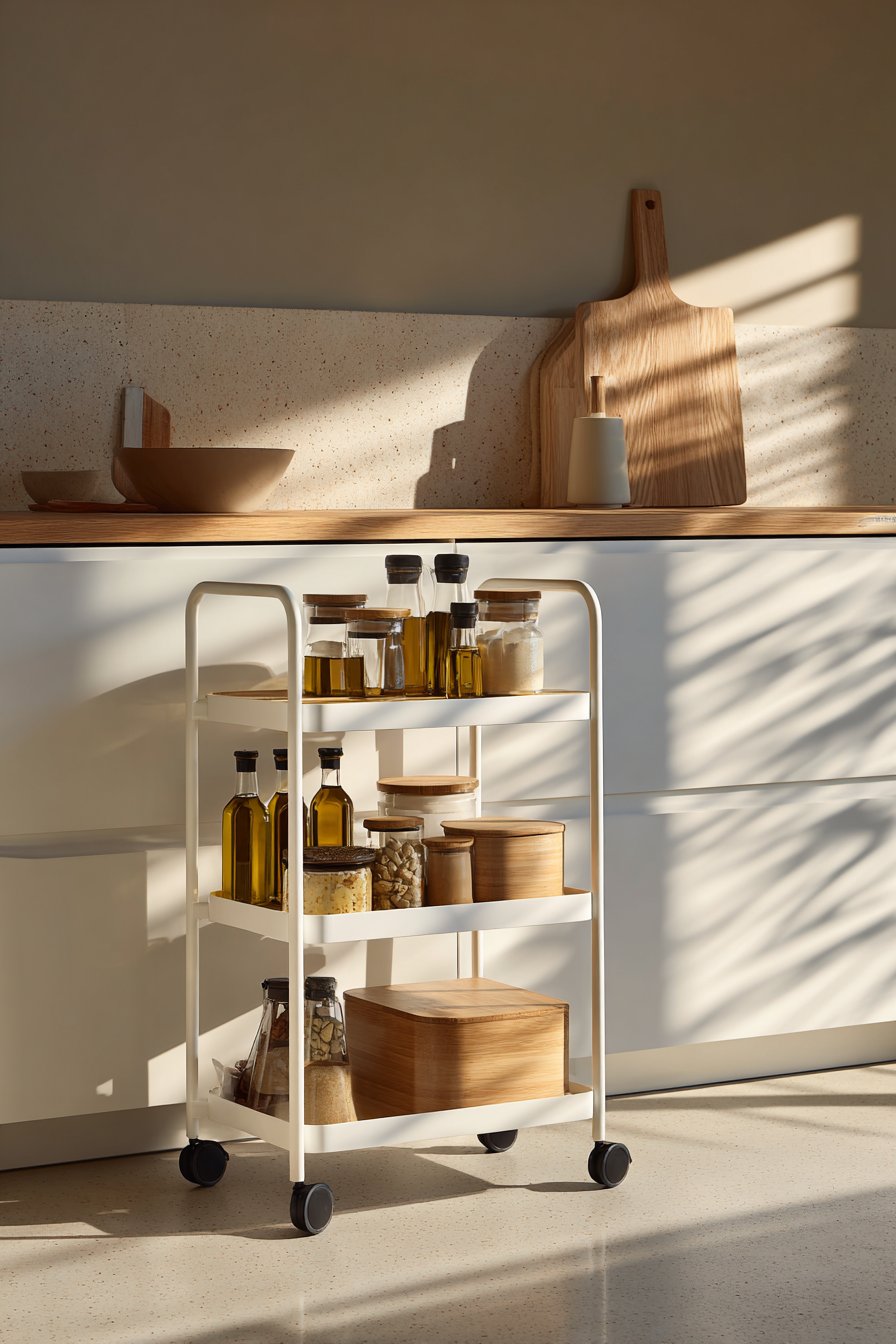
A slim rolling cart positioned between the refrigerator and counter features three tiers of storage for oils, vinegars, and frequently used cooking ingredients, demonstrating ingenious use of typically wasted narrow spaces. The cart features white powder-coated steel frame with natural bamboo shelves, creating a clean aesthetic that complements modern kitchens. Locking casters allow easy mobility for cleaning while preventing unwanted rolling during use. Natural kitchen lighting creates soft shadows, captured with interior photography techniques that emphasize the clever use of narrow spaces and portable organization solutions.
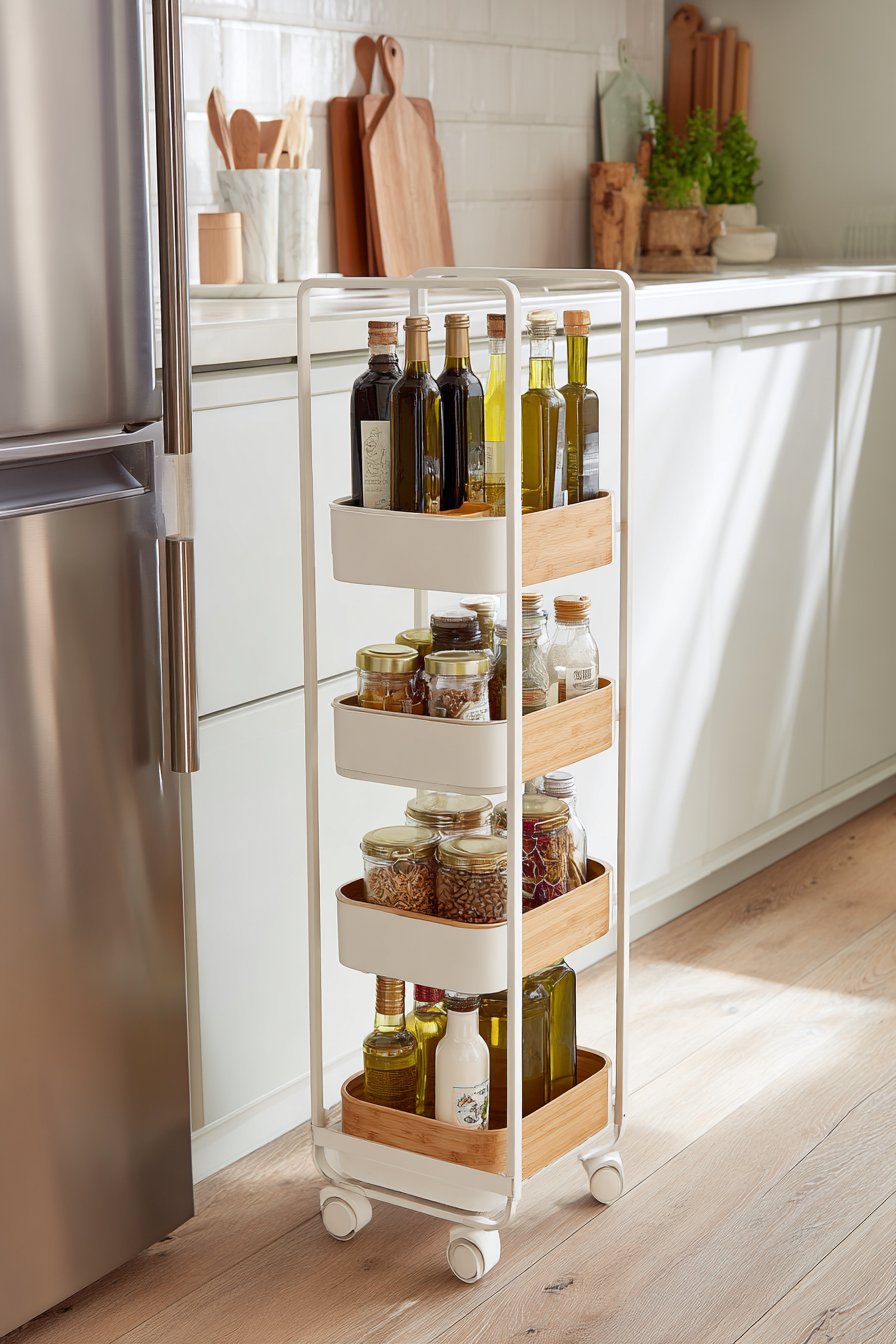
The narrow gaps between appliances and counters often become unintentional collection points for crumbs and dropped utensils—wasted space that this organizational solution transforms into valuable storage. Rolling carts designed for these specific dimensions turn problematic gaps into assets, providing accessible storage for items used frequently during cooking. The three-tier configuration maximizes vertical space in the narrow footprint, while the powder-coated steel frame offers durability and easy cleaning. Natural bamboo shelves add organic warmth while providing sturdy platforms for bottles and containers.
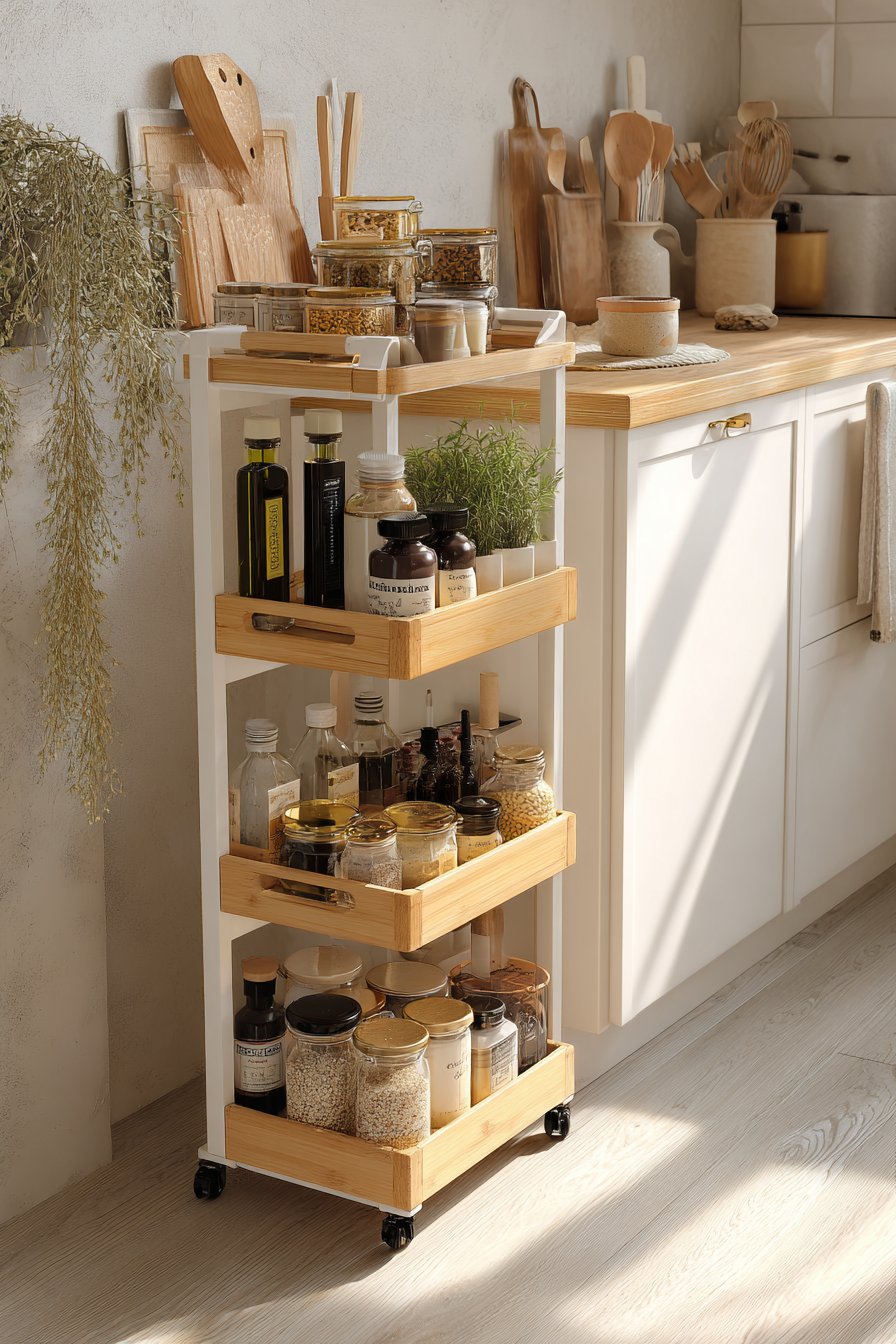
The mobility of rolling carts represents a significant advantage over fixed storage, allowing you to wheel stored items directly to where they’re needed during cooking, then return them to their compact home after use. The locking casters ensure stability during use while facilitating effortless movement when desired. This flexibility particularly benefits small kitchens where counter space is precious—the rolling cart can store prep ingredients during cooking, then wheel away to its narrow slot when counter space is needed for other purposes. The white and bamboo color palette coordinates with numerous kitchen styles, from contemporary to farmhouse, making this organizational solution both practical and aesthetically versatile.
Key Design Tips:
- Measure gap widths carefully before purchasing rolling carts—even an inch matters
- Select carts with locking wheels to prevent movement during use
- Store your most frequently used cooking ingredients on rolling carts for easy access
- Consider handle styles when selecting—some gaps are too narrow for protruding handles
- Keep cart contents within weight limits to ensure easy mobility
- Clean under and around carts weekly to prevent dust and crumb accumulation
16. Junk Drawer Tamed and Organized
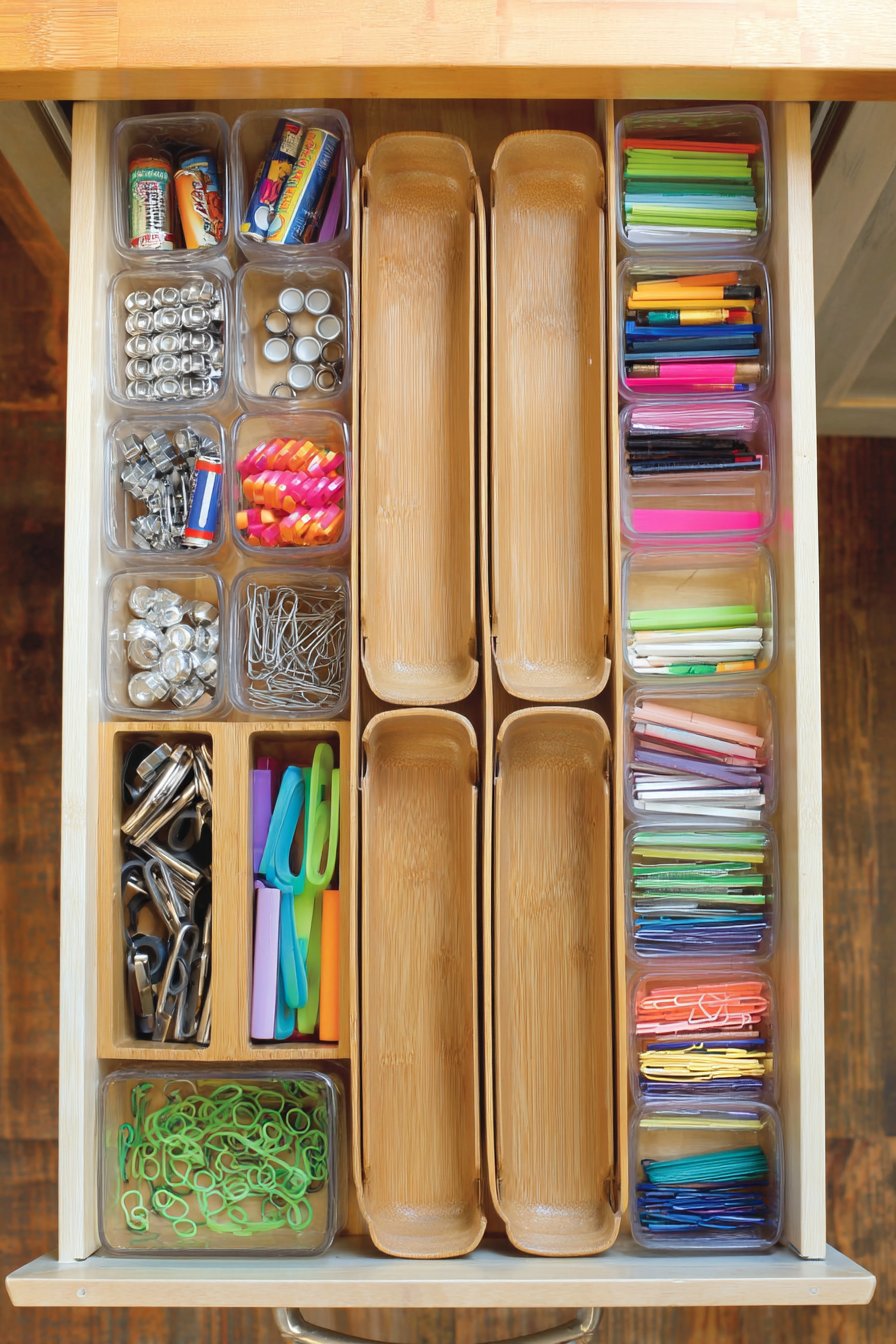
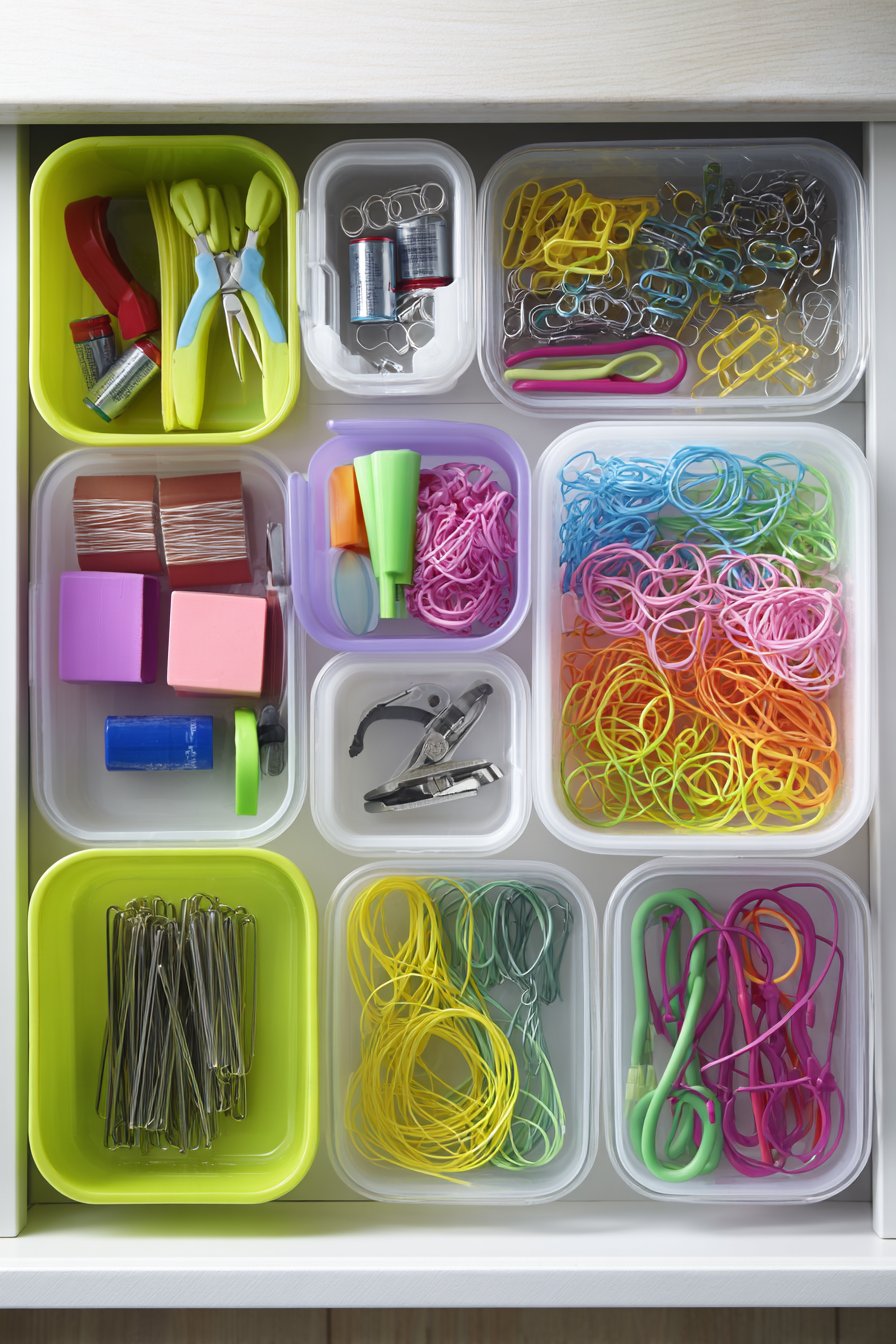
Even the infamous kitchen junk drawer can be transformed through drawer organizers specifically designed with small compartments holding batteries, twist ties, chip clips, rubber bands, and other kitchen miscellany. Expandable bamboo dividers create custom sections while maintaining a tidy appearance that contains the “organized chaos” of necessary odds and ends. This organizational system proves that even the most catch-all spaces deserve structure. Overhead interior photography with balanced lighting shows the transformation from chaos to functional organization that makes finding small necessities effortless rather than frustrating.
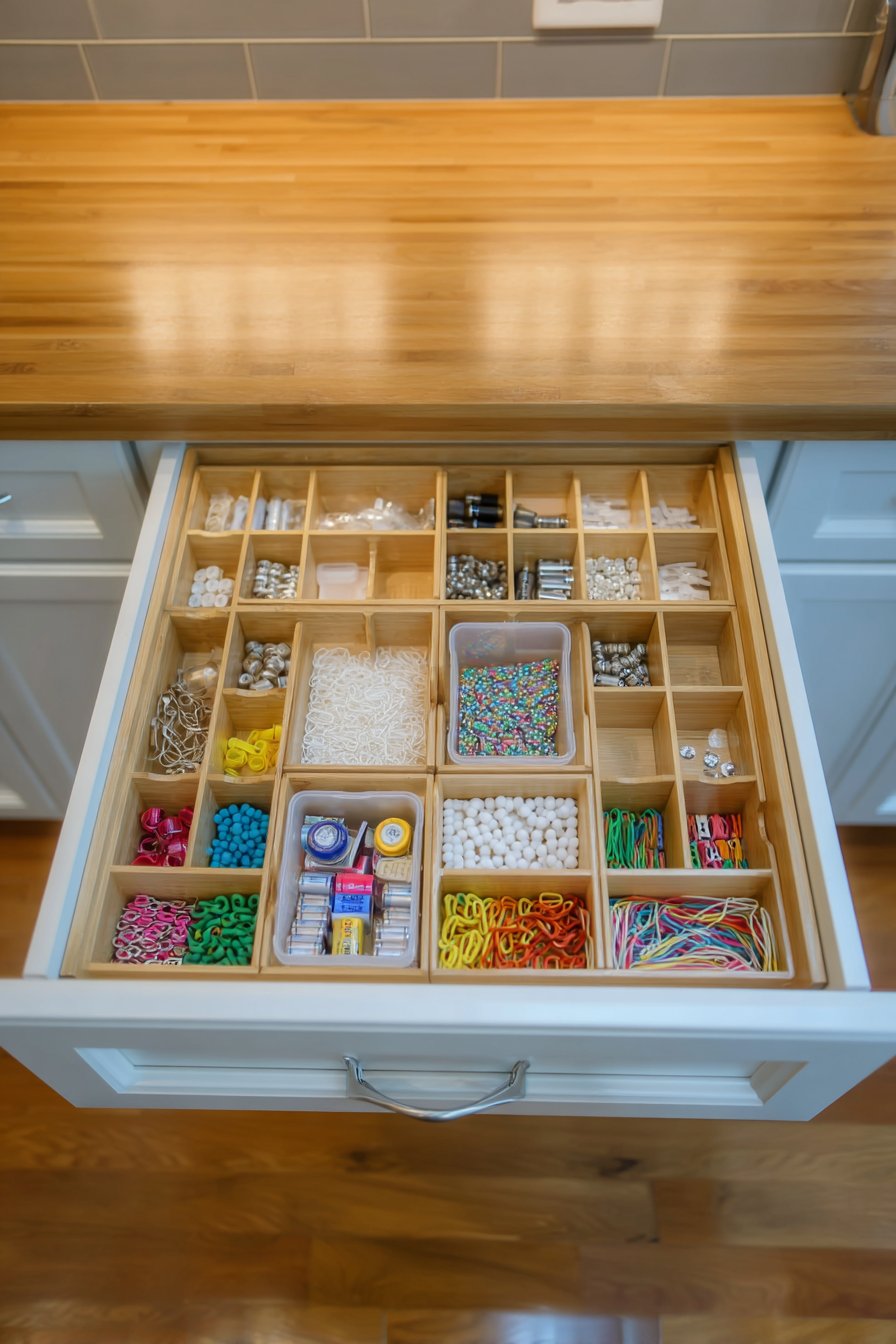
The junk drawer serves an important psychological function in kitchen organization—it’s the designated home for items that don’t fit neatly into other categorical storage. Rather than fighting this natural tendency to accumulate small miscellany, effective organization embraces it by creating a structured system within that designated catch-all space. The expandable bamboo dividers adjust to fit the specific drawer dimensions while creating compartments sized appropriately for different categories of small items. Batteries nestle in one section, bag clips gather in another, rubber bands corral in a third—each category separated but all coexisting within the same drawer.
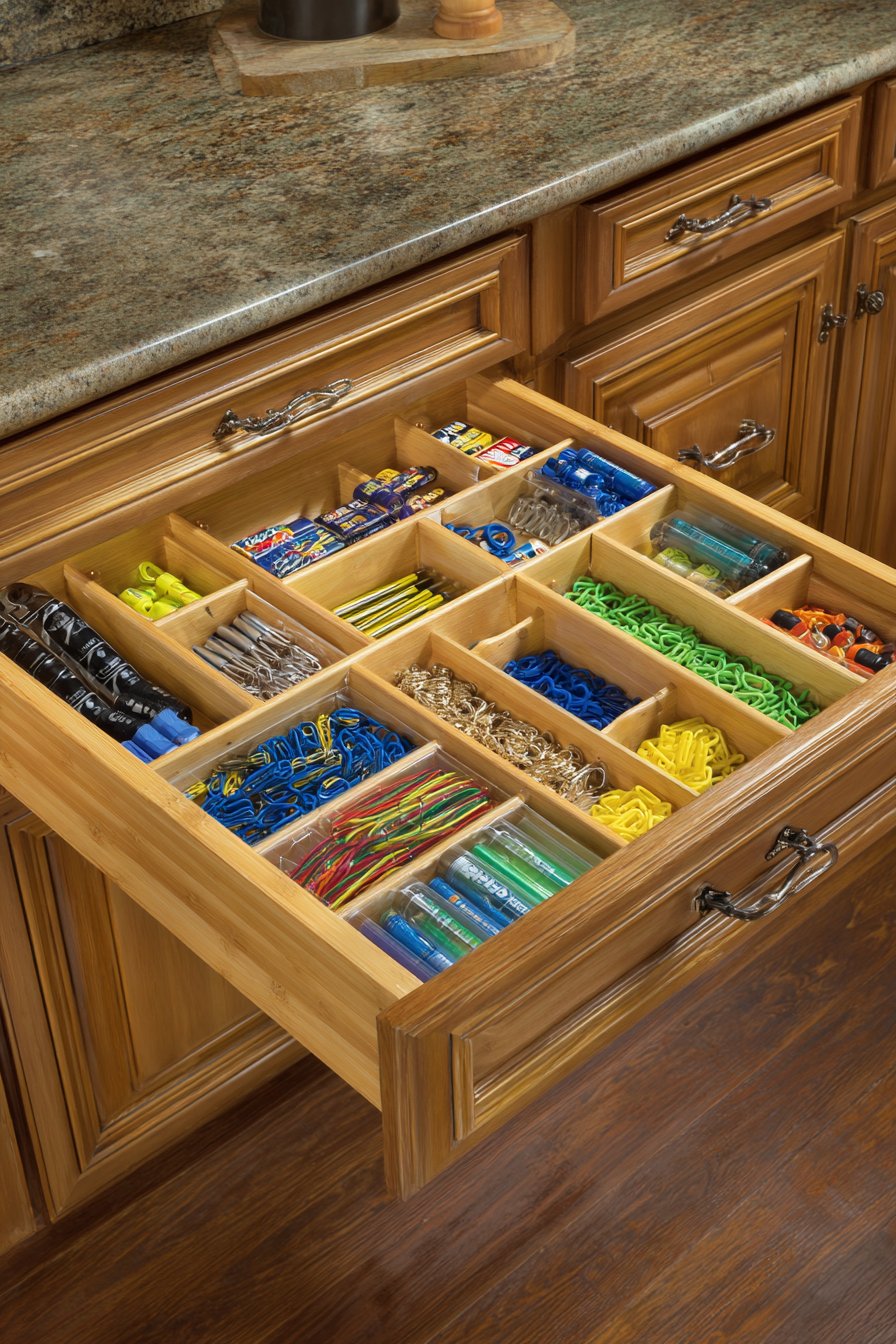
The beauty of proper junk drawer organization lies in how it transforms frustration into efficiency. Rather than pawing through a jumbled drawer searching for a working battery, you can reach directly into the battery compartment and select what you need. The bamboo dividers prevent the gradual entropy that affects all junk drawers, maintaining separation between categories even with frequent access. Overhead photography with balanced lighting captures not just the current organized state but communicates the satisfying visual order that greets you each time the drawer opens. This organizational approach proves that every drawer, even those designated for miscellaneous items, benefits from thoughtful structure.
Key Design Tips:
- Use expandable drawer dividers that adjust to your specific drawer dimensions
- Group items by category rather than mixing everything together randomly
- Purge junk drawers quarterly to eliminate items that have outlived their usefulness
- Store only truly useful miscellany—resist the urge to keep broken or obsolete items
- Consider small containers or cups within dividers for particularly tiny items like tacks
- Label compartments if multiple people use the kitchen to maintain organizational categories
17. Suspended Pot Rack Above Island
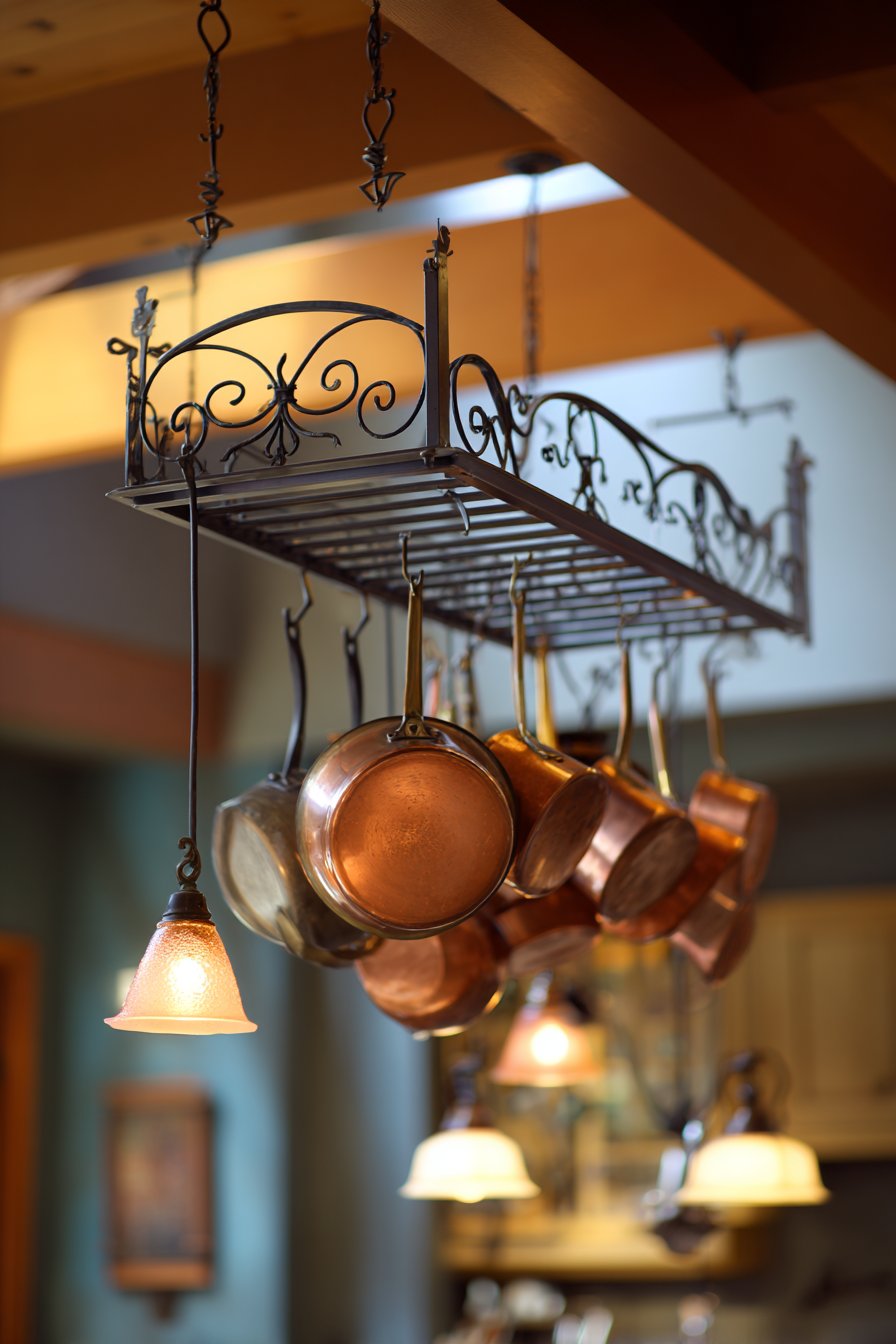
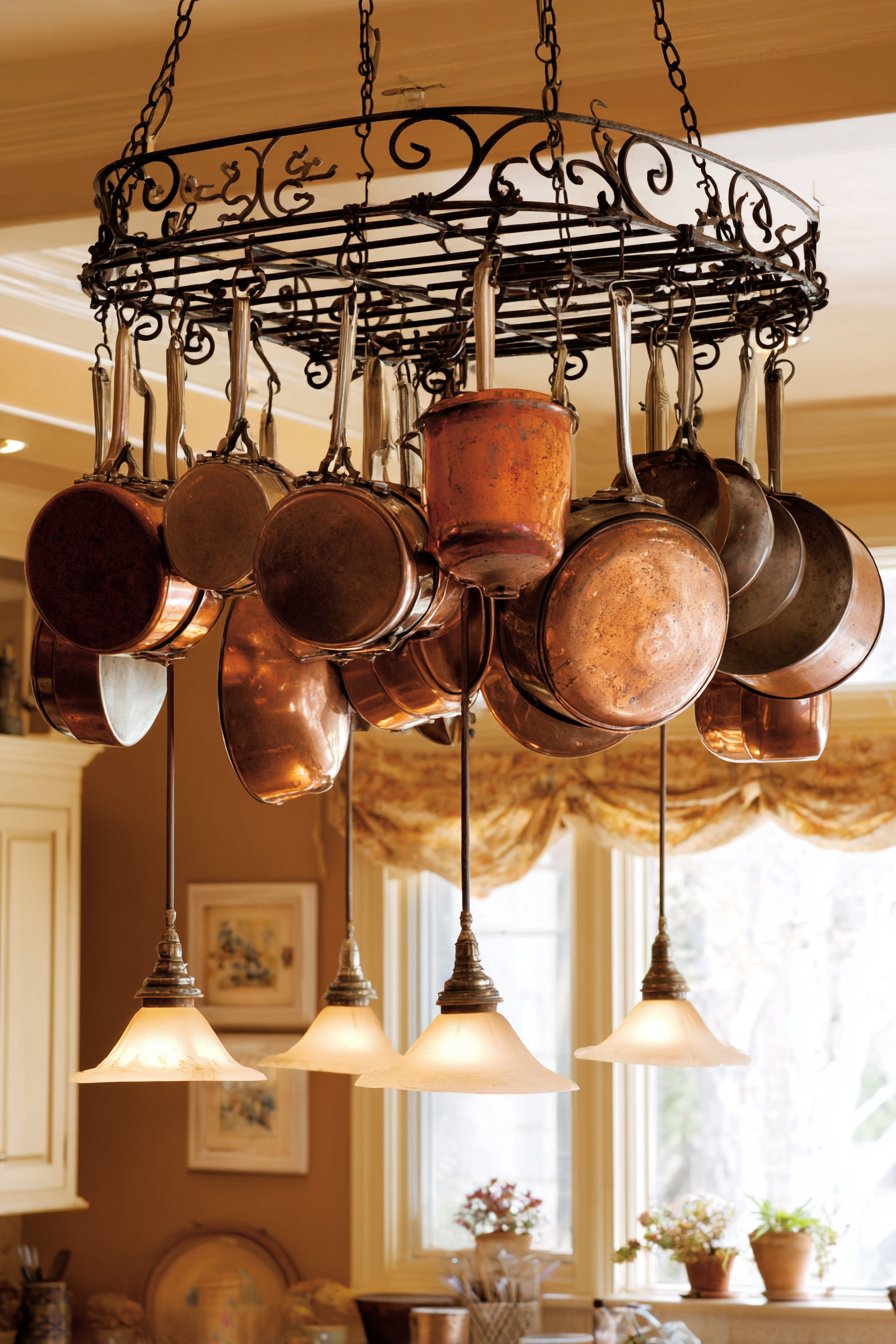
A pot rack suspended from the ceiling above a kitchen island holds frequently used copper and stainless steel cookware, demonstrating both practical storage and decorative appeal. The rack features wrought iron construction with decorative scrollwork and S-hooks for hanging various pot sizes and shapes. Nearby pendant lights illuminate the displayed cookware, creating visual interest through the interplay of metals and light. Wide-angle interior design photography captures the practical use of vertical space while adding visual interest to the kitchen with attention to the interplay of metals and shadows.
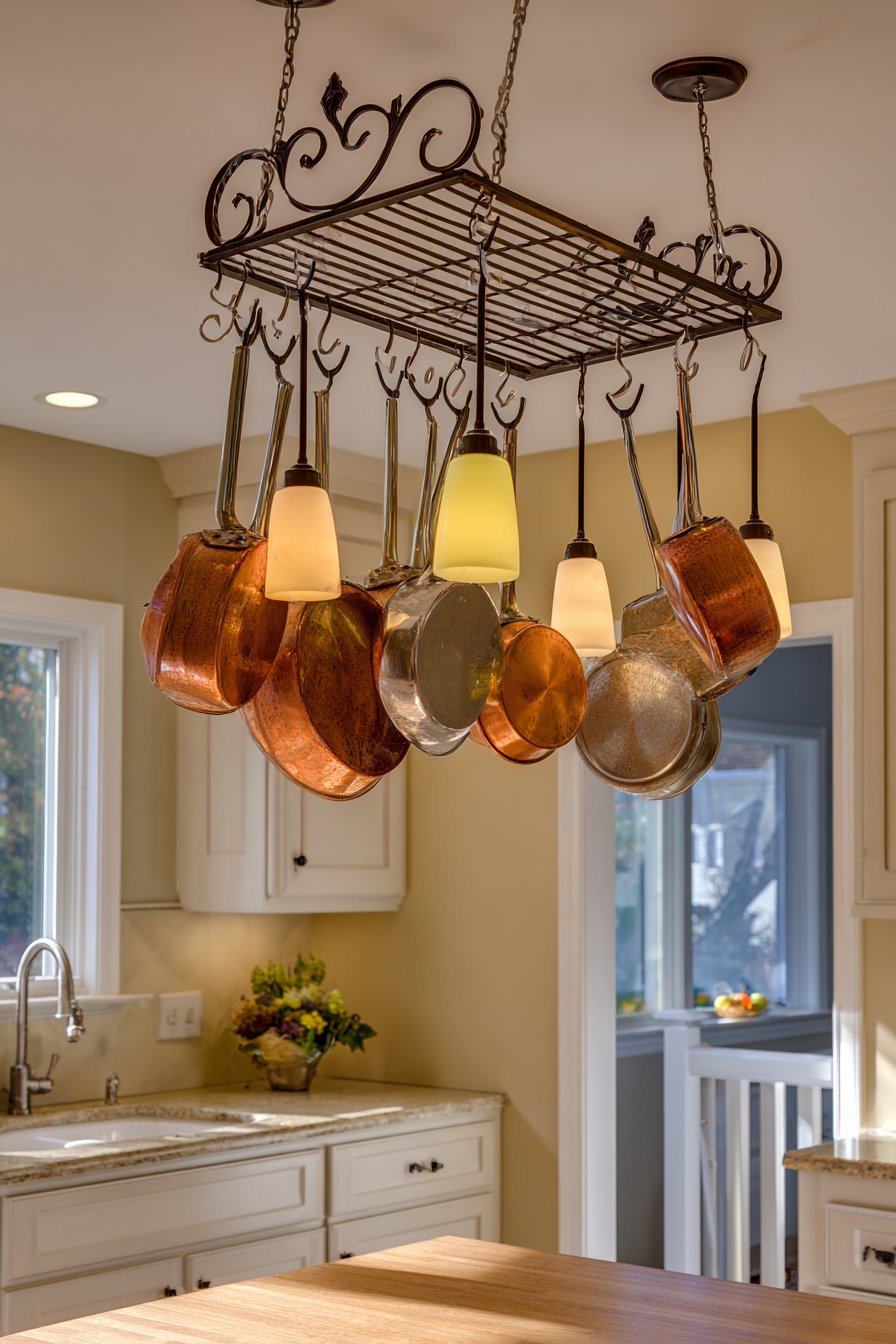
Ceiling-mounted pot racks transform cookware storage from hidden necessity to displayed focal point, celebrating beautiful cookware as kitchen art while keeping frequently used items within easy reach. The wrought iron construction with decorative scrollwork adds Old World charm that contrasts beautifully with contemporary kitchen finishes, creating visual complexity and depth. The combination of copper and stainless steel cookware hanging from the rack creates a professional kitchen aesthetic while the varied sizes and shapes of different pots and pans add organic visual interest that purely decorative elements cannot match.
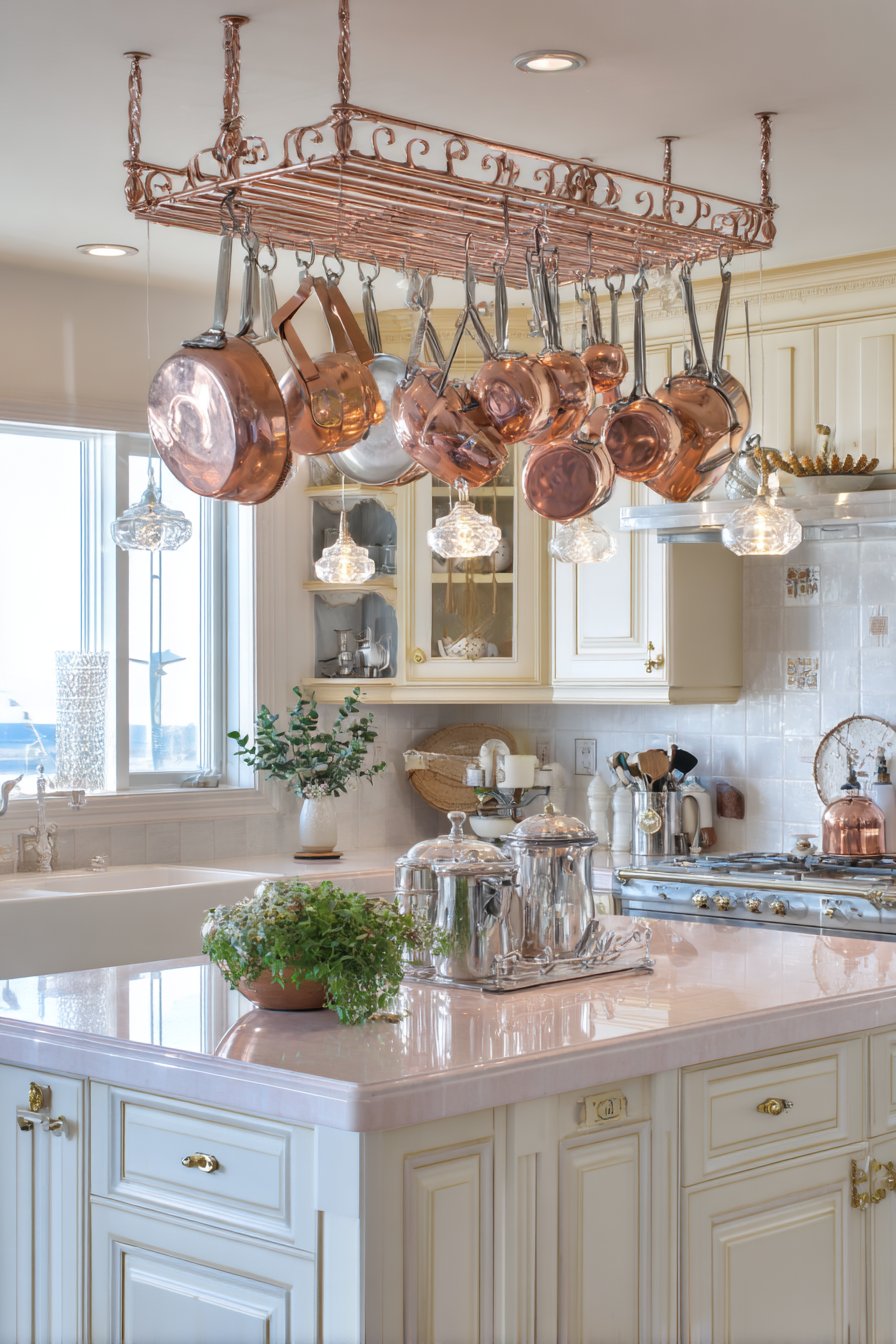
The practical advantages of overhead pot storage include freeing valuable cabinet space for other items, keeping heavy cookware accessible without bending to low cabinets, and air-drying pots and pans in a hygienic manner. Pendant lights positioned near the pot rack serve dual purposes—providing task lighting for the island workspace while creating dramatic shadows and highlights on the hanging cookware. This interplay of light and metal transforms functional storage into dynamic visual display that changes throughout the day as natural and artificial light sources shift. Wide-angle photography captures both the practical functionality and the aesthetic contribution of this organizational approach, demonstrating that the best kitchen storage solutions address both needs simultaneously.
Key Design Tips:
- Install pot racks high enough to prevent head bumping but low enough for easy access
- Ensure ceiling joists can support the combined weight of rack and cookware
- Hang most frequently used items in the most accessible positions
- Coordinate metal finishes between pot rack, cookware, and other kitchen hardware
- Install pot racks over islands or peninsulas, never above primary traffic paths
- Include more hooks than currently needed to accommodate collection growth
18. Appliance Storage with In-Drawer Power
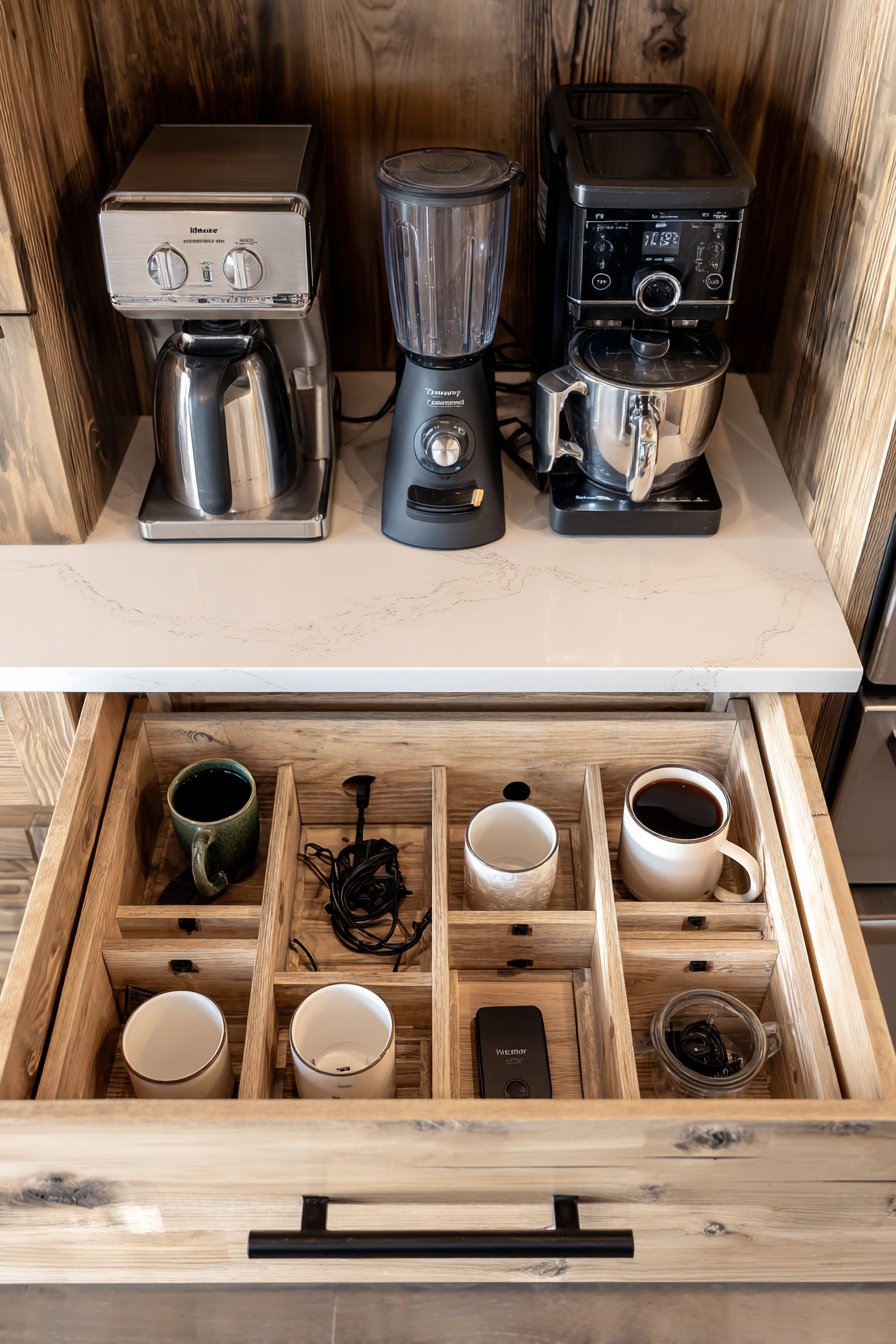
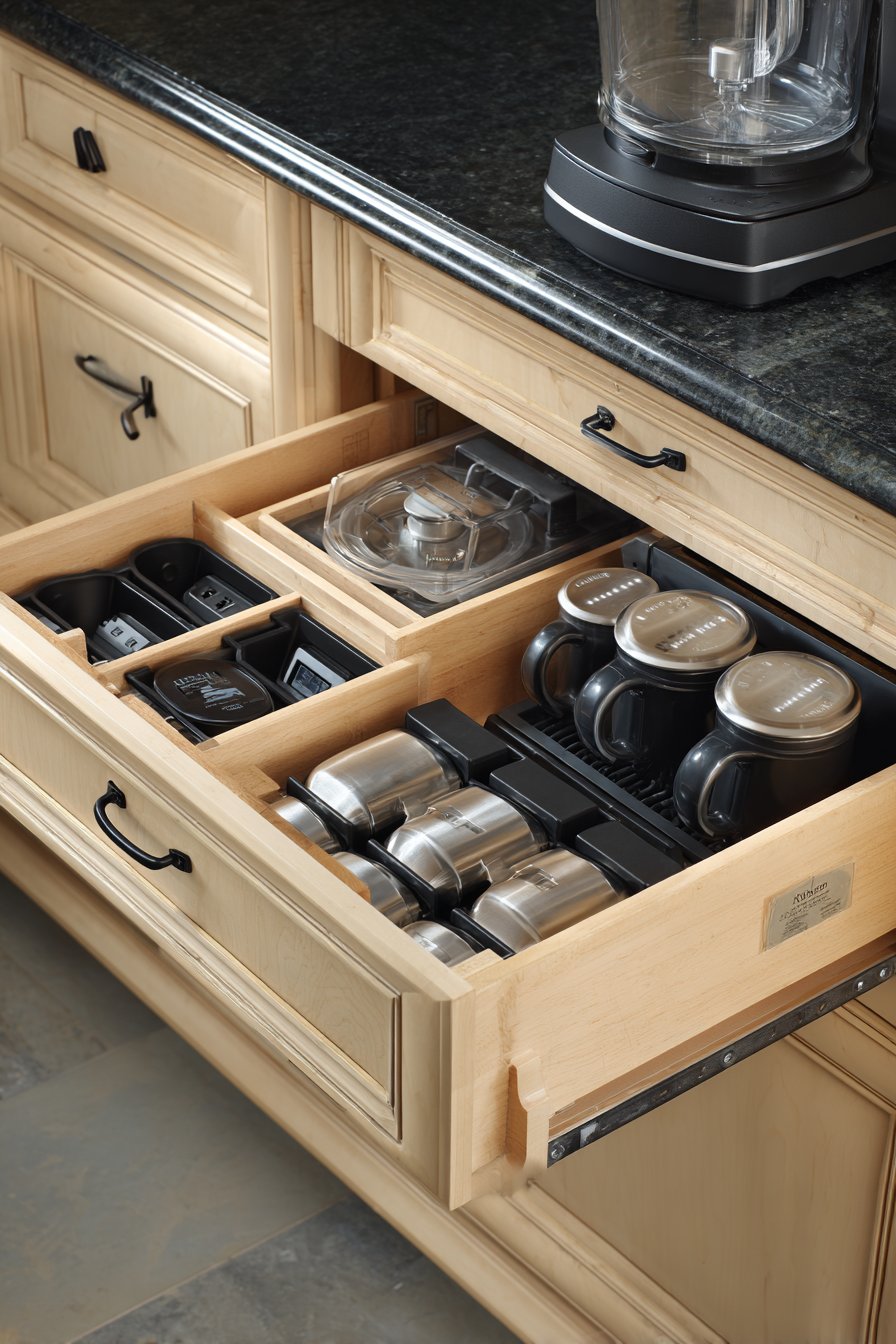
Deep drawer storage for small appliances including stand mixers, food processors, and blenders, each in dedicated compartments with custom foam inserts preventing shifting during drawer opening and closing, represents sophisticated organization engineering. Power strips installed inside drawers allow appliances to remain perpetually plugged in, eliminating the daily hassle of cord management and outlet availability. The drawer features heavy-duty slides capable of supporting substantial weight and natural maple construction that coordinates with kitchen cabinetry. Interior photography with balanced lighting shows the open drawer system that keeps countertops clear while maintaining appliance accessibility.
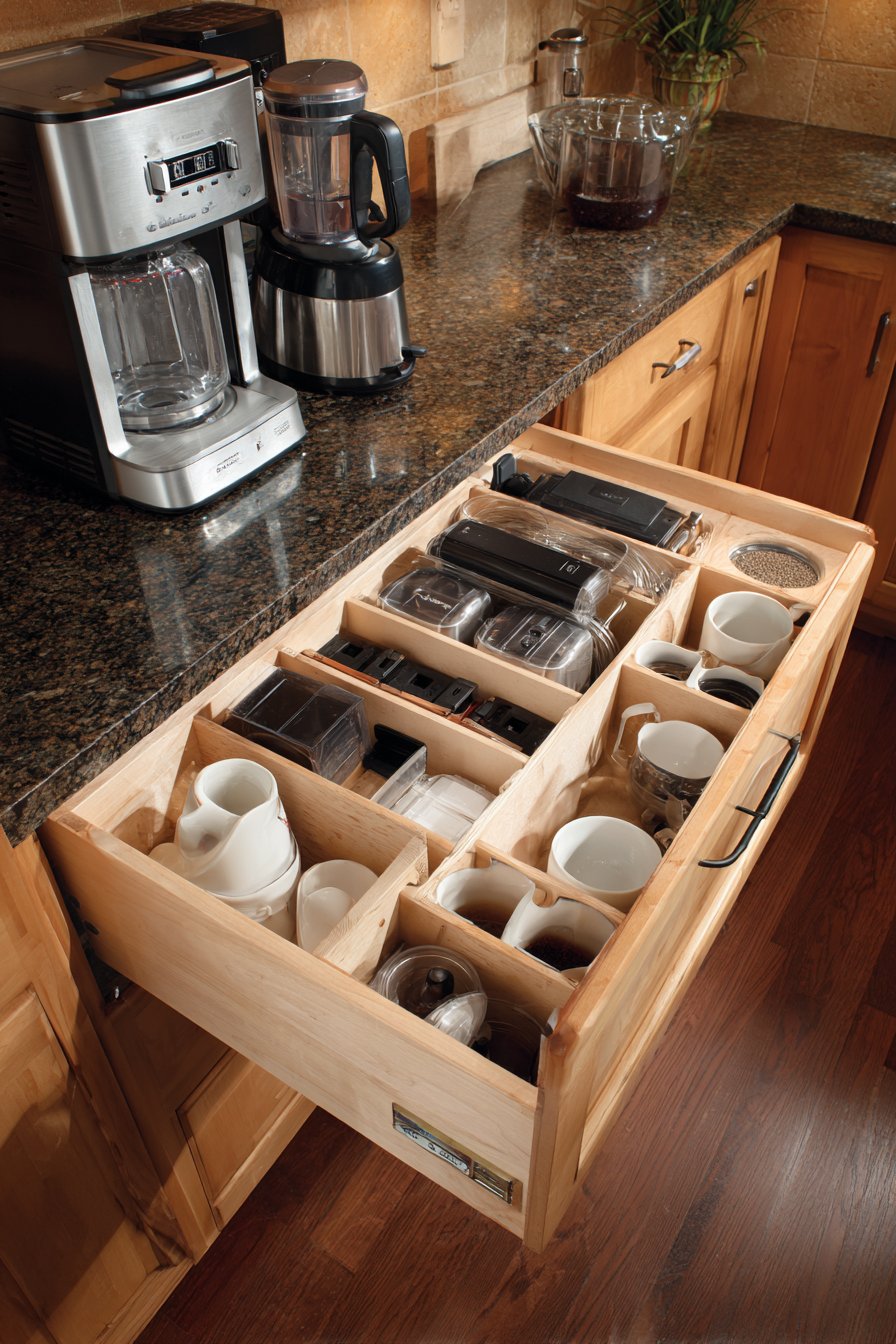
The innovation of in-drawer power outlets transforms small appliance storage from simple concealment to true functional integration. Appliances remain plugged in and ready for immediate use—you simply open the drawer, lift out the appliance, and begin working. This system particularly benefits heavy appliances like stand mixers that are cumbersome to repeatedly unpack and set up. The custom foam inserts serve multiple purposes: they prevent appliances from sliding and potentially damaging themselves or the drawer during opening and closing, they organize cords to prevent tangling, and they create designated homes that make returning appliances to storage effortless and intuitive.
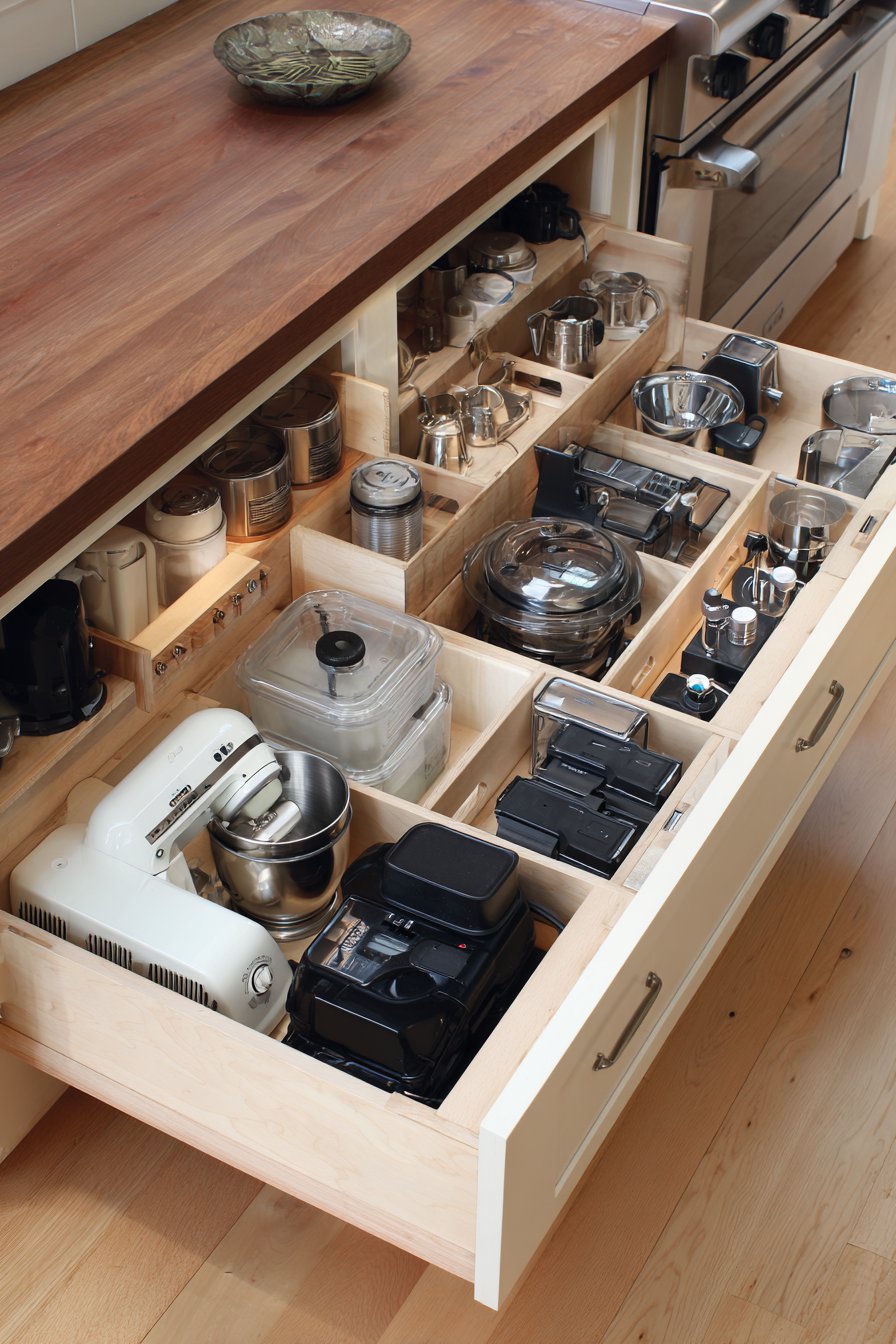
Heavy-duty drawer slides are essential for this organizational approach, as small appliances can weigh fifteen pounds or more. Standard drawer hardware simply cannot support this weight through repeated opening and closing. The investment in commercial-grade slides ensures smooth operation and longevity while preventing the drawer sag and binding that would occur with inadequate hardware. Natural maple construction coordinates with kitchen cabinetry while providing a warm, organic aesthetic that softens the technological sophistication of the integrated power system. This organizational solution demonstrates how thoughtful engineering can solve seemingly contradictory goals—keeping countertops clear while maintaining small appliance accessibility.
Key Design Tips:
- Install GFCI outlets inside appliance drawers for electrical safety and code compliance
- Ensure drawer depth accommodates appliances plus several inches for cords
- Use heavy-duty drawer slides rated for at least 100 pounds for appliance storage
- Create custom foam inserts or adjustable dividers sized for specific appliances
- Include ventilation if storing appliances that generate heat
- Position appliance drawers near areas where those appliances will be primarily used
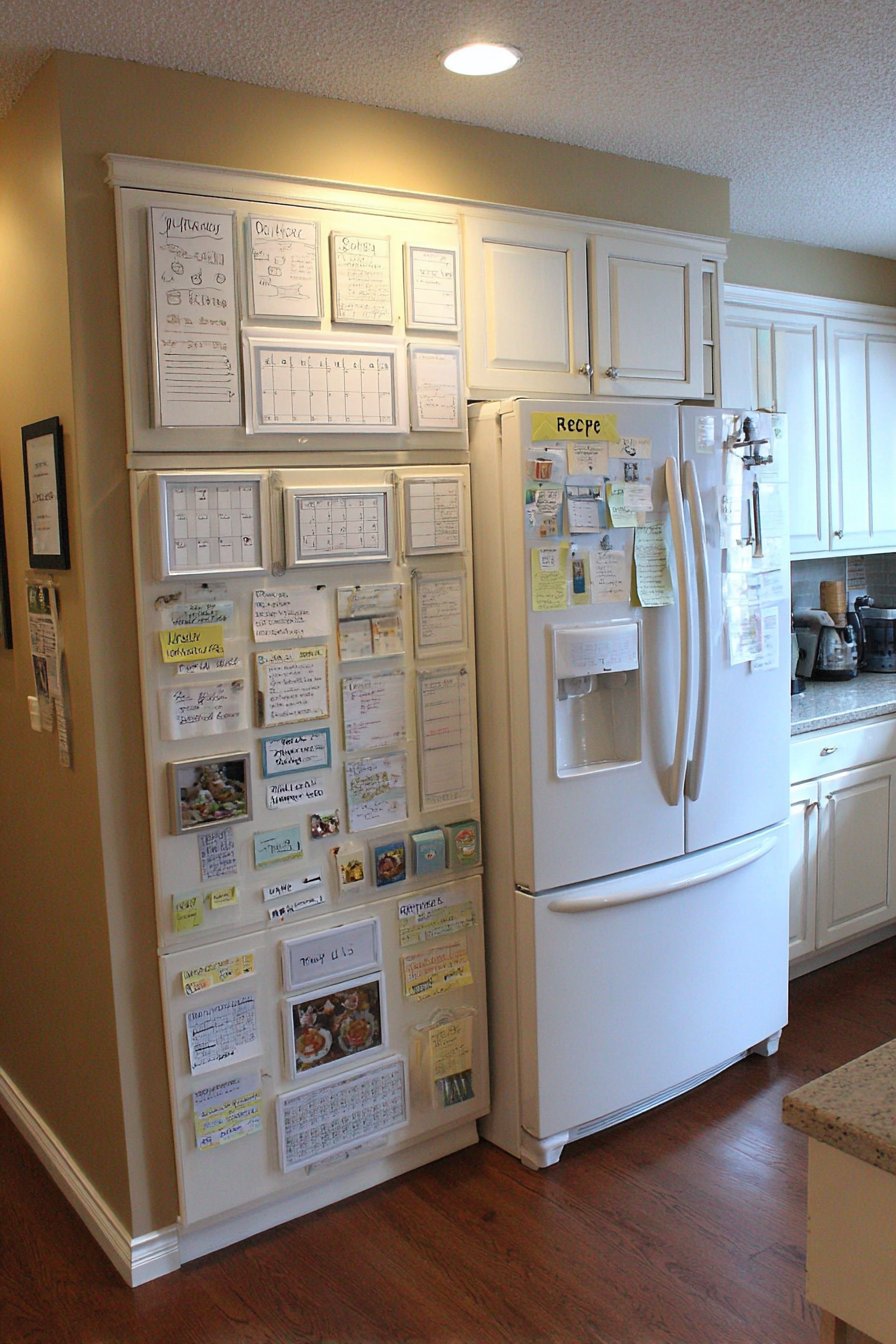
19. Command Center for Family Organization
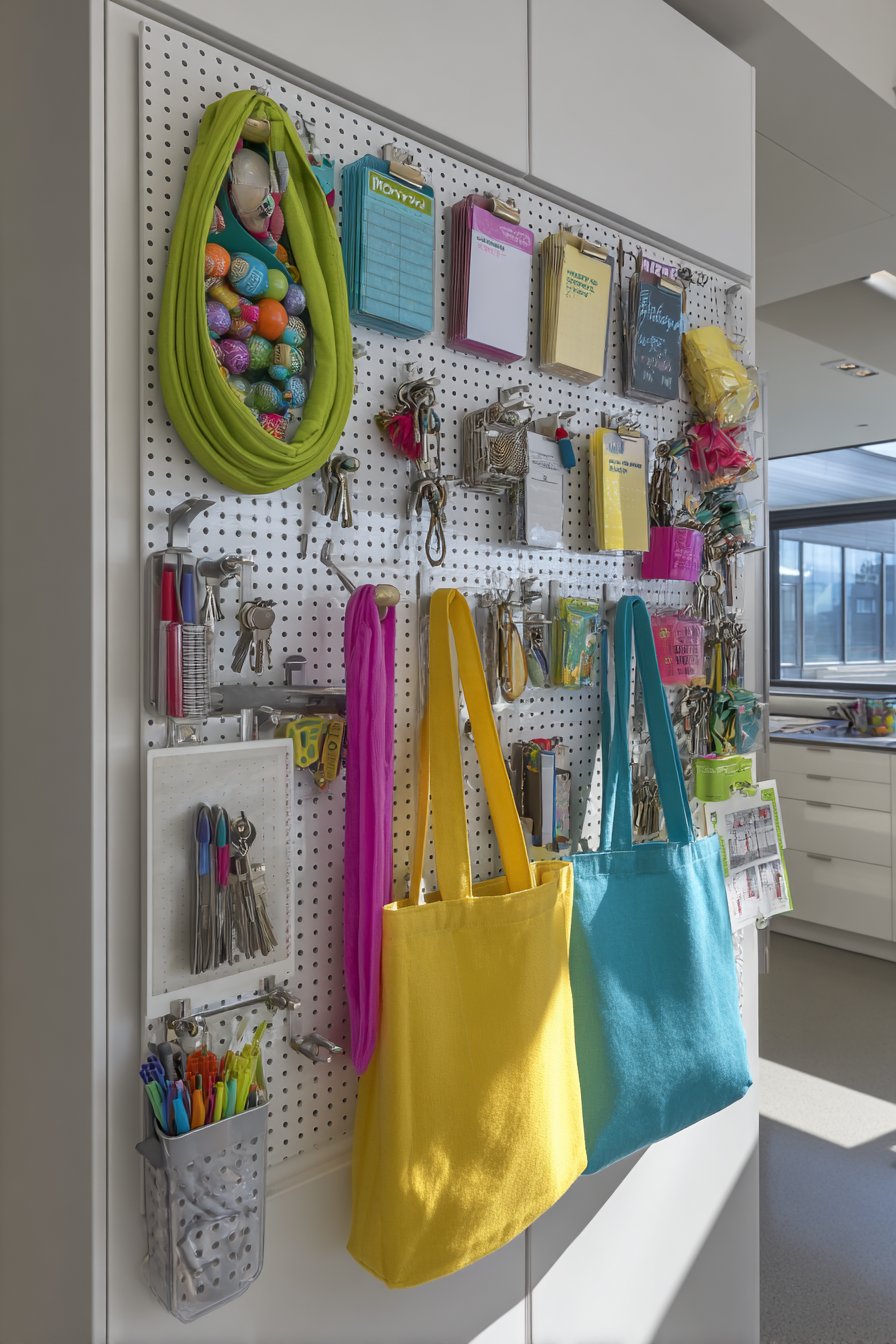
A command center positioned on the side of a refrigerator or cabinet end panel features magnetic message boards, calendar holders, recipe card displays, and hooks for keys and reusable shopping bags, creating a household organizational hub. The magnetic surface organizes into zones with different functions clearly separated yet accessible. Natural kitchen lighting highlights the practical organization hub that manages family schedules, shopping lists, and daily necessities. Interior design photography captures the family-friendly organizational system with attention to daily functionality and the seamless integration into kitchen space.
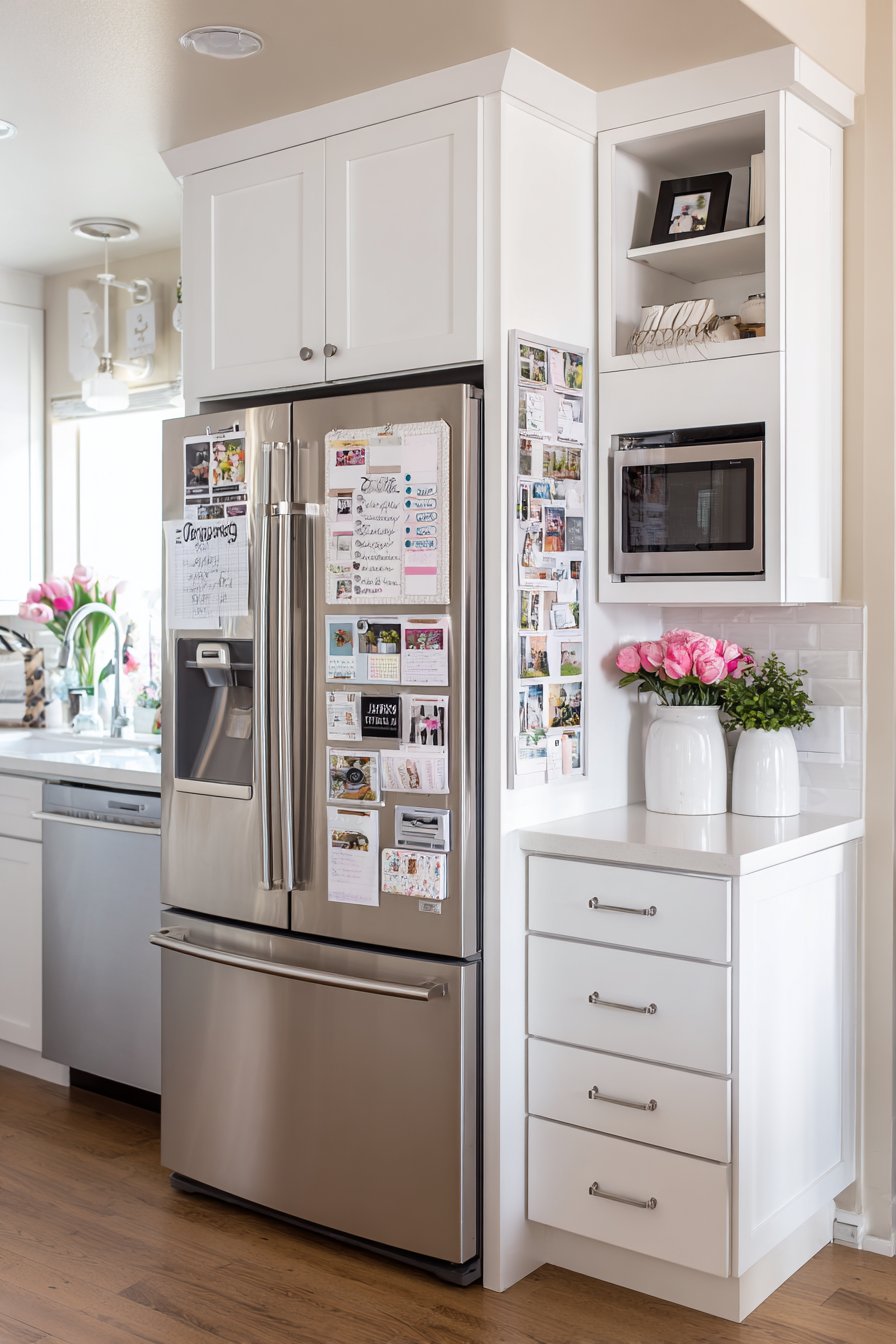
The command center concept recognizes that kitchens function as household communication headquarters where family members gather, coordinate schedules, and plan activities. By creating a dedicated organizational zone, you prevent paper clutter from spreading across countertops while ensuring that important information remains visible and accessible. Magnetic message boards allow notes and reminders to be posted without tape or pins, while calendar holders keep the family schedule prominently displayed. Recipe card displays put favorite recipes at eye level for easy reference during cooking, and hooks for keys and shopping bags ensure these frequently misplaced items have a designated home.
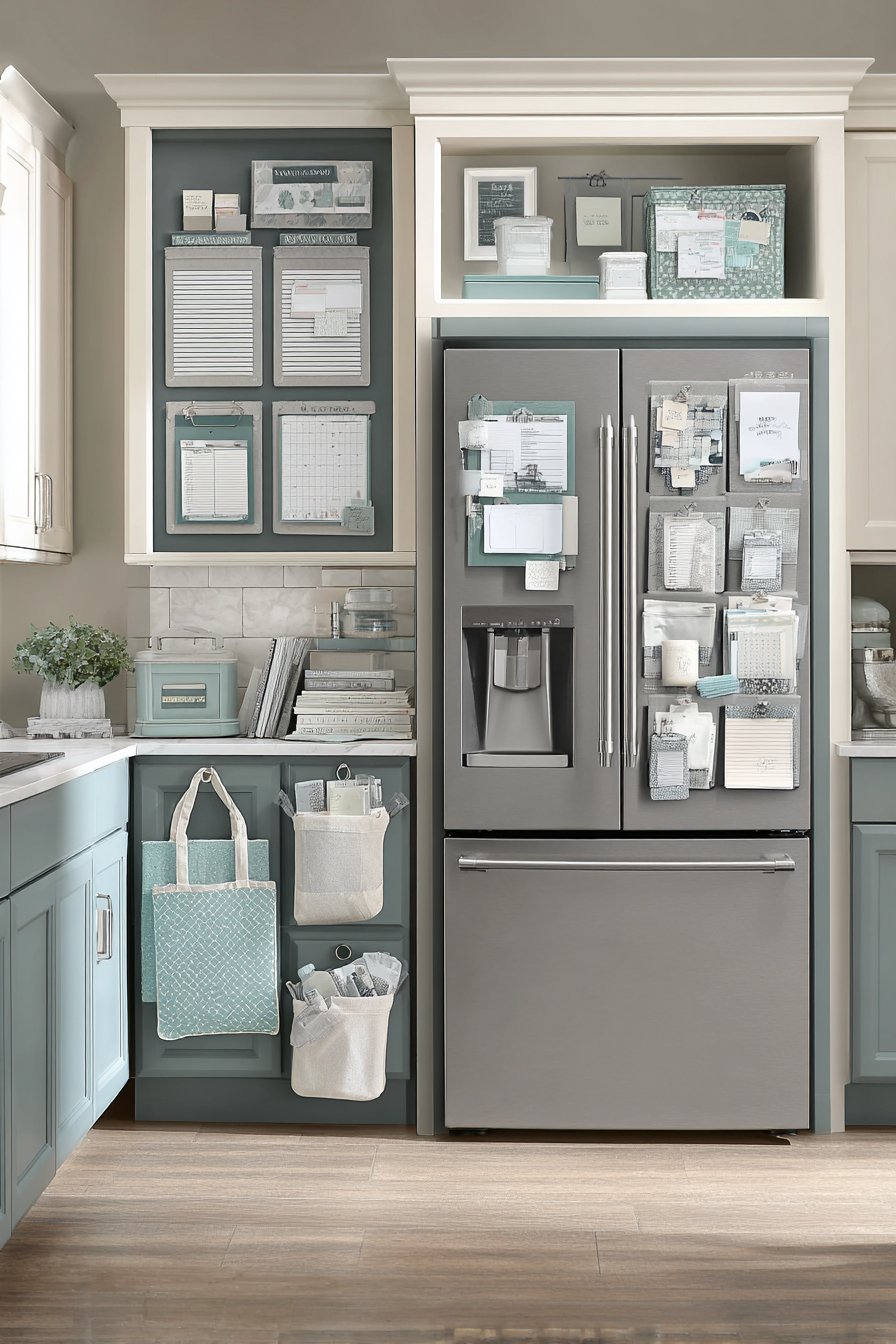
The zoning approach within the command center prevents organizational chaos—rather than randomly placing papers and magnets anywhere on the magnetic surface, designated zones create structure and predictability. The shopping list zone, for example, might include a notepad and pen on a string, while the family calendar zone displays the current month prominently. Natural kitchen lighting ensures the command center remains readable throughout the day, while the location on a refrigerator side or cabinet end panel makes intelligent use of typically unused vertical space. This organizational approach demonstrates that effective kitchen organization extends beyond food and cookware to encompass the informational infrastructure of family life.
Key Design Tips:
- Position command centers in highly visible locations that family members pass frequently
- Use magnetic surfaces that don’t require holes or damage to cabinets
- Create clearly defined zones for different information types to prevent cluttered appearance
- Include a small basket or hook for pens, pencils, and markers
- Update calendars and message boards weekly to maintain current information
- Consider digital displays for tech-forward families who prefer electronic organization
20. Dedicated Baking Zone Organization
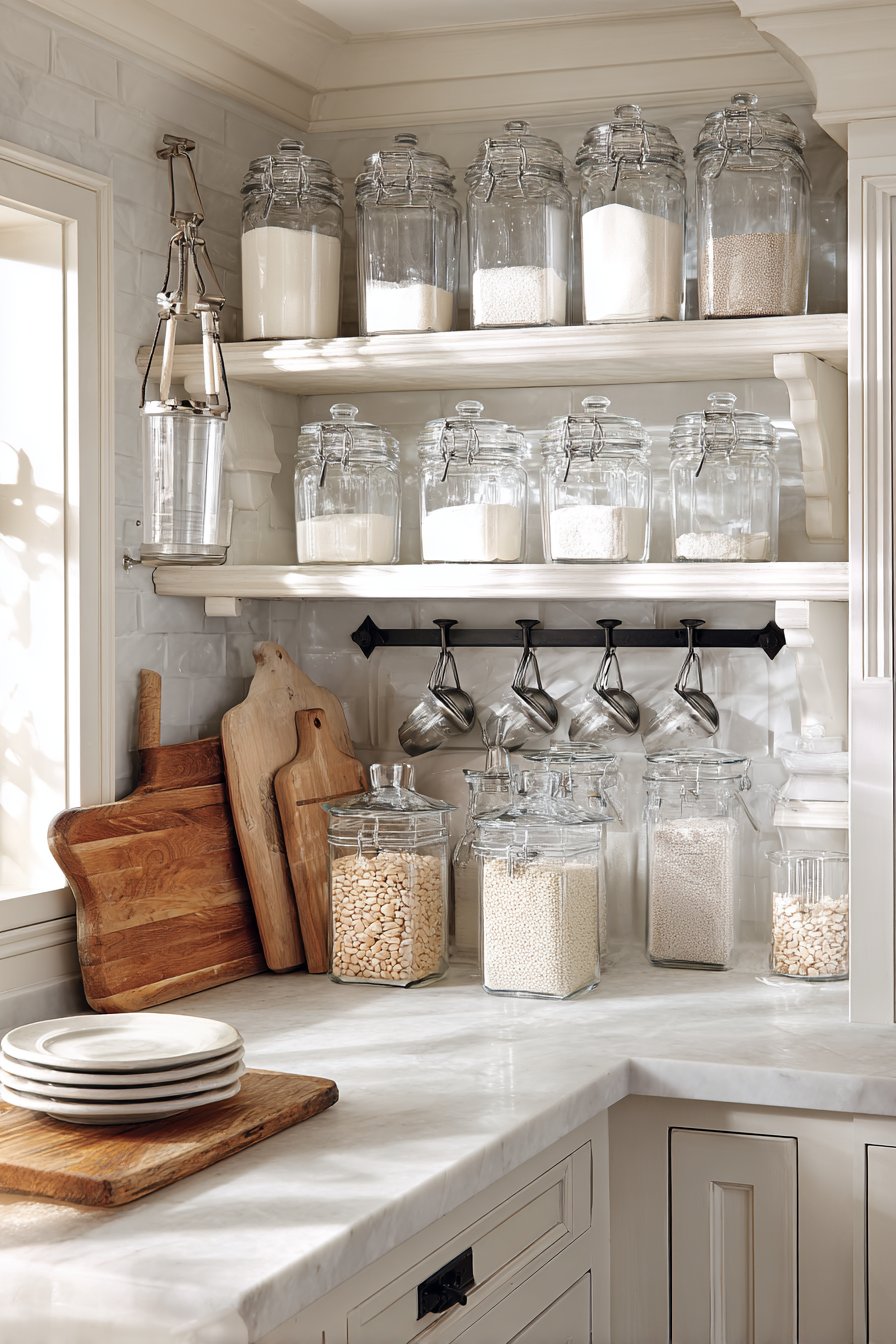
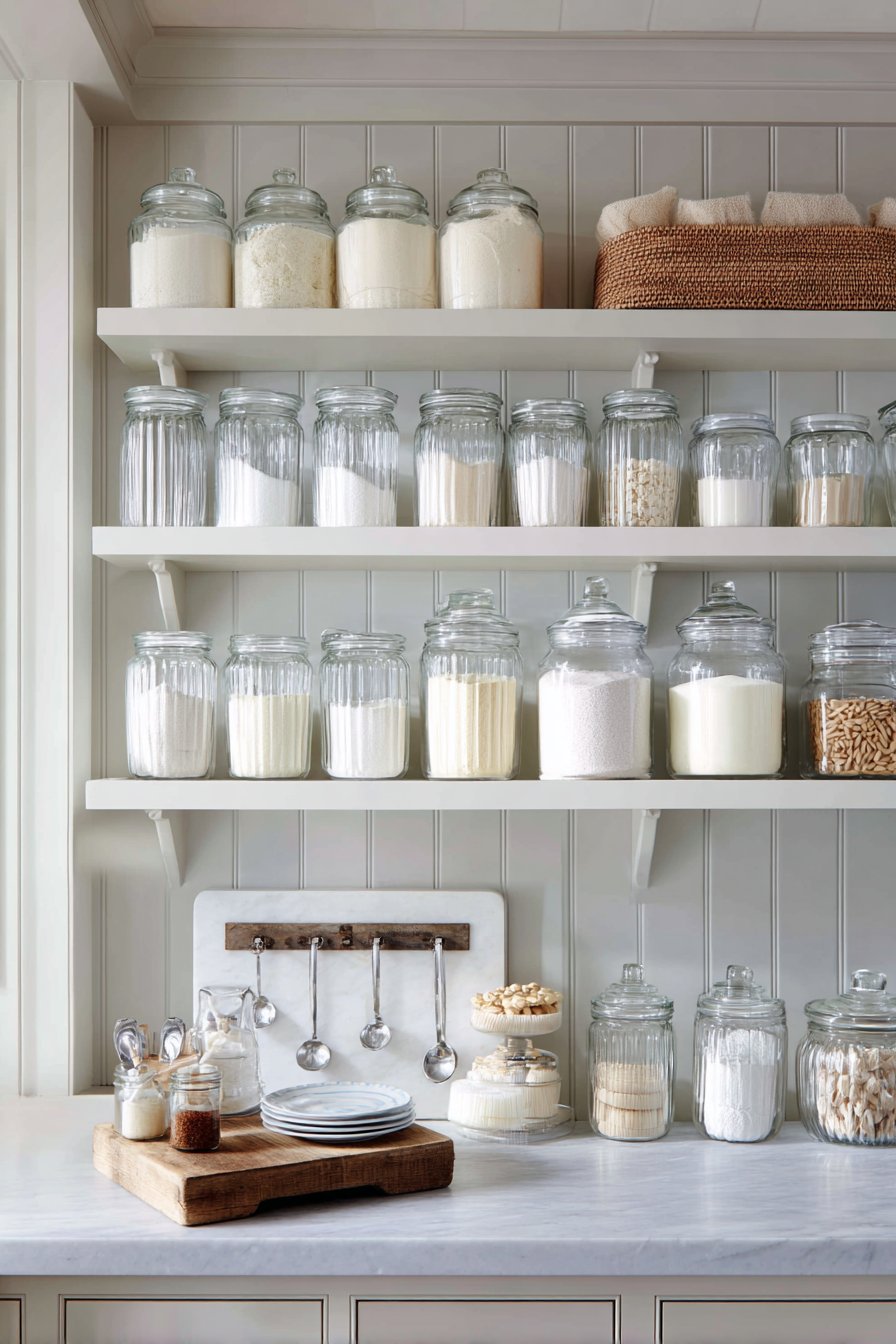
A dedicated baking zone with open shelving storing flour, sugar, and baking essentials in uniform glass canisters with airtight seals demonstrates specialized kitchen organization. Measuring cups hang from hooks beneath the shelf while a marble pastry board rests against the backsplash, ready for rolling dough. Light grey walls and white shelving create a clean backdrop that emphasizes the orderly arrangement of baking supplies. Soft natural lighting captured with professional interior photography emphasizes the dedicated baking station’s functionality and aesthetic harmony.
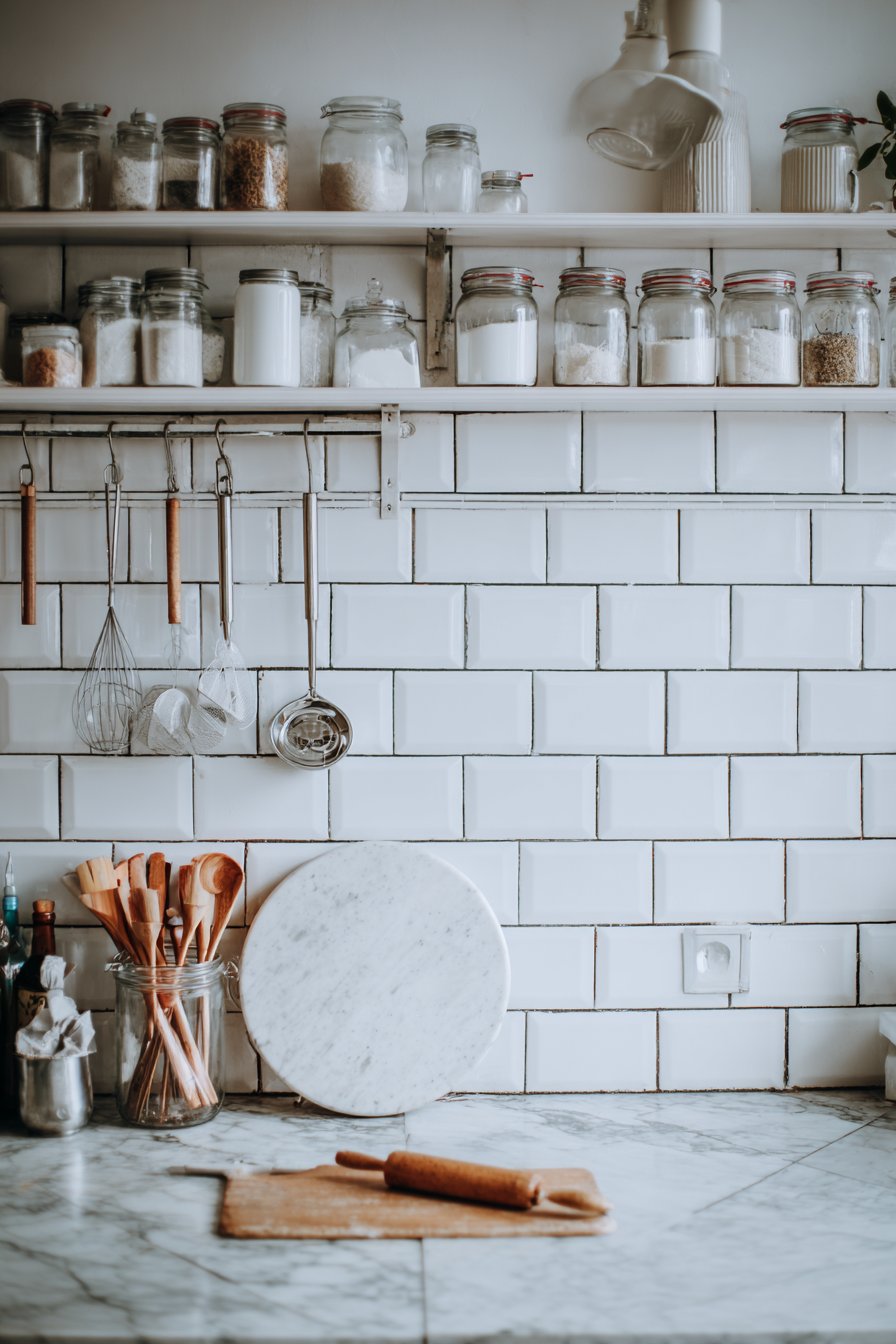
The concept of zone-based kitchen organization creates specialized areas for specific culinary tasks, dramatically improving efficiency while baking. When all baking ingredients, tools, and surfaces are consolidated in one location, the entire process—from measuring ingredients to rolling dough—flows smoothly without searching for scattered supplies. Uniform glass canisters with airtight seals preserve ingredient freshness while creating visual cohesion through consistent sizing and styling. The transparency of glass allows instant assessment of supply levels, facilitating timely restocking before you discover mid-recipe that you’re out of flour.
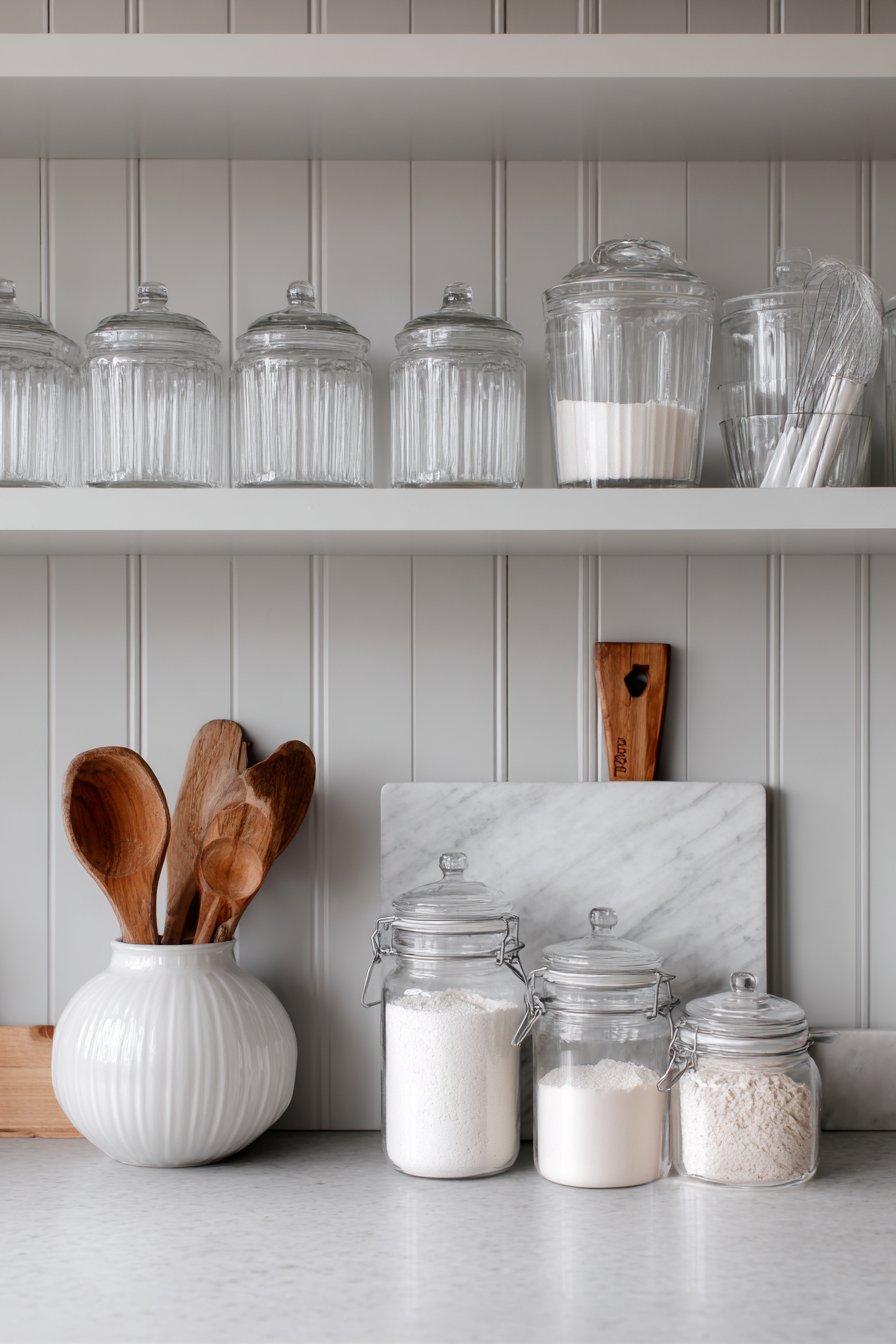
Measuring cups hanging from hooks beneath the shelf represent thoughtful micro-organization within the larger baking zone concept. These essential tools remain immediately accessible yet stored in a manner that doesn’t consume valuable shelf space. The marble pastry board resting against the backsplash serves dual purposes—it’s stored visibly so you remember to use it, and its cool surface provides ideal properties for working with pastry dough. The light grey walls and white shelving create a clean, flour-friendly environment where baking powder dust and flour spots are easily spotted and cleaned. This specialized approach to kitchen organization proves that creating dedicated zones for specific culinary activities enhances both efficiency and enjoyment.
Key Design Tips:
- Locate baking zones near countertop workspace suitable for dough rolling and mixing
- Store all baking ingredients together—flour, sugar, baking powder, vanilla, etc.
- Include storage for baking tools like whisks, spatulas, and pastry brushes
- Use airtight containers to protect ingredients from humidity and pests
- Display favorite mixing bowls and baking dishes if space allows
- Consider a small countertop mixer if baking frequency justifies the space
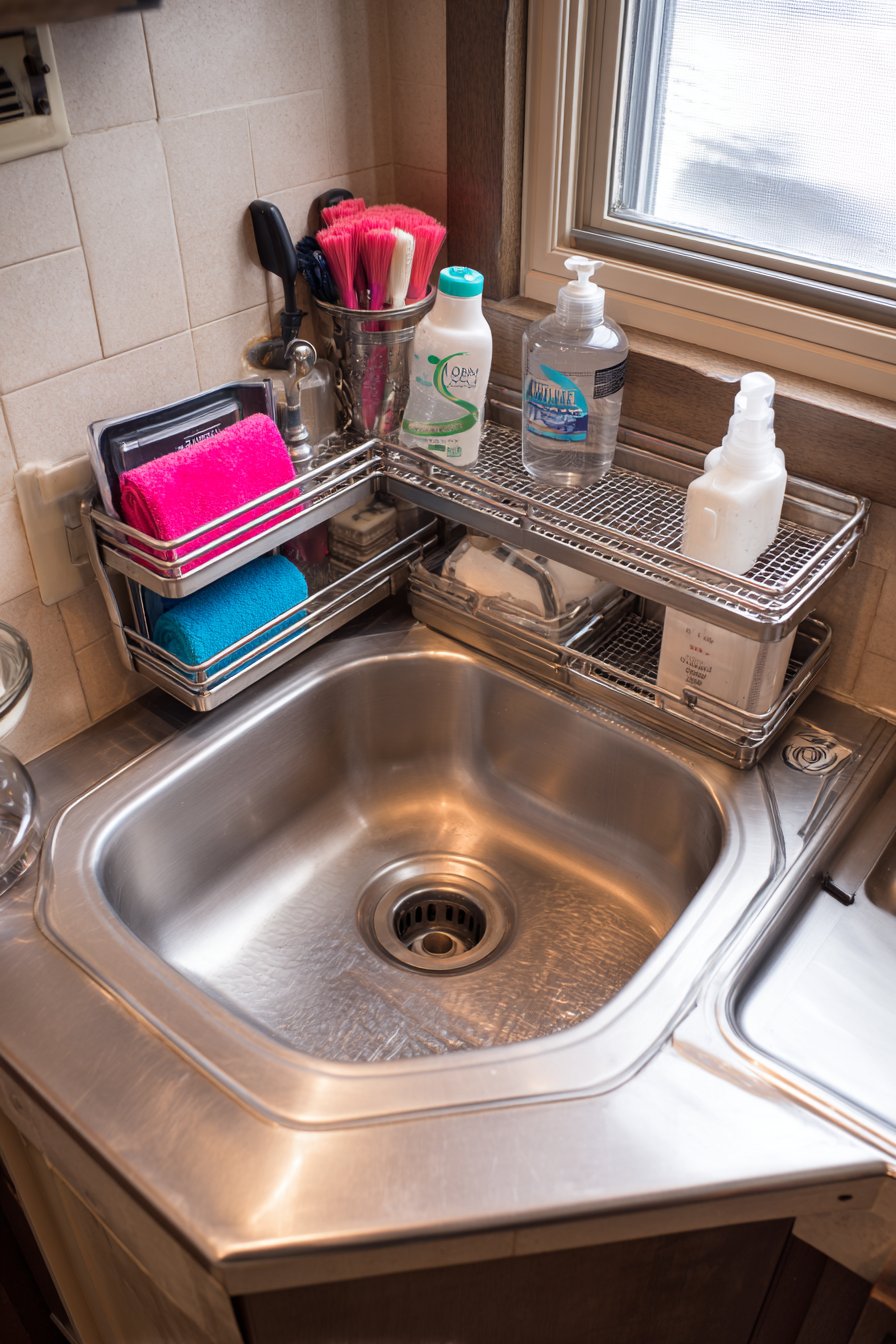
21. Sink Area Organization Solutions
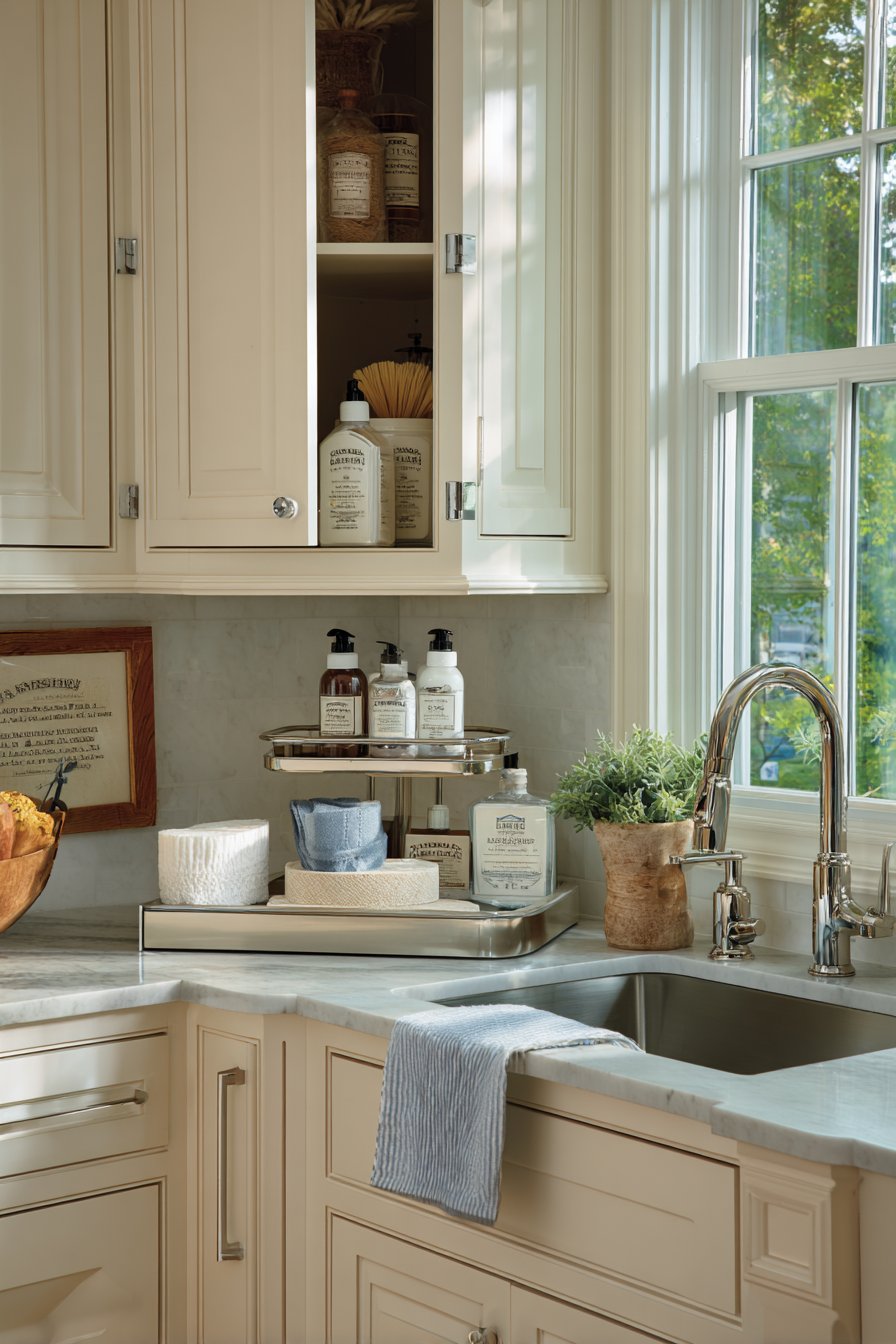
A well-organized sink area with a caddy holding dish soap, scrub brushes, and sponges, combined with a pull-out drying rack for dish towels mounted inside the cabinet door, maximizes efficiency in the kitchen’s cleaning zone. A slim tray beside the sink corrals hand soap and lotion, keeping these necessities accessible yet organized. Stainless steel sink with brushed nickel fixtures provides a clean, functional workspace that coordinates with organizational accessories. Detail-focused interior photography with natural window light highlights the thoughtful organization of daily-use items.
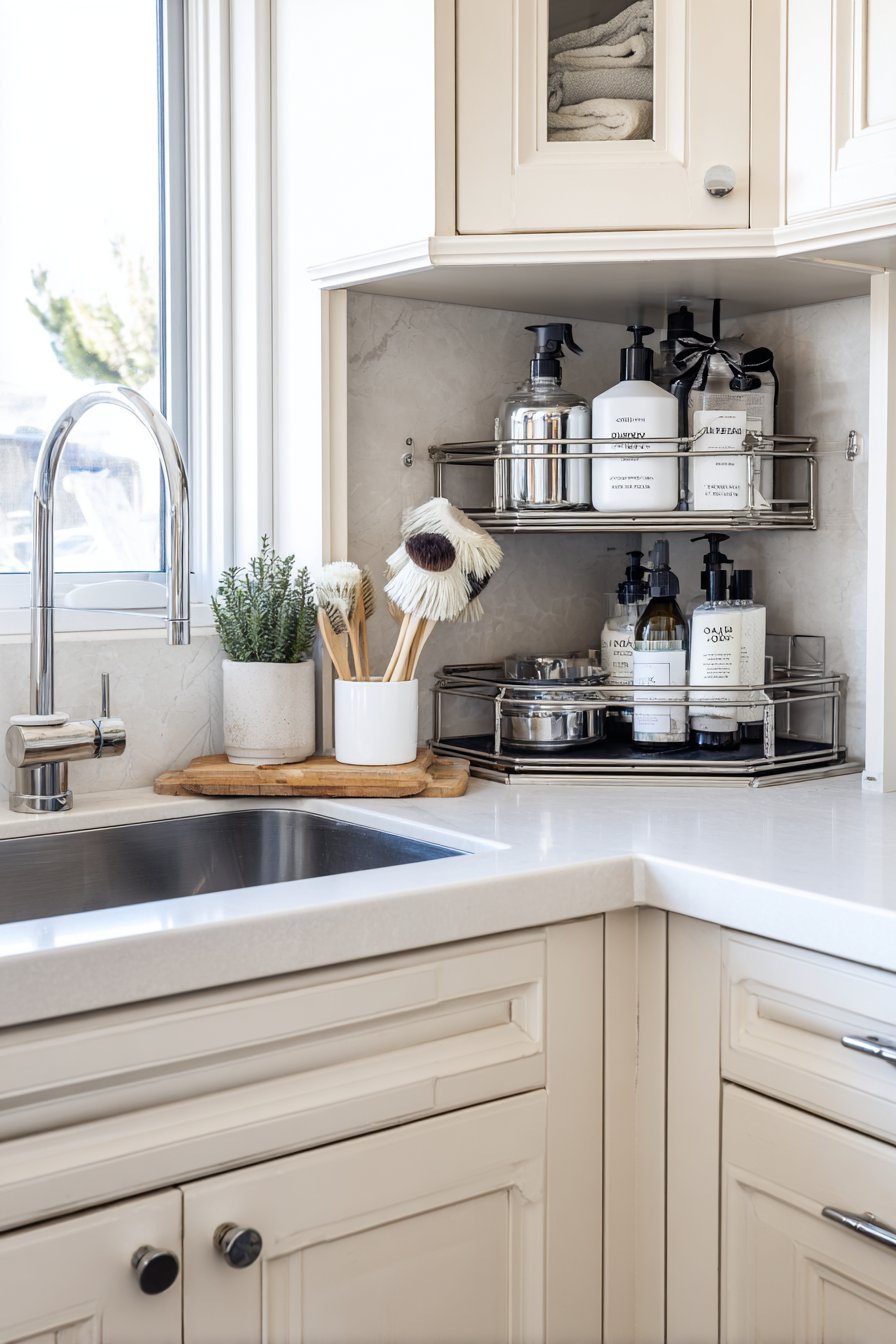
The sink area endures constant use and easily becomes cluttered with cleaning supplies, dish soaps, and wet sponges. Proper organization in this high-traffic zone prevents unsightly clutter while ensuring cleaning supplies remain accessible. A caddy containing dish soap, scrub brushes, and sponges corrals these necessities in one movable container that can be easily lifted for sink cleaning underneath. The pull-out drying rack for dish towels represents ingenious use of typically wasted cabinet interior door space, allowing damp towels to air-dry properly rather than mildewing in piles on the counter.
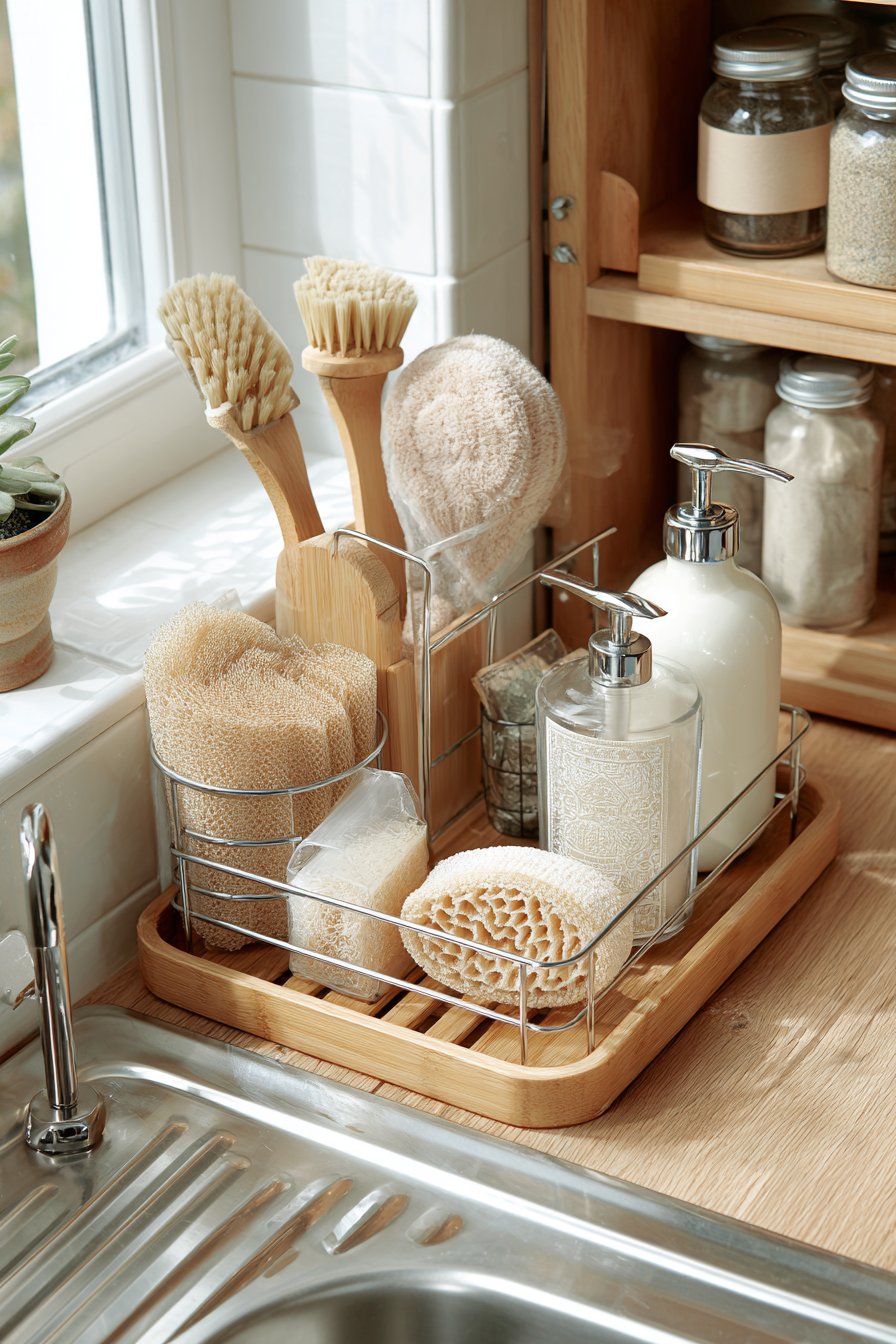
The slim tray beside the sink for hand soap and lotion demonstrates attention to the small details that collectively create a well-organized kitchen. These daily-use items need to be accessible but can create visual clutter when placed randomly around the sink area. A designated tray contains them attractively while protecting the countertop from soap drips and lotion residue. Stainless steel and brushed nickel finishes coordinate with organizational accessories while providing durable, easy-to-clean surfaces appropriate for the wet environment. Detail-focused photography captures these thoughtful organizational touches that make daily kitchen tasks more pleasant and efficient.
Key Design Tips:
- Use sink caddies with drainage holes to prevent water accumulation and mold
- Install pull-out towel bars or hooks inside cabinet doors for damp towel drying
- Keep only daily-use cleaning supplies at the sink; store backup supplies elsewhere
- Choose coordinating containers and trays that complement your kitchen finishes
- Position hand soap and lotion on a small tray to contain drips
- Clean sink area organizational accessories weekly to prevent soap scum buildup
22. Silverware Drawer with Velvet Lining
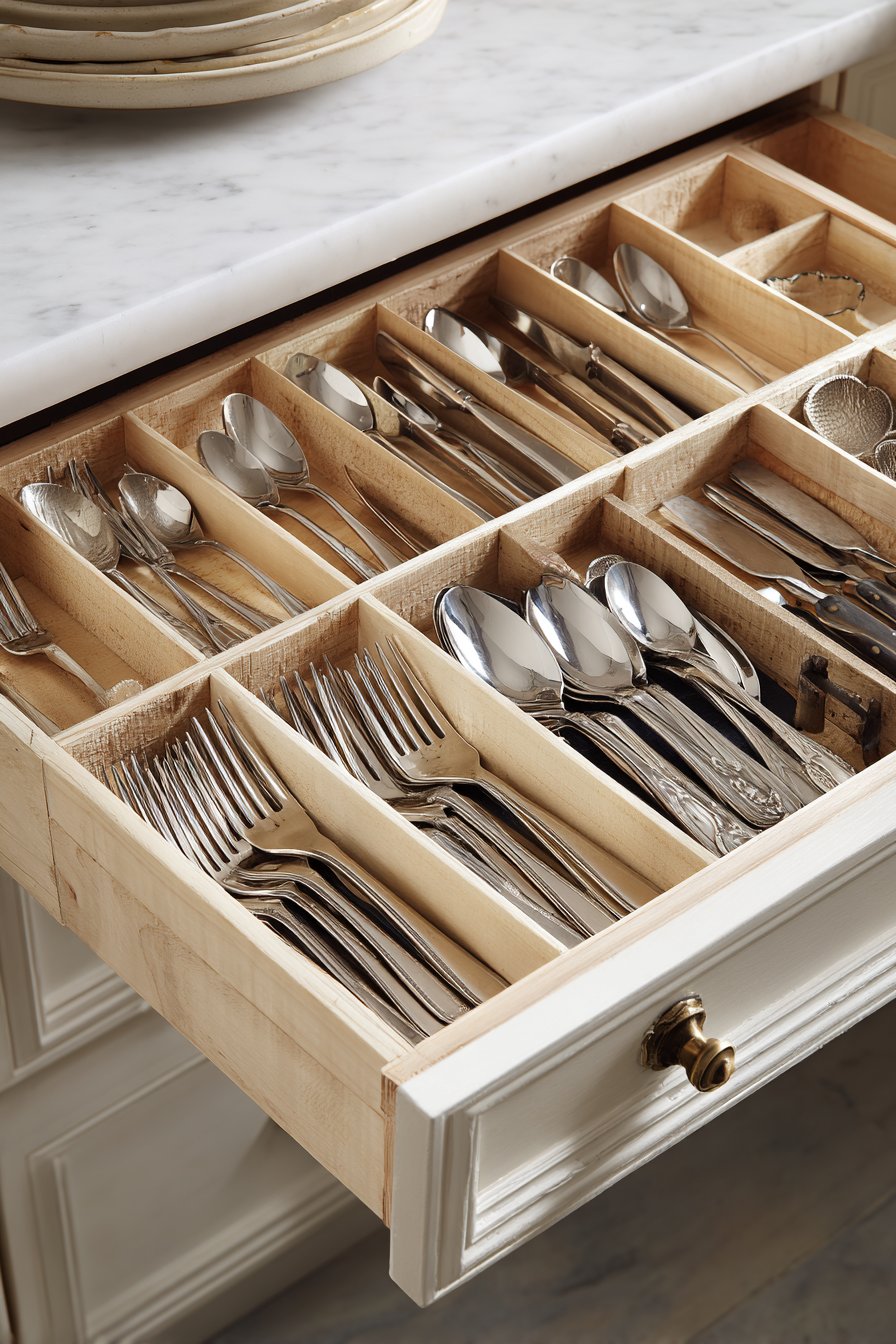
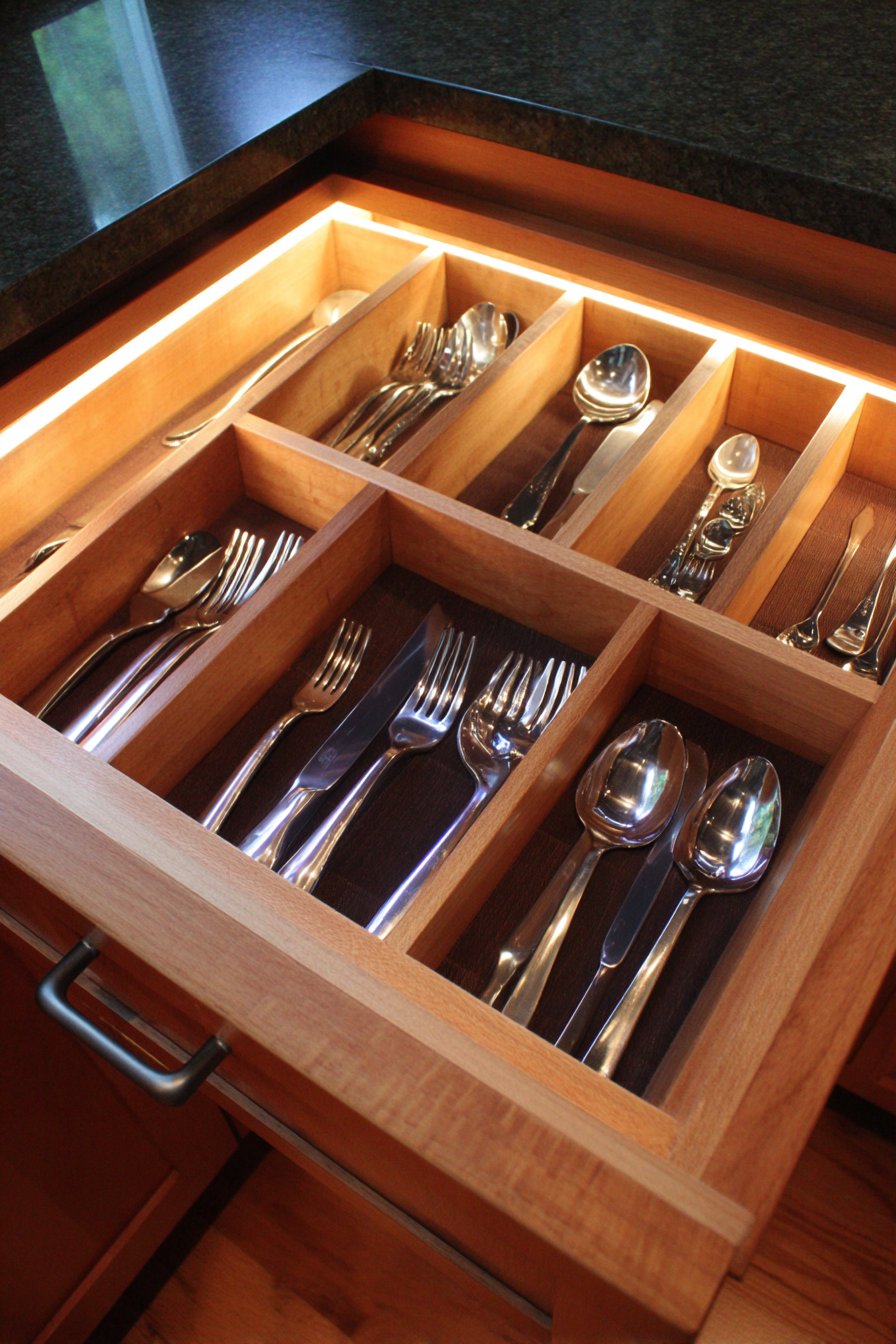
A custom drawer insert for silverware and serving utensils with velvet-lined compartments preventing tarnish and scratching represents organization that protects valuable items. The organizer features separate sections for dinner forks, salad forks, spoons, knives, and serving pieces arranged logically for intuitive access. Natural wood construction with dovetail joints shows quality craftsmanship that elevates functional storage into furniture-quality detailing. Overhead interior photography with soft diffused lighting captures the elegant organization system with attention to material quality and functional design.
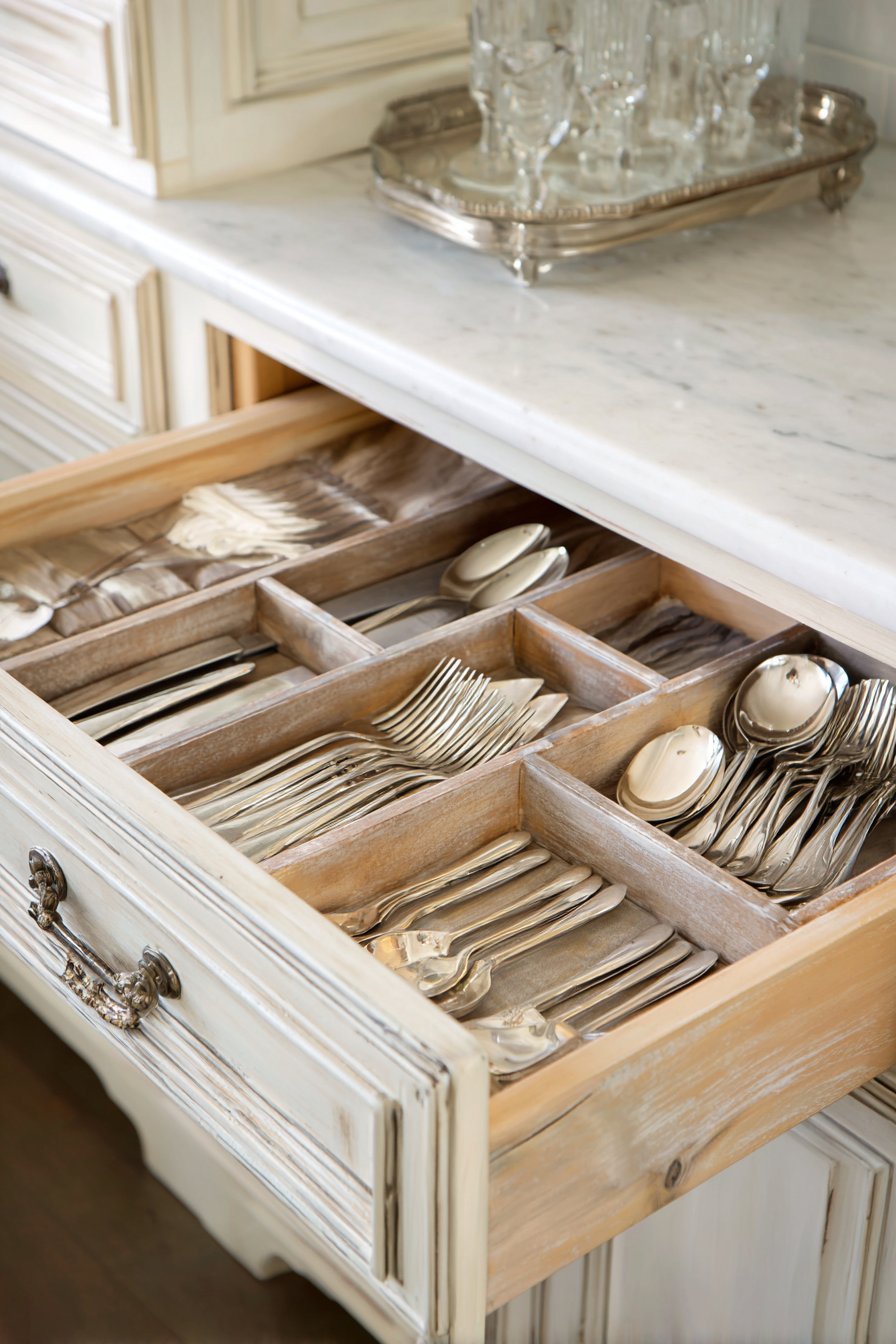
Silverware organization deserves special consideration because these items represent both functional necessity and often financial investment. Velvet-lined compartments serve practical purposes beyond luxury aesthetics—the soft fabric prevents scratching of silver plate and stainless steel while inhibiting tarnish formation on sterling silver through reduced air exposure. The separate sections for different utensil types create logical organization that makes table setting efficient and ensures that serving pieces don’t become buried beneath everyday flatware. This level of organizational sophistication demonstrates respect for both the utilitarian and precious nature of silverware collections.
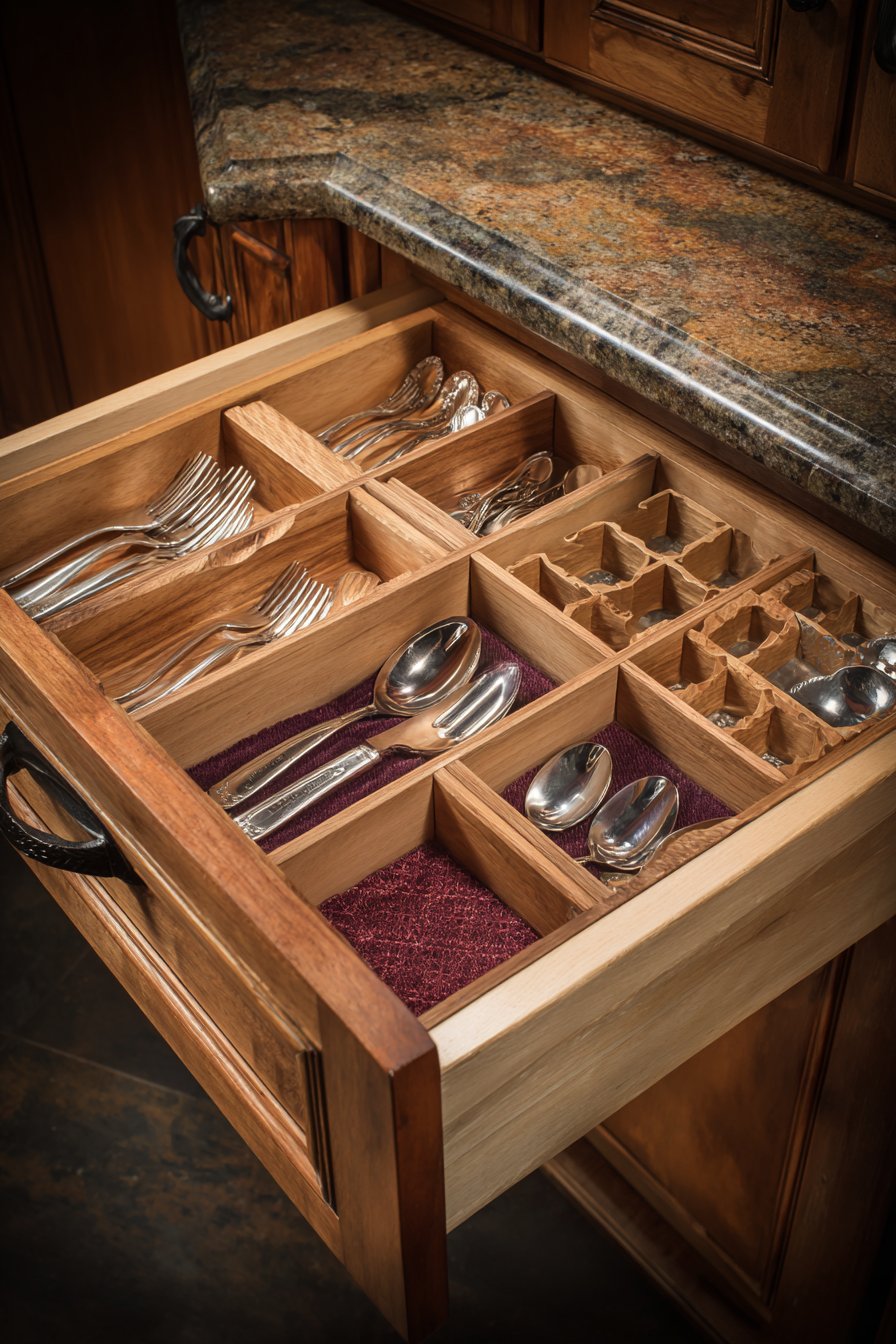
Natural wood construction with dovetail joints elevates drawer inserts from disposable organizers to permanent furniture components worthy of fine cabinetry. Dovetail joints represent traditional woodworking excellence, creating connections that grow stronger under use rather than loosening over time. This quality construction ensures the organizer will last as long as the kitchen itself, protecting silverware for decades. Overhead photography with soft diffused lighting emphasizes both the elegant organization and the quality materials, capturing shadows and highlights that reveal the velvet texture and wood grain. This organizational approach proves that functional storage can embody the same design excellence as visible furniture pieces.
Key Design Tips:
- Measure drawer dimensions precisely before ordering or building custom inserts
- Choose velvet or felt lining to protect silver and stainless finishes
- Arrange utensils with most frequently used items in the most accessible positions
- Include dedicated sections for serving pieces to prevent damage from daily flatware
- Consider expandable inserts if your silverware collection may grow
- Hand-polish silverware before placing in velvet-lined storage to prevent residue transfer
23. Vertical Lid Organization System
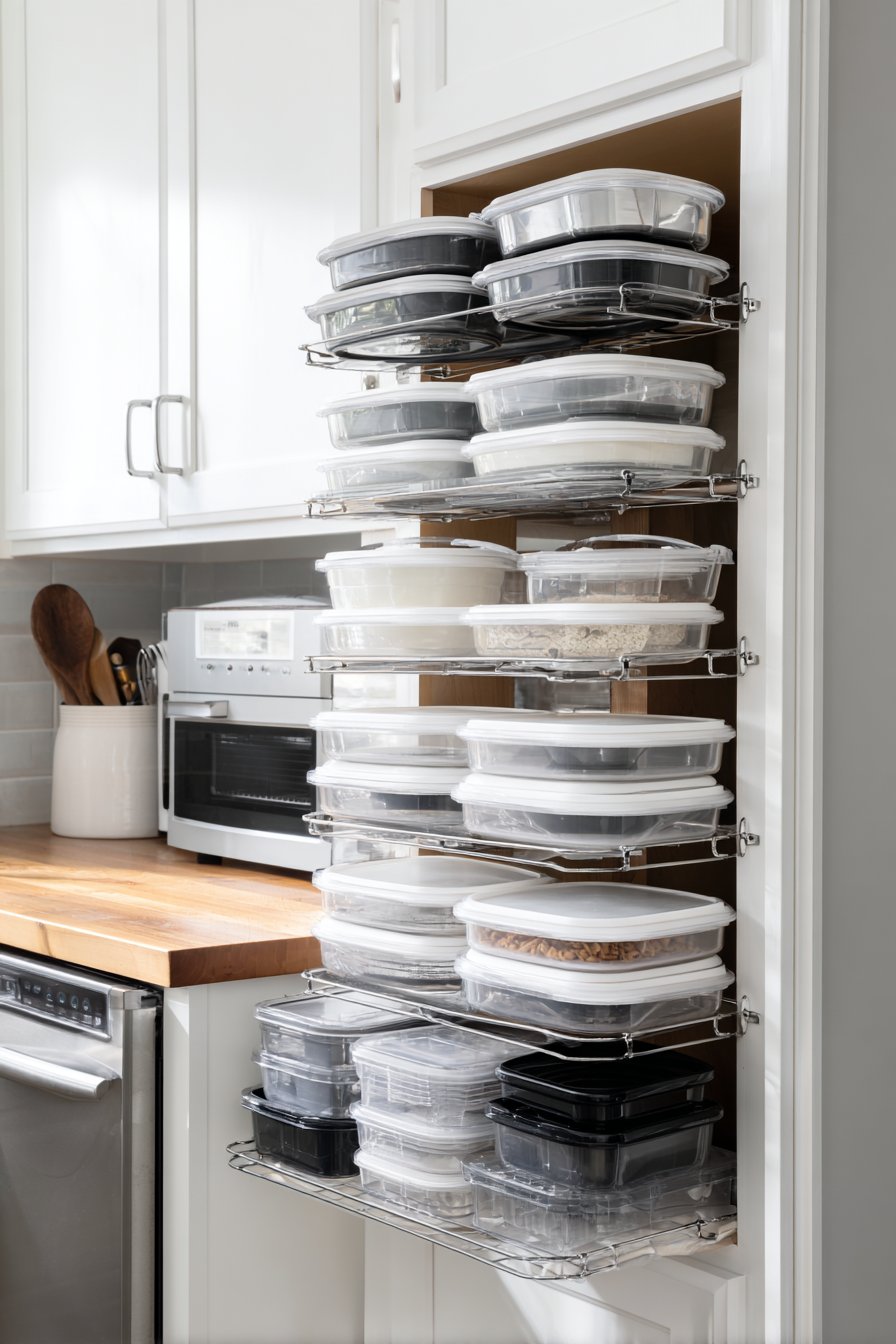
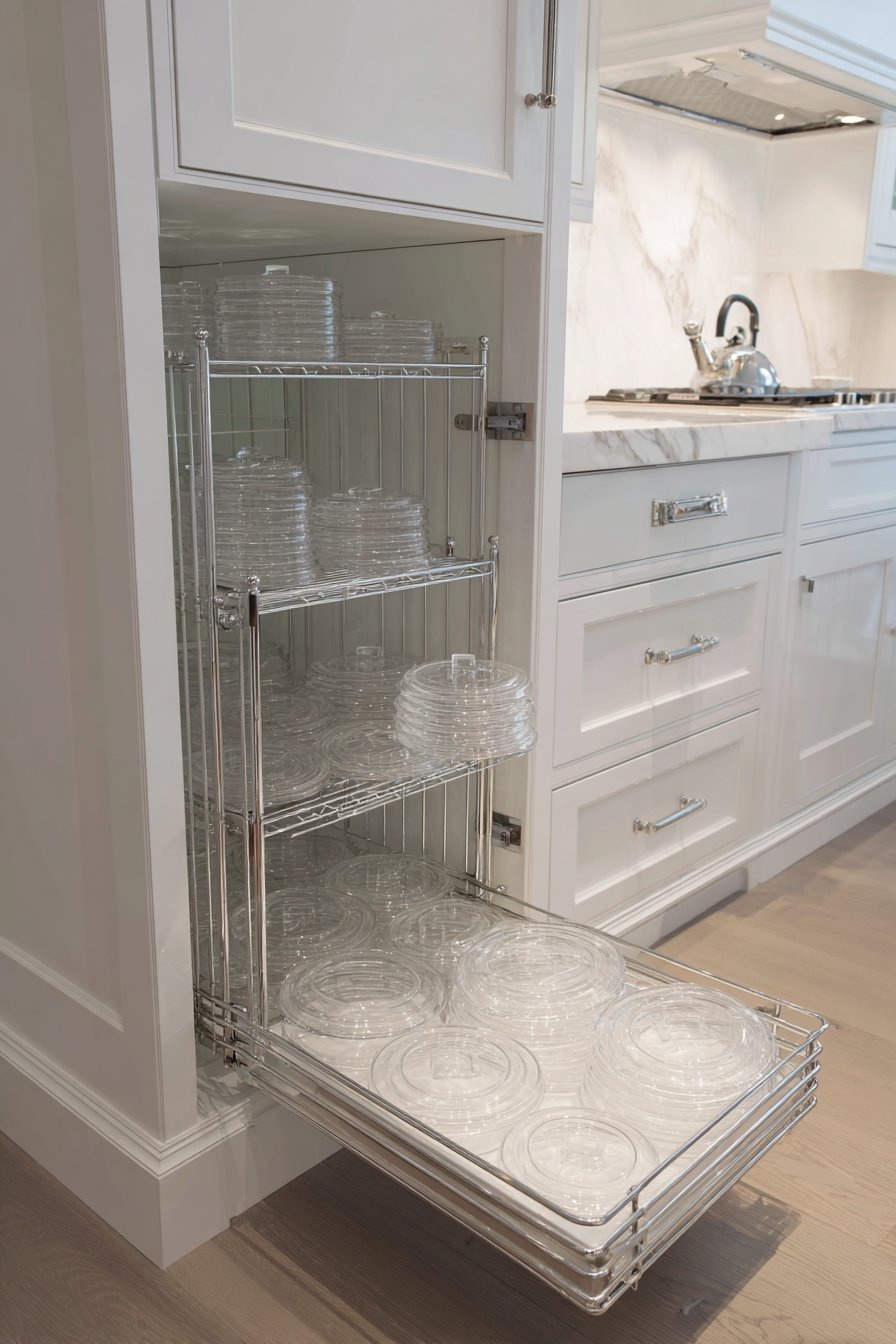
Plastic food storage lids organized vertically in a narrow pull-out cabinet using tension rods or commercial lid organizers create instant visual identification and easy access to matching lids. The system allows quick matching of lids to containers without excavating through chaotic piles. White cabinet interior keeps the space bright while chrome hardware complements modern kitchen aesthetics. Interior design photography with balanced exposure demonstrates the innovative solution for the typically frustrating lid storage problem that plagues many kitchens.
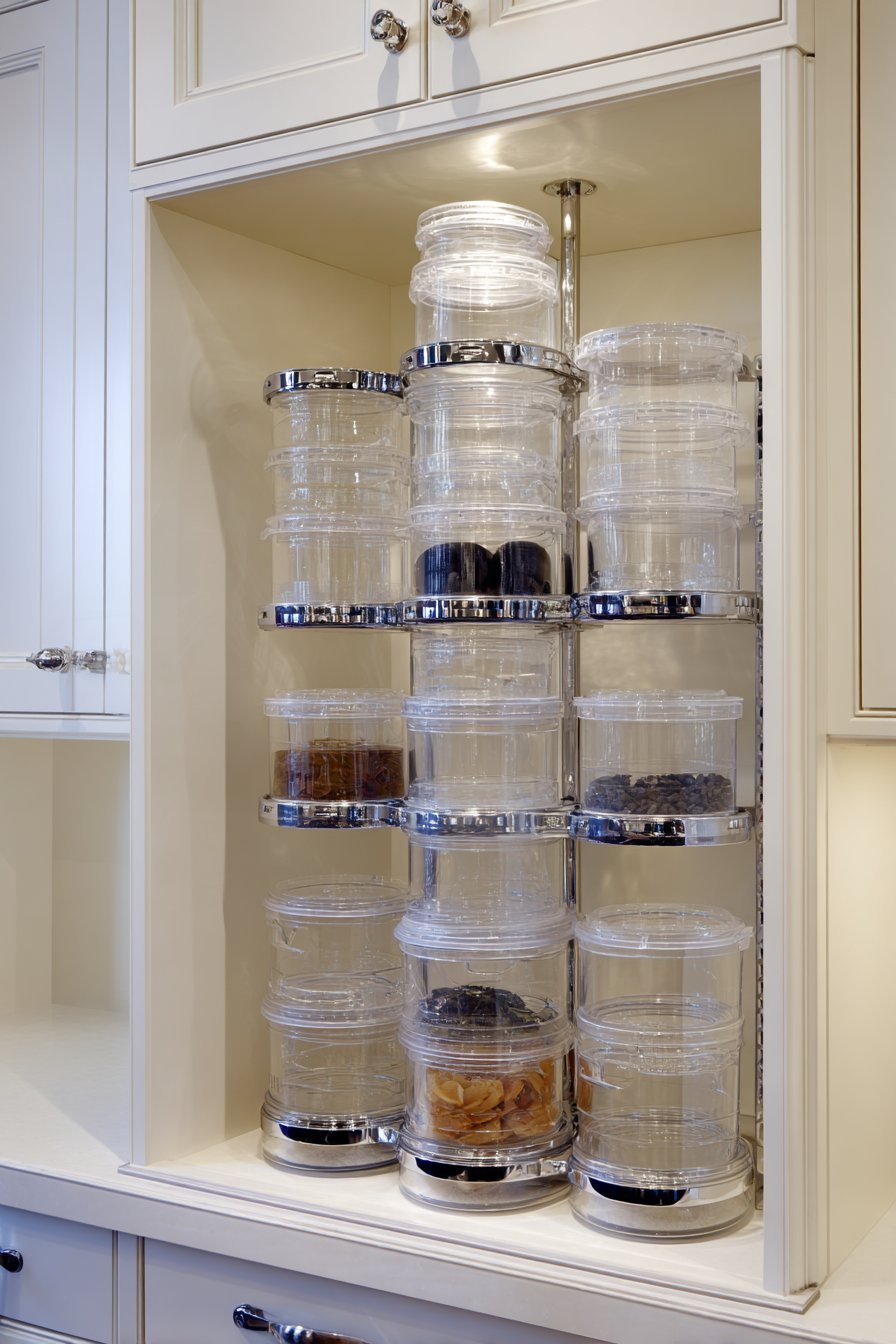
The maddening search for matching lids represents a near-universal kitchen frustration that vertical organization elegantly solves. Traditional lid storage—stacked horizontally in drawers or cabinets—requires removing multiple lids to access those underneath, inevitably creating chaos. Vertical storage, conversely, allows each lid to be visible and individually accessible, dramatically reducing the time spent matching lids to containers. Tension rods represent a low-cost, highly adaptable solution that can be customized to any cabinet width, while commercial lid organizers offer more structured storage for those willing to invest in specialized organizational products.
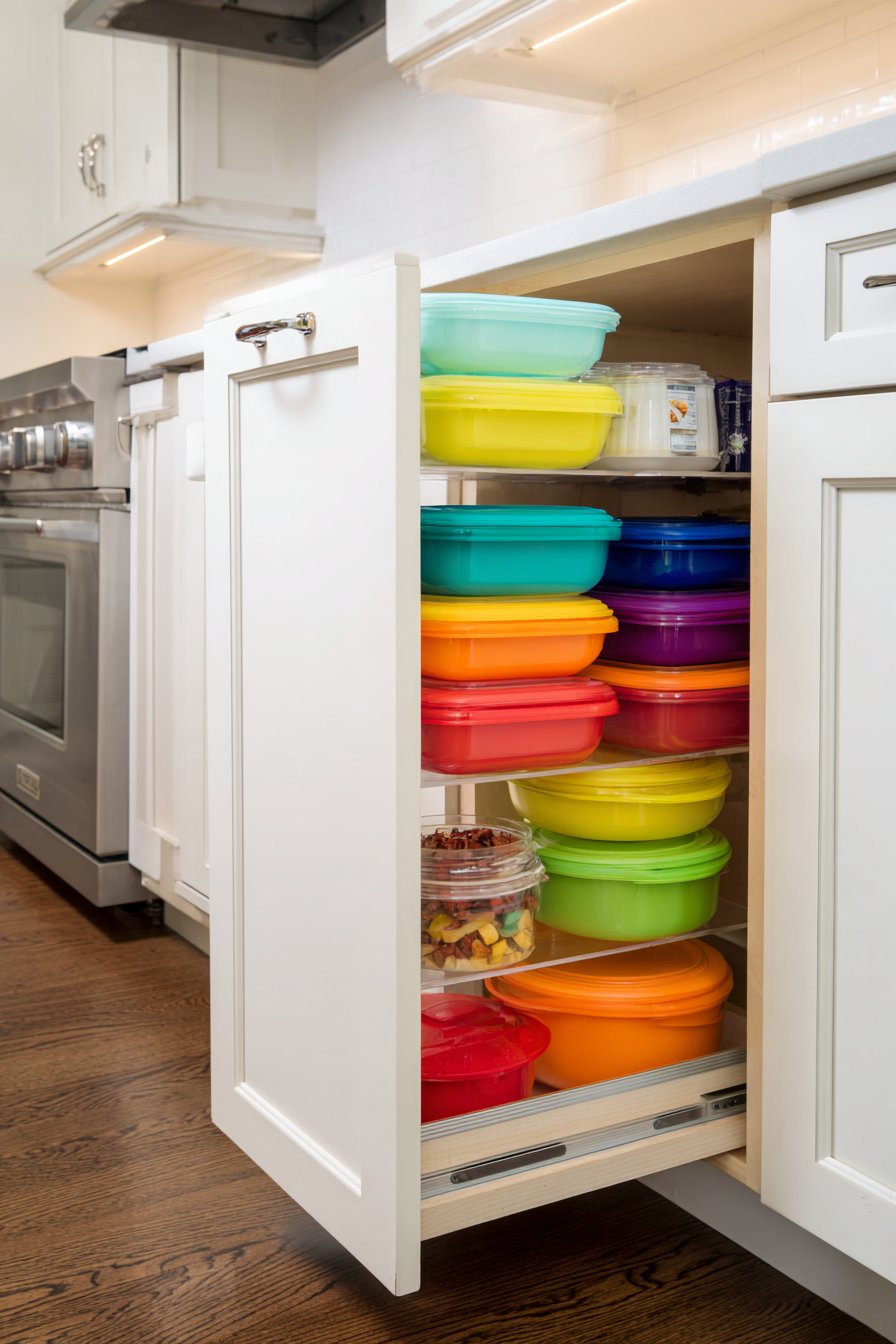
The narrow pull-out cabinet provides ideal housing for vertical lid storage, transforming typically underutilized space into a highly functional organizational zone. The pulling action brings lids forward for easy viewing and selection, while the narrow width prevents lids from falling over as might occur in deeper cabinets. White cabinet interiors maximize visibility, ensuring that even clear lids remain distinguishable against the bright background. Chrome hardware coordinates with modern kitchen finishes while providing smooth pulling action that withstands frequent daily use. This organizational solution demonstrates that even the most frustrating storage challenges can be solved with creative thinking and appropriate tools.
Key Design Tips:
- Install tension rods or commercial organizers in cabinets near food storage containers
- Organize lids by size for quick matching with containers
- Use cabinet doors for lid storage if wall cabinet space is limited
- Ensure lid organizers accommodate your largest lids without forcing them to bend
- Purge mismatched lids regularly to maintain system efficiency
- Consider storing lids with their matching containers if drawer space allows
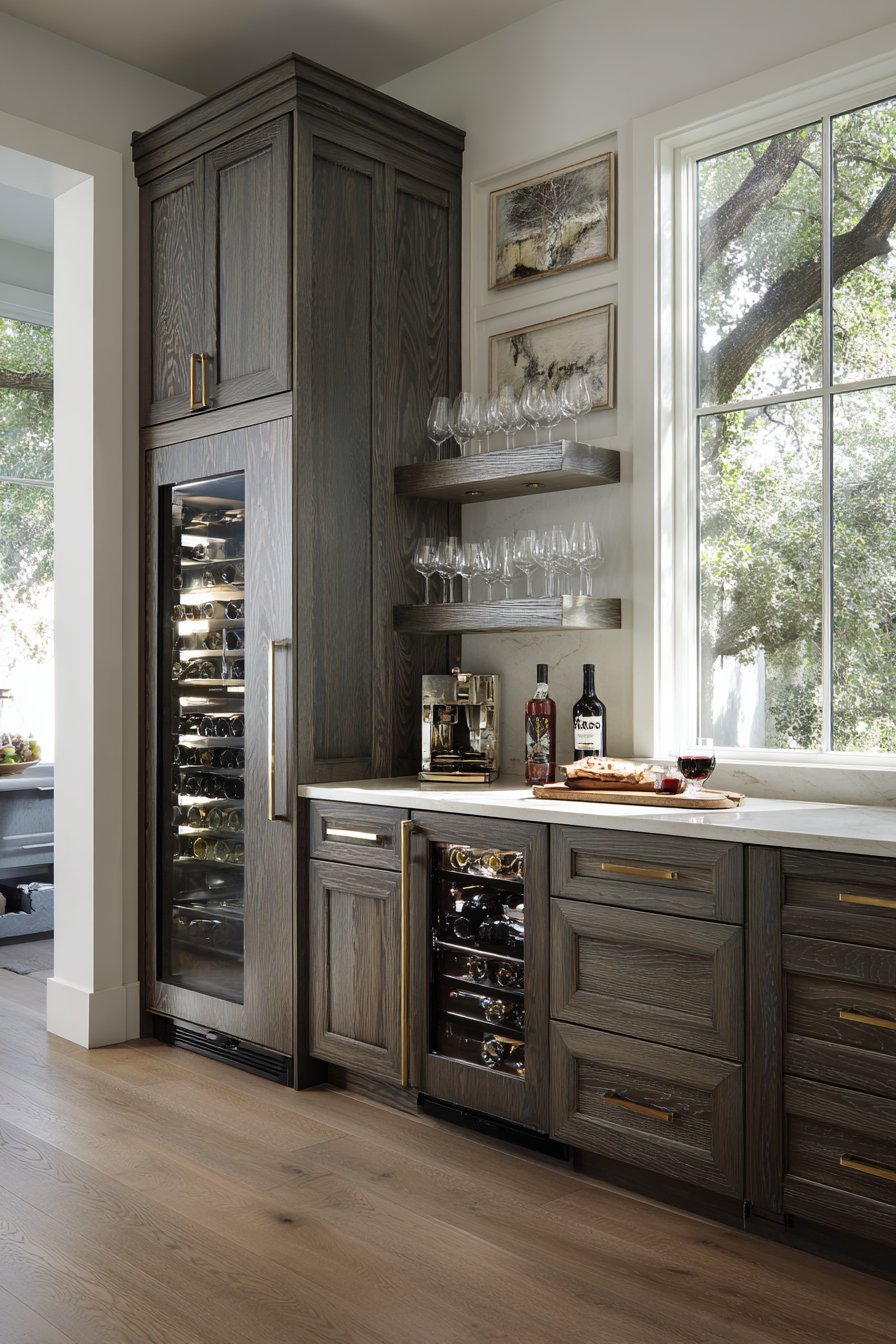
24. Wine and Beverage Station Organization
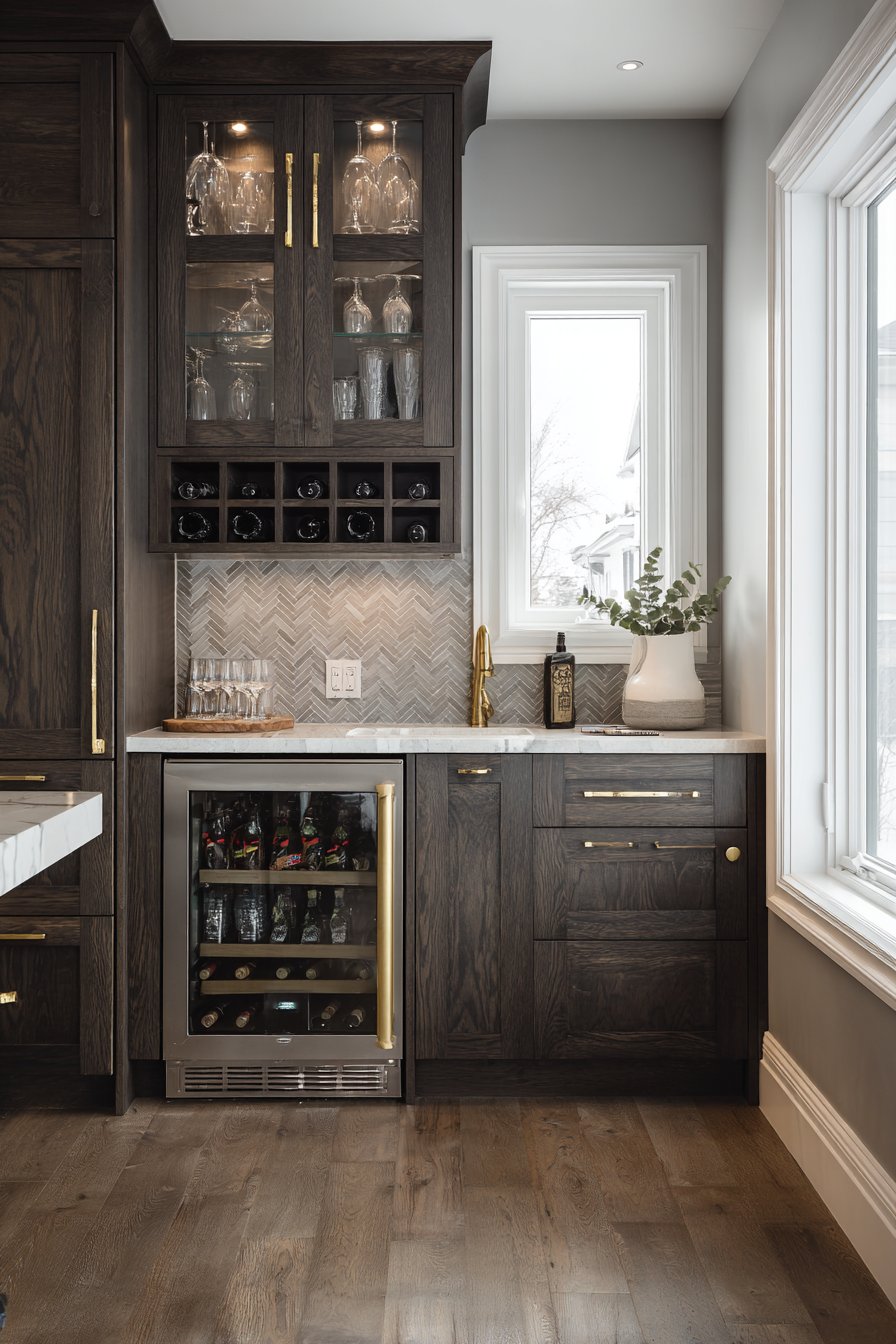
A wine and beverage station with a built-in wine rack holding bottles horizontally, glass storage hanging upside down from mounted racks, and a small wine fridge integrated into lower cabinetry creates a sophisticated entertaining zone. Dark wood tones contrast with light grey walls while brass accents add warmth and elegance. Natural light from an adjacent window creates gentle highlights on bottles and glassware. Wide-angle interior photography captures the sophisticated organization dedicated to beverage storage and serving, demonstrating zone-based organization for entertaining.
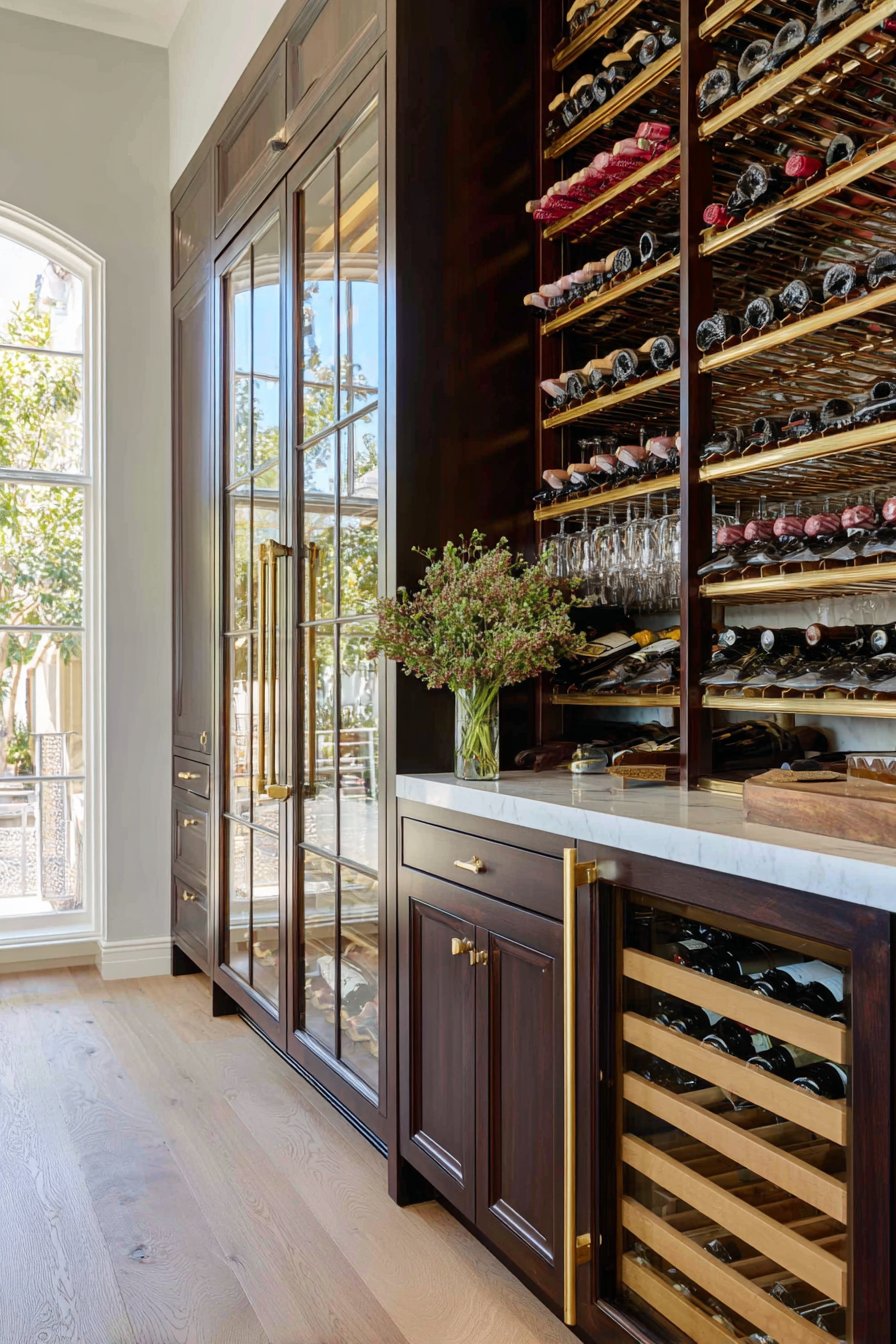
The beverage station concept creates a specialized zone dedicated to drink storage and service, elevating everyday wine storage into an entertaining-ready display. Horizontal wine racks position bottles properly for cork moisture maintenance while displaying labels for easy selection. Glass storage hanging upside down from mounted racks serves multiple practical purposes—glasses remain dust-free between uses, stemware stays organized without consuming shelf space, and the suspended glasses create visual interest as they catch and refract light. The small wine fridge integrated into lower cabinetry ensures properly chilled wines without sacrificing kitchen refrigerator space for bottles.
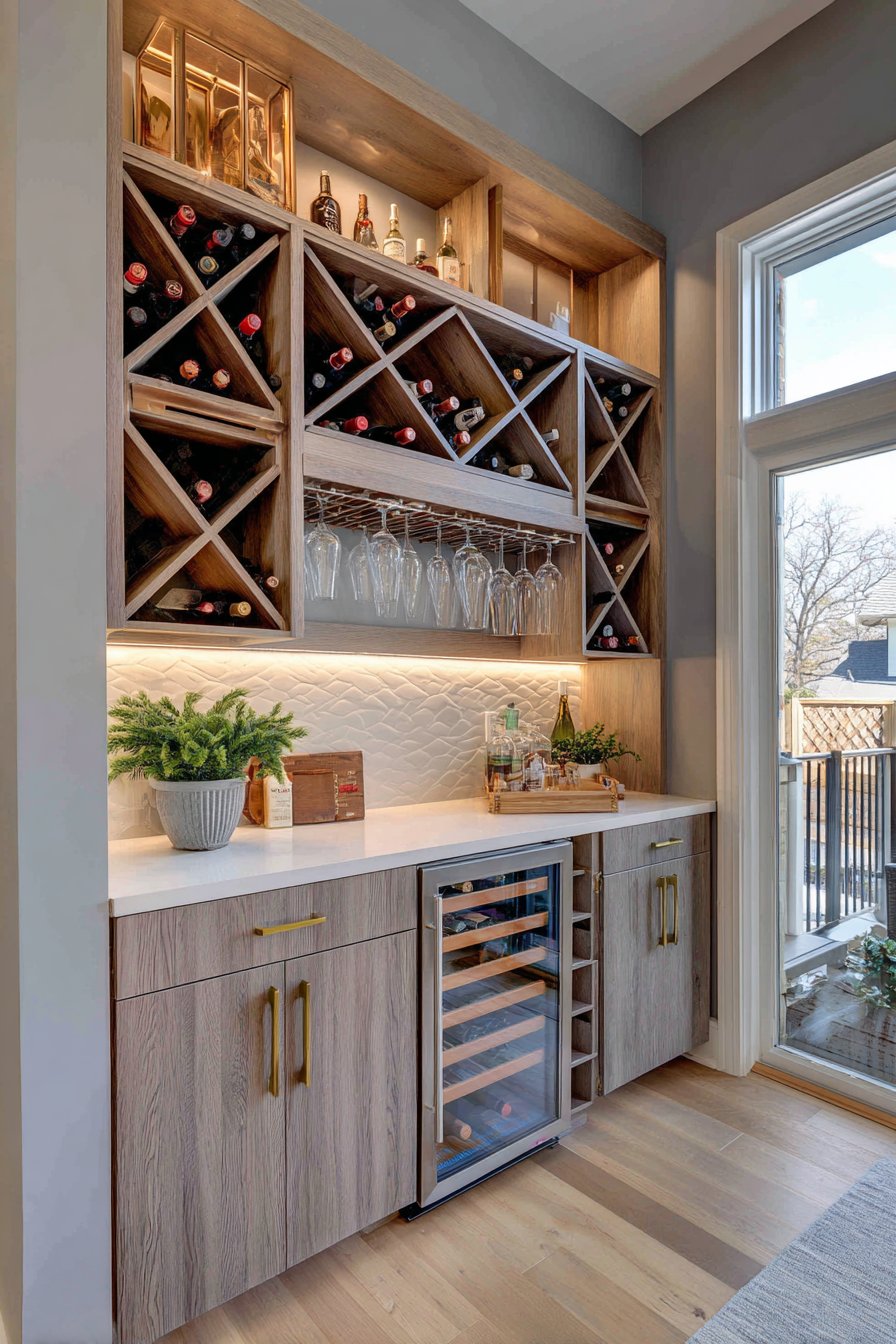
Dark wood tones throughout the beverage station create intimate sophistication appropriate for wine display, while contrast with light grey walls prevents the space from feeling heavy. Brass accents on wine rack mounting, glass holder brackets, and wine fridge handle add warm metallic notes that complement the richness of properly aged wood. Natural light from an adjacent window creates dynamic highlights that change throughout the day, highlighting bottle labels and creating sparkle on glass stems. This comprehensive approach to beverage organization demonstrates that specialized zones for entertaining enhance both daily function and special occasion hosting.
Key Design Tips:
- Install wine racks away from heat sources like ovens to protect wine quality
- Store wine bottles horizontally to keep corks moist and prevent oxidation
- Hang glassware close to the beverage station for convenient service
- Include a small wine fridge if entertaining frequently with properly chilled wines
- Use brass or copper accents to add warmth to wine storage displays
- Position beverage stations near serving areas or dining spaces
25. Corner Cabinet Lazy Susan System
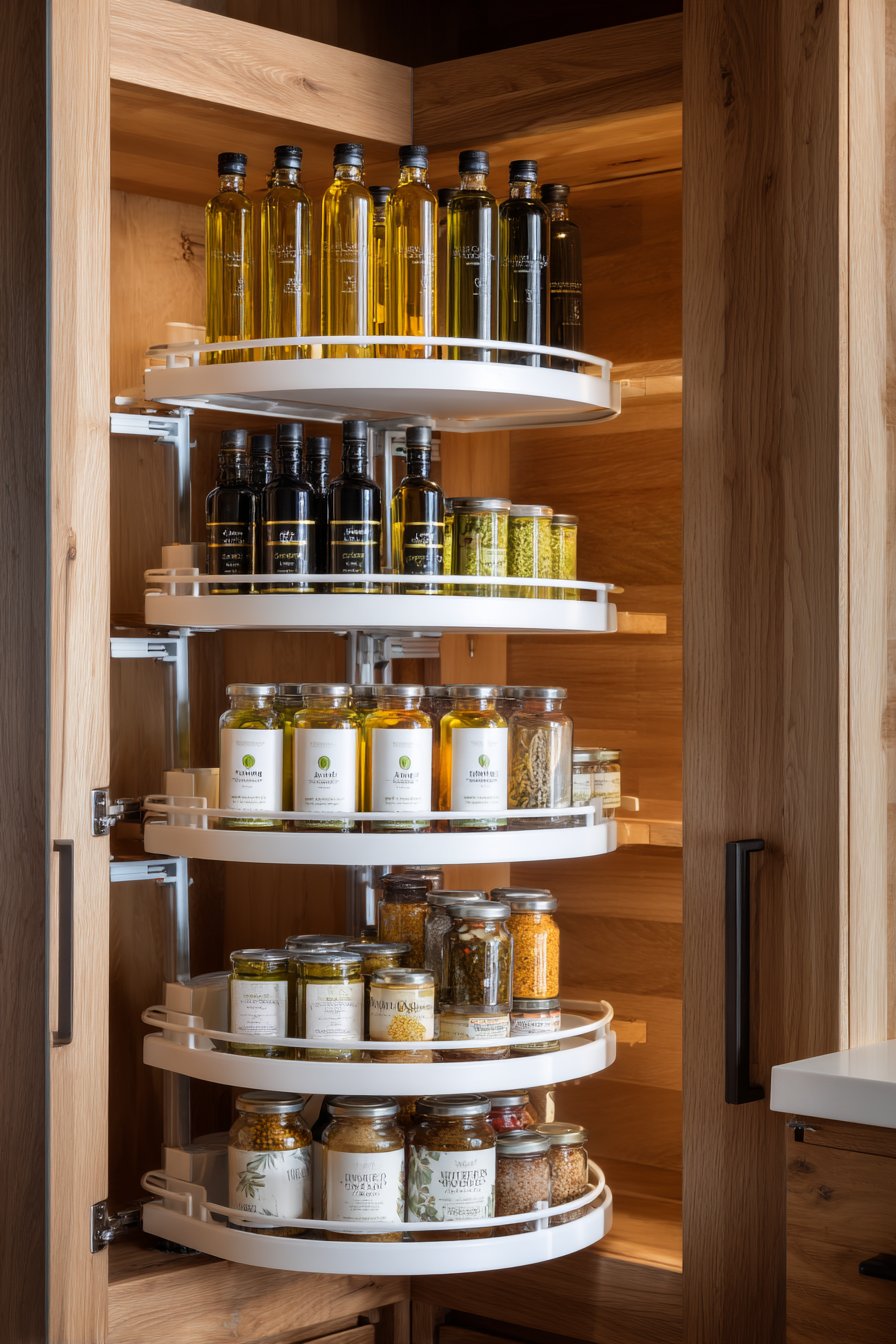
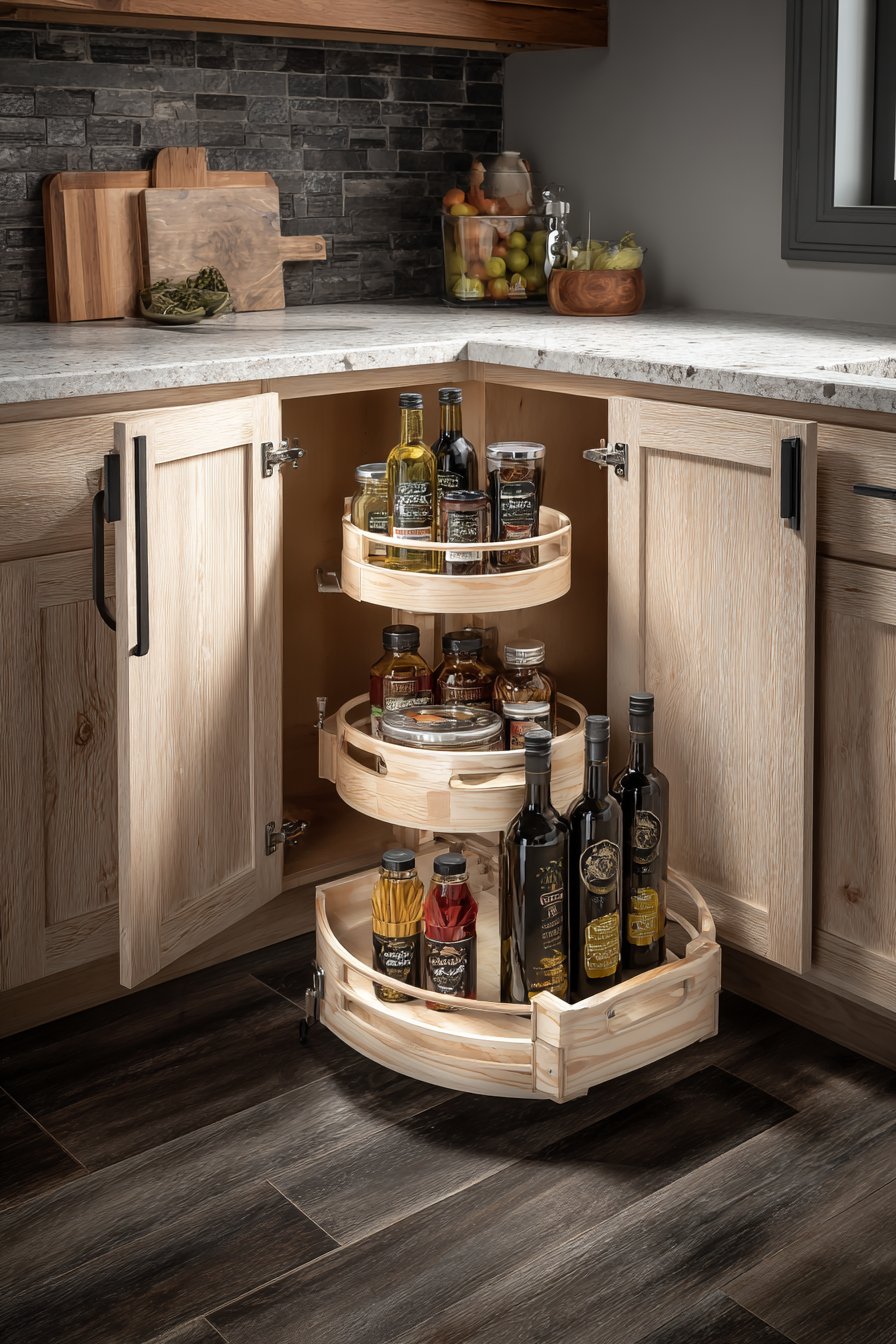
A lazy Susan organizer in a corner cabinet maximizes typically difficult-to-reach space with rotating tiers storing oils, vinegars, sauces, and canned goods. White plastic tiers contrast with natural wood cabinet interiors while providing smooth rotation that brings all items within easy reach. The full rotation is captured in interior photography showing how the mechanism provides complete accessibility to all stored items. Balanced lighting emphasizes the practical corner cabinet solution that transforms wasted space into functional storage.
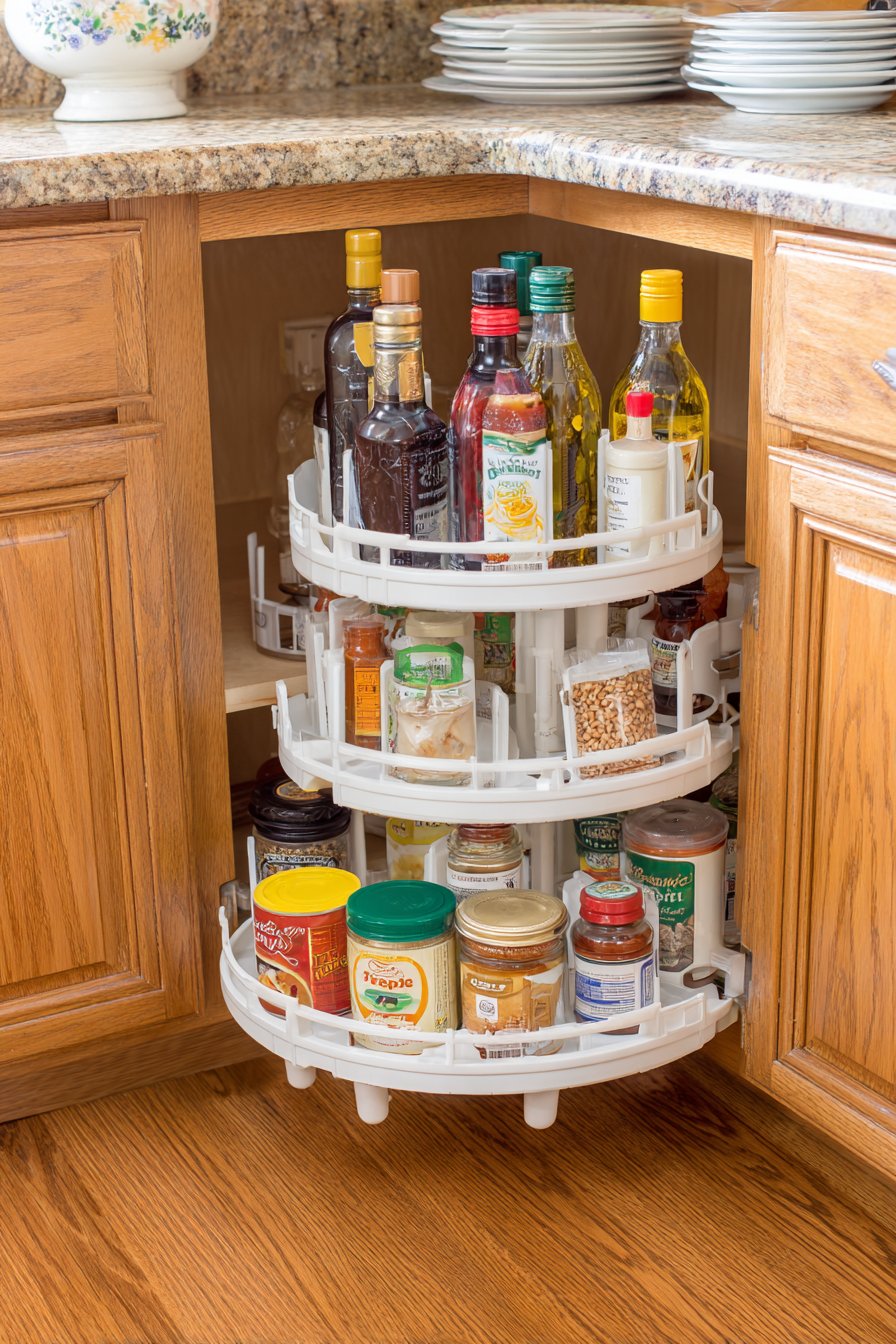
Corner cabinets present unique organizational challenges—the deep, angular space often becomes a black hole where items disappear and become inaccessible. Lazy Susan organizers solve this problem through circular platforms that rotate, bringing every stored item to the cabinet opening with a simple spin. The white plastic tiers provide clean, wipeable surfaces ideal for storing bottles and containers that may drip or leak, while the contrast against natural wood cabinet interiors makes items visually distinct and easy to identify even in deeper cabinet sections.
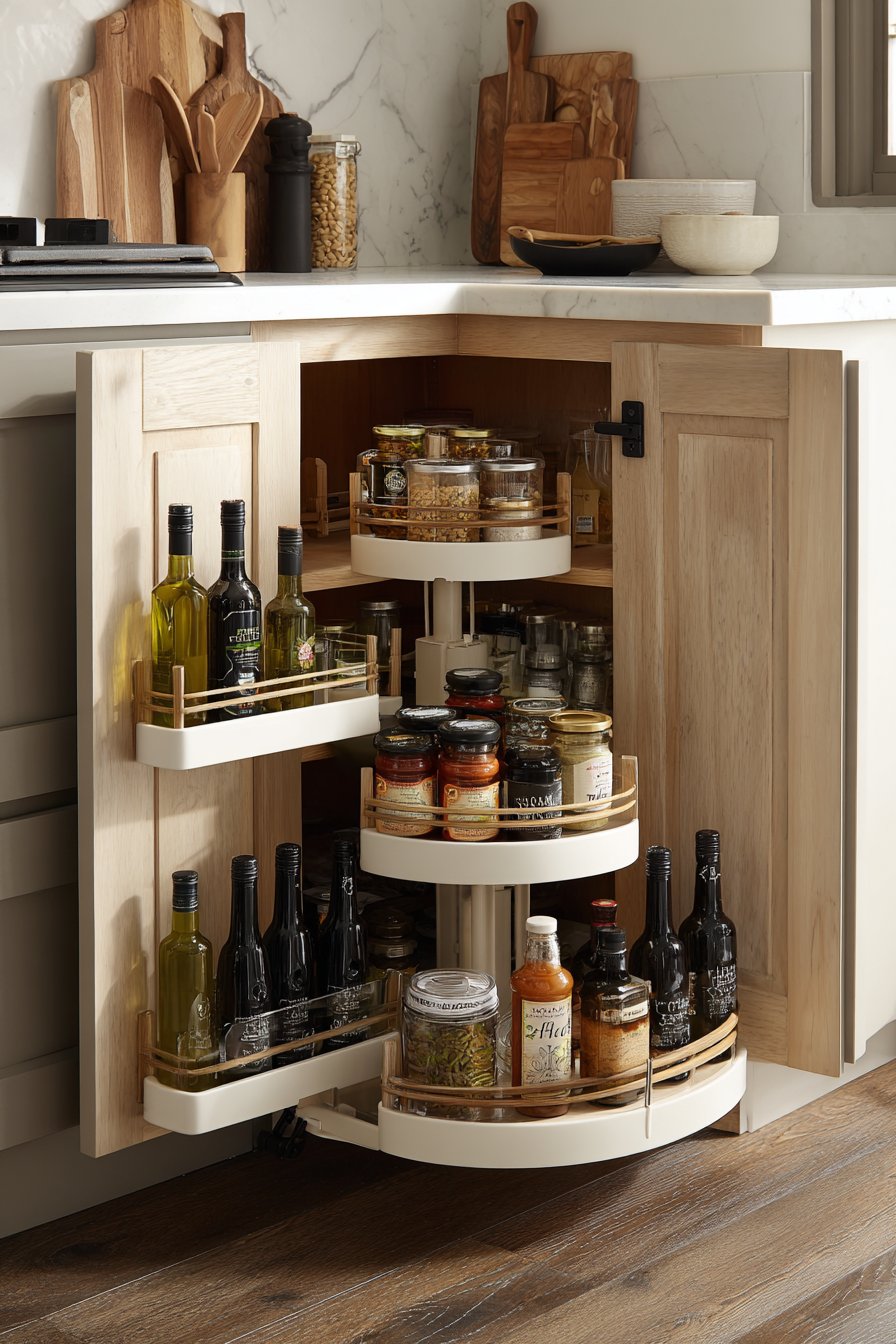
The mechanics of lazy Susan systems represent elegant problem-solving applied to spatial challenges. Rather than fighting the angular geometry of corner cabinets, lazy Susans embrace the circular motion that naturally suits corner spaces. The smooth ball-bearing rotation ensures that even fully loaded platforms spin effortlessly, making the corner cabinet as accessible as any frontal cabinet. Interior photography capturing full rotation demonstrates the completeness of accessibility—no item remains hidden or difficult to reach. This organizational solution proves that with appropriate mechanisms, even the most challenging cabinet configurations become fully functional storage spaces.
Key Design Tips:
- Measure corner cabinet dimensions carefully before purchasing lazy Susan organizers
- Choose two-tier or three-tier systems based on cabinet height
- Store heavier items on lower tiers for stability during rotation
- Avoid overloading lazy Susans, which makes rotation difficult
- Place frequently used items at the front position when the cabinet is closed
- Clean lazy Susan platforms quarterly to prevent sticky buildup that impedes rotation
26. Consolidated Breakfast Station
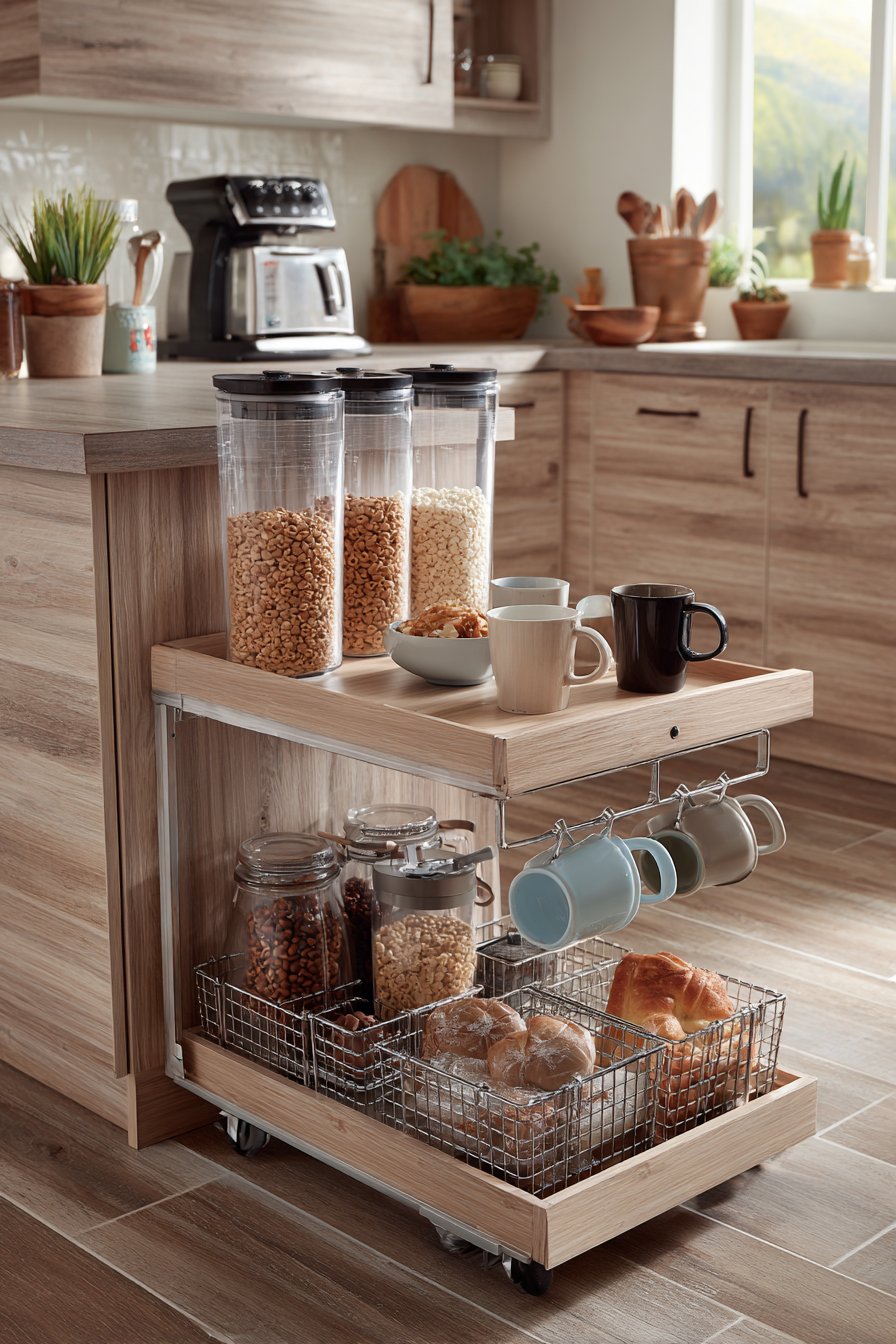
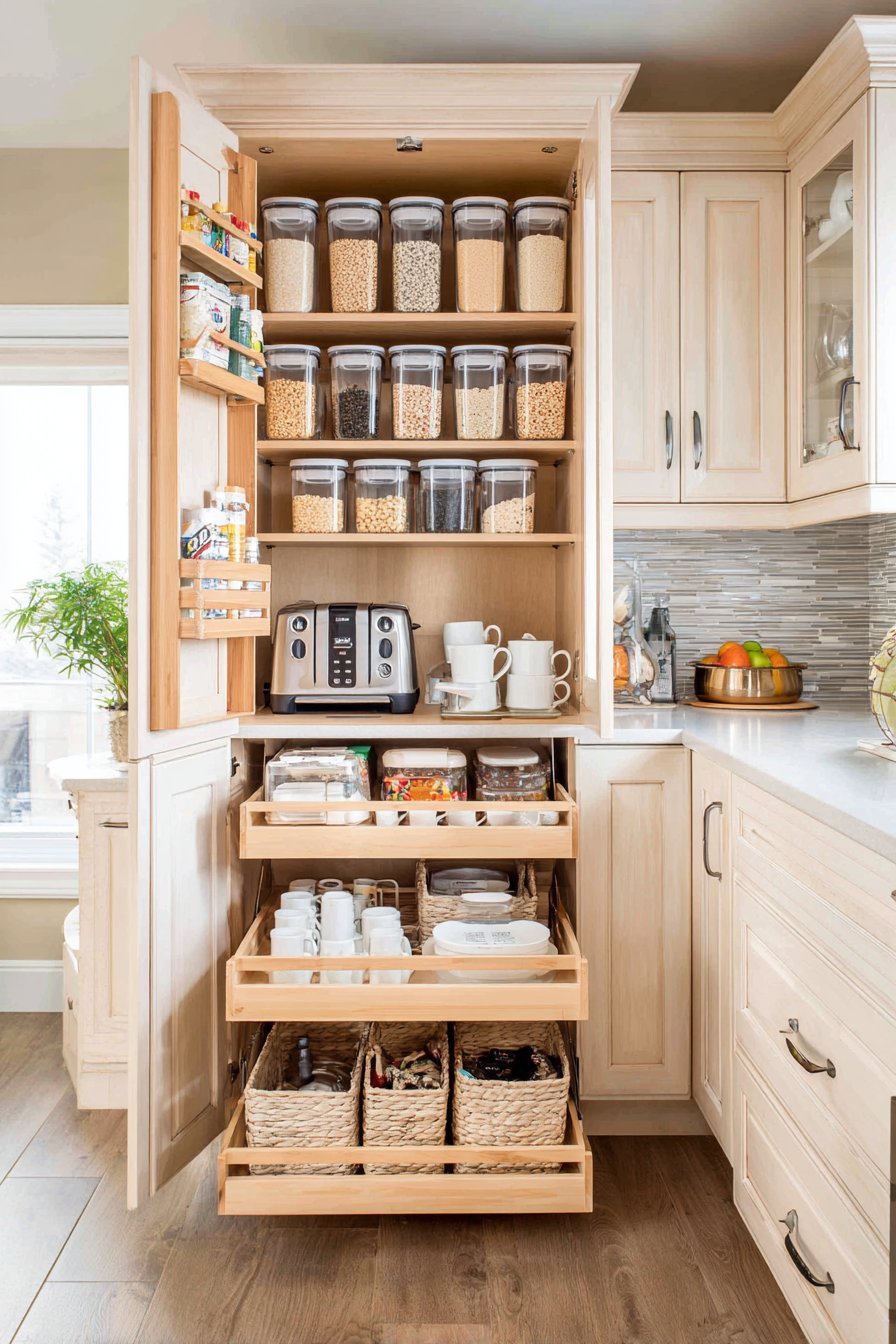
A dedicated breakfast station with a cabinet storing cereals in large clear containers, a toaster, and breakfast essentials organized on pull-out shelves creates morning meal efficiency. Small baskets hold individual serving items like sweeteners and breakfast bars while hooks inside the door hang coffee mugs. Light wood cabinetry with soft-close hinges maintains a cohesive kitchen aesthetic while concealing breakfast chaos. Interior photography with natural morning light highlights the convenience of consolidated breakfast preparation items.
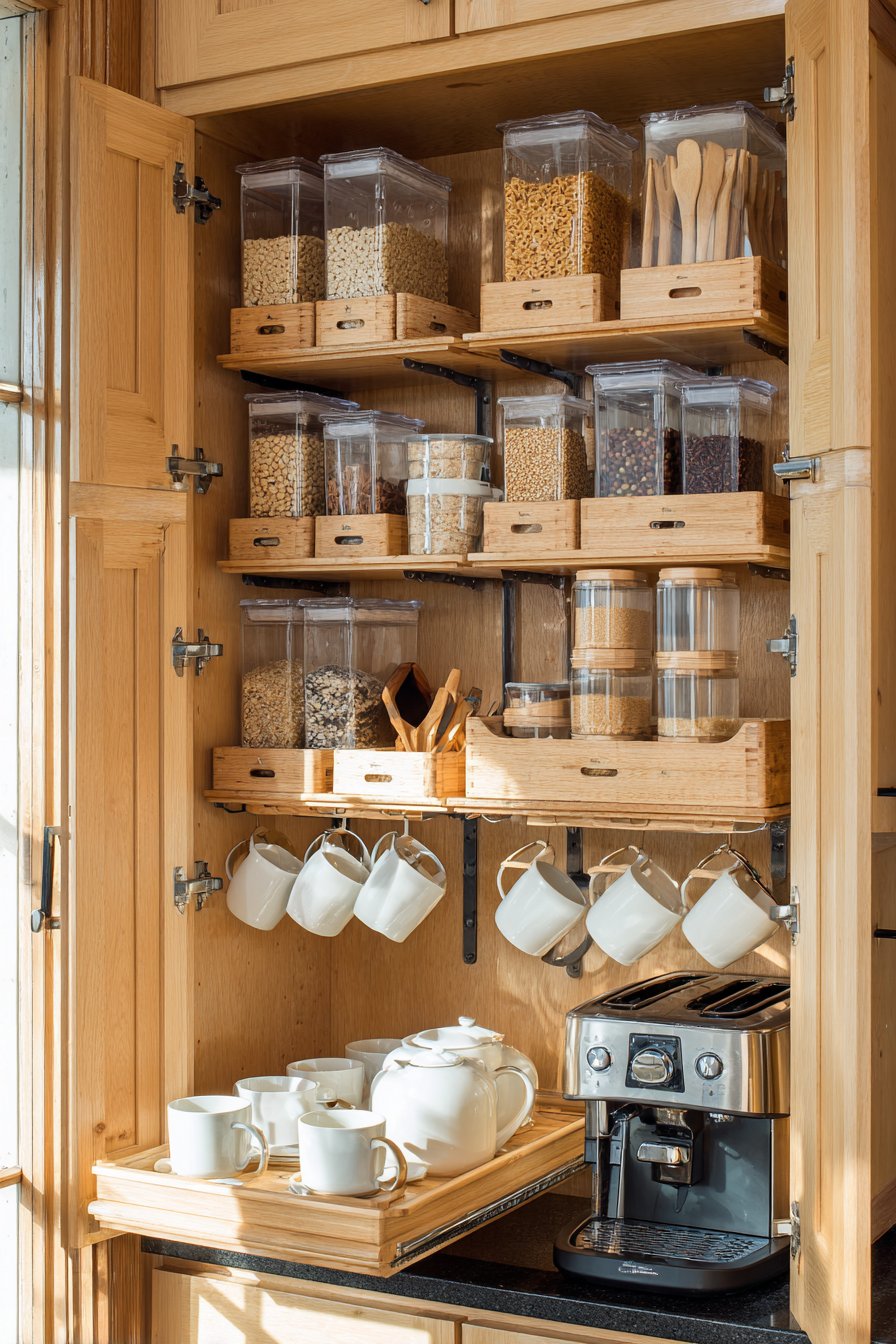
The breakfast station concept recognizes that morning meals often involve rushed preparation and benefit enormously from dedicated, consolidated storage. When everything needed for breakfast—cereals, toaster, mugs, sweeteners—resides in one cabinet, the morning routine becomes streamlined and efficient even when you’re groggy and rushed. Large clear containers storing cereals protect against staleness while allowing instant assessment of supply levels. Pull-out shelves bring items at cabinet depths forward for easy access, eliminating the frustrating reach toward the back of cabinets while holding a coffee mug or managing a restless child.
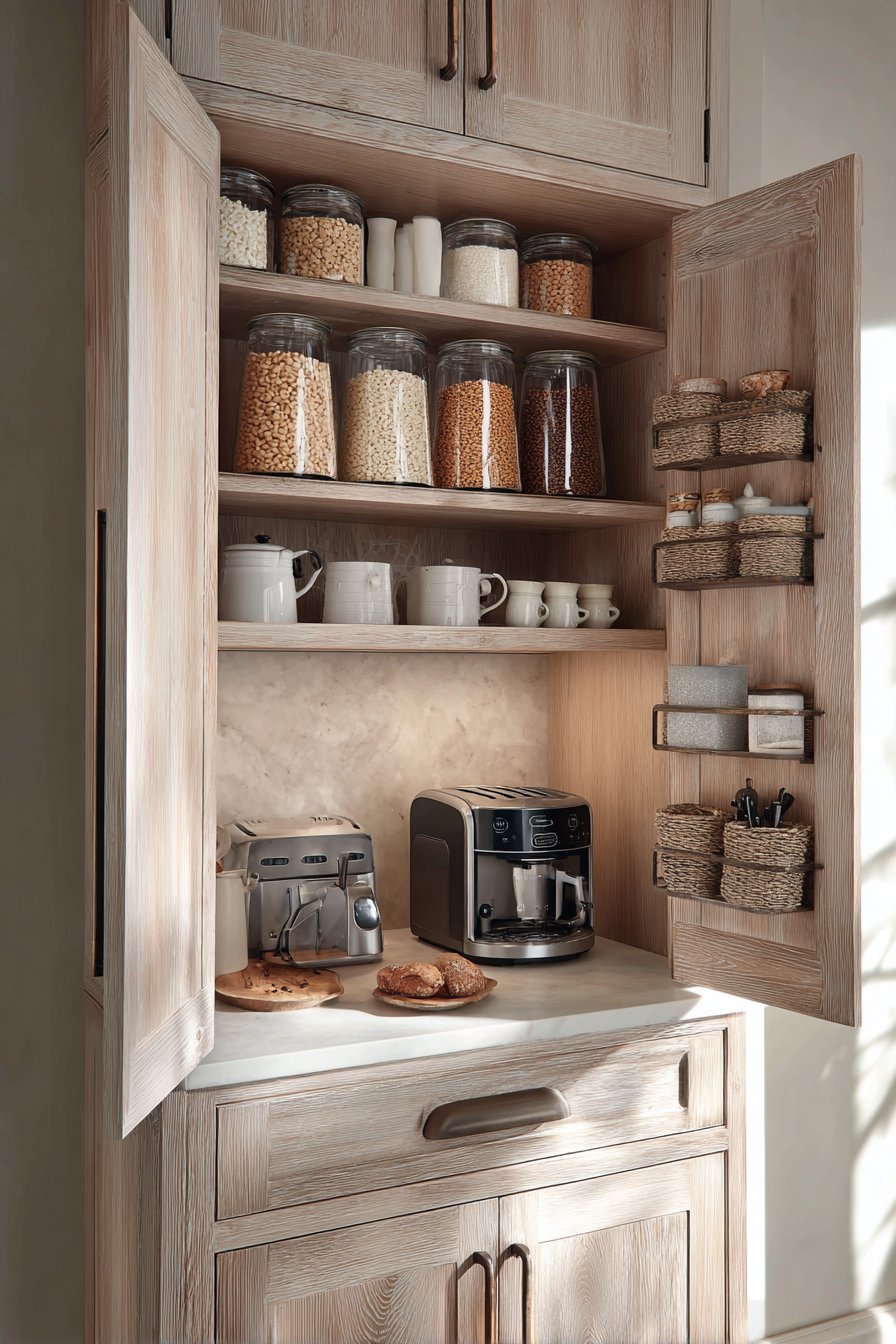
Small baskets holding individual serving items demonstrate micro-organization within the larger breakfast station concept. Rather than loose packets and bars scattered throughout the cabinet, baskets contain categories—one for sweeteners, another for individual oatmeal packets, a third for breakfast bars—creating order that survives daily use by multiple family members. Hooks inside cabinet doors for mugs maximize vertical space while keeping favorite mugs visible and accessible. Light wood cabinetry with soft-close hinges maintains visual consistency with surrounding kitchen cabinets while providing quiet operation appreciated during early morning hours when others may still be sleeping.
Key Design Tips:
- Locate breakfast stations near countertop space suitable for meal preparation
- Store all breakfast items together—cereals, toaster, coffee supplies, mugs
- Use clear containers for cereal storage to monitor freshness and supply
- Include pull-out shelves in cabinets deeper than twelve inches
- Organize within the cabinet using small baskets or bins for individual items
- Position breakfast stations near the dishwasher for easy morning cleanup
27. Fresh Produce Display and Storage
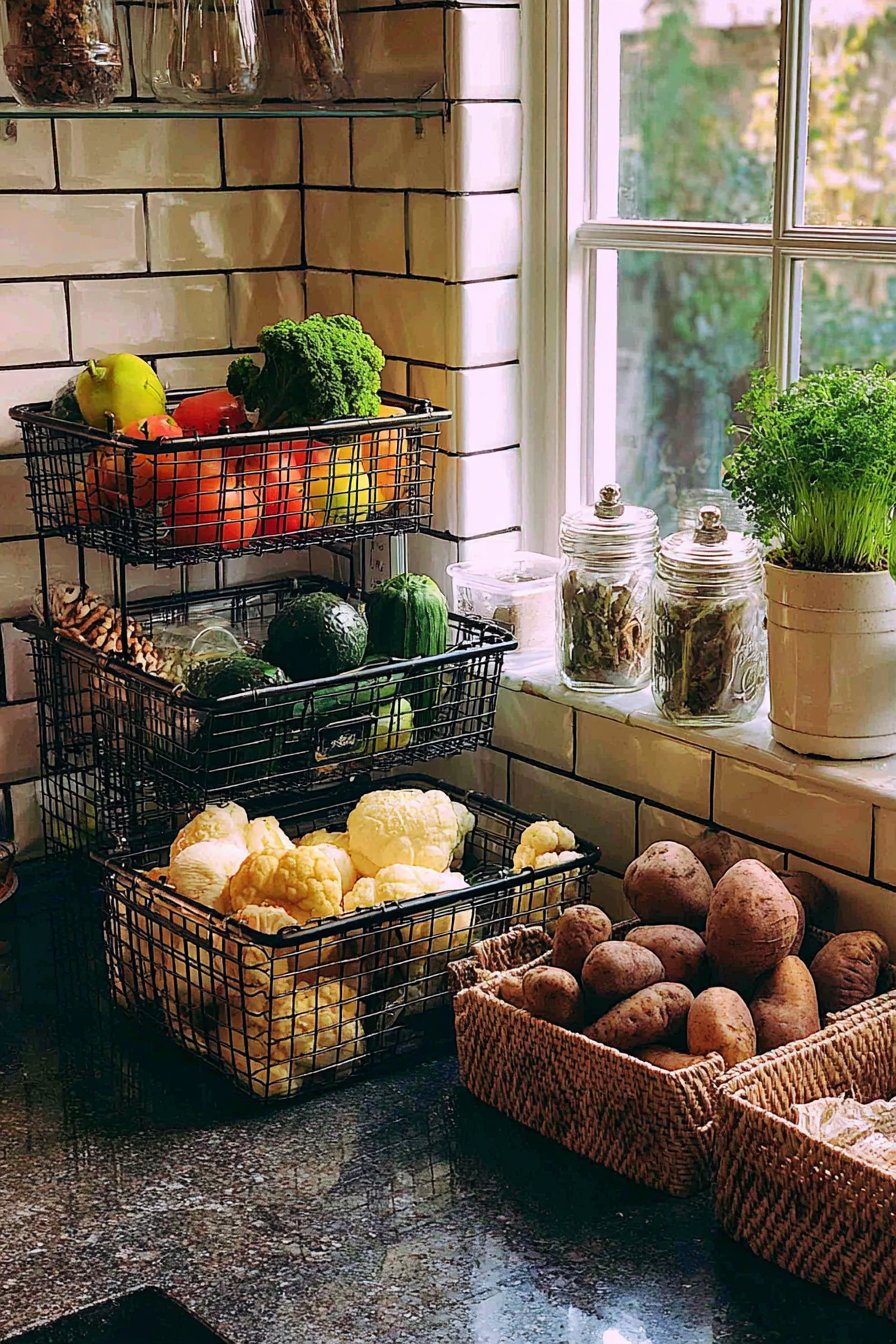
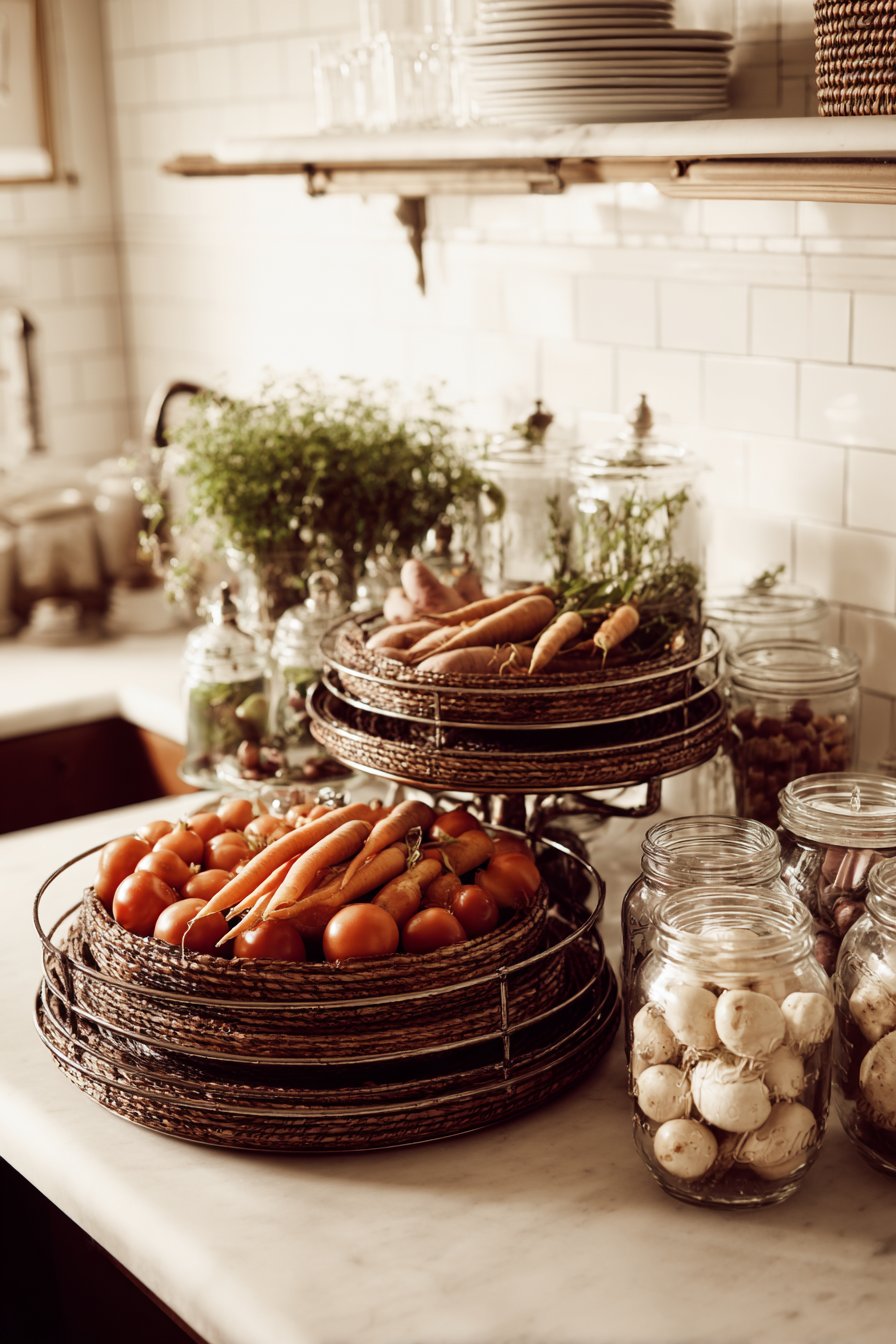
A produce storage solution with tiered wire baskets on the countertop holding fresh fruits and vegetables, arranged by ripeness and usage frequency, makes healthy eating convenient and visually appealing. Natural woven baskets for root vegetables sit nearby while a small herb garden in mason jars provides fresh garnishes. White subway tile backsplash provides a clean backdrop that highlights the natural colors of fresh produce. Soft natural lighting captured with interior design photography techniques emphasizes the fresh, organized approach to produce storage.
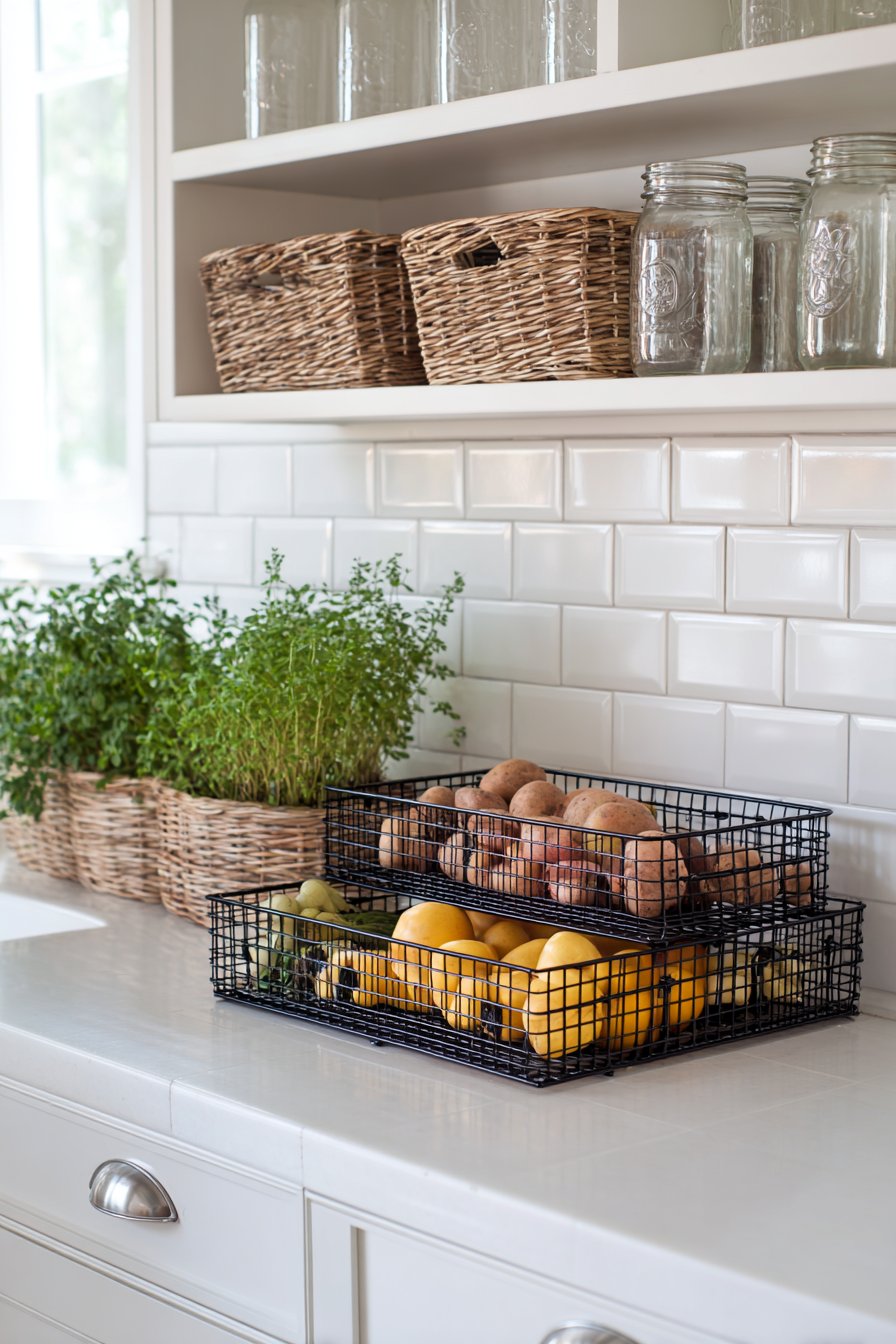
Proper produce storage requires understanding which fruits and vegetables benefit from refrigeration and which are best kept at room temperature. Countertop tiered wire baskets provide ideal storage for items like tomatoes, bananas, and citrus fruits that develop better flavor when not refrigerated. The tiered arrangement maximizes visibility—everything remains in sight rather than hidden in crisper drawers—which encourages consumption before spoilage. Organizing by ripeness creates an intuitive system where the ripest items position themselves prominently for immediate use, while firmer items wait their turn in less prominent positions.
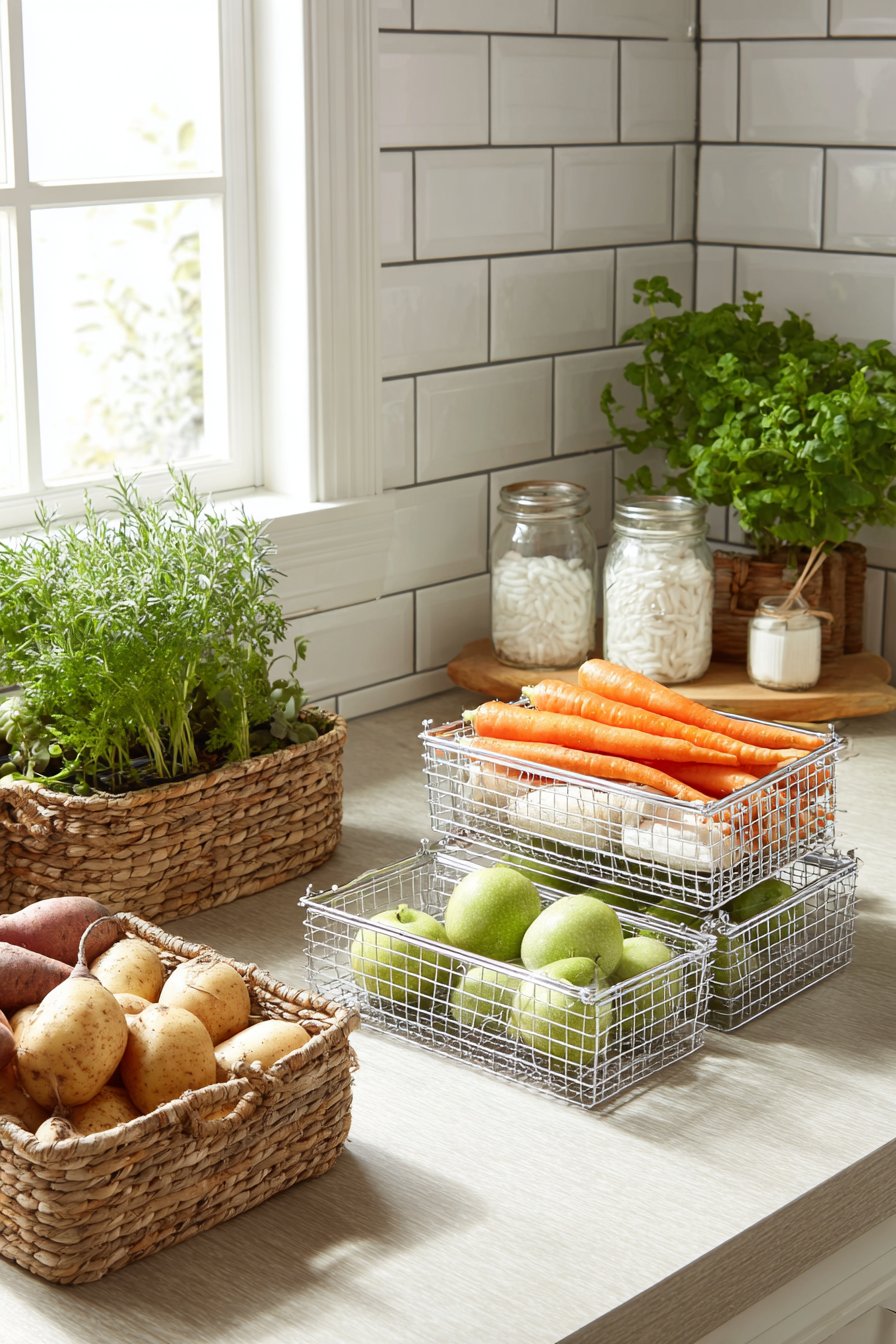
Natural woven baskets for root vegetables like potatoes, onions, and garlic provide the darkness and ventilation these items require for optimal storage. The woven construction allows air circulation that prevents premature sprouting while the natural materials add textural warmth to kitchen counter displays. The small herb garden in mason jars represents both functional storage and living decor—fresh herbs remain accessible for cooking while adding fragrance and greenery to the kitchen environment. This comprehensive approach to produce storage demonstrates that organization strategies can enhance both food quality and kitchen aesthetics simultaneously.
Key Design Tips:
- Store tomatoes, bananas, and citrus fruits at room temperature for best flavor
- Use tiered baskets to maximize visibility and encourage produce consumption
- Keep potatoes and onions in dark, ventilated baskets away from light
- Arrange produce by ripeness, with ripest items most prominently positioned
- Include a small herb garden for frequently used fresh herbs
- Position produce displays near food preparation areas for cooking convenience
28. Hidden Dish Drying Rack System
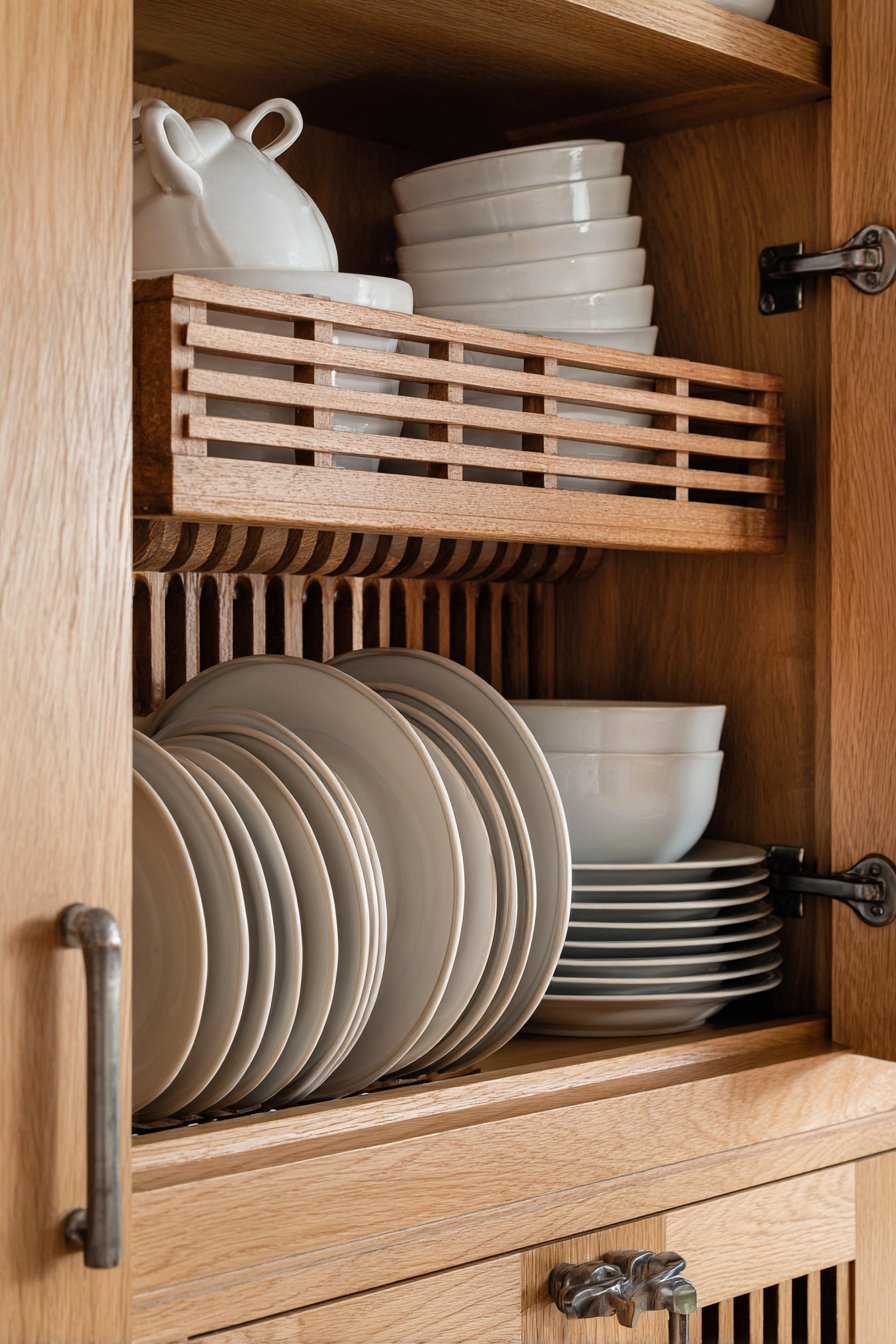
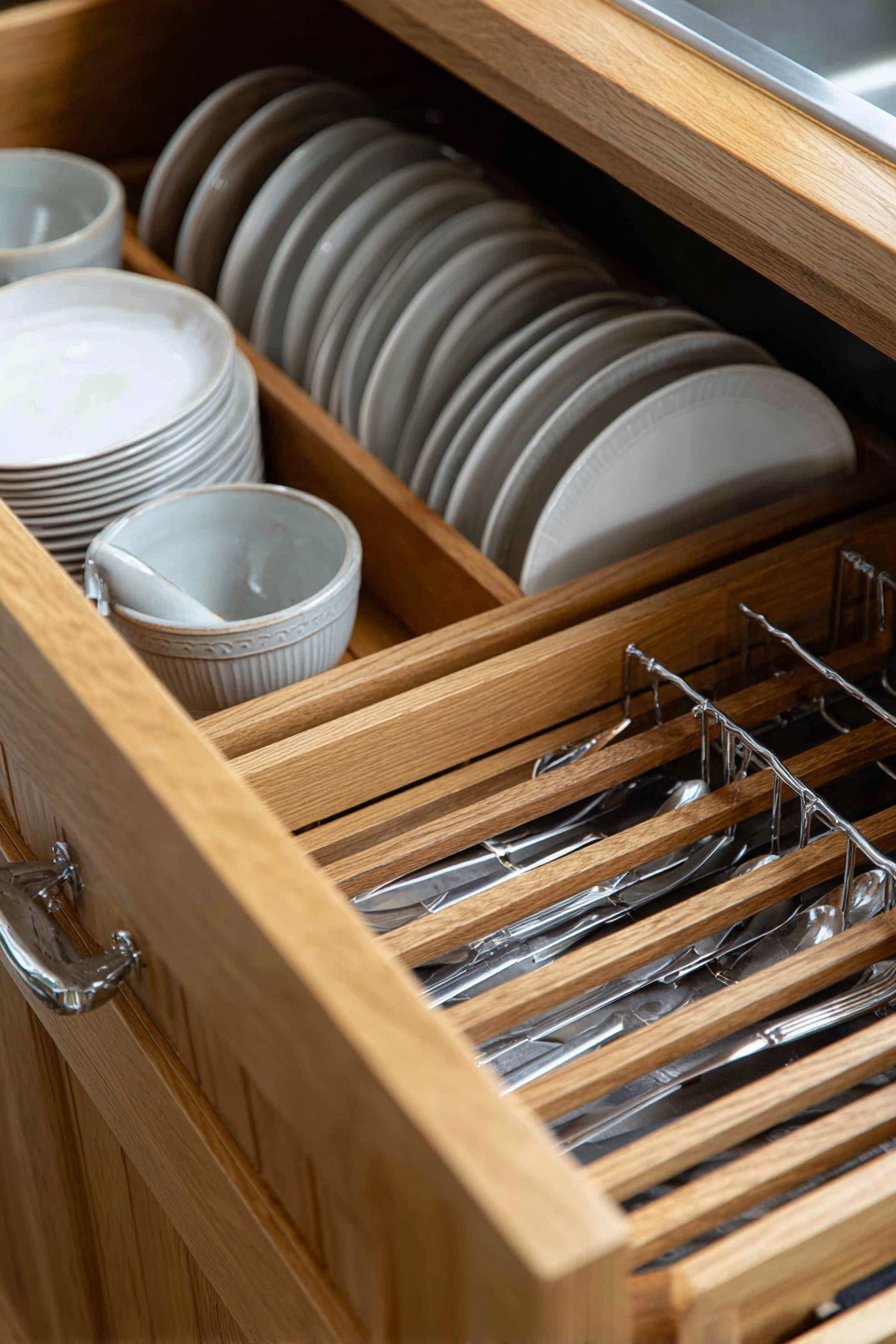
A dish drying rack system integrated into cabinetry above the sink with slatted wood inserts allowing dishes to drip-dry inside the cabinet represents invisible organization. The cabinet bottom features a drainage system directing water back into the sink below, preventing moisture accumulation. Natural oak construction with clear finish shows wood grain while chrome hardware complements modern fixtures. Detail shot with balanced lighting demonstrates the hidden yet highly functional drying solution that eliminates countertop dish racks.
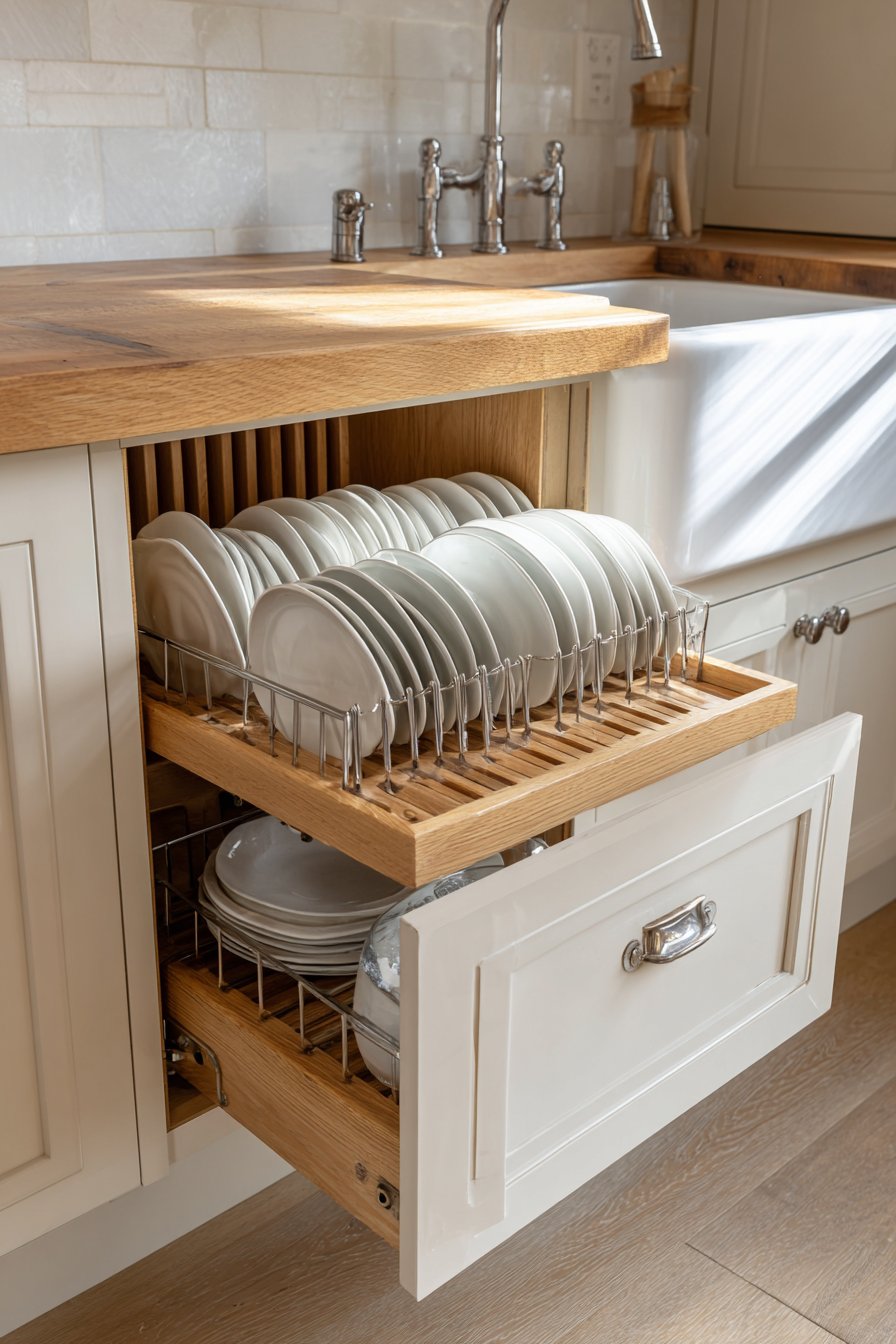
The integrated dish drying system solves the aesthetic problem of countertop dish racks—necessary but visually cluttering—by concealing the drying process within cabinetry. Slatted wood inserts provide support for plates, bowls, and glasses while allowing water to drip through to the drainage system below. This design maintains the kitchen’s clean countertop appearance while providing superior dish drying capacity compared to most countertop racks. The cabinet location above the sink makes sense both practically—dishes drip directly down into the sink area—and workflow-wise, as the act of washing and storing dishes occurs in one continuous motion without transporting wet items across the kitchen.
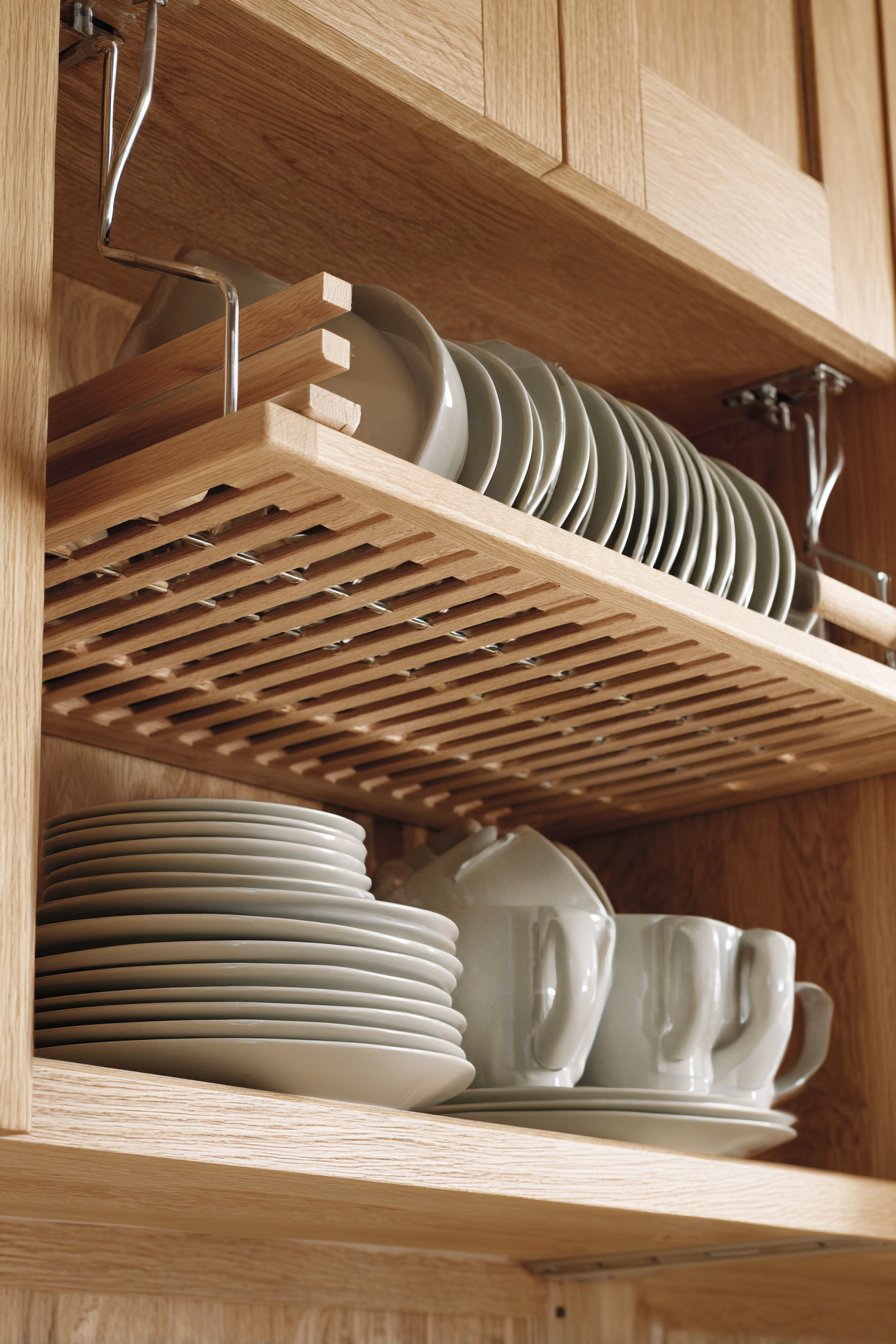
Natural oak construction with clear finish brings organic warmth to this highly functional system while showcasing the attractive wood grain variations. The slatted design requires careful woodworking to create uniform spacing that supports various dish sizes without allowing smaller items to fall through. Chrome hardware throughout coordinates with modern kitchen fixtures while providing smooth-operating hinges and latches. The drainage system represents the crucial engineering detail that makes this concept practical—without proper water direction, the cabinet would develop moisture problems and potential mold. This organizational solution demonstrates that the most effective storage sometimes involves complete concealment rather than display.
Key Design Tips:
- Install dish drying cabinets directly above the sink for proper drainage
- Use wood species resistant to moisture like teak, oak, or sealed pine
- Ensure adequate drainage system to prevent water accumulation
- Space slats appropriately to support various dish sizes without gaps
- Include cabinet ventilation to promote air circulation and prevent mustiness
- Clean and inspect drainage systems monthly to ensure proper function
29. Comprehensive Waste Management Center
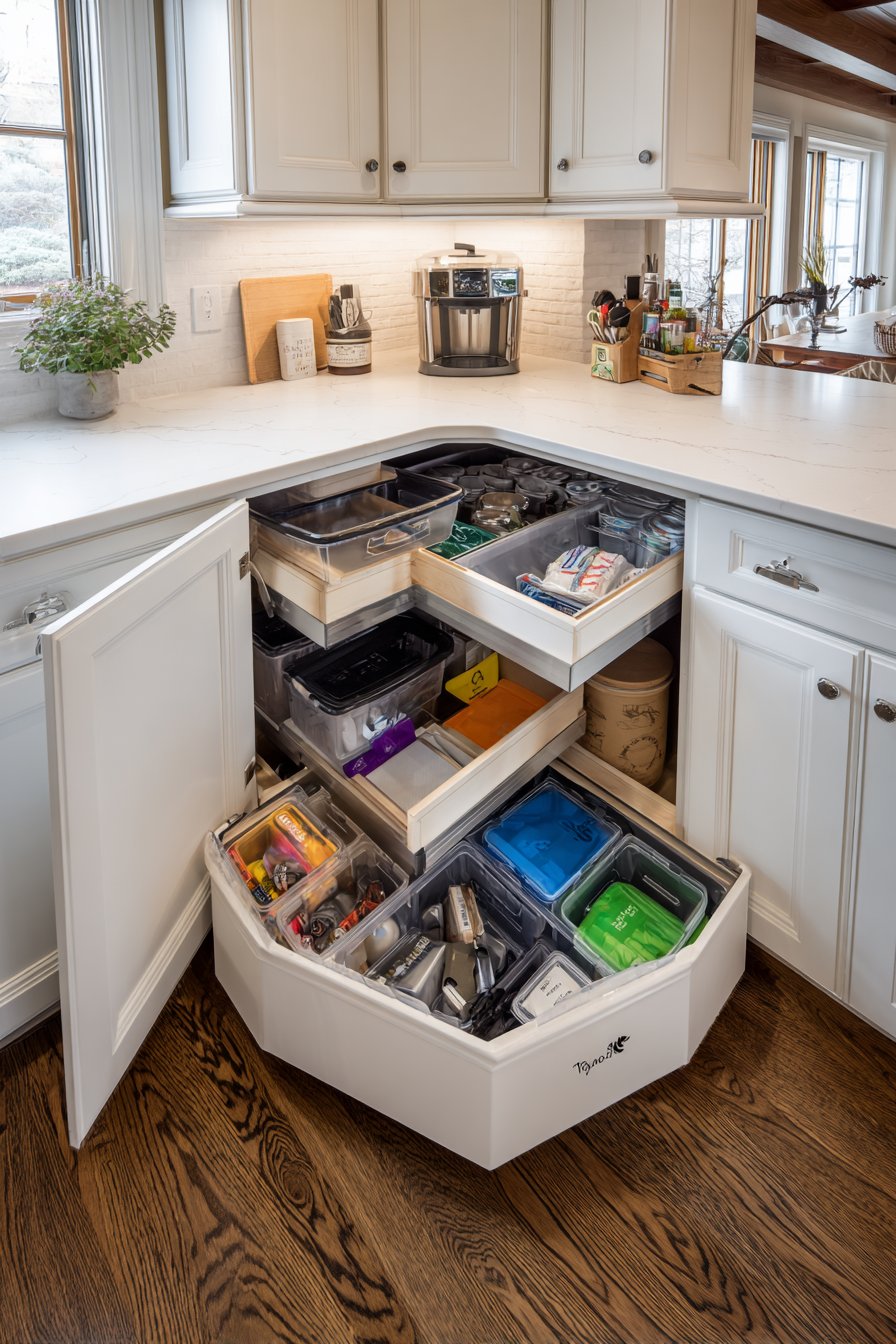
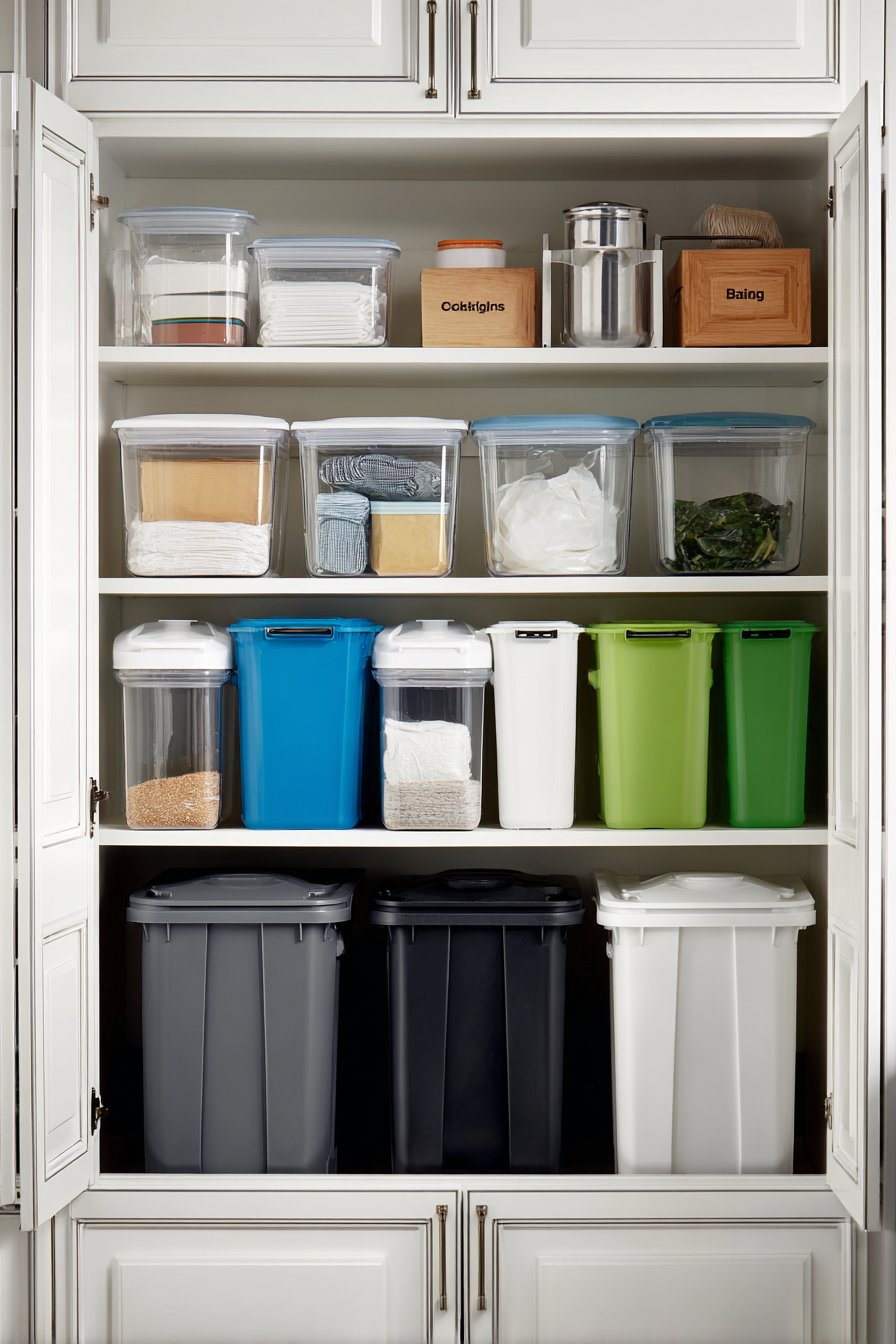
A trash and recycling center with pull-out bins separated into categories including trash, recycling, compost, and bag storage organizes waste management within kitchen cabinetry. The cabinet features soft-close mechanisms and ventilation to prevent odors while bins display clearly labeled, different colored lids for easy identification. White cabinet interior and chrome hardware maintain a clean aesthetic despite the unglamorous contents. Interior photography captures the comprehensive waste management system with attention to functionality and discretion.
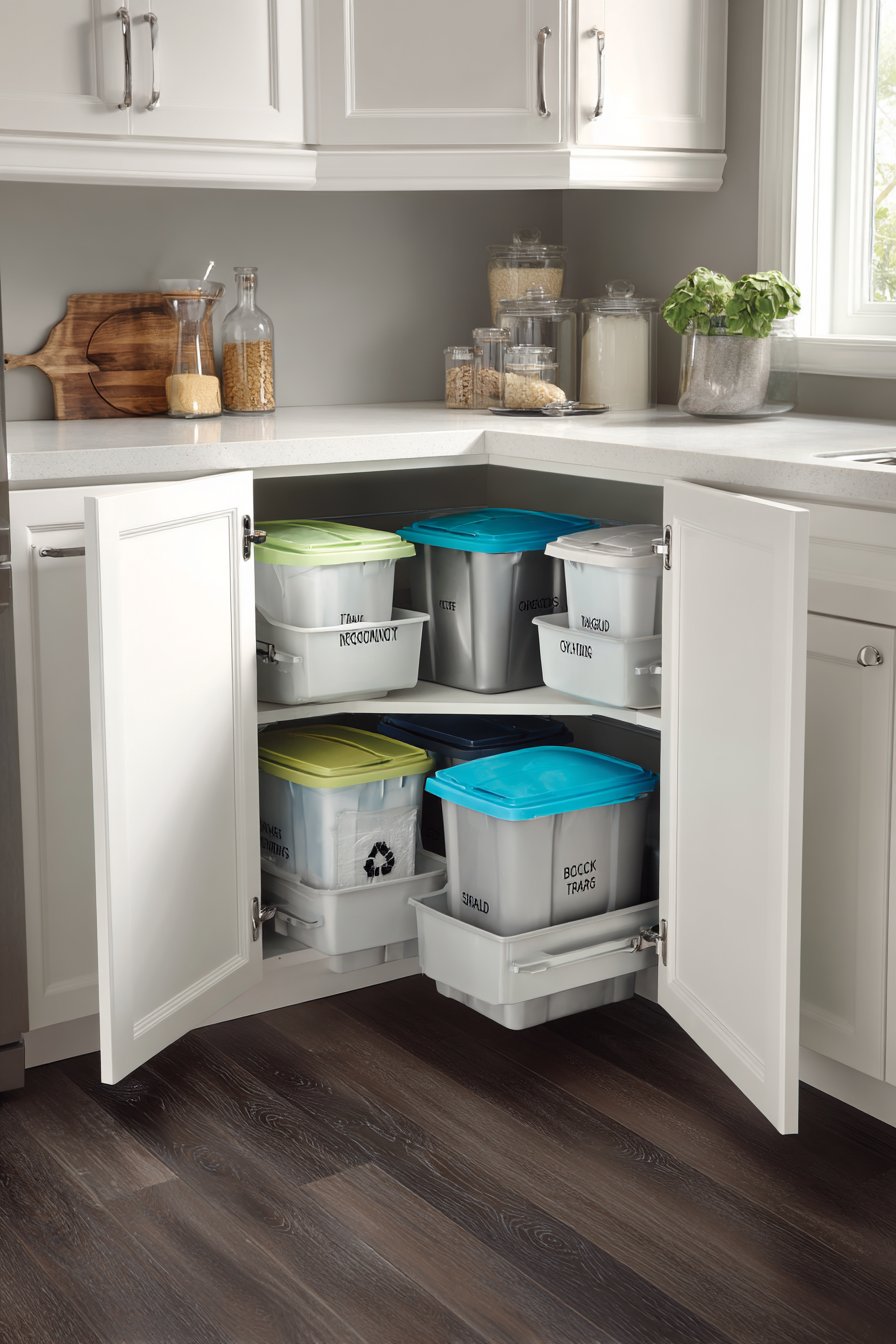
Waste management represents an essential but often aesthetically challenging aspect of kitchen function. Pull-out waste management centers conceal trash and recycling while maintaining easy access for disposal and removal. The separation into categories—trash, recycling, compost, and bag storage—facilitates responsible waste management and makes maintaining these systems effortless. Different colored lids create instant visual identification even when you’re approaching the cabinet with armloads of waste, ensuring proper sorting without requiring careful thought during busy cooking and cleanup times.
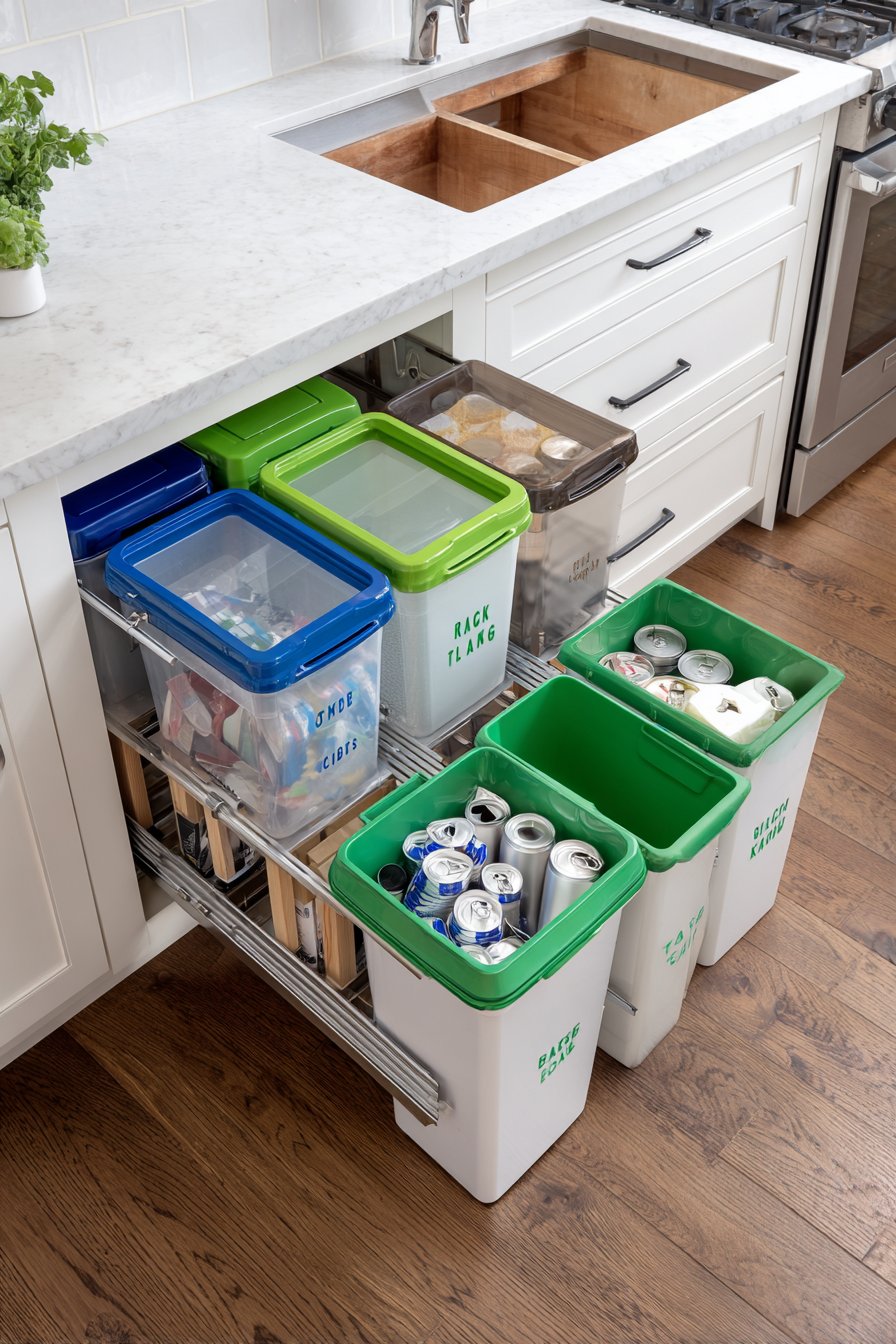
Soft-close mechanisms serve particularly important functions in waste management cabinets, preventing the slamming sounds that could disturb households during early morning or late evening kitchen use. Built-in ventilation addresses the practical reality that even well-maintained trash develops odors, drawing air away from kitchen spaces and preventing the cabinet from becoming unpleasant when opened. White cabinet interiors might seem counterintuitive for waste storage, but they actually serve important functions—the bright surface makes it easy to spot spills or leaks requiring cleanup, and the clean aesthetic encourages maintaining the organization rather than allowing gradual degradation into chaos.
Key Design Tips:
- Install waste management centers near primary food preparation and cleanup areas
- Use pull-out systems with heavy-duty slides rated for loaded bin weights
- Include ventilation if cabinets don’t open to exterior walls
- Select bins sized appropriately for your household’s waste generation
- Position compost bins within easy reach to encourage usage
- Clean waste cabinet interiors monthly to prevent odor and pest issues
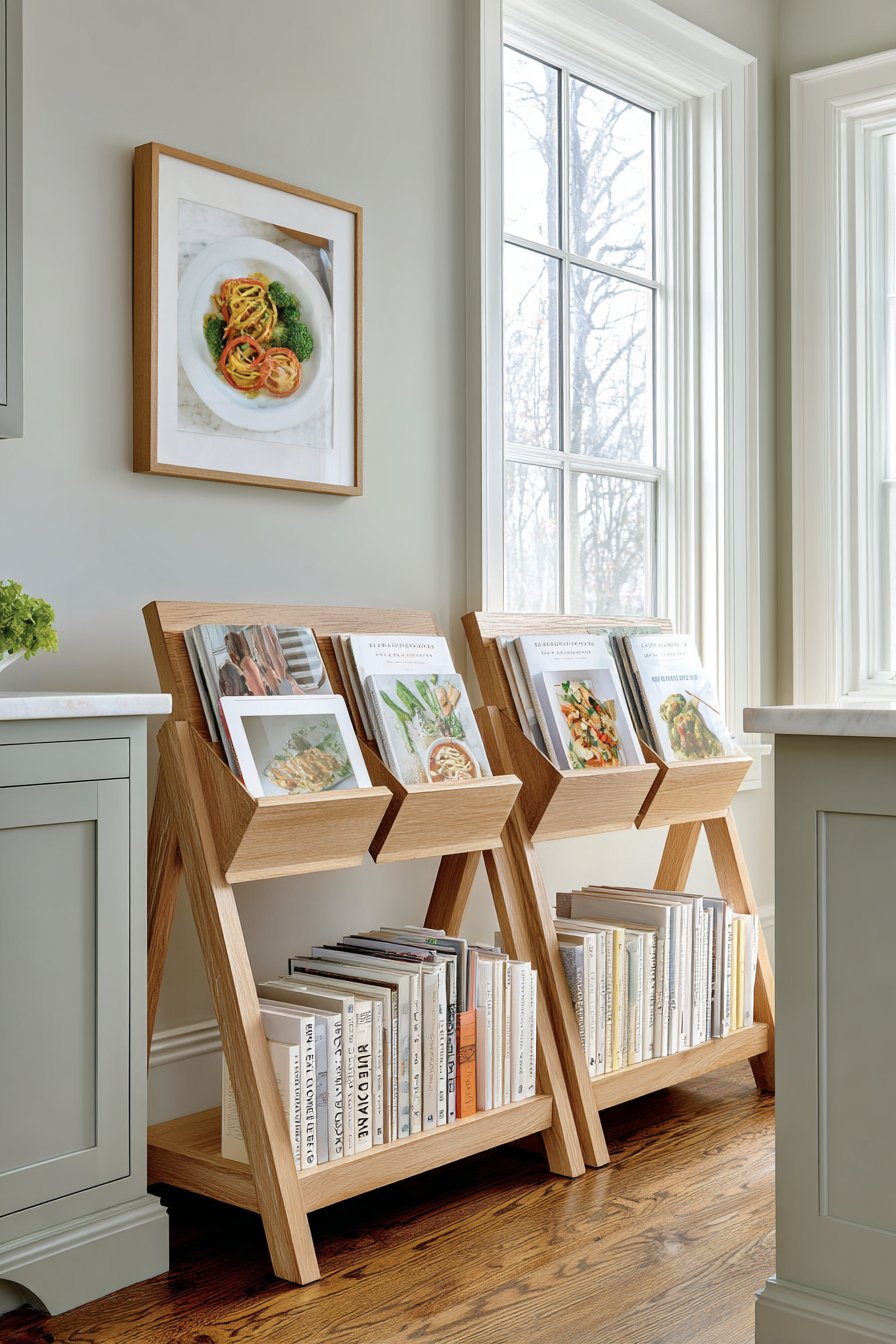
30. Cookbook and Tablet Recipe Holder
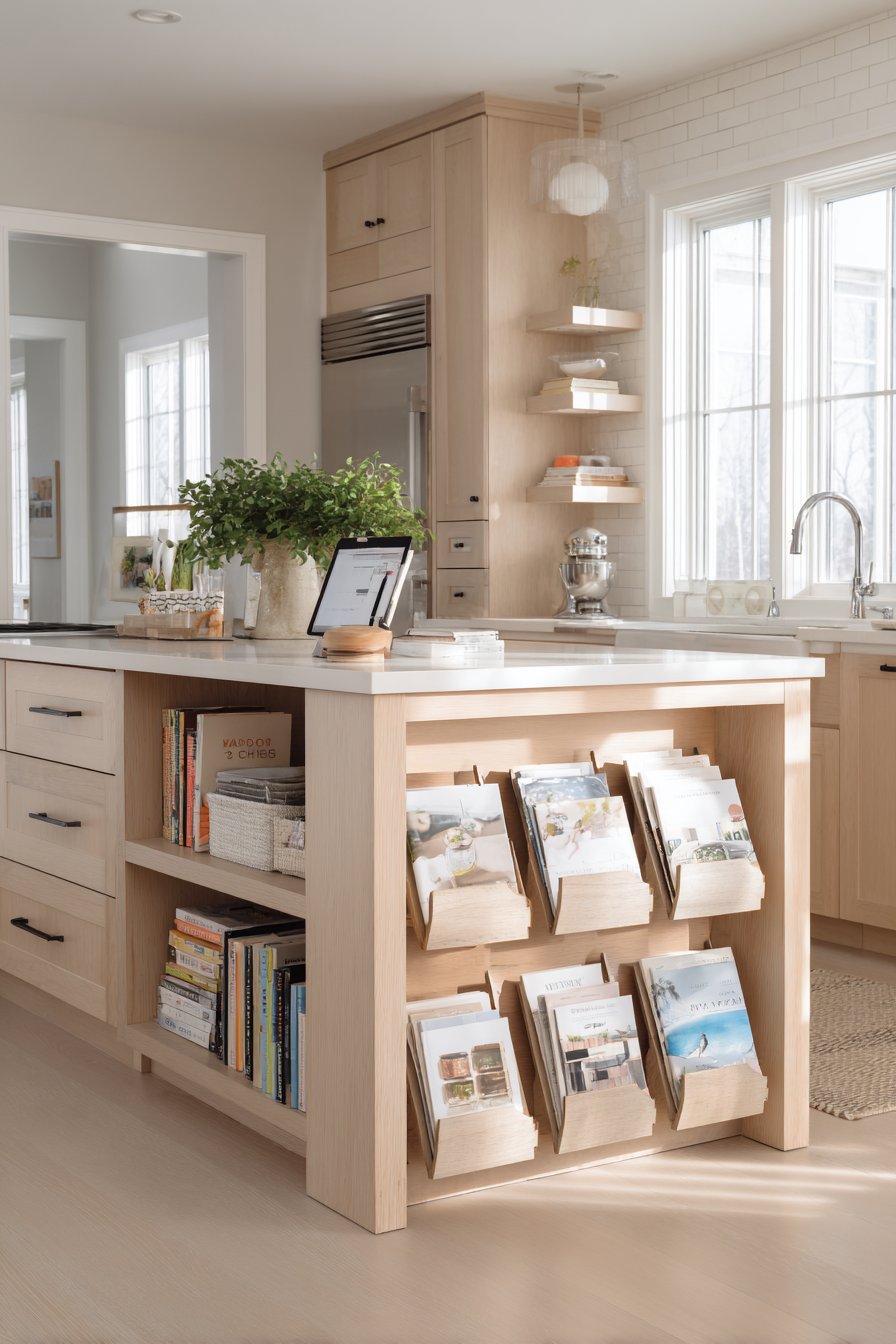
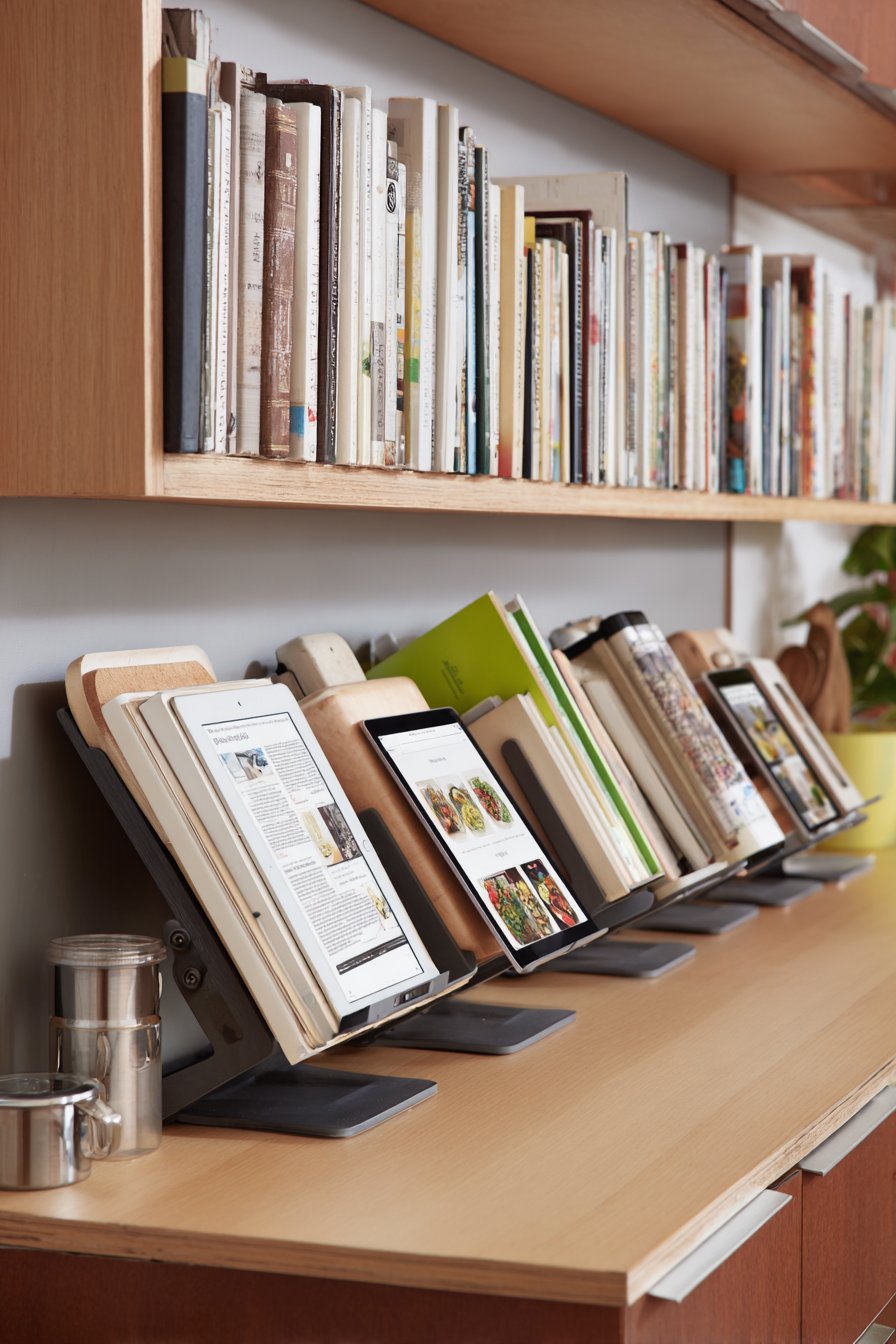
A cookbook and tablet holder built into an open shelf section of kitchen cabinetry with adjustable stands keeps recipes at eye level during cooking. The shelf also stores frequently referenced cookbooks with spines displayed for easy selection. Natural wood shelving against light grey walls creates visual warmth that elevates functional storage. Soft diffused lighting from nearby windows captured with interior photography techniques highlights the dedicated cooking reference station that makes following recipes convenient during active meal preparation.
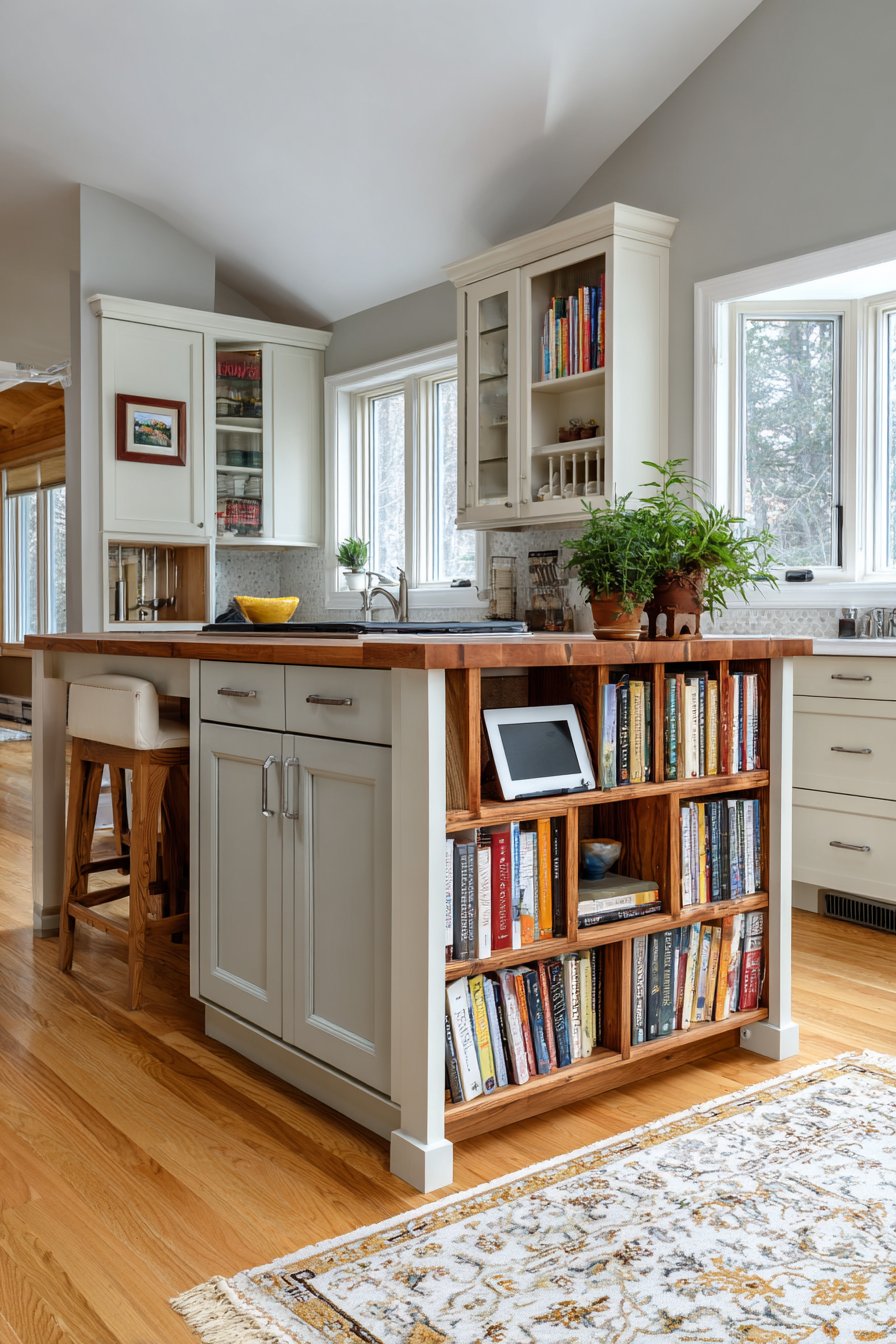
The cookbook holder concept addresses the practical challenge of referencing recipes while cooking—hands covered in flour or oil make page-turning difficult, and flat surfaces are often occupied by ingredients or equipment. Adjustable stands hold books open at the proper angle while elevating them safely above counter splatter zones. The integrated design within cabinetry shelving creates a permanent home for this function rather than requiring countertop space. Modern recipe access increasingly involves tablets and smartphones, and the adjustable stands accommodate these devices as securely as traditional cookbooks, protecting expensive electronics from kitchen hazards.
The shelf storage for frequently referenced cookbooks creates a curated collection that occupies the sweet spot between accessible and protected. Books displayed with spines facing outward facilitate quick selection of the desired recipe source, while the elevated shelf position keeps them safe from counter-level spills and splatters. Natural wood shelving against light grey walls provides warmth and visual interest while maintaining the clean aesthetic of contemporary kitchens. Soft diffused lighting from nearby windows ensures recipe text remains easily readable without harsh shadows or glare that might obscure important instructions during crucial cooking moments.
Key Design Tips:
- Position cookbook holders at comfortable reading height above countertops
- Choose adjustable stands that accommodate both cookbooks and tablets
- Include a small shelf or basket for frequently used recipes and cooking notes
- Locate recipe holders near primary food preparation areas
- Install task lighting if natural light is insufficient for comfortable reading
- Store only frequently used cookbooks in the kitchen; archive occasional-use books elsewhere
31. Utility Drawer with Built-In Cutters
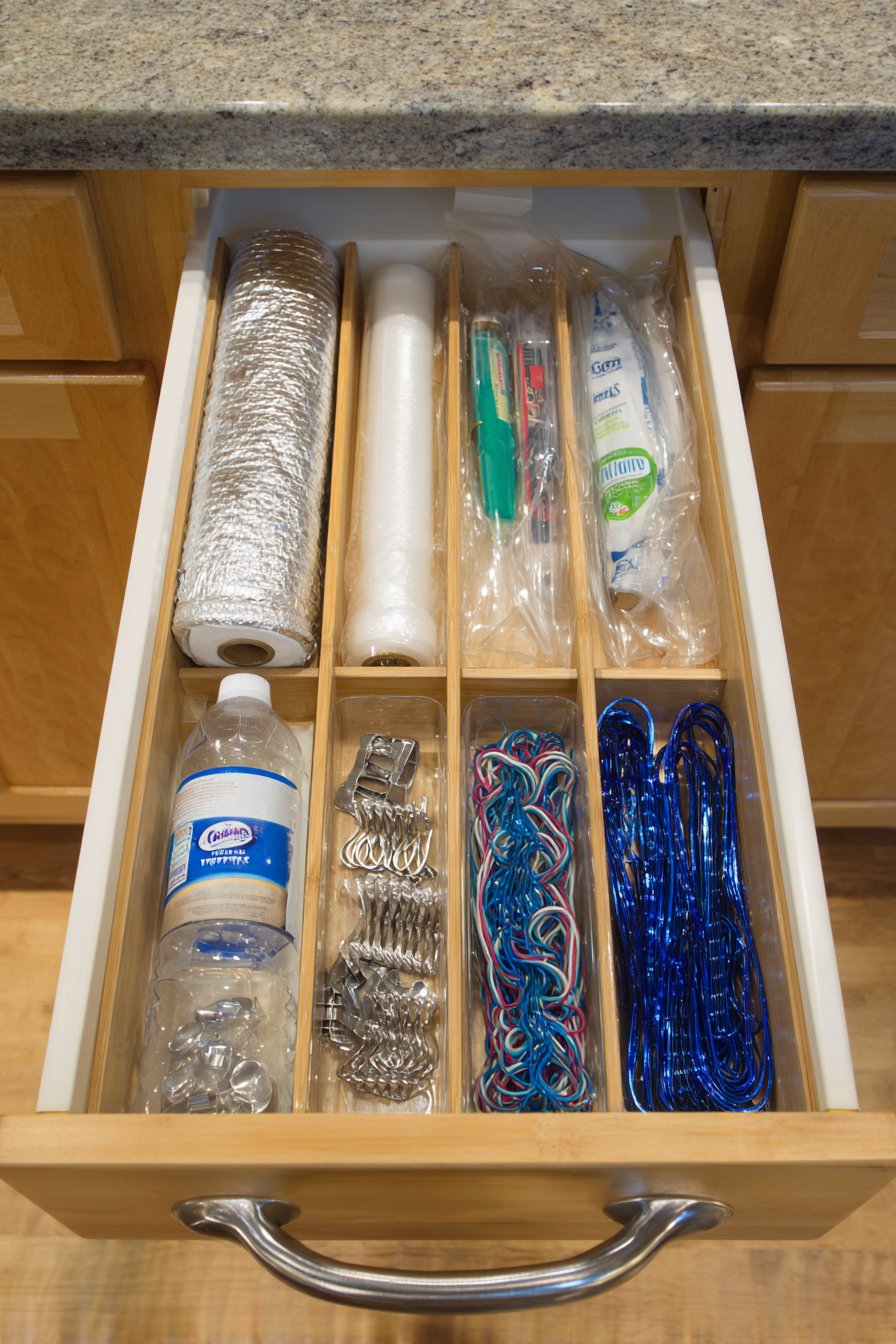
A utility drawer with divided sections for aluminum foil, plastic wrap, parchment paper, and plastic bags features built-in cutters for easy dispensing, transforming a typically messy drawer into an organized dispensing system. The drawer includes a small section for rubber bands and twist ties that often accompany food storage tasks. White interior coating and bamboo dividers create clean compartmentalization that maintains order despite frequent access. Overhead interior photography with balanced lighting captures the practical organization system that transforms a typically messy drawer into functional workspace.
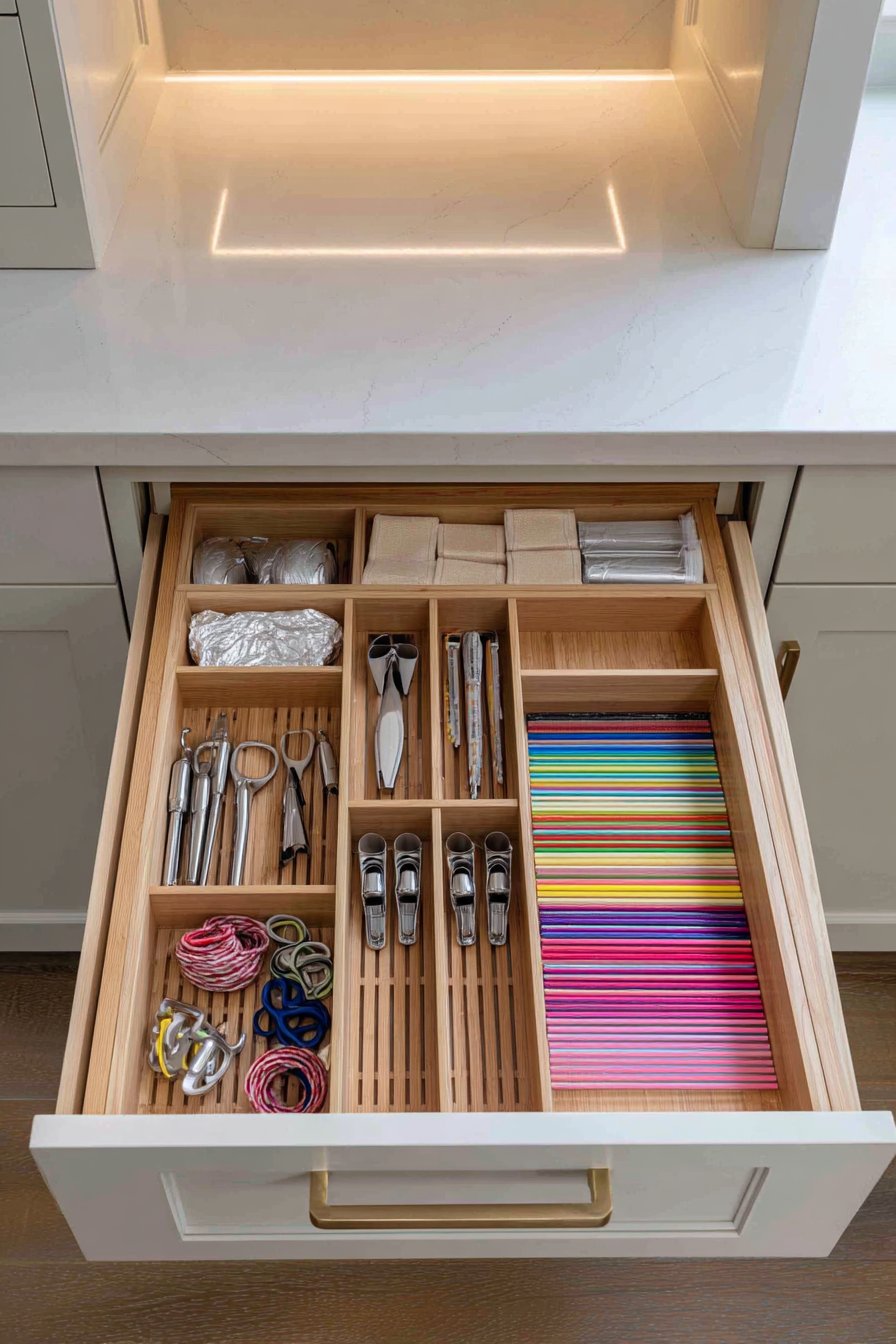
The utility drawer serves an important but often frustrating function—storing food storage and wrapping supplies that resist organized storage due to their awkward boxes and rolls. Built-in cutters solve the practical problem of foil and plastic wrap dispensing, eliminating the frustration of torn boxes and wrap that balls up on itself during cutting. The dedicated compartments sized specifically for these products prevent the shifting and disorganization that occurs in general-purpose drawers. The inclusion of a section for rubber bands and twist ties acknowledges that food storage involves more than just wrapping materials, creating a comprehensive system that addresses the complete workflow.
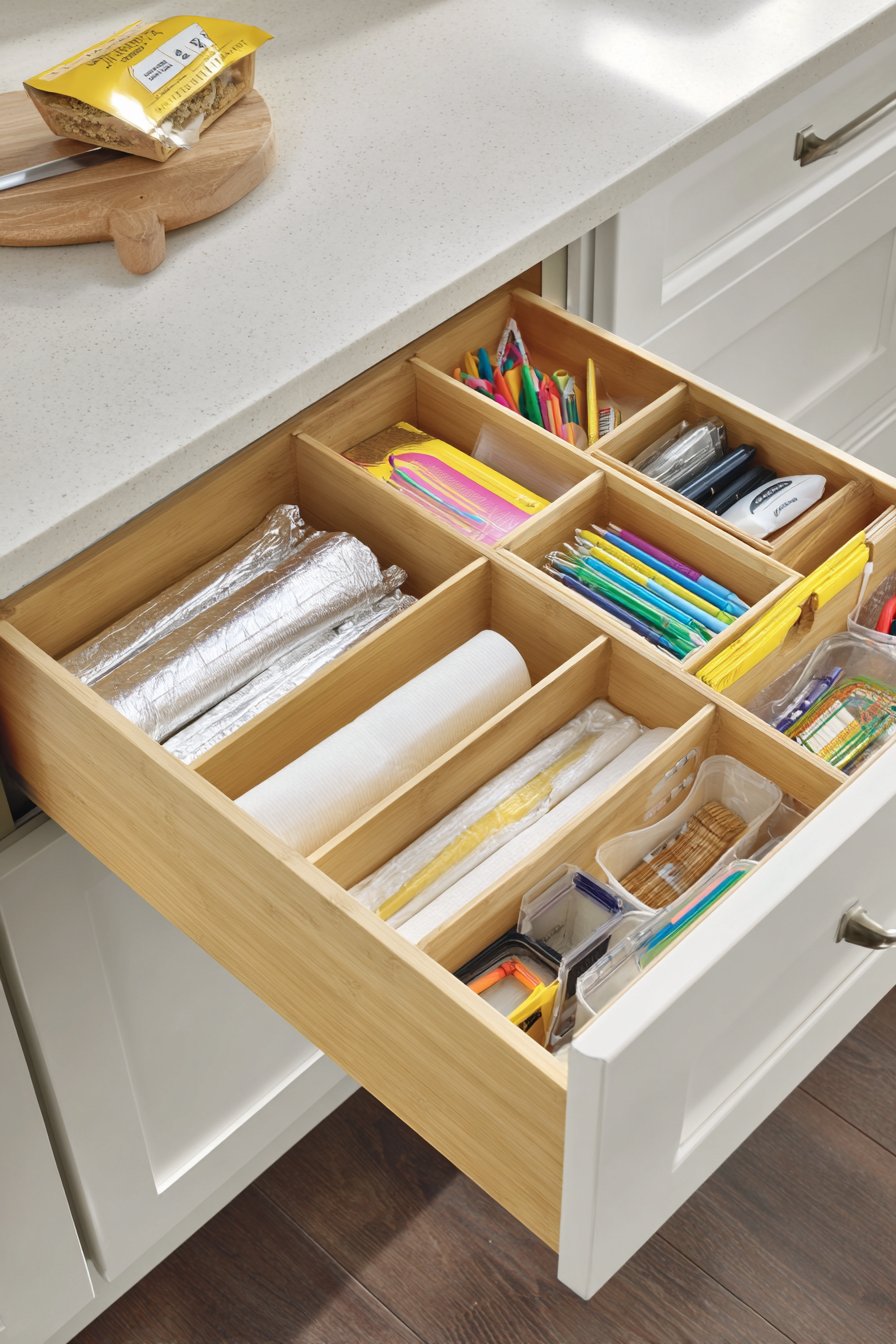
White interior coating throughout the drawer creates a clean, bright environment that makes locating specific items quick and effortless even in drawers without direct overhead lighting. Bamboo dividers provide warm, organic contrast while creating sturdy separations between compartments. The strategic organization of this drawer—the most frequently used items like plastic wrap and foil positioned nearest the front, occasional-use items like parchment paper toward the back—demonstrates thoughtfulness that makes daily kitchen tasks incrementally easier. Overhead photography with balanced lighting captures the satisfying order of this specialized drawer, proving that every kitchen storage challenge can be solved with appropriate organizational tools and thoughtful planning.
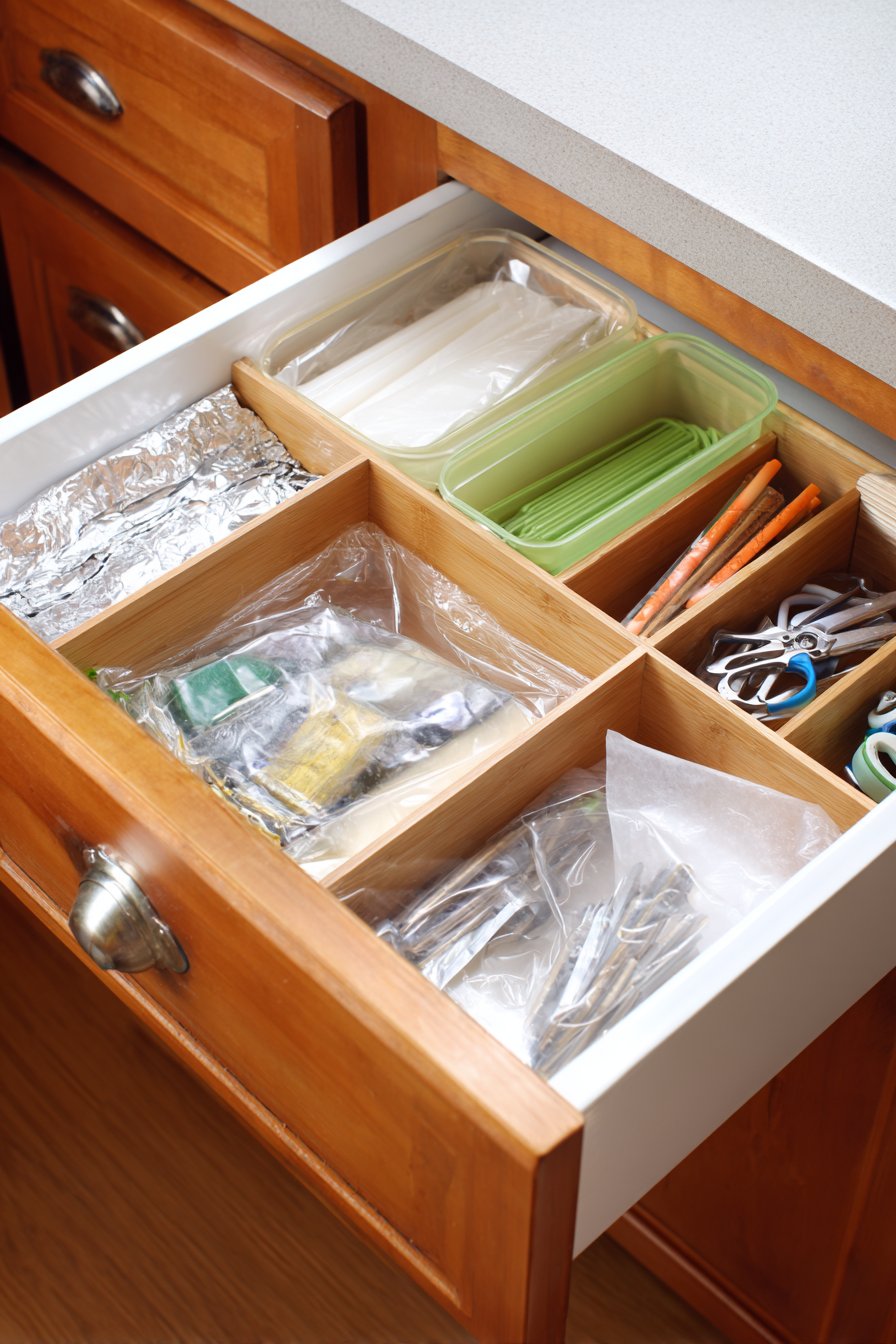
Key Design Tips:
- Install utility drawers near food storage areas for convenient access
- Select drawer inserts with built-in cutting blades for foil and plastic wrap
- Size compartments to accommodate standard packaging dimensions
- Include small sections for rubber bands, twist ties, and bag clips
- Position frequently used items at the drawer front for easy access
- Replace torn or damaged packaging promptly to maintain organizational integrity
Why These Kitchen Organization Ideas Represent the Best Solutions
These thirty-one kitchen organization ideas represent the best solutions for transforming culinary spaces because they address the fundamental challenges that plague modern kitchens while respecting the diverse needs of different households and cooking styles. Each organizational concept tackles specific pain points—from the frustration of mismatched food storage lids to the inefficiency of inaccessible corner cabinets—with practical solutions that have been tested and refined through years of real-world use. The best kitchen organization isn’t about implementing every trendy storage hack but rather selecting solutions that address your specific challenges while complementing your cooking habits and kitchen workflow.
What distinguishes exceptional kitchen organization from merely adequate storage is attention to the relationship between form and function. The drawer dividers, pantry systems, and specialized storage zones described throughout this article don’t just hide clutter—they actively improve kitchen efficiency by placing frequently used items within easy reach, grouping related supplies for intuitive access, and maximizing every cubic inch of available space. Contemporary kitchen organization embraces materials like bamboo, natural wood, chrome, and clear acrylic not merely for aesthetics but because these materials offer practical advantages: bamboo resists moisture naturally, clear containers make contents instantly visible, chrome hardware withstands repeated use without deteriorating.
The variety of organizational approaches presented ensures that every kitchen—regardless of size, style, or budget—can benefit from thoughtful storage improvements. Compact kitchens benefit enormously from vertical storage solutions like pegboards and magnetic knife strips that free precious counter space, while expansive kitchens with walk-in pantries require comprehensive zoning systems that prevent the paradox of having abundant space yet still struggling to find what you need. The rolling cart solution for narrow spaces demonstrates that effective organization doesn’t always require major renovation—sometimes the best solution involves adding portable elements that can be repositioned as needs evolve.
These organization ideas incorporate principles from professional kitchen design, where efficiency directly impacts productivity and profitability. Commercial kitchens have long understood that every second spent searching for tools or ingredients represents lost time and increased stress. Home kitchens benefit from adopting these professional principles through specialized storage zones: the baking station consolidates everything needed for pastry work, the beverage station creates an entertaining-ready display, the breakfast station streamlines hectic morning routines. This zone-based organization mimics the station setup of professional kitchens, where each cooking position has everything needed for its specific tasks immediately at hand.
The integration of technology into organizational systems—in-drawer power outlets for small appliances, specialized lighting within cabinets and drawers, smooth-operating heavy-duty slides—represents contemporary kitchen organization at its finest. These features transform storage from passive concealment into active facilitation of kitchen work. The appliance garage with interior outlets means your stand mixer is always ready for use without occupying counter space; the integrated dish drying system means clean counters without sacrificing dish drying capacity; the cookbook holder keeps recipes visible and protected during active cooking.
Material choices throughout these organizational solutions reflect both durability requirements and aesthetic sensibilities. Bamboo dividers, velvet-lined silverware inserts, natural oak shelving, and brass hardware elevate organizational systems from purely utilitarian infrastructure into components that contribute positively to overall kitchen design. The best organization doesn’t apologize for being visible—floating shelves, suspended pot racks, and glass-container pantry storage celebrate beautiful organization as kitchen decor rather than hiding it away. This approach acknowledges that in open-plan homes where kitchens flow into living spaces, organizational systems become part of the visual presentation rather than behind-closed-doors functionality.
The accessibility improvements inherent in many of these solutions benefit not only those with physical limitations but enhance convenience for everyone. Pull-out systems bring deep cabinet contents forward; lazy Susans make corner cabinets fully accessible; vertical storage eliminates bending to floor-level cabinets. These universal design principles create kitchens that work better for young families with children, older adults managing mobility challenges, and everyone in between. The soft-close mechanisms featured throughout multiple solutions represent quality construction that prevents noise while protecting cabinet integrity from repeated slamming.
Sustainability considerations thread throughout these organizational approaches. By making all stored items visible and accessible, these systems reduce food waste—you use what you have rather than forgetting about items hidden in cabinet depths. The emphasis on quality materials and construction means organizational systems last decades rather than requiring frequent replacement. Clear containers for pantry storage facilitate buying in bulk, reducing packaging waste, while proper produce storage extends freshness and reduces spoilage. The comprehensive waste management center makes recycling and composting convenient rather than cumbersome, encouraging environmentally responsible household practices.
The psychological benefits of well-organized kitchens extend far beyond aesthetic satisfaction. Cooking in an organized space reduces stress, increases creativity, and makes meal preparation enjoyable rather than frustrating. When you can find what you need immediately, when your workspace stays clear and functional, when your storage systems work with rather than against your natural habits—cooking transforms from chore to pleasure. The investment in quality organizational systems pays dividends in daily satisfaction and kitchen enjoyment that far exceed the initial time and financial costs.
These organizational solutions succeed because they’re rooted in reality rather than idealism. They acknowledge that kitchens are working spaces subject to spills, chaos, and daily use by multiple people with varying organizational skills. The systems incorporate practical elements like wipeable surfaces, adjustable components, and forgiving designs that maintain organization even with imperfect maintenance. The best organization isn’t fragile perfection requiring constant vigilance but robust systems that gracefully handle real-world use while maintaining their essential structure and function.
Conclusion
Creating an organized kitchen represents one of the most impactful home improvements you can undertake, transforming daily frustration into streamlined efficiency while making one of your home’s most important spaces more beautiful and functional. The thirty-one organization ideas presented throughout this comprehensive guide demonstrate that effective kitchen storage solutions span a wide spectrum—from simple drawer dividers requiring minimal investment to comprehensive pantry systems demanding significant planning and construction. What unites all these approaches is their commitment to solving real problems with practical solutions that respect both aesthetic preferences and functional requirements.
The journey toward an organized kitchen need not happen overnight. Consider beginning with one or two organizational projects that address your most pressing frustrations—perhaps the chaotic utensil drawer that makes every cooking session begin with annoying searches, or the pantry where expired cans hide behind newer purchases. Success with initial projects builds momentum and provides proof of concept that justifies tackling larger organizational challenges. Many households find that organizational improvements cascade naturally—once your drawers are properly organized, the contrast with chaotic cabinets becomes more apparent and motivating.
Remember that the best organizational system is one you’ll actually maintain. Elaborate solutions requiring extensive upkeep often deteriorate over time, while simpler systems aligned with your natural habits remain functional for years. Consider how you actually use your kitchen—which items you reach for most frequently, what your cooking patterns look like, how many people use the space—and select organizational solutions that work with rather than against these realities. The goal isn’t creating a showroom kitchen but designing a personal space that makes your specific culinary life easier and more enjoyable.
As you implement these kitchen organization ideas, allow yourself to experiment and adapt. What works brilliantly in one household might prove impractical in another due to differences in cooking styles, family sizes, or physical kitchen layouts. Professional organizers emphasize that effective organization is iterative—you implement systems, use them honestly for several weeks, then adjust based on what works and what doesn’t. This experimental approach prevents the discouragement that comes from expecting immediate perfection.
The organized kitchen you create will serve you for years to come, making meal preparation more efficient, reducing daily stress, and creating a space where cooking becomes genuine pleasure rather than necessary chore. Whether you implement comprehensive pantry systems, strategic drawer organizers, specialized storage zones, or any combination of the solutions presented here, each improvement contributes to a more functional and beautiful culinary space. Begin today with one small organizational project, experience the satisfaction of that improvement, and let that success motivate your continued journey toward the perfectly organized kitchen that works beautifully for your unique needs and lifestyle.
